

TL;DR:
- In 2026, successful digital commerce focuses on entertainment, social media, and immersive content that make shopping unavoidable. Brands leveraging live streams, shoppable videos, and creator campaigns generate higher engagement, loyalty, and organic reach. Effective operational systems, compliance, and integrated creative and commerce strategies are essential for sustained growth.
Digital commerce is no longer about putting products in a grid and running ads at people until they buy. The brands pulling ahead in 2026 are doing something fundamentally different: they are making shopping entertaining, social, and impossible to ignore. Live streams that sell out in minutes, shoppable videos that feel like content rather than catalogues, and creator-led campaigns that generate remarkable engagement across platforms are rewriting what commerce looks like. This guide breaks down the real mechanics behind entertainment-led digital commerce and shows you how to apply them.
Table of Contents
- What is digital commerce today?
- Why entertainment is the new engine of commerce
- Social and video benchmarks: How to interpret and use them
- Building operational excellence: Alignment, compliance, and rapid iteration
- Why most digital commerce strategies underutilise entertainment
- Scale your entertainment-driven commerce with expert support
- Frequently asked questions
Key Takeaways
| Point | Details |
|---|---|
| Entertainment drives conversion | Interactive, entertaining content directly increases both engagement and sales in digital commerce. |
| Benchmark context matters | Adapt generic engagement benchmarks to your unique brand, format, and funnel stage for accurate insights. |
| Compliance is critical | Proper controls and live monitoring are essential to minimise legal and reputational risks in live commerce. |
| Unified operations win | Brands that align creative, operational, and compliance teams achieve the greatest digital commerce impact. |
What is digital commerce today?
Most marketers still define digital commerce as e-commerce with better photography. That definition needs updating urgently. Digital commerce in 2026 covers every touchpoint where content, community, and transaction overlap. It includes your product listings, yes, but also the TikTok live that shifted 800 units in an afternoon, the YouTube series that builds purchase intent before a customer ever visits your site, and the community Discord that drives repeat orders through belonging rather than discounts.
The shift happened because platforms rewired how people discover and buy. Audiences no longer browse catalogues looking for something they already want. They encounter products inside entertainment they already love. That changes everything from creative strategy to measurement to operational structure. Social media is no longer a billboard. It is the shop floor, the entertainment venue, and the customer service desk simultaneously.
The practical features that define modern digital commerce are worth spelling out clearly:
- Shoppable videos: Product tags embedded inside short-form or long-form video, enabling purchase without leaving the viewing experience
- Affiliate rails: Creator-driven recommendation feeds that route commission-tracked traffic directly to product pages
- Live commerce events: Scheduled selling moments hosted by creators or brand presenters, combining entertainment with real-time purchasing
- User-generated content (UGC): Customer reviews, unboxings, and testimonials that function as both social proof and discoverability content
- Influencer partnerships: Long-term co-creation arrangements where creators produce native content that genuinely integrates the product
Alongside these formats, measurement has grown more sophisticated. Engagement is calculated as total interactions divided by follower count, and sample medians across verticals now serve as performance baselines for teams benchmarking their own creative.
Engagement rate benchmarks derived from sample medians provide a starting reference point, not a definitive target. Understanding how that number is calculated is essential before applying it to any campaign evaluation.
Explore customer engagement strategies that align with these new commerce mechanics, and keep pace with the media production trends reshaping how brands produce content at scale. There is also growing interest in podcast commerce strategies as audio-led discovery becomes part of the digital commerce stack.
Why entertainment is the new engine of commerce
Static product posts convert. But entertainment-led commerce converts and compounds. When a brand builds purchase moments inside genuinely entertaining content, it earns attention rather than buying it. That earned attention builds loyalty, triggers sharing, and extends reach far beyond what a paid media budget can achieve alone.
The data illustrates the gap clearly. Look at how different commerce formats compare on engagement and conversion potential:
| Format | Avg. engagement rate | Conversion trigger | Compounding effect |
|---|---|---|---|
| Static product post | Low (0.5–1.2%) | Direct click-through | Minimal organic reach |
| Shoppable short-form video | Medium (2–4%) | In-feed purchase tap | High shareability |
| Influencer-led campaign | Medium-high (3–6%) | Trust-led click | Audience cross-pollination |
| Live commerce event | High (5–12%+) | Real-time urgency | Replay and clip virality |
| Gamified commerce campaign | High (6–10%) | Participation reward | Community amplification |
The live commerce format stands out for a reason. When a host demonstrates a product in real time, answers audience questions, and creates genuine urgency through limited-time offers, purchase mechanics support the entertainment rather than interrupting it. The audience is already engaged, already leaning in, and the buying decision becomes part of the experience rather than a break from it.

This is why brands investing in live commerce strategies consistently report stronger results than those relying on static formats. The same principle applies to social video engagement, where the goal is to hold attention long enough that the product demonstration feels earned rather than intrusive.
Consider also how podcast-driven sales are emerging as a serious revenue channel. Listeners who follow a podcast over months develop genuine trust in the host. That trust transfers directly to product recommendations in a way that no banner ad can replicate.
Pro Tip: Prioritise formats where the purchase action happens in-stream without pulling the viewer out of the entertainment experience. Friction between enjoyment and buying is where conversion dies.
Social and video benchmarks: How to interpret and use them
Engagement benchmarks are useful. They are also wildly misused. The single biggest mistake marketing teams make is pulling a cross-vertical median engagement rate from a report and treating it as their performance target. That approach ignores format, audience size, funnel stage, and vertical, all of which dramatically affect what a good number actually looks like.
Benchmarks should be treated as assumptions, not absolute measures. Methodology varies across benchmark providers. One vendor may calculate engagement using total impressions as the denominator. Another uses follower count. A third may include saves and shares but exclude link clicks. These differences produce meaningfully different numbers from the same underlying performance data. The engagement rate derivation methodology matters as much as the benchmark figure itself.
Here is how leading benchmark sources differ in approach and recommended usage:
| Source | Methodology | Best used for | Caution |
|---|---|---|---|
| Quid / Brandwatch | Interactions ÷ followers, sample medians | Cross-vertical social baselines | Averages out niche variation |
| Improvado | Platform-native metrics, multi-stage | Funnel-specific measurement | Requires clean data integration |
| Platform analytics (native) | Raw reach and engagement data | Owned-channel performance | No external comparison context |
| Creator agency reports | Creator-tier averages | Influencer campaign planning | Bias towards premium creators |
To apply benchmarks accurately to your brand, follow these steps:
- Identify your funnel stage: Top-of-funnel awareness content will have different engagement patterns than mid-funnel product demonstrations. Do not compare them against the same benchmark.
- Match creative format to benchmark: A live commerce event benchmark should never be used to evaluate a static image post. Ensure like-for-like comparison.
- Adjust for audience size: Micro-influencers routinely outperform macro-influencers on engagement rate, not because their content is better, but because smaller audiences tend to be more closely aligned with the creator.
- Sanity-check against your own historical data: Your past campaigns are the most accurate benchmark you have. Use industry data to frame your performance, not replace your own evidence.
- Segment by platform: Engagement norms on TikTok differ significantly from those on YouTube or Instagram. Platform-specific benchmarks are more reliable than blended averages.
Explore brand engagement ROI frameworks that connect benchmark performance to revenue impact, and refine your engagement strategy using insight-led formats. Understanding which social media formats consistently outperform others is a strong starting point for creative planning. Teams tracking podcast engagement metrics will also find that audio-specific benchmarks require their own distinct calibration.
Pro Tip: Never apply a cross-vertical median benchmark to a specific niche campaign without first testing it against your own performance baseline. Industry averages can create false targets that either demotivate strong teams or let underperforming campaigns fly under the radar.
Building operational excellence: Alignment, compliance, and rapid iteration
Getting the creative right is half the challenge. The other half is building the operational infrastructure that allows entertainment-led commerce to run reliably, legally, and at scale. This is where many brands stumble. They produce excellent content, but the backend systems, approval workflows, and compliance processes have not kept pace.
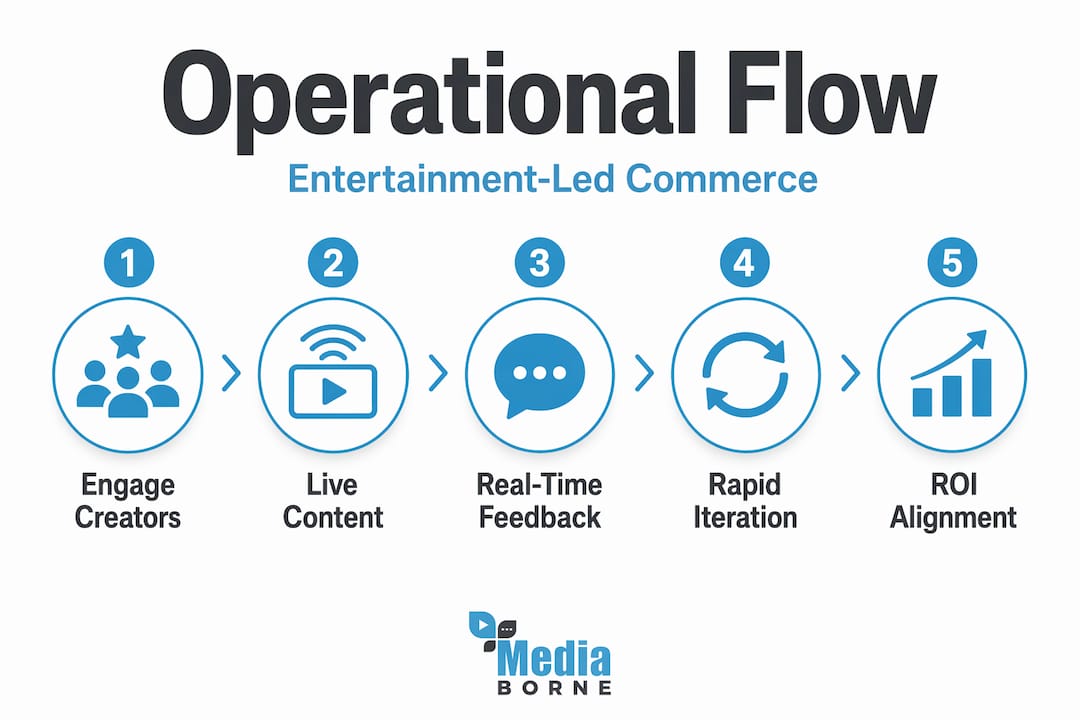
Live commerce in particular introduces compliance risks that require upstream controls. A host making an unscripted claim about a product during a live stream can create legal exposure within seconds. Unlike a written ad that goes through review before publication, live content is instant and irreversible. Brands that treat compliance as an afterthought in live formats take on significant risk.
The operational foundations for entertainment-led digital commerce need to cover:
- Creative and marketing alignment: Content teams and commerce teams must share briefs, not operate in separate lanes. The entertainment mechanic and the purchase moment need to be designed together from the start.
- Script approval and host briefing: Every live commerce event should have pre-approved talking points, claim restrictions, and a clear escalation path for off-script moments.
- Legal review of product claims: Any performance, health, or comparison claims require review before they are broadcast live or embedded in video content.
- Host training: Presenters need to understand both the product and the compliance boundaries. Technical product knowledge and regulatory awareness are both required.
- Live monitoring: A dedicated team member should be watching every live event in real time with authority to flag issues and, if necessary, pause the broadcast.
- Rapid analytics review: Post-event data should be in front of the team within hours, not days. Fast measurement enables fast iteration.
The brands that treat social video workflows as a core operational discipline, rather than a creative afterthought, consistently produce stronger results and avoid the reputational damage that a single unchecked live claim can cause. Sustainable growth in this space comes from systems, not just brilliant creative moments.
Pro Tip: Build a direct feedback loop between your measurement team and your creative producers. When analytics inform the next shoot brief in real time, you collapse the distance between insight and action. That speed is a genuine competitive advantage.
Why most digital commerce strategies underutilise entertainment
Here is an uncomfortable observation after working across entertainment-led campaigns for multiple brands: most marketing teams do not actually treat entertainment as a commercial mechanism. They treat it as a promotional wrapper. There is a significant difference.
Using entertainment as a wrapper means producing an engaging video and then cutting to a product message at the end. Using entertainment as a commercial mechanism means designing the purchase moment into the entertainment itself from the outset. The first approach interrupts. The second converts.
The brands genuinely outperforming in digital commerce right now are those who have stopped asking "how do we make our ads more entertaining?" and started asking "how do we make our entertainment shoppable?" That question change is strategic, not semantic. It shifts the brief from the comms team to a joint creative-commerce function where product, content, and transaction design sit in the same room.
The most durable commercial outcomes come from content that earns attention first and converts it second. Brands that reverse this order, designing for conversion before entertainment, consistently see lower engagement and weaker long-term loyalty.
The other missed opportunity is feedback integration. Entertainment-led campaigns generate enormous amounts of audience signal. Comment sentiment, replay rates, pause points in video, and live chat interaction all tell you what the audience finds compelling and where purchase intent is highest. Most brands capture this data and file it. The ones leading the field feed it directly back into the creative brief for the next production cycle, creating a loop that gets tighter and more effective with every campaign.
The practical implication is that entertainment and commerce can no longer be siloed disciplines with a handoff between them. They need to be a unified system, with creative talent, commerce mechanics, and compliance controls working from the same brief and measuring against the same outcomes.
Scale your entertainment-driven commerce with expert support
Putting these strategies into practice requires more than a good idea and a capable in-house team. It requires production expertise, platform fluency, and the ability to design entertainment and commerce mechanics as a single integrated system rather than two teams negotiating a compromise.
At Media Borne, we build exactly that. Our work spans the full spectrum, from video production designed to perform across social and streaming platforms, to social selling programmes that turn live content into measurable revenue. For brands exploring immersive and emerging formats, our virtual and immersive production capability opens up experiences that static commerce simply cannot replicate. If you are ready to move beyond the product grid and build commerce that genuinely earns attention, we would like to help you do it properly.
Frequently asked questions
How is engagement measured in digital commerce?
Engagement rate is calculated as total interactions divided by follower count, with industry benchmarks typically derived from sample medians across verticals and platforms.
What formats drive the most sales in entertainment-led digital commerce?
Shoppable live streams, interactive videos, and influencer-led campaigns consistently outperform static formats because purchase mechanics integrate naturally into the entertainment experience rather than interrupting it.
How do brands ensure compliance during live commerce?
Brands need scripts, pre-approved claim sets, host training, and a live monitor present during every broadcast, as upstream compliance controls are essential to managing legal risk in real-time selling formats.
How should marketers use engagement benchmarks?
Always treat industry benchmarks as starting assumptions rather than definitive targets, and calibrate them against your own historical data, vertical niche, and specific creative format before drawing any conclusions about performance.