

Video content on social media generates 38% higher engagement than static images and 105% more than text posts, yet many marketing professionals struggle to translate these statistics into consistent results. The difference lies not in producing more video content, but in building a deliberate social video strategy that aligns platform mechanics, audience psychology, and brand objectives. This guide breaks down the precise components marketing teams need to construct video campaigns that convert attention into measurable brand growth through entertainment-led approaches.
Table of Contents
- Key Takeaways
- Understanding social video strategy fundamentals
- Optimising video content for engagement on social platforms
- Navigating platform differences and emerging challenges in social video
- Putting social video strategy into practice for entertainment-led campaigns
- Discover Media Borne's video production services
- Frequently asked questions
Key Takeaways
| Point | Details |
|---|---|
| Goal aligned funnel | Define whether your video content aims for awareness, consideration or conversion and tailor the approach to that stage. |
| Platform specific formats | Select vertical or horizontal formats, appropriate lengths and narrative styles to match each platform rather than applying a universal template. |
| Thematic content | Develop recurring formats and visual styles to build recognisable audience expectations. |
| Hook in first three seconds | Create an immediate value hook in the first three seconds to prevent viewers from scrolling past and to improve retention. |
Understanding social video strategy fundamentals
A social video strategy is not simply posting video content across platforms. It involves setting clear goals aligned with the marketing funnel, selecting platforms and formats, establishing content themes, and measuring performance with analytics. Marketing professionals must first determine whether their video content serves awareness, consideration, or conversion objectives, then architect their approach accordingly.
Platform selection drives format decisions. TikTok demands vertical, fast-paced storytelling. LinkedIn rewards longer, educational content. Instagram sits between these extremes with Reels and Stories serving different audience behaviours. Each platform has distinct algorithmic preferences that reward native content over repurposed material. Your strategic video marketing approach must account for these technical realities before production begins.
Content themes provide editorial consistency that builds audience recognition. Rather than producing isolated viral attempts, successful brands develop recurring formats, visual styles, and narrative frameworks that audiences learn to anticipate. This thematic consistency allows you to test variables systematically whilst maintaining brand coherence across campaigns.
Performance measurement extends beyond vanity metrics. Views and likes indicate reach but reveal little about commercial impact. Effective social video strategies track metrics tied to business outcomes: click-through rates to product pages, cost per acquisition from video traffic, audience retention curves that show where viewers disengage, and qualitative indicators like comment sentiment and share context.
Pro tip: Map each video concept to a specific funnel stage before production. Awareness content educates broadly, consideration content demonstrates differentiation, conversion content removes final purchase barriers. This clarity prevents the common mistake of creating entertaining content that generates views but no commercial momentum.
Key performance indicators must reflect your strategic intent. If building brand awareness, track reach and impression frequency. For consideration, measure watch time and engagement rate. Conversion-focused video demands attribution tracking that connects views to sales. Many marketing teams fail because they optimise for the wrong metrics at each funnel stage.
Optimising video content for engagement on social platforms
Video content drives 38% higher engagement than static images and 105% more than text posts, but these advantages only materialise when content matches platform-specific best practices. Understanding optimal video length prevents the common mistake of applying one-size-fits-all durations across different social environments.
| Platform | Optimal length | Format considerations |
|---|---|---|
| Instagram Reels | 60-90 seconds | Vertical 9:16, strong hook in first 3 seconds |
| TikTok | 21-34 seconds | Native editing preferred over external tools |
| 2-3 minutes | Educational value, professional context | |
| 60-90 seconds | Captions essential, sound-off viewing common | |
| YouTube Shorts | 15-60 seconds | Vertical format, quick payoff required |
The first 3 seconds determine whether viewers continue watching or scroll past. This hook window demands immediate value delivery, whether through surprising statistics, provocative questions, or visually arresting imagery. Generic introductions and slow build-ups guarantee abandonment before your message registers.

Research on short video content characteristics shows that usefulness, ease of use, and entertainment value positively influence consumer trust and purchase intention. These three dimensions create a framework for content evaluation. Useful videos solve specific problems or answer pressing questions. Easy-to-understand content respects viewer time with clear structure and simple language. Entertaining material holds attention through storytelling, humour, or unexpected insights.
Trust-building characteristics in social video include:
- Authentic presentation that avoids overproduced corporate aesthetics
- Transparent messaging that acknowledges limitations alongside benefits
- Consistent visual identity that builds recognition across content
- Expert credibility demonstrated through specific knowledge rather than credentials
- Social proof embedded naturally through user testimonials or case results
Pro tip: Create useful, easy-to-understand, and entertaining short videos by starting with a single viewer problem, delivering the solution in under 60 seconds, and packaging the information with unexpected angles or counterintuitive insights that make the content memorable and shareable.
Purchase intention increases when video content combines these trust factors with clear next steps. The most effective social media video production balances entertainment value with commercial clarity, ensuring viewers understand both what you offer and why it matters to them specifically.
Comparing your video performance against social media management tools helps identify whether content quality or distribution strategy limits results. Sometimes excellent creative underperforms due to poor posting schedules or inadequate budget allocation behind high-performing content.
Navigating platform differences and emerging challenges in social video
Engagement rates vary dramatically across platforms, requiring tailored approaches rather than cross-posting identical content. TikTok achieves 3.70% engagement rates with 49% year-over-year growth, whilst Instagram manages 0.48% and Facebook delivers 0.15%. These differences reflect both platform maturity and algorithmic priorities.
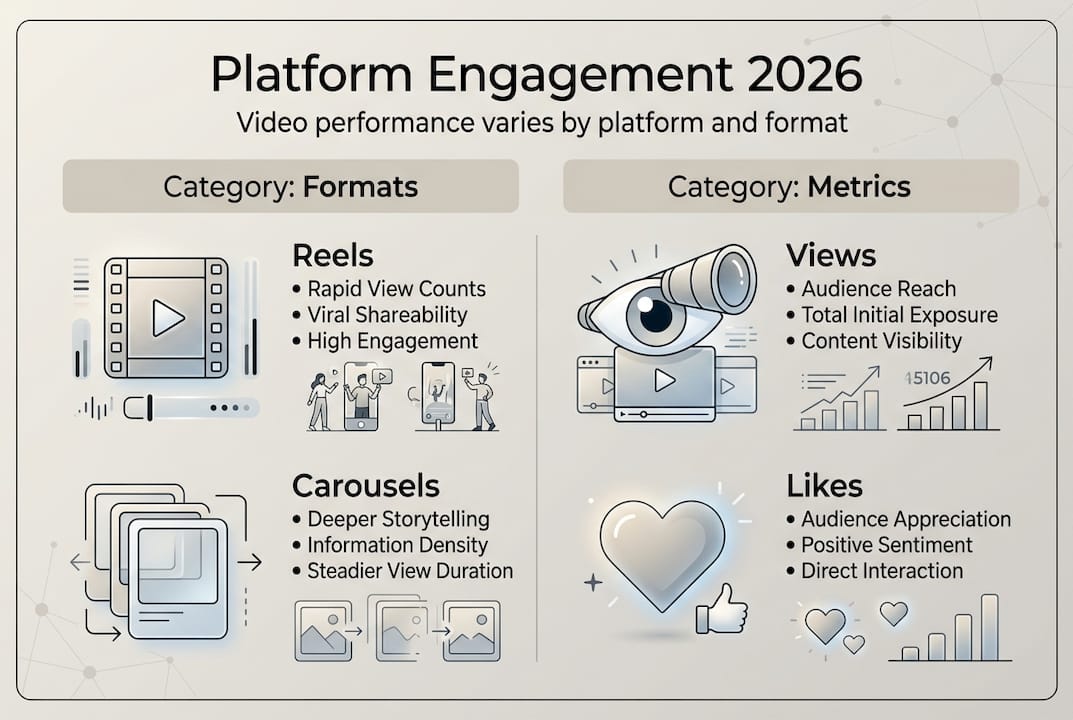
Instagram demonstrates how format choice within a single platform impacts results. Reels and Carousels generate 44% higher engagement than static images, proving that the platform's algorithm actively favours video and interactive content over traditional photo posts. Marketing professionals who continue prioritising static imagery leave substantial engagement potential untapped.
The rise of AI-generated video content has introduced new challenges. Pure AI-generated videos underperform by 30-50% if not hybridised with human creativity. Audiences detect the uncanny valley effect in fully automated content, responding with lower engagement and trust. Successful teams use AI for ideation, scripting assistance, and editing efficiency whilst maintaining human direction and authentic presentation.
One-off viral attempts fail compared to systematic content production. Brands that create isolated videos hoping for breakthrough moments consistently underperform those building iterative content systems. These systems produce multiple variants, test different hooks and formats, and compound learning across campaigns. Each video informs the next, creating upward performance trajectories rather than random spikes.
Poor hooks represent the critical failure point in social video marketing. If you lose viewers in the first 3 seconds, no amount of brilliant content in seconds 10 through 60 will recover that attention. Hook optimisation deserves equal production time to main content development.
Platform-specific challenges include:
- TikTok's rapid trend cycles requiring daily monitoring and quick adaptation
- Instagram's algorithm changes that periodically reset engagement baselines
- LinkedIn's professional context demanding different entertainment approaches
- Facebook's declining organic reach forcing greater paid distribution budgets
- YouTube Shorts competing with established long-form content on the same platform
Successful social selling video production acknowledges these platform realities whilst maintaining brand consistency. The solution lies not in identical content across channels but in coherent brand storytelling adapted to each platform's unique mechanics and audience expectations.
Advertising campaign videos must balance paid amplification with organic growth strategies. Over-reliance on paid reach creates unsustainable cost structures, whilst purely organic approaches limit scale. The optimal mix varies by industry, audience, and campaign objectives, requiring continuous testing and adjustment.
Exploring AI marketing support tools helps teams scale content production without sacrificing quality. The key lies in using AI for repetitive tasks whilst preserving human judgement for creative direction, strategic decisions, and authentic communication that builds genuine audience relationships.
Putting social video strategy into practice for entertainment-led campaigns
Applying social video strategy principles to entertainment-focused marketing requires systematic execution across five key stages:
-
Define thematic pillars aligned with audience interests. Identify 3-5 recurring content themes that connect your brand expertise with topics your target audience actively seeks. These pillars provide structure for content calendars whilst allowing creative variation within each theme.
-
Establish production workflows that enable iteration. Build systems for rapid content creation, testing, and refinement. This includes templated formats that maintain quality whilst reducing production time, standardised approval processes that prevent bottlenecks, and clear success criteria that determine which content variants receive amplification budgets.
-
Implement measurement frameworks beyond surface metrics. Traditional metrics prove inadequate for interactive social media, with empirical studies showing the need for qualitative case studies and KPIs like trust mediation. Track how video content influences brand perception, consideration, and purchase intent through surveys, attribution analysis, and cohort comparisons.
-
Create feedback loops connecting performance data to content decisions. Analyse which hooks retain viewers, which topics drive shares, which calls-to-action generate clicks, and which formats outperform on specific platforms. Use these insights to refine your content strategy continuously rather than waiting for quarterly reviews.
-
Scale successful formats through systematic variation. Once you identify high-performing content patterns, create multiple versions testing different angles, presentations, and contexts. This approach compounds learning whilst maintaining the core elements that drive results.
Thematic consistency matters more than production polish. Audiences forgive imperfect lighting or amateur editing when content delivers genuine value. They abandon slickly produced videos that waste their time with generic advice or thinly veiled sales pitches. Your entertainment-led approach must genuinely entertain, educate, or inspire before asking for commercial consideration.
Measuring trust mediation requires qualitative research alongside quantitative analytics. Conduct periodic audience surveys asking how video content influenced brand perception. Track sentiment in comments and shares. Compare purchase rates between audiences exposed to your video content versus those who were not. These deeper insights reveal whether your social video strategy builds the trust foundation necessary for sustained commercial growth.
Iterative content production based on performance analytics creates competitive advantages. Most brands produce content, analyse results, then start fresh with new concepts. High-performing teams treat each video as a learning opportunity, systematically testing variables whilst maintaining successful core elements. This approach accelerates improvement and compounds returns over time.
Content campaign services that integrate strategy, production, and performance analysis help brands maintain this iterative discipline. External expertise provides objectivity and pattern recognition across multiple campaigns, identifying success factors that internal teams might miss when focused on individual executions.
Your social media video production must balance consistency with experimentation. Maintain thematic coherence and brand identity whilst testing new formats, platforms, and creative approaches. This balance prevents stagnation without sacrificing the recognition that builds audience loyalty.
Discover Media Borne's video production services
Building an effective social video strategy requires more than understanding principles. You need production capabilities, platform expertise, and iterative testing frameworks that turn theory into measurable results. Media Borne specialises in entertainment-led video content that captures attention and converts audiences into customers through engaging formats designed for social platforms.
Our video production services combine creative storytelling with data-driven optimisation, ensuring your social video content performs across TikTok, Instagram, LinkedIn, and emerging platforms. We develop content campaigns that maintain thematic consistency whilst testing variables systematically to improve performance continuously. Explore how our video production and content creation expertise can amplify your brand's social presence and drive commercial outcomes through strategic entertainment.
Frequently asked questions
What is the optimal length for social video content on different platforms?
Instagram Reels perform best between 60 to 90 seconds, whilst LinkedIn videos prove most effective at 2 to 3 minutes. TikTok favours shorter content between 21 and 34 seconds. Tailoring video length to platform norms significantly improves engagement rates because algorithms reward content that matches user behaviour patterns on each platform.
How can marketers measure success beyond traditional video views?
Views and likes alone fail to capture engagement depth or commercial impact. Traditional metrics prove inadequate for interactive social media, requiring qualitative KPIs like trust mediation that assess how video content influences brand perception and purchase intent. Case studies examining audience behaviour changes, attribution analysis connecting views to conversions, and sentiment tracking in comments provide deeper performance insights than surface-level metrics.
Why do AI-generated videos often underperform on social media?
Pure AI-generated videos underperform by 30-50% when not hybridised with human creativity. Audiences detect artificial patterns in fully automated content, responding with lower engagement and trust. Successful approaches use AI for efficiency in scripting, editing, and ideation whilst maintaining human direction for authentic storytelling and strategic decisions that connect with viewers emotionally.
How do entertainment-led video campaigns differ from traditional advertising?
Entertainment-led campaigns prioritise audience value over direct promotion, building attention through content people actively choose to watch rather than tolerate. This approach creates communities around your brand's content rather than interrupting existing entertainment. The commercial payoff comes from sustained attention and trust rather than immediate sales messages, resulting in higher long-term conversion rates and lower customer acquisition costs.
What role does thematic consistency play in social video strategy?
Thematic consistency allows audiences to recognise your brand's content instantly whilst providing structure for systematic testing and improvement. Rather than creating isolated viral attempts, recurring themes enable you to refine formats, hooks, and messaging across multiple videos. This consistency compounds learning and builds audience anticipation, creating predictable engagement patterns that support reliable commercial outcomes.