

TL;DR:
- Short-form entertainment content significantly boosts ad recall and engagement compared to traditional ads.
- Successful campaigns prioritize authentic, creator-style production and rapid testing of creatives.
- Choosing between TikTok and YouTube Shorts depends on audience, campaign goals, and content strategy.
Most brands are still betting on ad formats that audiences have learnt to ignore. Meanwhile, YouTube Shorts native ads boost ad recall 2 to 4 times compared to traditional placements, and TikTok continues to rewrite what engagement actually looks like. The gap between brands that treat video as entertainment and those that treat it as interruption is widening fast. This article breaks down why short-form, entertainment-led content is now the most powerful lever in digital marketing, which platforms deliver the strongest results, and how to measure what actually matters.
Table of Contents
- Why short-form entertainment leads digital marketing now
- Key mechanics for engaging short-form video campaigns
- Comparing platforms: TikTok vs YouTube Shorts for brand impact
- Measuring success: Metrics to track and learn from
- Our take: Why relentless testing still beats best practice
- Work with experts in entertainment-led digital marketing
- Frequently asked questions
Key Takeaways
| Point | Details |
|---|---|
| Short-form leads engagement | Entertainment-driven video on TikTok and YouTube Shorts delivers up to four times higher recall and interaction than traditional formats. |
| Balance education with fun | Mix informative and entertaining elements for authentic connections with modern audiences. |
| Pick platforms wisely | Choose platforms based on your brand goals and audience habits for maximum campaign impact. |
| Track the right metrics | Use CTR, ad recall, and post-view actions to measure what really matters and guide improvements. |
Why short-form entertainment leads digital marketing now
Something fundamental has shifted in how audiences consume branded content. It is not just that attention spans have shortened. It is that audiences have developed a genuine intolerance for content that feels like advertising. Short-form video, particularly content under 60 seconds, sidesteps that intolerance entirely by wrapping brand messages inside entertainment that people actively choose to watch.
The numbers back this up clearly. Ad recall rises 2 to 4 times when brands use channel-led creative on YouTube Shorts that feels authentic rather than produced. One chocolate brand achieved a 20% higher CTR by making Shorts content contextually relevant to the viewing moment rather than repurposing TV spots. These are not marginal gains. They represent a structural advantage for brands willing to think like media companies.
What drives this? Three things stand out. First, creator-style production feels native to the platform. Audiences trust content that looks and sounds like the creators they already follow. Second, entertainment elements such as challenges, humour, and trending audio extend watch time significantly, which feeds platform algorithms and expands organic reach. Third, short-form video compresses the awareness-to-interest journey into a single piece of content.
Here is a quick comparison of how the two approaches stack up:
| Metric | Traditional ad formats | Short-form entertainment content |
|---|---|---|
| Ad recall lift | Baseline | 2 to 4x higher |
| Click-through rate | Baseline | Up to 20% higher |
| Watch time growth | Low | Significant organic uplift |
| Audience trust | Moderate | High (creator-style) |
| Algorithm favour | Paid only | Organic and paid combined |
The brands winning right now are not simply spending more on ads. They are building content that earns attention rather than buying it. If you want a deeper look at how this plays out across formats, our YouTube for brands overview covers the mechanics in detail, and our short-form video guide walks through production decisions from brief to publish.
Key mechanics for engaging short-form video campaigns
Knowing that short-form video works is one thing. Knowing how to make it work for your specific brand is another. There are a handful of non-negotiable mechanics that separate campaigns with strong performance from those that disappear without a trace.
1. Start with a three-second hook. A compelling opening moment raises completion rates by up to 40%. This is not about a fancy visual. It is about creating immediate relevance. Ask a question your audience is already asking. Show the end result first. Open on movement or contrast.
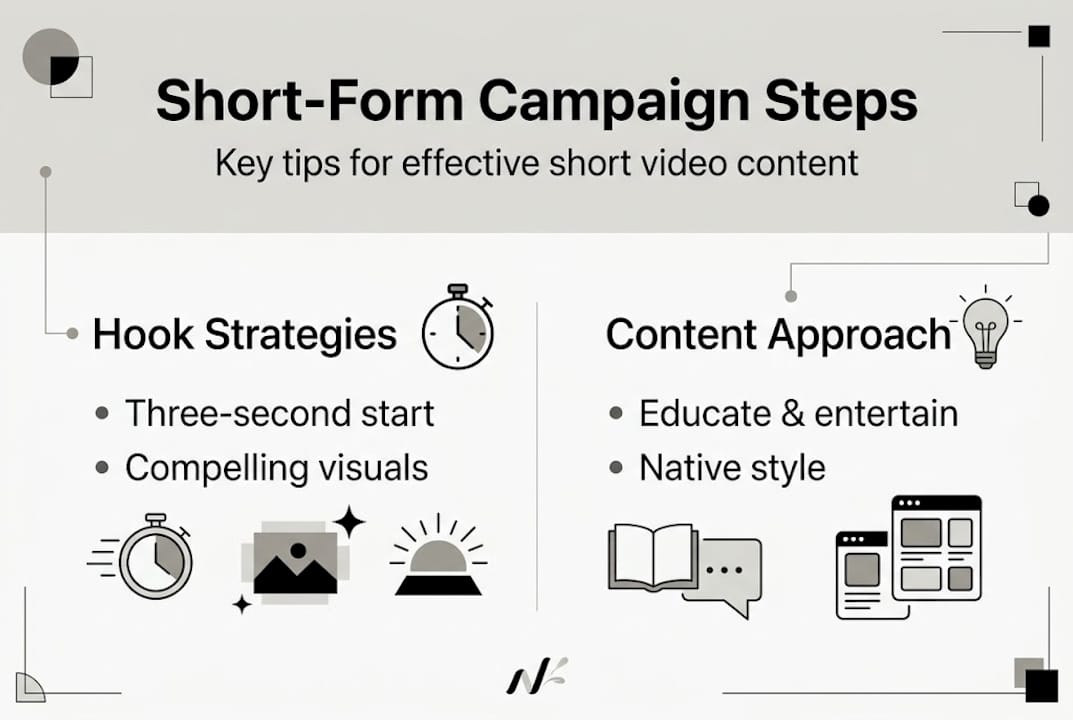
2. Balance education with entertainment. Content that only entertains rarely converts. Content that only educates rarely gets watched. The sweet spot is showing your brand solving a real problem in an engaging way, without it feeling like a tutorial or a pitch.
3. Commit to native, creator-style production. Polished corporate video repurposed for TikTok performs poorly. The authenticity of creator-style storytelling builds trust that traditional formats simply cannot replicate.
4. Tap into timely trends, but filter for brand fit. Not every trending sound or challenge belongs in your content plan. The strongest campaigns identify where cultural moments intersect with genuine brand values, then move quickly.
5. Test rapidly and iterate from real feedback. Do not wait for a quarterly review to see what is working. Publish, observe, adjust, and repeat within days.
"The brands that treat each Short as a data point rather than a finished product are the ones compounding their results month on month."
Pro Tip: When testing hooks, produce three to five variations of your first three seconds and run them to a small audience before committing budget. The winning hook often surprises even experienced teams.
For a full breakdown of how to optimise video campaigns for both engagement and conversion, and how media production choices affect ROI, both resources are worth reviewing before your next brief.
Comparing platforms: TikTok vs YouTube Shorts for brand impact
Choosing between TikTok and YouTube Shorts is not simply a matter of preference. Each platform has a distinct audience profile, algorithmic behaviour, and creative expectation. Getting this wrong means producing great content for the wrong room.
| Feature | TikTok | YouTube Shorts |
|---|---|---|
| Primary audience | 18 to 34, trend-led | Broader, 18 to 45+ |
| Algorithm | Interest graph, viral potential | Search and subscription signals |
| Ad recall strength | Moderate | High (2 to 4x uplift) |
| Creative flexibility | High, raw, fast | Moderate, more polished acceptable |
| Influencer ecosystem | Extensive | Growing via YouTube creators |
| Best for | Awareness, virality, Gen Z | Education, brand search, recall |
YouTube Shorts shines for brands where recall and education matter. LEGO is a strong example here. The brand's Shorts share rose to 46% of its total YouTube content mix, with 19% watch time growth following the shift. That is a deliberate strategic choice, not an accident.

TikTok, on the other hand, offers unmatched viral velocity. Content that taps into trends can reach millions organically without paid amplification. The trade-off is that the audience skews younger and the shelf life of content is shorter.
Key considerations when choosing your platform:
- Audience age and behaviour: Where does your core customer actually spend time?
- Campaign objective: Is this an awareness play or a recall and conversion campaign?
- Content cadence: TikTok rewards volume. YouTube Shorts rewards quality signals.
- Creator partnerships: Both platforms benefit from creator collaboration, but the influencer culture differs significantly.
Many brands find the strongest approach is running both platforms simultaneously, with slightly adapted formats for each. The underlying story stays consistent. The execution is tailored. For more on which formats drive higher engagement in 2026, that resource covers current platform-specific data.
Measuring success: Metrics to track and learn from
Once your campaign is live, measurement is where strategy either compounds or stalls. Too many brands track vanity metrics and draw the wrong conclusions. Here is what actually matters.
Core metrics to monitor:
- Ad recall: Measures whether your brand message is sticking. Surveys and brand lift studies provide this. It is the clearest indicator of whether your creative is working.
- Click-through rate (CTR): Shows whether your content motivates action. A 20% CTR uplift achieved by tailoring Shorts to contextual relevance demonstrates how much creative choices affect commercial outcomes.
- Average watch time: Reflects genuine audience interest. If viewers drop off in the first three seconds, your hook needs work. If they drop at 15 seconds, your content loses relevance after the opening.
- Completion rate: Particularly important for Shorts. A high completion rate signals strong content structure and feeds platform algorithms positively.
- Post-view actions: Site visits, branded search volume, and app installs that follow video exposure tell you whether your content is converting attention into intent.
Pro Tip: Set up a brand search monitoring segment in your analytics before a campaign launches. A spike in branded searches following video exposure is one of the clearest signals that your content has made an impression, even when users do not click through directly.
The brands doing this well treat every campaign as a learning exercise. LEGO and similar brands that adapted their content mix based on real performance data saw compounding returns. That iterative approach is covered in more depth in our social video strategy resource, alongside our branded short-form video guide for measuring brand power over time.
Our take: Why relentless testing still beats best practice
Everyone in marketing talks about best practice. We have found it is often the most dangerous concept in a fast-moving channel.
By the time a tactic becomes best practice, it has been replicated across thousands of brands. The algorithm has already adjusted. The audience has already tuned it out. What worked six months ago in short-form video is often exactly what you should avoid today.
The brands we see achieving consistent results are not the ones following the rulebook. They are the ones running rapid micro-tests, watching audience signals closely, and making creative decisions based on their own data rather than industry benchmarks. Trends are useful as a starting point. They are not a strategy.
Our campaign experience shows that the biggest performance jumps come from unexpected creative angles that no competitor had tried yet, often discovered only through deliberate failure. If you want to understand where innovative production trends are heading, that resource offers a useful lens on what to experiment with next. Expect some tests to underperform. Learn fast, and keep moving.
Work with experts in entertainment-led digital marketing
The strategies covered in this article work. But executing them consistently, at speed, and with the creative quality that platforms reward takes genuine production and strategy expertise.
At Media Borne, we build campaigns specifically for brands that want to grow through entertainment rather than interruption. Our video production services are designed to deliver platform-native content that earns attention and converts it into measurable results. We also specialise in social selling video formats that connect content directly to commercial outcomes. If you want to see what this looks like in practice, explore our production portfolio and get a sense of the brands and formats we work with. Let us help you make entertainment your competitive advantage.
Frequently asked questions
What is entertainment-led digital marketing?
It is a strategy that builds brand awareness and conversions through engaging, authentic video content on platforms like TikTok and YouTube, rather than relying on interruptive ads. Channel-led creative designed for authenticity is central to its success.
How do you measure ROI on short-form video campaigns?
Focus on CTR, ad recall, watch time, and post-view actions such as branded search and site visits. A 20% higher CTR is achievable when content is contextually relevant to the viewing moment.
Which platform is better: TikTok or YouTube Shorts?
Both are effective for different goals. TikTok suits younger audiences and trend-driven awareness, while YouTube Shorts delivers stronger ad recall, with LEGO's Shorts share reaching 46% alongside 19% watch time growth.
What is the biggest mistake brands make with short-form campaigns?
Copying trending formats without testing them against their own audience. Native creator-style storytelling built around real audience feedback consistently outperforms replicated trends.