

TL;DR:
- Choosing the right social media format is a strategic move that impacts engagement and campaign success.
- Carousels outperform video for engagement on LinkedIn and Instagram, challenging common assumptions.
- Innovative, community-driven formats like polls, UGC, and live streams foster genuine brand loyalty and interaction.
Most marketers assume the format with the widest reach is automatically the most valuable. That assumption costs brands real engagement. The format with the widest reach isn't always the most engaging, and the gap between the two can be enormous depending on platform, audience, and objective. Choosing the wrong format isn't just a creative misstep; it's a strategic one that quietly undermines campaign performance. This guide cuts through the confusion with clear definitions, 2026 benchmark data, algorithm insights, and format-by-format recommendations built specifically for brand marketers who want results, not just impressions.
Table of Contents
- What is a social media format?
- Mechanics: Adapting content to each platform
- Benchmarks: Data on format performance in 2026
- Nuances and edge cases: Trade-offs and algorithm factors
- Innovative and community-driven formats for brands
- Why format-first thinking is the next brand differentiator
- Supercharge your brand content with expert production
- Frequently asked questions
Key Takeaways
| Point | Details |
|---|---|
| Format impacts engagement | Choosing the right format can boost your results more than changing your message or visuals alone. |
| Adapt for each platform | Adjust every content piece to fit the technical and cultural norms of each channel for best performance. |
| Benchmarks drive strategy | Use up-to-date engagement data to test, compare, and refine your content mix for your brand’s audience. |
| Experiment with innovation | Trying out innovative and interactive formats can foster genuine engagement and stronger communities. |
What is a social media format?
Having outlined why format choice is strategic, let's clarify what a social media format actually is and how it impacts your content approach.
A social media format is the structural container for your content. It determines how your message is delivered, how the platform serves it, and how your audience interacts with it. Two brands can share the same message but achieve wildly different results simply because one chose a carousel and the other chose a static image.
Social media formats refer to diverse content structures optimised for specific platforms, including text posts, images, short and long-form video, carousels, stories, polls, live streams, infographics, and user-generated content (UGC). Each format has its own rules, strengths, and audience expectations.
Here is a quick overview of the major format types:
- Text posts: Best for opinion, commentary, and thought leadership, especially on LinkedIn and X
- Static images: Strong for brand aesthetics, product showcases, and quick announcements
- Short-form video: High reach on TikTok, Instagram Reels, and YouTube Shorts
- Long-form video: Deep storytelling and tutorials, suited to YouTube and Facebook
- Carousels: Excellent for guides, step-by-step content, and sustained engagement
- Stories: Ephemeral, authentic, and ideal for daily touchpoints
- Polls and quizzes: Interactive formats that invite participation and signal intent
- Live streams: Real-time community building and social commerce
- Infographics: Data-heavy content made visually digestible
- UGC: Authentic peer content that builds trust faster than branded material
"Format is not just a packaging decision. It is a strategic signal to the platform's algorithm and a psychological cue to your audience about how to engage."
Understanding the full range of content formats available across platforms is the foundation of any serious social media strategy.
Mechanics: Adapting content to each platform
Once the core format types are clear, successful marketing means adjusting each piece for its intended platform.

Every platform has technical and cultural norms that dictate how content should be structured. Platform-specific adaptations include 9:16 vertical framing for short-form video, carousel structures for step-by-step guides, and pillar-to-microformat repurposing to extend content reach efficiently.
Here is a simple workflow for building a format-adapted content process:
- Define your content pillars — identify three to five core themes your brand owns
- Create pillar content — produce one substantial piece per pillar, such as a long-form video or detailed article
- Identify platform destinations — map each pillar to the platforms where your audience is most active
- Adapt the format — recut video for social media video production formats, extract quotes for text posts, convert key points into carousel slides
- Optimise for platform specs — apply the correct aspect ratio, caption length, and hashtag strategy per platform
- Schedule and test — use a content mix framework and monitor performance weekly
Two popular content mix frameworks are worth knowing. The 70/20/10 rule suggests 70% educational or entertaining content, 20% shared or curated content, and 10% promotional. The 50/30/20 split allocates 50% to engagement-focused content, 30% to brand storytelling, and 20% to direct offers. Neither is universally correct; the right balance depends on your audience's expectations and platform behaviour.
Pro Tip: Before repurposing any content, watch how you drive engagement with video on each platform separately. A clip that performs brilliantly on TikTok may need a completely different hook and pacing for Instagram Reels.
Learning to plan video workflows in advance saves significant time and ensures each format serves its platform properly. A well-structured workflow also makes adjusting format for each platform far less overwhelming.
Benchmarks: Data on format performance in 2026
To make smart format choices, you need data. Here are the latest platform benchmarks for engagement in 2026.
The numbers tell a story that surprises most marketers. LinkedIn carousels achieve 21.77% engagement, Instagram carousels reach 6.9%, TikTok videos sit at 3.39%, Facebook images deliver 5.2%, and X text posts land at 3.56%. Carousels dominate on both LinkedIn and Instagram, which challenges the assumption that video is always king.
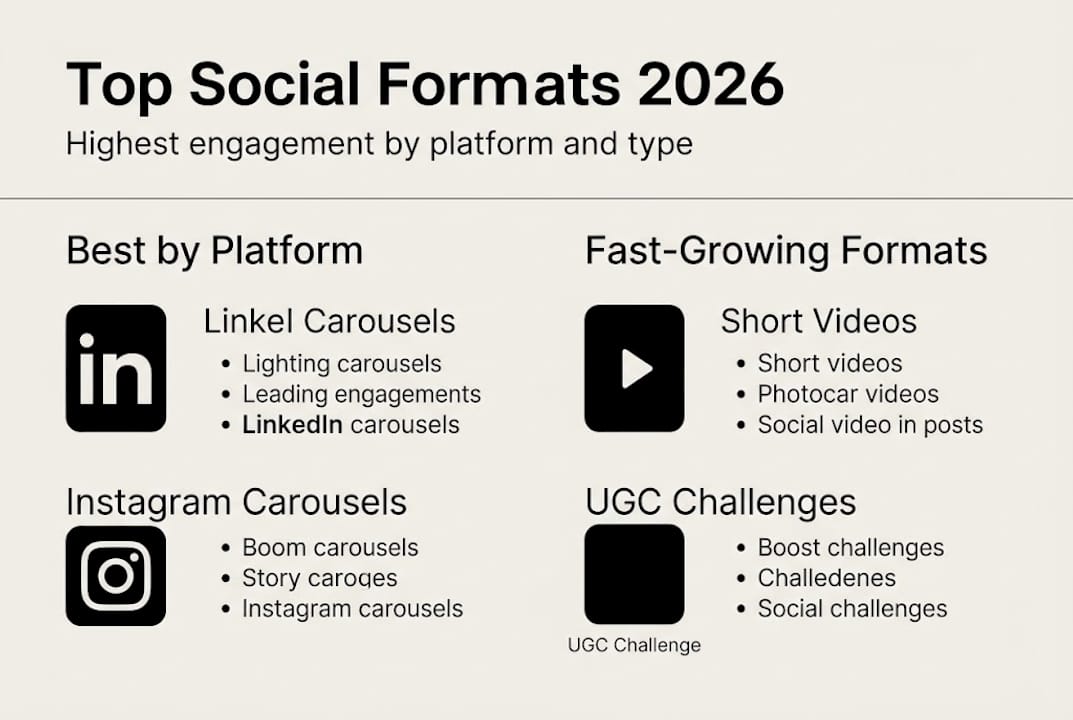
| Platform | Top format | Engagement rate |
|---|---|---|
| Carousels | 21.77% | |
| Carousels | 6.9% | |
| Images | 5.2% | |
| X (Twitter) | Text posts | 3.56% |
| TikTok | Short-form video | 3.39% |
Key insight: Carousels outperform video for engagement on LinkedIn and Instagram, even though video dominates reach metrics on TikTok and Reels.
Here is what the data recommends by platform:
- LinkedIn: Prioritise carousels and long-form text for maximum engagement
- Instagram: Lead with carousels, support with Reels for reach
- TikTok: Short-form video is non-negotiable, but focus on watch time over likes
- Facebook: Static images and link posts still perform well for community-focused brands
- X: Conversational text and threads drive the strongest interaction
For broader context, the Hootsuite benchmarks provide platform-wide averages that help calibrate your own performance expectations. Pairing these benchmarks with your own analytics is the most reliable way to identify which formats suit your specific audience.
For deeper strategy tips for engagement that go beyond format selection, it is worth reviewing how top-performing brands structure their entire content calendar around these data points.
Nuances and edge cases: Trade-offs and algorithm factors
Beyond the numbers, marketers need to understand the strategic nuances and common pitfalls when selecting content formats.
Reach and engagement rarely move in the same direction. Reels and short-form video push content to new audiences efficiently, but carousels and text posts tend to generate deeper interaction from existing followers. Choosing between them is not a quality judgement; it is a strategic one based on your current objective.
"Chasing reach without engagement is like filling a leaky bucket. The audience arrives but does not stay."
Algorithms across all major platforms now reward content that generates meaningful interaction. Replies, saves, and shares carry far more weight than passive likes. This is where video storytelling for brands becomes critical. A well-told story in video format prompts comments and shares organically, without any manipulation.
The reach versus engagement trade-off also connects directly to the risks of engagement bait. Tactics like "tag a friend" or "comment YES if you agree" may spike short-term numbers, but platforms actively detect and downgrade this behaviour. The engagement bait pitfalls are well-documented, and the algorithmic penalties can suppress your organic reach for weeks.
Pro Tip: Focus on formats that naturally invite replies rather than forcing them. A genuine question embedded in a carousel slide or a cliffhanger in a short-form video generates authentic interaction that algorithms reward consistently.
| Format | Reach potential | Engagement depth | Algorithm risk |
|---|---|---|---|
| Short-form video | High | Medium | Low if authentic |
| Carousels | Medium | High | Very low |
| Text posts | Medium | High | Very low |
| Engagement bait | Short-term spike | Very low | High |
For brands investing in video marketing for brands, the key is producing content that earns interaction rather than engineering it.
Innovative and community-driven formats for brands
With the complexities of algorithms and benchmarks covered, let's focus on how brands can stand out and foster genuine community through innovative, interactive formats.
Interactive formats such as polls, quizzes, and UGC can double engagement rates and build community loyalty that passive content simply cannot match. These formats work because they shift the audience from spectator to participant.
Here are the most effective community-driven formats for brand marketers right now:
- Polls: Fast, low-friction participation that signals audience preferences and generates instant data
- Quizzes: Longer engagement windows and high shareability, particularly on Instagram Stories and LinkedIn
- UGC campaigns: Invite customers to share content using a branded hashtag, then reshare the best submissions
- Live streams: Real-time Q&A, product launches, and behind-the-scenes content that rewards loyal followers
- Collaborative posts: Co-created content with creators or community members that expands reach organically
Cross-platform adaptation is essential here. A poll that works on Instagram Stories can be reframed as a LinkedIn question post or a Twitter thread. The format changes; the community-building intent stays the same.
Sample campaign idea: Launch a UGC challenge on TikTok with a branded sound, repurpose the best submissions as Instagram Reels, then compile the top entries into a YouTube highlight. One campaign concept, three formats, three platforms, one growing community.
Pro Tip: UGC is not just a content shortcut. It is social proof at scale. When real customers create content about your brand, it carries credibility that even the most polished production cannot replicate.
Investing in media production for brand growth ensures that even community-driven formats are supported by professional creative direction, keeping brand consistency intact while authenticity drives the engagement. For broader engagement strategies, interactive formats consistently outperform passive ones across every major platform.
Why format-first thinking is the next brand differentiator
Stepping back from the mechanics, here is a candid perspective informed by years of direct brand work in media.
Most brands spend enormous energy on message refinement and visual identity while treating format as an afterthought. The brief says "make a video" or "post something on LinkedIn" without any real interrogation of whether that format serves the objective. That is a significant missed opportunity.
Format is not neutral. It shapes how audiences feel about your content before they have processed a single word. A carousel communicates depth and effort. A raw, vertical video communicates immediacy and authenticity. A polished long-form production communicates authority. These are not interchangeable signals.
The brands that will win the next phase of social media are not the ones with the biggest budgets or the most consistent posting schedules. They are the ones willing to experiment with format, read the data honestly, and adapt quickly. Formulaic consistency is comfortable but rarely differentiating. Agility in format experimentation, combined with strong creative direction, produces outsized results.
Future-proof strategies are built around adaptation and community, not volume. Knowing how to produce viral videos is valuable, but knowing when a viral video is the right format, and when a quiet carousel will outperform it, is what separates strategic marketers from content factories.
Supercharge your brand content with expert production
Great format strategy only delivers results when the production quality matches the platform's expectations. Choosing the right format is step one; executing it with precision is what converts attention into genuine commercial outcomes.
At Media Borne, we specialise in producing content built for every major social format, from professional video production optimised for TikTok and YouTube to social selling content designed to convert audiences directly. Whether you need a full content strategy or a single high-impact campaign, our team combines creative production with platform-native thinking. Explore our partnership opportunities and find out how we can help your brand turn format intelligence into measurable growth.
Frequently asked questions
How do I choose the best social media format for my brand?
Test several formats against your own analytics and benchmark data, then prioritise the formats that consistently deliver the highest engagement for your specific audience on each platform.
Does short-form video always get the most reach?
Short-form video gains broad reach, but carousels outperform video for engagement on LinkedIn and Instagram, making them the stronger choice when depth of interaction matters more than raw impressions.
Are engagement bait tactics effective long term?
Engagement bait can produce a brief spike in numbers, but algorithm downgrades are a real risk, and the resulting drop in organic reach typically outweighs any short-term gain.
How can I repurpose pillar content across formats?
Pillar-to-microformat repurposing works by breaking a long-form piece into platform-specific fragments: turn a detailed video into stories, extract key points for a carousel, and adapt the core argument into a text thread for LinkedIn or X.