

Video marketing now drives over 80% of conversions and is projected to account for 82% of all internet traffic by 2026. Those numbers are striking, but they mask a dangerous assumption: that simply producing more video content will automatically translate into brand growth. Many marketing teams are churning out reels, shorts, and clips at pace, yet seeing diminishing returns. The real opportunity lies not in volume, but in strategy. This article breaks down what social video marketing actually means, how to build a methodology that aligns with your funnel, and how to avoid the pitfalls that quietly drain budgets.
Table of Contents
- Defining social video marketing
- Core methodologies and the funnel alignment
- Platforms, formats and empirical benchmarks
- Beyond the hype: pitfalls, scepticism and integrated ecosystems
- Practical steps for applying social video marketing
- Drive results with professional social video solutions
- Frequently asked questions
Key Takeaways
| Point | Details |
|---|---|
| Strategic video use | Social video marketing relies on planned content aligned with brand goals, not just posting more videos. |
| Short-form wins engagement | Short-form video drives top ROI and rapid discovery for brands across key platforms. |
| Integrated approach | Combining video with text, audio, and PR creates stronger results than video-only strategies. |
| Measure what matters | Tracking relevant metrics like engagement and conversions is essential for optimising ROI. |
| Authenticity and repurposing | Authentic storytelling and smart content repurposing boost sustainable engagement and efficiency. |
Defining social video marketing
Social video marketing is not simply posting videos on social platforms. It is a deliberate, strategic discipline. As Sprout Social defines it, social video marketing uses video content on social platforms to achieve specific goals including brand awareness, audience engagement, lead generation, and conversions. The distinction matters because it shifts the conversation from output to outcome.
In practice, this spans platforms including TikTok, Instagram Reels, LinkedIn, YouTube, and Facebook. Each platform carries its own audience behaviour, algorithm logic, and content expectations. A brand that treats all platforms identically is leaving significant performance on the table.
The core stages of any effective social video marketing effort include:
- Planning: Defining objectives, audience personas, and content themes
- Production: Scripting, filming, and editing with platform-specific formats in mind
- Distribution: Organic posting, paid amplification, and cross-channel syndication
- Measurement: Tracking views, watch time, engagement rates, and conversion attribution
"The brands winning with social video are not the ones posting the most. They are the ones posting with the clearest intent."
For teams looking to sharpen their approach, exploring engagement strategy tips and social media strategy tips can provide a strong foundation. If YouTube is part of your mix, understanding YouTube for brand growth is equally essential.
Core methodologies and the funnel alignment
Effective social video marketing follows a structured methodology, not a creative free-for-all. The framework moves from pre-production through to analytics, with every decision anchored to a specific funnel stage.
Here is a practical step-by-step process:
- Set SMART goals tied to funnel stages: awareness, consideration, or decision
- Select platforms and formats based on where your audience actually spends time
- Define brand guidelines for tone, visual identity, and messaging consistency
- Plan production with scripted hooks, batch filming schedules, and repurposing in mind
- Optimise for algorithms by using native formats, captions, and trending audio where relevant
- Distribute across channels using a mix of organic, paid, and owned media
- Measure and iterate using engagement, watch time, click-through rates, and ROI
As Sprout Social outlines, setting SMART goals tied to funnel stages and selecting the right platforms and formats is the foundation of any successful video strategy.
| Funnel stage | Video format | Primary goal |
|---|---|---|
| Awareness | Short-form, Reels, TikTok | Reach and brand recall |
| Consideration | Explainers, testimonials, webinars | Trust and education |
| Decision | Product demos, case studies, live video | Conversion and purchase |
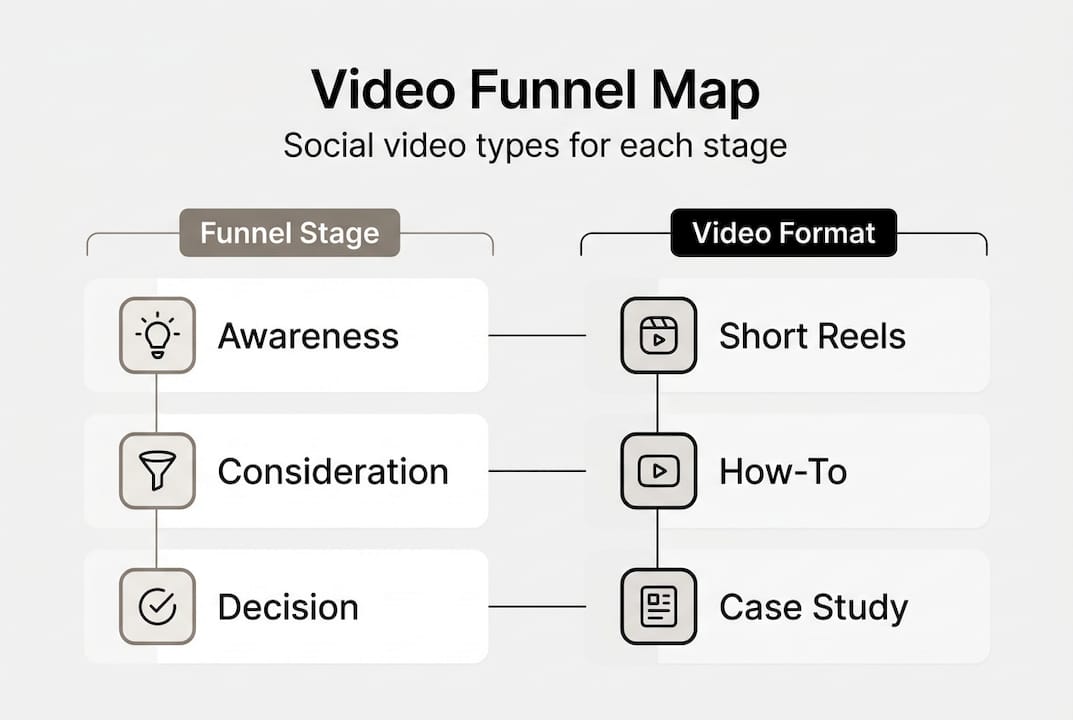
For teams managing complex campaigns, workflow planning for success is a critical resource. You can also find top video marketing tips to sharpen execution at every stage.
Pro Tip: Map every content theme directly to a customer journey stage before production begins. Brands that do this consistently report higher ROI because every piece of content has a defined job to do.
Platforms, formats and empirical benchmarks
The data on social video marketing is now robust enough to guide confident investment decisions. 91 to 93% of businesses now use video marketing, and 93% report a positive ROI. Short-form video consistently delivers the highest returns across formats, and LinkedIn videos are now 97% vertical, reflecting a broader shift in how professional audiences consume content.

Here is how the major platforms compare on key performance indicators:
| Platform | Best format | Optimal length | Audience strength |
|---|---|---|---|
| TikTok | Short-form vertical | 15 to 60 seconds | B2C, Gen Z, discovery |
| Reels, Stories | 15 to 30 seconds | B2C, lifestyle, retail | |
| Native video, vertical | 30 to 90 seconds | B2B, professional services | |
| YouTube | Long-form, Shorts | 7 to 15 minutes or under 60 seconds | All audiences, search-driven |
| Live video, short clips | 1 to 3 minutes | B2C, community, older demographics |
Key benchmarks worth noting:
- Short-form video delivers the highest ROI of any video format in 2026
- Vertical video now dominates across all major platforms, not just TikTok
- Live video generates significantly higher engagement than pre-recorded content
- Brands using social media video formats tailored to each platform outperform those using repurposed horizontal content
For brands running paid campaigns, advertising campaign videos built natively for each platform consistently outperform generic creative. If your strategy includes webinars or long-form live content, reviewing webinar best practices is a worthwhile investment of time.
Beyond the hype: pitfalls, scepticism and integrated ecosystems
Video's dominance in the data does not mean video alone is sufficient. This is where many brands make costly mistakes. As one critical analysis notes, video-only strategies rarely succeed for high-intent decisions. Ecosystems combining video, text, audio, and PR consistently drive superior results.
The most common pitfalls brands encounter include:
- Production overwhelm: Teams burning out trying to maintain unsustainable posting schedules
- Vanity metrics: Optimising for views and likes rather than engagement depth and conversion
- Platform uniformity: Posting identical content across all channels without adaptation
- Neglecting long-form: Over-indexing on short-form at the expense of content that nurtures deeper relationships
- Ignoring small account dynamics: Smaller, niche accounts often see higher engagement rates than large ones
"Authenticity and strategic intent will always outperform volume. A single well-crafted video aligned to a specific audience need will outperform ten generic clips every time."
The integrated approach works because different content types serve different cognitive needs. Video captures attention and builds emotional connection. Text provides depth and searchability. Audio builds habit and intimacy. PR amplifies credibility. Brands that treat corporate video strategy as one component of a broader content ecosystem, rather than the entire strategy, consistently see stronger long-term results.
Small accounts with highly targeted audiences frequently outperform large accounts with passive followings. This is a counter-intuitive but well-documented pattern. Niche relevance beats broad reach when conversion is the goal.
Practical steps for applying social video marketing
Translating strategy into execution requires discipline and a clear operational framework. Here is a practical sequence for marketing teams ready to act:
- Define your objectives with specific, measurable outcomes tied to funnel stages
- Audit your current platforms and identify where your audience is most active and receptive
- Develop content themes aligned to customer journey stages, not just trending topics
- Batch film content to reduce production pressure and maintain consistency
- Script your hooks in the first two to three seconds, as this is where retention is won or lost
- Leverage AI tools for scripting assistance, caption generation, and trend identification
- Optimise for each platform using native formats, relevant hashtags, and platform-specific aspect ratios
- Distribute across paid, organic, and owned channels to maximise reach at each funnel stage
- Track meaningful metrics: engagement rate, watch time, click-through rate, and conversion attribution
- Review and iterate monthly based on what the data tells you, not what feels right
As HubSpot's research confirms, investing where ROI is proven, tracking engagement over vanity metrics, and testing platform-specific strategies are the three behaviours that separate high-performing video marketers from the rest.
For teams seeking end-to-end support, content creation solutions that combine strategy, production, and distribution under one roof can dramatically accelerate results.
Pro Tip: Repurpose every long-form video into at least three short-form assets. A 10-minute YouTube video can become three TikToks, two Instagram Reels, and a LinkedIn clip. This multiplies your content output without multiplying your production effort.
Drive results with professional social video solutions
For brands ready to elevate their social video strategy, expert support can accelerate impact significantly. Media Borne offers end-to-end professional video production built specifically for social platforms, combining strategic planning, filming, editing, and distribution into a single, cohesive service.
Whether you are building a social-first content engine or exploring social selling video production to convert audiences directly into customers, Media Borne brings both creative and commercial expertise to every project. If you are looking for a longer-term partnership that goes beyond individual campaigns, explore brand partnership opportunities to see how we build entertainment-led ecosystems that grow with your brand.
Frequently asked questions
How can brands track the ROI of their social video campaigns?
Brands should measure engagement, conversions, watch time, and calculate ROI against original campaign objectives. With 93% of marketers reporting positive ROI, short-form video consistently delivers the strongest returns when tracked correctly.
Which platforms deliver the best results for social video marketing?
TikTok and Instagram drive the highest engagement for B2C brands, while LinkedIn offers premium reach for B2B audiences. LinkedIn videos are 97% vertical, and short-form content on TikTok and Instagram remains optimal for discovery and engagement.
Is it better to use short-form or long-form video content?
Short-form video is best for discovery, reach, and top-of-funnel engagement, while long-form content builds deeper relationships and nurtures consideration. As Sprout Social notes, long-form performs particularly well on YouTube and LinkedIn for nurturing audiences toward conversion.
What are typical content themes brands should use in social video?
Authenticity, educational content, behind-the-scenes footage, customer testimonials, and trend-responsive material consistently perform well. Themes aligned to the customer journey increase both engagement and ROI by ensuring every piece of content serves a clear strategic purpose.
How can brands overcome production challenges and avoid overwhelm?
Batch filming, template-based scripting, strategic content repurposing, and AI-assisted tools all reduce production pressure significantly. Over 62% of marketers report production overwhelm, making a streamlined workflow one of the most valuable investments a marketing team can make.