

TL;DR:
- High engagement often focuses on vanity metrics like likes and shares, but true engagement reflects deeper emotional and transactional relationships. Building genuine connections through strategic content, empowered teams, and seamless customer experiences is essential for sustainable growth. Prioritizing platform-specific strategies and fixing operational friction points enhances long-term audience loyalty and commercial value.
Most marketing professionals assume high engagement means lots of likes, shares, and comments. That assumption is costing brands growth. Platform-level data tells a more nuanced story: engagement rates vary wildly across channels, and the difference between a 0.8% Facebook rate and a 3.0% Instagram rate is not just a number. It represents fundamentally different audience behaviours and content opportunities. The brands winning in 2026 are not chasing vanity metrics. They are building genuine interaction through strategic content, empowered teams, and frictionless digital experiences.
Table of Contents
- What is customer engagement and why does it matter?
- Comparing engagement across platforms: Insights and impact
- Creative content strategies for deeper engagement
- Empowering teams and fixing friction: The hidden engagement lever
- Practical application: Building your engagement plan
- The uncomfortable truth about engagement: More than metrics
- Unlock your engagement potential with Media Borne
- Frequently asked questions
Key Takeaways
| Point | Details |
|---|---|
| Platform choice matters | Engagement rates vary widely; pick channels that fit your audience and goals. |
| Content drives interaction | Innovative, original content leads to deeper customer involvement and retention. |
| Team empowerment pays off | Giving your teams autonomy to solve customer issues transforms loyalty and long-term value. |
| Fix friction early | Proactive resolution of support and purchase barriers creates immediate improvements in engagement. |
| Measure what matters | Look beyond likes and comments to track authentic engagement and real business impact. |
What is customer engagement and why does it matter?
Customer engagement is not simply the act of someone liking your post or opening your email. It is the ongoing emotional and transactional relationship between your brand and its audience. Think of it this way: a customer who watches your full video, clicks through to your product page, and returns to purchase two weeks later is deeply engaged. A customer who double-taps a photo and scrolls on is not. The distinction matters enormously when you are allocating budget and creative resources.
True engagement reveals itself through metrics that go beyond surface interaction. Saves and shares signal that content is genuinely valuable. Repeat visits indicate brand relevance. Repeat purchases confirm emotional resonance has converted into commercial behaviour. These signals are far more instructive than follower counts or impression volume.
"Engagement is the bridge between attention and loyalty. Without it, even the most creative content becomes wallpaper."
Why does this matter strategically? Because engaged customers are retained customers. Research consistently shows that increasing customer retention by even a small percentage has an outsized impact on revenue. Engaged audiences also amplify brand reach organically, reducing your dependency on paid media spend over time.
Key indicators of genuine engagement include:
- Saves and bookmarks: The audience found the content worth returning to
- Direct messages and replies: Genuine two-way communication, not passive consumption
- Content sharing: The audience is comfortable associating your content with their identity
- Repeat site visits: Signals intent that goes beyond curiosity
- Purchase frequency: The clearest signal that engagement has translated to commercial value
To boost engagement tips that actually move these deeper metrics, the strategy needs to begin with the right platform decisions and the right creative approach for each channel.
Comparing engagement across platforms: Insights and impact
Not all platforms are equal, and your choice of channel has a direct impact on the quality and volume of engagement you can realistically achieve. The latest platform data for media and entertainment brands paints a clear picture of where audiences are most responsive.
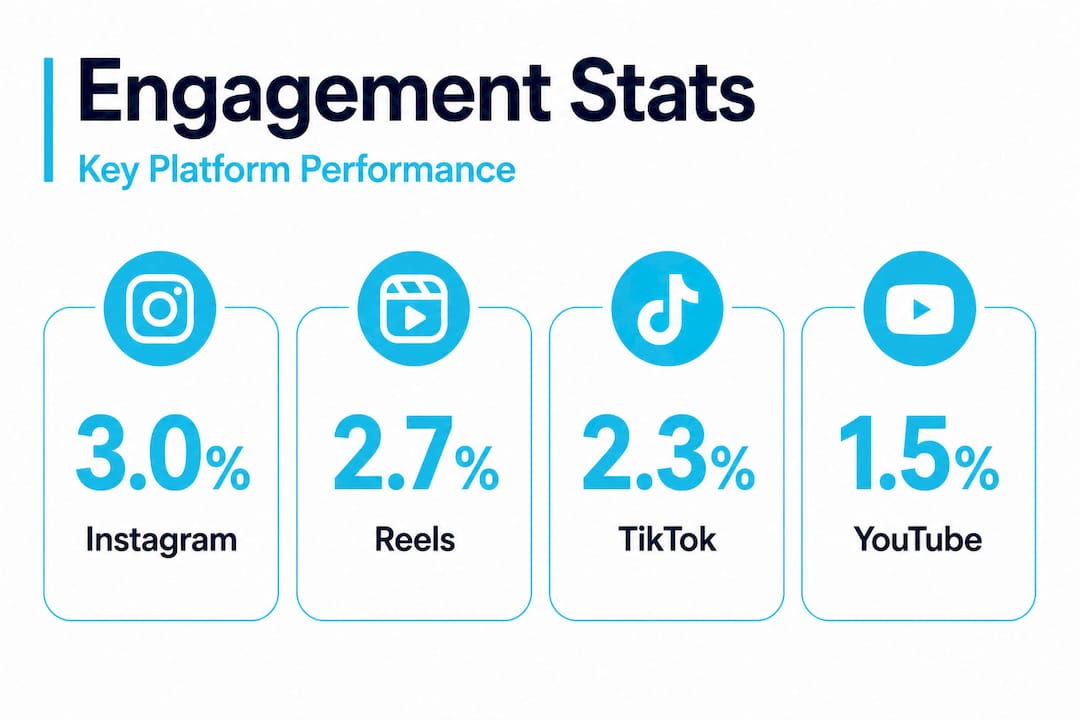
| Platform | Average engagement rate (media and entertainment) |
|---|---|
| 3.0% | |
| Instagram Reels | 2.7% |
| 2.0% | |
| TikTok | 1.8% |
| X (Twitter) | 1.7% |
| 0.8% |
Instagram leads the table, but the story is more complex than a single percentage. Instagram Reels at 2.7% confirms that short-form video dominates even within the platform. TikTok's 1.8% might appear modest by comparison, but it masks an important truth: TikTok's algorithm surfaces content to non-followers at a far higher rate than most platforms, meaning absolute reach is considerably broader. For entertainment and e-commerce brands, this reach advantage is significant.
Facebook's 0.8% rate should prompt a strategic rethink for any brand still investing heavily in organic Facebook content without a clear justification. The platform's engagement has been declining organically for several years as its algorithm increasingly favours paid distribution.
What does this mean in practice for e-commerce and entertainment marketers?
- Prioritise Instagram for brand storytelling: The combination of feed posts, Stories, and Reels provides multiple touchpoints for varied content formats
- Use TikTok for discovery and community building: Its algorithm rewards authentic, entertaining content regardless of follower count
- Leverage LinkedIn for B2B entertainment and media partnerships: The 2.0% rate is impressive in a professional context where content often skews dry
- Rethink Facebook strategy: Focus budget on paid rather than organic unless you have a highly active community already established
Explore TikTok engagement strategies specific to e-commerce audiences, and build a video engagement strategy that maps content formats to platform strengths rather than replicating the same asset everywhere.
Creative content strategies for deeper engagement
Understanding platform data is the foundation. What you build on top of it determines whether your engagement rates improve or plateau. Creative strategy is where theory meets execution, and the most effective approaches share a common thread: they treat the audience as participants, not passive viewers.
Here are the most impactful creative strategies for deeper engagement in 2026:
-
Serialised content formats: Rather than one-off posts, build content that rewards returning audiences. A weekly product reveal, an ongoing brand story told in episodes, or a recurring social series gives audiences a reason to come back. Entertainment brands understand this instinctively. E-commerce brands rarely apply it.
-
User-generated content (UGC) campaigns: Invite your audience to contribute. UGC not only reduces content production costs but dramatically increases the authenticity that modern audiences demand. Brands that build UGC campaigns around genuine product experiences see significantly higher trust signals than polished brand content alone.
-
Live social selling events: Platforms including TikTok Live and Instagram Live enable brands to sell in real time while building genuine community. The interactive format naturally drives higher engagement because audiences can ask questions, influence product choices, and feel personally acknowledged.
-
Behind-the-scenes content: Audiences are increasingly drawn to transparency. Showing the process behind your product, your team, or your creative decisions builds emotional investment that promotional content cannot replicate.
-
Interactive polls, challenges, and co-creation: Give your audience agency in shaping content. A poll about which product launches next or a challenge that invites creative participation turns passive followers into active contributors.
| Strategy | Best platform | Primary engagement signal |
|---|---|---|
| Serialised episodes | YouTube, TikTok | Return visits, watch time |
| UGC campaigns | Instagram, TikTok | Shares, saves, submissions |
| Live social selling | TikTok, Instagram | Real-time comments, purchases |
| Behind-the-scenes | Instagram Stories, YouTube | Saves, direct messages |
| Interactive challenges | TikTok, Instagram | Participation, shares |
For e-commerce brands, the expert insight from customer experience improvement research is instructive: empowering customer experience teams to resolve difficult scenarios autonomously, such as offering no-return refunds to retain a long-term customer, directly increases customer lifetime value (LTV). Creative content strategy and operational customer experience strategy are not separate disciplines. They reinforce each other.

Pro Tip: Before investing in new content formats, audit your existing content for friction. If your most engaging posts lead to a confusing product page or a difficult checkout flow, you are generating engagement that cannot convert. Fix the downstream experience before scaling the creative.
Explore creative engagement strategies, the power of short-form video for engagement, and how lifestyle engagement strategies can deepen audience connection beyond product-focused content.
Empowering teams and fixing friction: The hidden engagement lever
Most engagement conversations focus on content. Far fewer focus on what happens when a customer hits a problem. That gap is where brand loyalty is won or lost, and it is one of the most underused levers in both e-commerce and entertainment marketing.
"The brands customers love most are not the ones that never have problems. They are the ones that fix problems brilliantly."
Expert research into e-commerce customer experience highlights a critical operational principle: customer experience teams need genuine autonomy to handle difficult scenarios. When a CX agent can issue a refund outside standard policy because the customer has a strong purchase history, that decision creates a disproportionate loyalty response. The customer does not just return. They tell others.
This principle has direct implications for engagement strategy:
- Grant CX teams decision-making authority: Scripts and rigid policies create frustrating experiences. Autonomy creates memorable ones.
- Practise honest self-reflection: When engagement drops or complaint volumes rise, the first question should be "what did we do wrong?" rather than "how do we manage this?"
- Fix product detail page (PDP) gaps proactively: Many support queries stem from unclear product information. Closing those information gaps reduces friction before it reaches the customer, which means fewer negative interactions and higher purchase confidence.
- Map the full customer journey: Identify every point at which a customer might disengage, from a confusing navigation menu to an unexplained delivery delay, and address each one systematically.
Pro Tip: Run a monthly audit of your top 10 customer support queries. Each one is a friction point that is actively eroding engagement. Prioritise fixing the most common issues in your product pages, onboarding flows, or post-purchase communications before investing in new content campaigns.
The connection between operational empowerment and engagement is well documented in media innovation trends that show brands combining content excellence with seamless customer experience outperform those focused on content alone. Explore how entertainment social media strategies can be paired with operational improvements to create a genuinely differentiated brand experience.
Practical application: Building your engagement plan
Knowing what works is useful. Having a framework to implement it is essential. Building an engagement plan requires you to align your creative approach, platform choices, and operational processes around a clear set of goals.
Here is a practical step-by-step framework:
-
Define your engagement goals: Separate surface goals (more followers, more likes) from substantive ones (higher return purchase rate, lower support ticket volume, increased LTV). Be specific. "Increase repeat purchase rate by 15% in Q3" is an engagement goal. "Get more engagement" is not.
-
Audit your current performance: Map your existing engagement rates by platform and identify which content formats are driving the deepest interaction. Look at saves, shares, and click-throughs rather than raw impressions.
-
Select your platform priorities: Based on the data in Section 3, choose two or three platforms where your audience is most active and where the format fits your content strengths. Avoid spreading across every channel without a clear rationale.
-
Build a content calendar with serialised formats: Plan content in sequences rather than individual posts. Map out a four-week content arc that builds narrative momentum and rewards loyal followers.
-
Fix the top three friction points: Use your customer support data, website analytics, and product page exit rates to identify where potential engagement is leaking. Address these before launching new creative campaigns.
-
Empower your CX team: Define the scenarios in which your team has authority to make independent decisions. Document the outcomes to build an internal knowledge base of what works.
-
Review and iterate monthly: Set a monthly review cadence to assess engagement metrics against your defined goals, adjust content formats, and update your friction audit.
| Action area | Key tactic | Success metric |
|---|---|---|
| Platform strategy | Prioritise Instagram and TikTok | Engagement rate per post |
| Content format | Serialised and interactive content | Return visits, saves |
| Customer experience | CX team autonomy | Repeat purchase rate |
| Friction reduction | PDP and journey fixes | Support query volume |
| Measurement | Monthly performance review | LTV, retention rate |
Building strategic brand partnerships is also a high-impact tactic at this stage, particularly for entertainment and e-commerce brands looking to accelerate audience growth without proportional increases in content spend.
The uncomfortable truth about engagement: More than metrics
Here is something the industry rarely says clearly: most engagement strategies fail not because the content is bad, but because the organisation behind the content is not structured to support genuine connection.
We see this repeatedly. A brand invests in high-quality video content, builds a consistent posting schedule, and watches engagement rates tick upward. Then a customer has a poor experience. They post about it. The brand's social team responds with a generic, legally vetted reply. The goodwill built over months evaporates in a public thread.
The conventional metric-driven approach treats engagement as a content problem. It is actually an organisational problem. Sustainable engagement requires that every touchpoint, from your Instagram Reels to your returns policy to your email subject lines, reflects the same understanding of what your audience values.
The brands that genuinely move the needle on marketing ROI insights are the ones that have aligned content strategy with customer experience strategy. They are not running them as separate departments with separate KPIs. They understand that a resolved complaint, handled with empathy and speed, is an engagement event. It creates a story the customer will tell. That word-of-mouth is worth more than any paid campaign.
Our view at Media Borne is that attention is the entry point, not the goal. The goal is the relationship. When your content earns attention and your operations honour it, engagement becomes a natural outcome rather than a metric you are endlessly chasing.
Unlock your engagement potential with Media Borne
If this article has prompted you to think differently about your engagement strategy, the next step is putting the right production and strategic infrastructure behind your ambitions.
Media Borne specialises in building engagement-driven content ecosystems for e-commerce and entertainment brands. From professional video production that captures genuine brand stories to social selling video solutions that convert attention into measurable revenue, we combine creative excellence with platform-specific strategy. For brands ready to go further, our immersive video services open new dimensions of audience interaction. Explore what a tailored engagement strategy looks like when it is built by a team that treats entertainment as a growth engine.
Frequently asked questions
Which social platform delivers the highest engagement for entertainment brands?
Instagram leads with an average engagement rate of 3.0% for media and entertainment audiences, making it the strongest platform for organic brand storytelling and community building.
How can e-commerce brands increase customer lifetime value through engagement?
Empowering CX teams with decision-making autonomy in difficult scenarios, such as issuing goodwill refunds, combined with proactively fixing friction points, directly increases repeat purchase behaviour and long-term LTV.
What are common mistakes in measuring customer engagement?
Relying solely on likes, comments, or follower counts misses the deeper signals of engagement, such as saves, direct messages, and repeat purchase frequency, which are far more indicative of genuine audience connection.
What is one actionable step to improve engagement today?
Review your top customer support queries and fix friction points in your product pages or purchase journey to reduce drop-off and improve the overall customer experience immediately.