

TL;DR:
- Relying solely on performance marketing increases costs and weakens long-term brand value.
- Combining brand content with performance ads creates a sustainable, hybrid growth model called brandformance.
- Investing in owned media and content assets reduces dependency on paid channels and boosts resilience.
Performance marketing built on short-term metrics alone is quietly becoming one of the most expensive mistakes in retail and entertainment. The promise of immediate, measurable results is seductive, but performance marketing alone leads to higher customer acquisition costs, platform dependency, and weakens long-term demand. The brands pulling ahead in 2026 are not those spending more on paid ads; they are the ones rethinking what performance actually means. This article sets out why content-driven campaigns are now central to sustainable revenue growth, and how a smarter, hybrid approach can deliver both the engagement and the commercial outcomes your brand needs.
Table of Contents
- What is performance marketing in 2026?
- The myth of pure performance: Why balance matters
- How content-driven campaigns fuel long-term revenue
- Hybrid strategies: Brandformance in retail and entertainment
- Our perspective: Why the future belongs to brandformance
- Connect with Media Borne for superior brandformance results
- Frequently asked questions
Key Takeaways
| Point | Details |
|---|---|
| Brandformance is key | Blending brand and performance marketing is essential for long-term growth and lower customer acquisition costs. |
| Content fuels engagement | Investing in content-driven campaigns creates demand, boosts engagement, and futureproofs your marketing. |
| Hybrid strategies optimise ROI | Integrated approaches deliver the strongest return on spend while minimising risk and reliance on platforms. |
| Continuous measurement required | Regularly track, test and refine both brand and performance initiatives to keep a competitive edge. |
What is performance marketing in 2026?
Performance marketing is data-driven marketing focused on measurable actions: clicks, conversions, purchases, sign-ups. It is optimised for immediate outcomes and, historically, it has been the dominant model for retail and entertainment brands chasing fast returns. But in 2026, the definition has expanded considerably.
The platforms at the centre of performance marketing now include:
- Paid social (Meta, TikTok, Pinterest)
- Pay-per-click search advertising
- Influencer commerce and affiliate programmes
- Content syndication and native advertising
Each of these channels has become more competitive and more expensive. Rising CAC and signal loss are making pure performance unsustainable for brands that rely solely on paid platforms for growth. At the same time, cookie deprecation has made attribution far harder. Tracking the ROI of a single campaign across a fragmented, multi-device customer journey is now genuinely difficult. Marketers who once relied on last-click attribution are finding that model increasingly unreliable.
Algorithmic changes on major platforms have compounded the issue. Organic reach has declined sharply, meaning that brands must pay more to reach audiences they used to reach for free. The result is a treadmill effect: spend more, get slightly less, repeat.
Keeping pace with emerging production trends is part of the answer here. Formats that were niche two years ago, such as shoppable video and live social selling, are now mainstream performance channels. Staying static is not an option.
Pro Tip: Start building first-party data assets now. Email lists, loyalty programmes, and owned content hubs give you signal that no platform change can take away. Pair these with creative content to reduce your dependency on paid traffic and offset the impact of tracking limitations.
The brands that will thrive are those treating performance marketing not as a single-channel spend decision, but as an ecosystem of paid, owned, and earned media working in coordination.
The myth of pure performance: Why balance matters
There is a widespread belief in retail and entertainment that if you optimise hard enough for conversions, the brand will look after itself. This belief is costing companies real money.
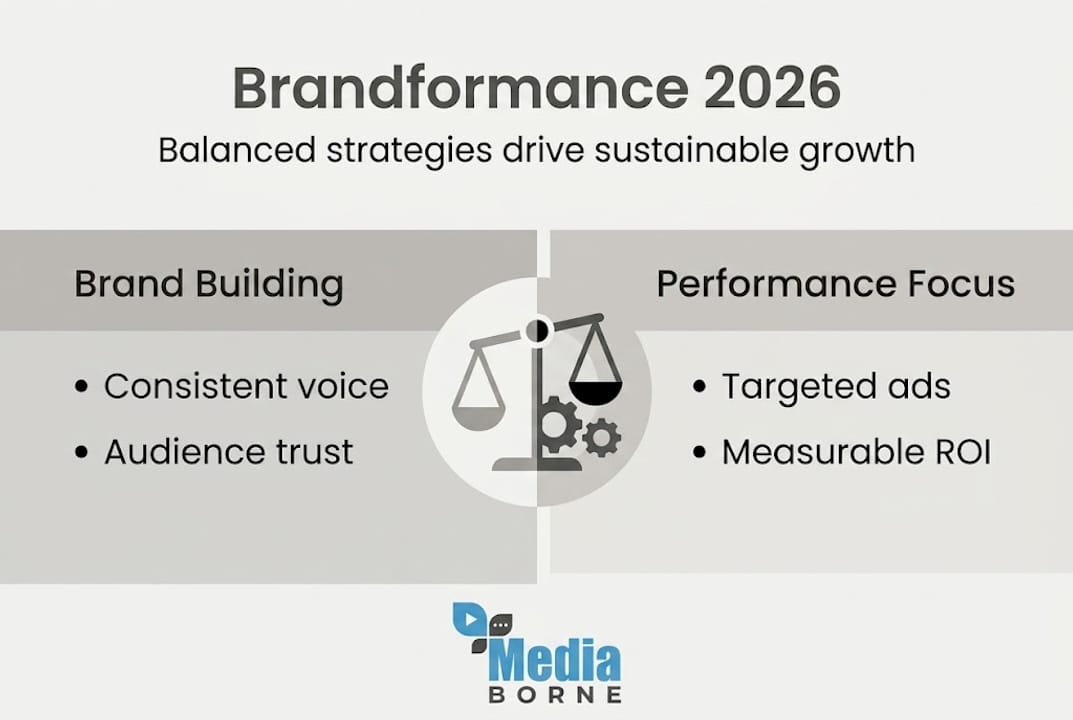
Performance-only tactics drive up CAC and increase platform dependence. Research supports a 60/40 split, with 60% allocated to brand marketing and 40% to performance activation, as the optimal model for sustained growth and lower acquisition costs. Yet most retail and entertainment brands still operate with those numbers reversed.
"Brands that invest in both emotional resonance and performance activation see compounding returns. The brand halo effect reduces conversion friction by warming audiences before a direct response campaign ever runs."
This is the core logic of brandformance: integrating brand-building with performance campaigns so that each amplifies the other. Brand activity creates familiarity and desire. Performance activity harvests that desire efficiently. Without the former, the latter becomes increasingly expensive.
The contrast between the two approaches is significant:
| Approach | Short-term results | Long-term CAC | Brand equity | Platform risk |
|---|---|---|---|---|
| Pure performance | High spike potential | Rising sharply | Low | Very high |
| Hybrid brandformance | Steady, compounding | Declining over time | Strong | Managed |
Top drawbacks of all-in performance tactics:
- Audiences become fatigued by repeated direct response ads
- CAC rises as competition for the same audiences intensifies
- Brand recognition stays weak, making retargeting less effective
- You are entirely at the mercy of platform algorithm changes
Benefits of a hybrid approach:
- Brand content warms cold audiences before paid campaigns activate
- Lower cost per conversion over time as recognition builds
- Owned media assets reduce dependence on paid channels
- Creative learning from brand campaigns improves performance ad quality
Understanding media's brand impact is not optional for marketers in 2026. It is the foundation of a strategy that actually compounds.
How content-driven campaigns fuel long-term revenue
Content-driven campaigns are not a soft alternative to performance marketing. They are a performance accelerator. Content campaigns reduce CAC and platform dependency while improving ROAS over time. For retail and entertainment brands, the right content investment creates a compound asset: it attracts new audiences, nurtures existing ones, and converts interest into revenue without requiring ever-increasing ad spend.
The content types with the highest impact in 2026 are:
- Short-form video: Fast, thumb-stopping, and optimised for TikTok and Instagram Reels. Drives discovery and shares.
- Branded entertainment: Episodic shows, documentary formats, and hosted content series that build loyal repeat audiences.
- Educational content hubs: Deep-dive articles, guides, and comparison tools that capture high-intent search traffic.
| Campaign type | Avg. engagement rate | ROAS improvement | Customer lifetime value impact |
|---|---|---|---|
| Short-form video | High | +20 to 35% | Moderate |
| Branded entertainment | Very high | +30 to 50% | Strong |
| Educational hub content | Moderate | +15 to 25% | Very strong |
Building this kind of content operation requires a structured approach:
- Define your content pillars based on your audience's genuine interests, not just product categories.
- Map content formats to funnel stages so awareness content, consideration content, and conversion content each play a distinct role.
- Distribute strategically across owned, earned, and paid channels to maximise reach without over-relying on any single platform.
- Measure compounding value by tracking returning visitors, email subscribers, and content-assisted conversions alongside direct ROAS.
Well-structured content hubs boost conversion rates by creating a destination that audiences return to repeatedly. Strong branded content strategies turn passive viewers into active customers. And optimising video content for each platform ensures your production investment stretches further.

Pro Tip: Treat content as intellectual property, not just marketing collateral. A well-produced series or educational hub has lasting value. It can be repurposed, licenced, and built upon. Paid ads stop working the moment you stop paying. Good content keeps working long after it is published.
Hybrid strategies: Brandformance in retail and entertainment
Knowing that hybrid works is one thing. Building it in practice requires a clear model. The brandformance approach blends content-driven demand creation with performance activation, so brand investment directly feeds commercial outcomes.
For retail and entertainment brands specifically, the most effective tactics include:
- Live video commerce: Shoppable live streams on TikTok and YouTube that combine entertainment with direct purchasing.
- Influencer-led content series: Ongoing creator partnerships that build narrative and community rather than one-off posts.
- Episodic branded content: Short series that give your brand a recurring presence in your audience's feed, building familiarity over time.
- Integrated branded entertainment: Content formats where brand values are embedded naturally rather than bolted on.
Hybrid tactics combining brand and performance improve ROAS and reduce cost per conversion in competitive verticals. Meanwhile, brand-led strategies lower long-term acquisition costs and build equity that survives platform changes.
To design and execute an integrated campaign:
- Align objectives across brand and performance teams before a single piece of creative is produced.
- Build a content calendar that sequences brand content ahead of performance pushes to prime your audience.
- Share data between teams so that insights from paid campaigns inform creative decisions and vice versa.
- Set dual KPIs that measure both brand health metrics (recall, sentiment, reach) and performance metrics (ROAS, CPA, conversion rate).
- Review and iterate on a monthly basis, adjusting the brand-to-performance ratio based on results.
A strong social video strategy sits at the intersection of both worlds. It builds audiences and converts them.
Pro Tip: Avoid siloed teams at all costs. When your creative team and paid media team operate in separate rooms with separate briefs, you lose the learning that makes hybrid models effective. The best results come from shared creative reviews, shared data, and a shared definition of what success looks like.
Our perspective: Why the future belongs to brandformance
Here is the uncomfortable truth that the performance marketing industry is slow to acknowledge: the playbook that worked in 2018 is not just less effective now. It is actively working against the brands that cling to it.
As platforms continue to constrain data access and raise the cost of attention, pure performance marketing becomes a race to the bottom. Budgets increase, margins compress, and brand meaning erodes. We have watched this pattern repeat across retail and entertainment brands that prioritise quarterly metrics over long-term audience relationships.
The brands that will genuinely futureproof themselves are investing now in content IP value as a strategic asset. Not because it is fashionable, but because owned audiences and recognisable brand identities are the only real protection against platform volatility.
The hidden risk of over-relying on paid platforms is not just financial. It is structural. Brands that have never built organic audience equity find themselves unable to adapt quickly when conditions change. Real resilience comes from treating data, creative, and brand as a coordinated system rather than separate budget lines.
Connect with Media Borne for superior brandformance results
If the shift toward brandformance feels like the right direction but the execution feels unclear, that is exactly where Media Borne comes in.
We specialise in performance-driven content strategies for retail and entertainment brands, from professional video production through to full-scale social video campaigns that convert audiences into customers. Our approach blends creative storytelling with hard commercial outcomes, so you are not choosing between brand and performance. You are running both, intelligently. If you are ready to build something that compounds over time rather than resets every quarter, explore the growth opportunities available when you work with a team that treats attention as a genuine business asset.
Frequently asked questions
What is the ideal mix of brand and performance marketing?
Research supports a 60/40 split in favour of brand marketing for long-term growth and lower acquisition costs. This balance allows performance activity to harvest demand that brand investment has already created.
How does content marketing reduce customer acquisition costs?
Content campaigns reduce CAC and platform dependency while improving ROAS over time. By generating organic demand and building audience loyalty, brands spend less on paid acquisition for each new customer.
Are hybrid brandformance strategies difficult to implement?
A phased approach and cross-team collaboration allow most brands to adopt hybrid models without major disruption. Hybrid brandformance is actionable with the right frameworks and a shared focus on both creative quality and analytics.
Why is performance marketing alone becoming less effective?
Rising costs, privacy changes, and platform dependence make pure performance less sustainable compared to hybrid models. Rising CAC and signal loss erode the effectiveness of performance-only marketing over time.