
TL;DR:
- Live commerce creates an interactive, real-time dialogue that builds trust and accelerates sales.
- Success relies on seamless integration of engagement signals, live demos, and quick purchase options.
- Brands should treat live commerce as a long-term, strategic capability rather than a one-off campaign.
Live commerce is not simply a camera pointed at a product. It is a real-time, interactive system that fuses entertainment, community, and instant purchasing into one continuous experience, and brands that understand this distinction are already pulling ahead. Research confirms that interaction reduces perceived risk and builds the kind of presence that static product pages simply cannot replicate. This guide gives you the frameworks, evidence, and hands-on strategies to turn live commerce from a novelty into a genuine growth engine for your brand.
Table of Contents
- What is live commerce and why does it matter?
- Key mechanics: Driving momentum and conversion
- Understanding user psychology: Building trust and urgency
- Emerging platforms and strategic opportunities
- Blueprint for integrating live commerce into your strategy
- Why live commerce must become an ongoing strategic pillar, not a trend
- Take your next step with expert video production partners
- Frequently asked questions
Key Takeaways
| Point | Details |
|---|---|
| Engagement drives sales | Real-time interaction and social presence boost conversion rates in live commerce. |
| Frictionless checkout is critical | Low-latency in-stream purchasing minimises drop-off and improves sales outcomes. |
| Psychology influences buying | Trust and urgency from live content reduce risk and accelerate decisions. |
| Multi-channel platforms expand reach | Modern live commerce tools help brands grow audience and deepen engagement. |
| Strategic integration wins | Viewing live commerce as a repeatable, co-creative process yields the best long-term results. |
What is live commerce and why does it matter?
Live commerce is the practice of selling products through a live video stream where viewers can interact in real time via chat, Q&A, reactions, and in-stream purchase buttons. It is not a webinar, and it is not a standard product video. It is an environment where the audience participates, shapes the conversation, and buys without ever leaving the stream.
The distinction matters enormously for how you approach it as a strategist. Static e-commerce is a monologue. Live commerce is a dialogue. And dialogue builds trust at a speed that no carousel ad or email sequence can match.
"Customer interaction enhances social presence and lowers perceived risk, a winning combination for sustained sales performance."
The core mechanics that make live commerce work include:
- Real-time interaction: Chat, polls, and Q&A keep viewers emotionally invested
- Frictionless purchase: In-stream checkout removes the steps that cause drop-off
- Live product demonstration: Showing a product in use eliminates the imagination gap
- Real-time decision making: Limited-time offers and visible social proof accelerate commitment
The data supports this emphatically. User engagement signals, specifically comments and ratings, carry the highest weight (0.188) in determining marketing performance outcomes, ranking above click-through rate and conversion rate in isolation. This tells you something important: the conversation happening in the stream is not background noise. It is the engine. Understanding how to harness this is why investing in media production marketing ROI is becoming a central concern for forward-thinking brands.
The heightened sense of presence that live formats create is also a critical psychological factor. When a viewer watches a host answer questions from real people in real time, they feel as though they are in the room. That feeling reduces the uncertainty that typically blocks online purchases, particularly for higher-value or tactile products.
Key mechanics: Driving momentum and conversion
Understanding why live commerce works is one thing. Knowing precisely how to build it so that it converts is another. The architecture matters.
| Feature | Passive e-commerce | Live commerce |
|---|---|---|
| Interaction | None | Real-time chat, Q&A, reactions |
| Conversion trigger | Static copy and imagery | Social proof, urgency, live demo |
| Purchase friction | Multiple clicks, page loads | In-stream, one-tap checkout |
| Engagement duration | Seconds to minutes | 20 to 60+ minutes |
| Trust signals | Reviews, ratings | Live audience behaviour, host credibility |
The table above makes the competitive advantage obvious. But the mechanics only deliver results when they are integrated properly. Live commerce momentum depends on converting real-time interaction directly into an in-stream purchase flow with minimal latency and almost no friction between impulse and transaction.
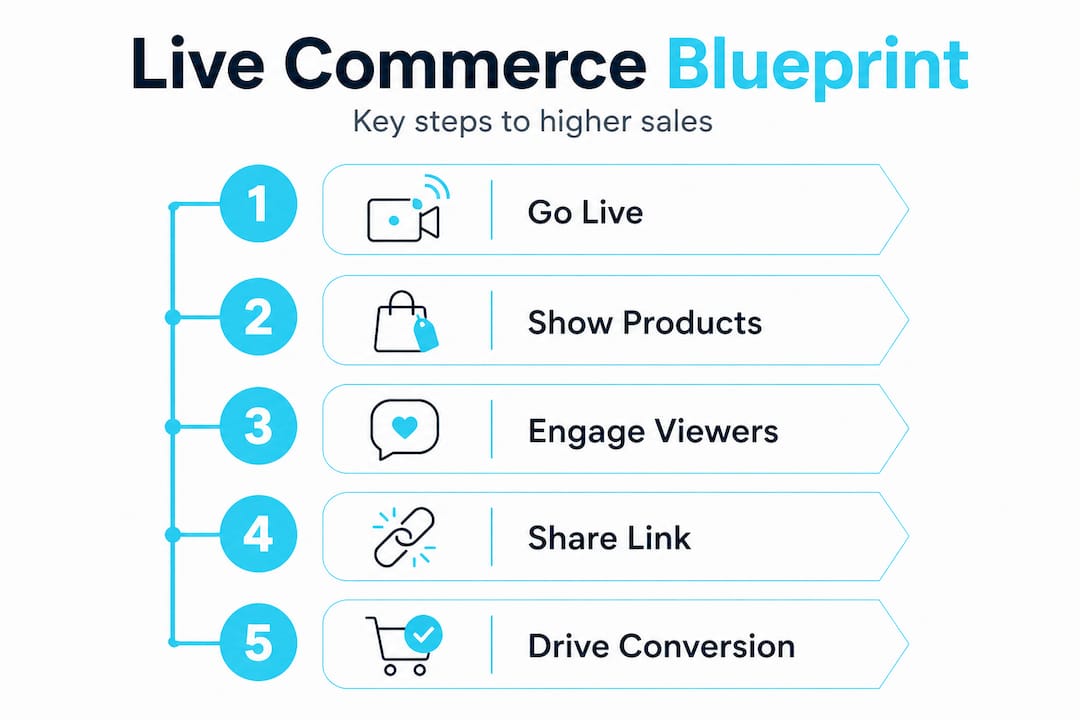
Here is a practical sequence for integrating live commerce technology into your existing e-commerce setup:
- Select your platform based on your audience's existing behaviour. TikTok Live, YouTube Live, and dedicated platforms like Amaze Live each serve different demographics and commerce maturity levels.
- Audit your latency before going live. A delay of more than a few seconds between viewer action and host response kills the sense of presence. Test rigorously.
- Integrate in-stream checkout so that product links appear on screen during demonstrations. Viewers should never need to open a new tab or navigate away.
- Run a full technical rehearsal at least 48 hours before your first live event to identify audio, video, or connectivity failures.
- Monitor engagement signals in real time during the stream and adjust pacing, product focus, or offer urgency based on chat activity.
User engagement signals and conversion are closely linked, which means your production team and your marketing team need to be operating from the same data during every stream. Planning social video workflows for e-commerce in advance is what separates brands that convert consistently from those that produce great content but see patchy results.

Pro Tip: Never let more than 60 seconds pass between a product being shown and the purchase link appearing on screen. Every extra second of lag between engagement and checkout opportunity costs you real revenue.
The goal is driving video engagement that converts within the same session. A viewer who has to leave the stream to complete a purchase is a viewer you are likely to lose.
Understanding user psychology: Building trust and urgency
The technical infrastructure only performs when it meets an audience that is psychologically ready to buy. Live commerce accelerates that readiness in ways that are well documented and highly actionable.
The sense of presence, that feeling of actually being in the same space as the host and other viewers, is one of the most powerful psychological forces at work in a live stream. It makes the experience feel consequential. Missing the stream feels like missing an event, not just a page visit.
| Psychological outcome | Live commerce mechanism | Marketing impact |
|---|---|---|
| Trust | Host authenticity, live Q&A | Reduces buyer hesitation |
| Urgency | Limited stock, countdown timers | Accelerates purchase decision |
| Fear of missing out | Visible viewer count, reactions | Encourages immediate action |
| Customer assurance | Live demo, instant support | Removes post-purchase anxiety |
Service assurance and credible product portrayal are directly linked to reduced perceived risk and higher conversion rates. This means your host's ability to demonstrate the product honestly, answer objections openly, and project confidence is not a soft skill. It is a commercial lever.
Elements that specifically reduce purchase anxiety during a live stream include:
- Live product demonstration showing the product in real conditions, not studio-perfect staging
- Open Q&A where any viewer question receives a genuine, unscripted answer
- Visible audience interaction such as comments and reactions that show others are engaged and buying
- Swift support where queries about sizing, compatibility, or delivery are answered within the stream itself
This is where brand-led media engagement becomes a genuine commercial advantage. Brands that show up authentically, with hosts who know the product intimately and can hold a room, convert at significantly higher rates than those that treat live commerce as a polished advertisement.
Pro Tip: Dedicate a team member specifically to monitoring the chat during every live event. Their sole job is to surface the best questions for the host to answer on camera, ensuring objections are resolved publicly and visibly.
The psychology also extends to content creation for commerce. Every element of your live set, the lighting, the framing, the host's energy, and the pacing of product reveals, communicates credibility or undermines it. Design each element intentionally.
Emerging platforms and strategic opportunities
The live commerce landscape in 2026 is not the single-channel world it was even two years ago. The platforms are evolving rapidly, and the brands that understand where this is heading will have a structural advantage over those still running one-off TikTok Lives.
The significant shift is from single-channel livestreams to multi-channel, creator-first ecosystems where the commerce layer is embedded across every touchpoint. Platforms like Amaze Live are building infrastructure that connects a creator's live experience across multiple channels simultaneously, complete with in-stream storefronts, community features, and analytics that span the entire ecosystem.
The features that define next-generation live commerce platforms include:
- Cross-channel reach: Broadcast to TikTok, YouTube, and your own website simultaneously from a single production
- Commerce overlays: Product cards, pricing, and purchase buttons that appear automatically during demonstrations
- Influencer integration: Creator-managed storefronts that allow affiliate and brand partners to participate in the same live event
- Analytics dashboard: Real-time and post-event data covering watch time, click-through, conversion, and audience sentiment
Brands with multi-channel live shopping strategies consistently report higher engagement and conversion metrics compared to those operating on a single platform. The reason is straightforward: you are meeting your audience wherever they already are, rather than asking them to travel to you.
Staying across innovative trends in media production is no longer optional for brand strategists. The platforms are becoming more capable, the audiences are becoming more sophisticated, and the brands that invest in understanding the infrastructure now will be the ones with loyal communities in twelve months.
Building content hubs and engagement ecosystems around your live commerce activity, including replays, clips, community posts, and follow-up content, is how you maximise the return on every production.
Blueprint for integrating live commerce into your strategy
Having the right platform and the right psychology in mind means nothing without a repeatable operational system. Here is a practical blueprint for integrating live commerce as a growth engine rather than a one-off experiment.
"View live commerce as value co-creation, not a campaign. Success is built through discipline and intentional design, repeated consistently over time."
This framing, grounded in interactive value-co-creation principles, changes how you resource, plan, and evaluate every live event.
- Preparation: Define your product selection, key messages, host brief, and audience warm-up content at least one week before the event.
- Platform selection: Choose based on where your target audience spends time and which platform offers the commerce integrations your checkout requires.
- Content creation: Script the key product moments, plan the Q&A structure, and create any visual assets that will appear as overlays during the stream.
- Presenter training: Your host needs product knowledge, camera confidence, and the ability to hold energy across a 30 to 60 minute live event. This requires deliberate practice.
- Technical rehearsal: Run the full event end-to-end at least twice before going live, including checkout testing and support team dry runs.
- Live event: Execute with a dedicated production team managing the stream, a chat moderator surfacing questions, and a support team handling purchase queries in real time.
- Post-event analytics: Review engagement signals, peak view moments, conversion rates, and audience feedback. Use this data to refine every subsequent event.
The value is in the system, not the single broadcast. Brands that follow this blueprint consistently and use video production growth investment to professionalise their live operations compound their results over time.
Pro Tip: After every live event, identify the three moments where engagement peaked and the three where it dropped. These data points are your most valuable creative brief for the next event.
Why live commerce must become an ongoing strategic pillar, not a trend
Here is an uncomfortable truth that most guides on live commerce will not tell you: one-off live events almost never build the commercial results brands expect from them. The brands experiencing genuine, compounding growth from live commerce are not the ones who ran a brilliant launch event. They are the ones who showed up consistently, learned from each event, and built a community that anticipated the next one.
Live commerce's real power comes from learning loops. Each event teaches you something about your audience's language, their objections, their preferences, and their buying triggers. That intelligence accumulates. Over time, it makes your hosts sharper, your product selection more precise, and your conversion rates more predictable. None of that happens from a single campaign burst.
The other dimension most brands miss is advocacy. A viewer who watches your live commerce event, buys something, and has a brilliant experience does not just become a customer. They become a participant in something they feel ownership over. That is qualitatively different from someone who clicked an ad and converted. The brand-led media perspective that underpins effective live commerce treats viewers as community members, not just conversion targets.
Most live commerce failures share a common cause. The brand treated it as a campaign rather than a capability. They hired a host for one event, patched together a technical setup, ran the stream, were disappointed by the numbers relative to their investment, and quietly shelved the initiative. The discipline, the talent development, and the operational infrastructure were never built.
The brands worth studying, whether in beauty, tech, food, or fashion, have treated live commerce as a media operation. They invest in their hosts the way a broadcaster invests in talent. They build production systems that improve with every event. They use community feedback to shape future content. This is not an experiment. It is a strategic pillar.
If you are a marketing manager or brand strategist reading this, the question is not whether live commerce is right for your brand. The question is how quickly you can build the repeatable system that makes it inevitable.
Take your next step with expert video production partners
Knowing what live commerce should look like is one thing. Building the production quality, technical rigour, and on-camera talent that makes it convert consistently is another challenge entirely.
At Media Borne, we combine professional video production with deep expertise in social selling video services to help brands build live commerce operations that perform from the first event and compound over time. We handle the creative, the technical infrastructure, and the strategic framework so that your team can focus on what they do best. Whether you are launching your first live commerce event or scaling an existing programme, explore everything we do and find out how we can help you turn your audience's attention into measurable commercial outcomes.
Frequently asked questions
What types of products work best for live commerce?
Products that benefit from demonstration, storytelling, and immediate feedback, such as cosmetics, apparel, gadgets, and lifestyle goods, perform especially well because live formats remove the imagination gap between product and purchase.
How do you measure live commerce success beyond sales?
Key metrics include engagement rate, real-time comment volume, average watch duration, click-through rate, and follow-up conversion, as engagement signals like comments are among the strongest predictors of overall marketing performance.
Is live commerce only for large brands?
No. Small and mid-sized brands can leverage live commerce effectively using accessible multi-channel platforms and a disciplined, repeatable operational approach that grows in sophistication over time.
How can live commerce reduce customer hesitation?
Live Q&A, real-time product demonstrations, and visible audience interaction all reduce risk perception, making it significantly easier for potential customers to commit to a purchase with confidence.
What is the first step to get started with live commerce?
The first step is selecting a platform that enables frictionless in-stream checkout and integrates cleanly with your existing e-commerce systems, with multi-channel platforms like Amaze Live offering a strong starting point for brands ready to scale their reach from day one.
Recommended
- Master the content creation process for e-commerce
- How to plan social video workflows for e-commerce success
- Social Selling Video Production to Drive More Sales
- Top video marketing tips to boost engagement by 80%
- Nectar Blog | Q4 Ecommerce Strategy Guide for Maximizing Sales Results
- Proven Remarketing Strategies to Boost Ecommerce Sales – Lind Creative