

TL;DR:
- TikTok Shop has become a significant platform, drastically shortening the discovery-to-purchase process.
- Success relies on native storytelling, integrating short videos, live streams, and profile shops to drive impulse buying and build trust.
TikTok Shop is no longer an experiment. Sales rose 84% between March 2025 and February 2026, with over $1.3 billion generated in just the final two months of that period. For e-commerce marketers and brand managers, that number signals something bigger than a platform update. It signals a structural shift in how consumers discover, evaluate, and buy products. The brands paying attention now are the ones building the playbooks everyone else will copy in two years.
Table of Contents
- Understanding TikTok Shop: features and user experience
- How TikTok Shop is changing e-commerce marketing
- Operational essentials: managing a TikTok Shop storefront
- Building buyer trust and safeguarding customer experience
- Measuring success and optimising your TikTok Shop campaigns
- Rethinking social commerce: lessons beyond the TikTok craze
- Boost your TikTok Shop strategy with expert video production
- Frequently asked questions
Key Takeaways
| Point | Details |
|---|---|
| Integrated shopping experience | TikTok Shop lets users discover and purchase products directly without leaving the app, reducing friction and boosting impulse buys. |
| Native storytelling matters | Successful marketing on TikTok Shop relies on embedding product promotion naturally within entertaining short-form content. |
| Coordinated operations | Managing inventory, orders, and campaigns via Seller Center synchronized with creative schedules is key for smooth shop performance. |
| Building buyer trust | Clear return policies and authentic, accurate listings greatly enhance buyer confidence and conversion rates on social commerce. |
| Data-driven optimisation | Regularly analyse performance metrics and iterate creatives to nurture habitual purchases and maximise TikTok Shop sales. |
Understanding TikTok Shop: features and user experience
TikTok Shop is an integrated commerce layer built directly into the TikTok app. It is not a bolt-on. It is not a redirect to an external website. Users discover and buy products without ever leaving the app, through a dedicated Shop tab, product links embedded in videos, and live shopping during creator streams. That frictionless path is precisely what makes it different from every other social commerce attempt that came before it.
The platform offers several distinct shopping paths:
- Shoppable videos: Products are tagged directly in-feed videos, so a viewer watching a skincare tutorial can tap and purchase within seconds.
- Live shopping: Sellers and creators host live streams with real-time product demos, countdown timers, and limited-time offers that create genuine urgency.
- Shop tab: A curated storefront discovery feed, separate from the main content feed, where users browse products from accounts they follow and trending sellers.
- Snap-to-search: A camera-based discovery tool where users photograph a product in the real world and find it via TikTok, similar to Google Lens but native to the shopping experience.
- Offers and flash sales: A dedicated area featuring coupons, limited-time discounts, and promotional pricing designed to trigger impulse purchases.
The experience is deliberately tuned for the TikTok user's short attention span and high browsing velocity. A user might see a product mentioned in passing during a video, tap a tag, skim the listing, and check out in under ninety seconds. That is not an accident. It is the result of TikTok building its commerce infrastructure around the content behaviour it already understood deeply. For TikTok e-commerce strategies, this native integration changes what good marketing actually looks like.
How TikTok Shop is changing e-commerce marketing
The most important thing TikTok Shop does is shorten the discovery-to-purchase path, which forces marketers to rethink the entire role of content. When a product can be bought in the same moment it is seen, the old model of driving traffic to a website becomes a detour nobody needs to take.
What replaces it is native storytelling. Products that perform well on TikTok Shop are not advertised. They are demonstrated, often in genuinely entertaining content that would work even without the purchase link. This is a meaningful distinction. The creator is not interrupting entertainment to show an ad. The product becomes part of the story.
Successful TikTok Shop strategies combine three content types working together:
- Short-form videos that introduce the product in context, creating awareness and emotional pull.
- Livestreams that build community and convert warmed-up viewers through live demos and real-time Q&A.
- Profile shops that serve as a persistent destination for followers who are ready to browse and buy.
These are not interchangeable formats. Each plays a different role in the purchase cycle, and brands that treat them as separate campaigns miss the cumulative effect of running all three in sequence. Think of short-form video as the top of the funnel, live shopping as the middle, and the profile shop as the close.
Pro Tip: Plan your content across all three formats for each product launch. A short video drives discovery, a scheduled livestream converts interest, and a well-merchandised profile shop captures anyone who comes back later.
Impulse buying is the engine here. TikTok's streamlined checkout removes the friction that kills purchase intent on other platforms. The marketer's job is to generate enough desire in the first few seconds of a video that clicking "buy" feels natural, almost inevitable. That requires creative iteration, not just creative quality. Test formats, hooks, and product angles constantly. The engagement and conversion strategies that work on TikTok are built through volume and learning, not single polished campaigns. And if you are still unsure where short-form video marketing fits in your broader mix, it has earned a top billing.

Operational essentials: managing a TikTok Shop storefront
Understanding the marketing potential is vital, but effective seller operations are just as critical for success on TikTok Shop. A brilliant livestream that sells out your stock in twenty minutes is a disaster if your fulfilment process cannot keep pace.
Here is how to structure your operational setup from day one:
- Register through Seller Center: Download the TikTok Shop Seller Center app or access the web portal. This is your control centre for everything from product listings to payout tracking.
- Build your product catalogue: Upload clear product images, accurate descriptions, and correct categorisation. Listings that match your video content reduce disputes and returns significantly.
- Set up fulfilment: Connect your warehouse or third-party logistics provider. TikTok Shop supports multiple fulfilment models including self-shipping and integrated fulfilment services.
- Plan your promotions in advance: Marketing campaigns must be coordinated with inventory readiness. A flash sale you have not stocked for is worse than no sale at all.
- Activate customer chat: Real-time messaging within Seller Center lets you answer pre-purchase questions, which directly improves conversion on higher-ticket items.
Pro Tip: Treat your content calendar and your Seller Center campaign scheduler as one document, not two. When your promotional pricing and your video release are aligned to the same moment, conversion rates improve substantially because you capture demand at its peak rather than after it fades.
Live streaming for sales adds another operational layer worth planning carefully. Livestreams generate short, intense spikes in order volume. If your fulfilment cannot absorb those spikes cleanly, the customer experience suffers and your seller rating drops. Build buffer stock before any promoted stream. A useful complement here is reviewing your social media strategy more broadly to ensure TikTok Shop fits within a coherent content plan rather than running in isolation.
Building buyer trust and safeguarding customer experience
With seamless operations in place, the next priority is building buyer trust to ensure strong conversions and repeat customers. On TikTok Shop, trust is earned or lost fast. A single misleading product claim can generate a wave of negative comments that kills conversion for weeks.
Key trust-building practices include:
- Accurate listings: Every product description must match what appears in your videos. If a creator demonstrates a product on camera, the spec sheet in the listing needs to align exactly.
- Clear return policies: TikTok Shop offers a 30-day return window and a 90-day limited refund guarantee for damaged or defective items. Communicate these clearly in your shop details rather than burying them.
- Transparent seller profiles: Complete your profile, respond to reviews, and address negative feedback publicly and professionally. Silence reads as guilt on social platforms.
- Consistent seller signals: Verified badges, positive ratings, and prompt shipping all feed into TikTok's ranking algorithm for Shop tab visibility.
| Feature | TikTok Shop | Typical marketplace |
|---|---|---|
| Return window | 30 days | 14 to 30 days |
| Defective item guarantee | 90-day limited refund | Varies by seller |
| In-app checkout | Yes | Rarely |
| Creator-verified listings | Common | Uncommon |
| Buyer protection | Platform-managed | Often seller-managed |
Buyer trust signals such as return policies, seller authenticity, and accurate listings materially affect conversion on social commerce platforms. The difference between a 2% and a 5% conversion rate on TikTok Shop often comes down to how trustworthy the listing feels, not how good the video is. Explore boosting consumer trust through entertainment and the creator economy for practical frameworks that translate directly to TikTok Shop.
Measuring success and optimising your TikTok Shop campaigns
Understanding measurement and optimisation lets you fully use TikTok Shop's potential for your brand. Without clear metrics, you are producing content and hoping. With them, you are running a system.
Key metrics to track:
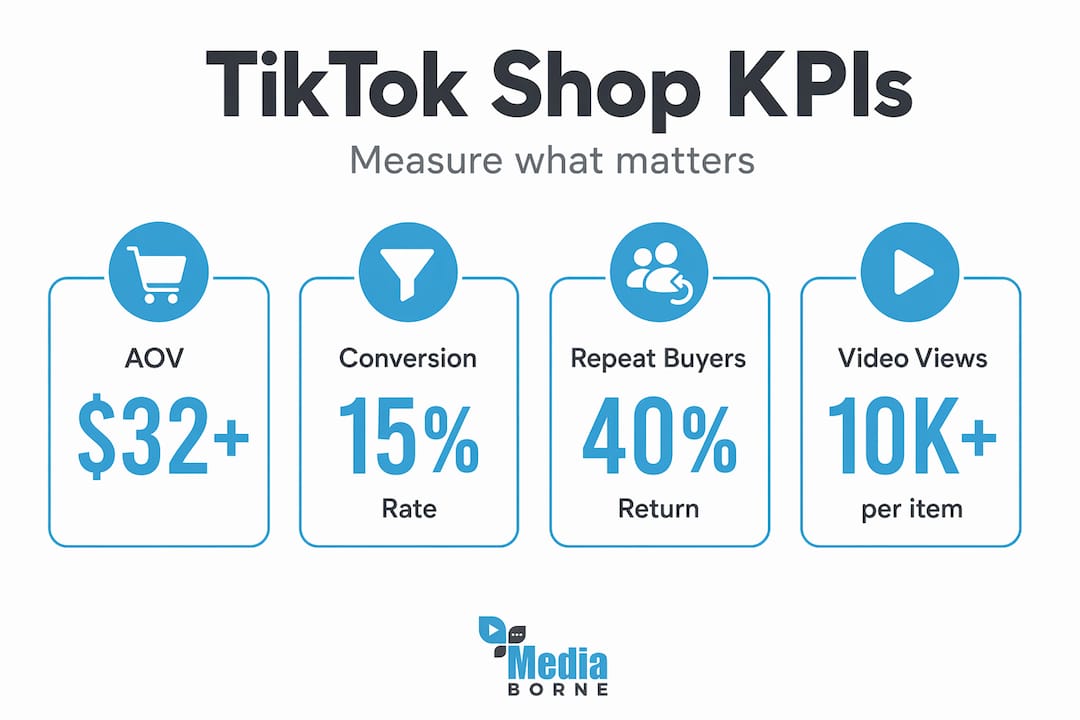
- Average order value (AOV): Are customers buying one item or building a basket?
- Purchase frequency: Average TikTok Shop customers spend $108 per year across 3 to 4 purchases. Your campaigns should work to push both numbers upward.
- Video-to-purchase rate: What percentage of viewers who tap a product link actually complete checkout?
- Live stream conversion rate: Orders per viewer is a more useful metric than total viewers during a stream.
- Campaign engagement: Saves, shares, and comments on shoppable videos predict purchase intent better than likes alone.
| Metric | Benchmark target | Why it matters |
|---|---|---|
| AOV | Above $30 | Indicates category and basket depth |
| Purchase frequency | 4+ per year | Signals habitual buying behaviour |
| Video-to-purchase rate | 2 to 5% | Measures creative effectiveness |
| Live conversion rate | 1 to 3% of viewers | Reflects host skill and offer quality |
| Return rate | Below 10% | Reflects product and listing accuracy |
Treating conversion as a habit-building process and iterating creative content toward higher in-app purchase readiness is the mindset shift that separates brands who sustain growth from those who have one good month. Test your hooks in the first three seconds. Test your offer structures during livestreams. Test your product sequencing across short-form series. Then let Seller Center data and TikTok analytics tell you which direction to push harder. An innovative digital content strategy and branded content approach will give you the creative infrastructure to iterate quickly.
Pro Tip: Set a fixed creative review cycle, ideally every two weeks. Pull your top-performing and worst-performing shoppable videos, identify the structural differences, and brief your next content batch around what the data is telling you.
Rethinking social commerce: lessons beyond the TikTok craze
Having covered the practicalities, it is worth stepping back and considering what TikTok Shop actually represents. Because the brands that will win long-term are not the ones who got onto the platform earliest. They are the ones who understood why it works.
TikTok Shop's rapid growth reflects a fundamental shift toward discovery-led commerce powered by community and entertainment. That sentence is easy to read and hard to act on. Most brands still approach TikTok Shop as a new ad channel. Put product, run video, measure sales. That is the wrong mental model entirely.
The brands building durable success on TikTok Shop are treating it as a community channel that happens to have a buy button. Their creators talk about products the way a trusted friend would, with nuance, with honest opinions, with context. That authenticity is not a brand voice decision. It is an operational one. It requires giving creators genuine latitude, aligning your content calendar with your fulfilment capacity, and accepting that some of your best-performing content will look nothing like a traditional product advertisement.
There is also a sustainability question that most marketers avoid. TikTok's algorithm rewards novelty. The content format that drives 30% conversion rates today will plateau within months as it becomes familiar. Brands that treat creative iteration as a core operational function, not a quarterly campaign concern, are the ones who compound their advantage over time. The creator economy offers the talent infrastructure to sustain that pace. Use it.
The uncomfortable truth is that TikTok Shop rewards brands that are genuinely interesting. Not polished. Not well-funded. Interesting. If your product has a compelling story, a visual transformation, or a community of passionate users, TikTok Shop is built for you. If your product is purely utilitarian with no personality, you will need to build one before the platform can help you.
Boost your TikTok Shop strategy with expert video production
These insights give you a clear picture of what TikTok Shop demands. But knowing what great content looks like and being able to produce it consistently are two very different challenges.
At Media Borne, we produce social selling videos built specifically for TikTok's native audience, designed to feel at home in the feed rather than interrupting it. From product storytelling and livestream production to full creative campaign coordination, our video production services are built around the real mechanics of TikTok commerce. We help brands align their creative calendar with their Seller Center promotions so that every campaign lands with maximum impact. If you are ready to turn TikTok attention into measurable sales, we are ready to help you build the content engine to do it.
Frequently asked questions
What is TikTok Shop and how does it work?
TikTok Shop is an integrated e-commerce platform within TikTok that allows users to discover and purchase products without leaving the app, through shoppable videos, livestreams, and a dedicated Shop tab, with TikTok managing payments and sellers managing orders via Seller Center.
How can I start selling on TikTok Shop?
Connect a TikTok business account, register for TikTok Shop if it is available in your region, then set up your product catalogue and campaigns using the Seller Center app or integrations such as TikTok for Shopify.
What buyer protections does TikTok Shop offer?
TikTok Shop provides a 30-day return window after delivery for eligible products and a 90-day limited refund guarantee for damaged or defective items, though exact policies may vary by product category and region.
How do I manage my TikTok Shop operations?
Sellers use the Seller Center app or web portal to manage product listings, process orders and returns, launch promotional campaigns, and communicate directly with customers using real-time data dashboards.
What strategies improve sales on TikTok Shop?
Combine short-form videos, livestreams, and profile shops to build purchase intent at every stage of the buyer journey, and align your creative releases with Seller Center promotions so that content and commerce work together rather than independently.