
TL;DR:
- Live streaming significantly increases e-commerce conversion rates, reaching up to 30 percent.
- Effective live streams require proper planning, technical setup, and real-time audience engagement.
- Repurposing and promoting replays enhances long-term revenue and brand engagement.
Flat product pages and static imagery can only do so much. If your conversion rates have plateaued and your audience scrolls past without pausing, you are not alone. Traditional e-commerce formats were built for browsers, not buyers. Live streaming changes that entirely, delivering 6-10x higher conversion rates compared to conventional online retail. This guide walks you through how to set up, execute, and scale live shopping events that turn passive viewers into paying customers, covering everything from technical requirements to analytics and the pitfalls that trip up even experienced teams.
Table of Contents
- Understanding live streaming's impact on e-commerce
- Essential tools and requirements for live streaming success
- Planning and executing an engaging live stream
- Optimising interaction and measuring success
- Troubleshooting and common pitfalls in live streaming
- Our perspective: What most e-commerce brands get wrong about live streaming
- Elevate your brand with professional live streaming support
- Frequently asked questions
Key Takeaways
| Point | Details |
|---|---|
| Live streaming multiplies conversions | Brands using live commerce streams see 6–10x higher conversion rates compared to static e-commerce. |
| Strategic planning boosts ROI | Adapting stream type, content, and timing to your market and products increases returns and customer loyalty. |
| Mobile-first and low-latency are essential | Most viewers join on mobile, and low-latency tech avoids frustrating delays during shoppable events. |
| Interact to drive repeat sales | Real-time chat and polling not only lift engagement but also build long-term buyer trust. |
Understanding live streaming's impact on e-commerce
Live streaming in e-commerce is exactly what it sounds like: real-time video broadcast combined with interactive commerce features. Viewers watch a host demonstrate products, ask questions in a live chat, respond to polls, and purchase directly through shoppable product cards, all without leaving the stream. Flash sales and countdown timers add urgency that static pages simply cannot replicate.
The numbers behind this format are striking. Conversion rates reach 9-30% in live commerce, compared to a typical 1-3% for standard e-commerce pages, and the global market has already surpassed $600 billion. Return rates also drop significantly because customers see products in real use before they buy.
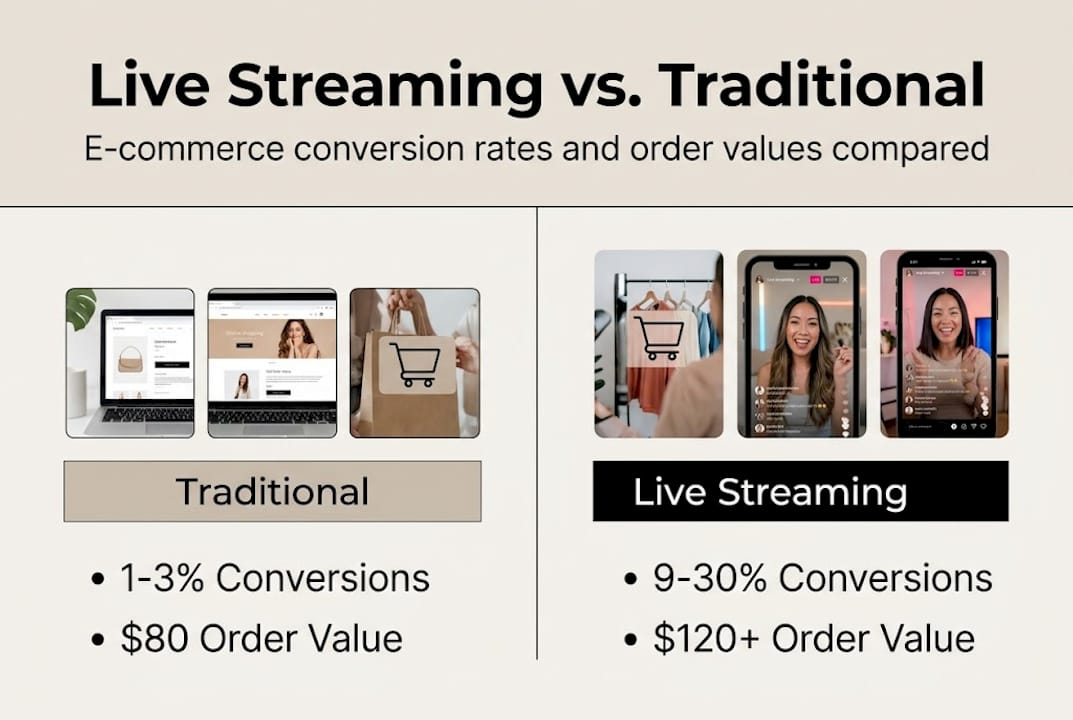
Key live commerce benchmarks at a glance:
| Metric | Traditional e-commerce | Live streaming |
|---|---|---|
| Conversion rate | 1-3% | 9-30% |
| Average order value | Baseline | Up to 40% higher |
| Return rate | 20-30% | Significantly lower |
| Customer acquisition cost | High | Reduced via organic reach |
Regionally, China pioneered this format and now accounts for the majority of global live commerce revenue. Western markets, particularly the US and Europe, are still in an earlier adoption phase, which means genuine first-mover advantage remains on the table for e-commerce brands willing to move now. Building your social video strategy around live formats now positions you ahead of the curve before saturation sets in.
The real-world results are not theoretical. One standout example is activewear brand Andar, which generated over £134,000 in a single three-hour session. According to livestream commerce stats, brands across fashion, beauty, electronics, and food are all seeing meaningful revenue uplift when they approach live commerce with intention rather than improvisation.
"Live streaming is not just a channel. It is a sales event, a community moment, and a brand story told in real time."
Essential tools and requirements for live streaming success
With impact and opportunity in clear view, preparation is key. Getting the technical and operational foundation right is what separates a polished live shopping event from a chaotic broadcast that loses viewers in the first two minutes.

Platform and hardware comparison:
| Setup type | Best for | Key tools |
|---|---|---|
| Mobile-first | Small teams, agile brands | Smartphone, ring light, lavalier mic |
| Studio setup | High-volume brands, regular shows | DSLR/mirrorless camera, dedicated encoder, acoustic treatment |
| Hybrid | Scaling brands | Mobile cam plus software encoder such as OBS |
On the technical side, streaming protocol matters more than most marketers realise. LL-HLS (Low-Latency HTTP Live Streaming) reduces the delay between broadcast and viewer to under three seconds, which is essential for interactive commerce. WebRTC goes even further for ultra-low latency but requires more infrastructure. The live commerce tech guide covers the protocol trade-offs in detail. Critically, 78% of live sessions happen on mobile, so your stream must be optimised for smaller screens and variable connectivity.
Beyond hardware, you need people. A capable live stream team typically includes:
- A host or presenter with product knowledge and on-camera confidence
- A chat moderator to manage questions, filter spam, and surface key comments
- A product expert available off-camera to answer technical queries in real time
- A social media operator to amplify the stream across channels simultaneously
Compliance matters too. If you are collecting payments or personal data during a live stream, GDPR obligations apply. Ensure your payment gateway is secure and that data capture practices are clearly communicated to viewers. Your video workflow planning should include a compliance checklist before every broadcast.
Pro Tip: Always configure your primary stream for mobile viewing first. A stream that looks excellent on a smartphone will translate well to desktop, but the reverse is rarely true.
If producing consistent, high-quality live content feels daunting, content campaign services can help you build the infrastructure and repeatable workflows you need.
Planning and executing an engaging live stream
Once your foundation is in place, it is time to bring your live stream to life. The difference between a stream that converts and one that disappoints almost always comes down to planning, not production budget.
Follow this step-by-step framework:
- Choose your products carefully. Lead with two or three hero products that have strong visual appeal and clear customer benefits. Avoid anything that requires lengthy explanation without a compelling demo.
- Select your format. Product demonstration streams suit most categories. Personality-driven formats work particularly well in beauty and fashion where the host's recommendation carries weight.
- Build a content outline. You do not need a word-for-word script, but you do need a structured outline covering opening hook, product sequence, interactive moments, and a clear close.
- Launch a teaser campaign. Promote the event on social media three to seven days in advance. Short-form teasers on TikTok and Instagram Reels drive pre-registration and anticipation.
- Partner with an influencer. A mid-tier creator in your niche brings their existing audience trust and significantly lifts viewership for your first few sessions.
- Activate in the live session. Use polls, pinned product links, countdown timers, and direct responses to viewer questions to keep energy high throughout.
For Western audiences, short streams deliver disproportionate results, with 10-minute pop-up formats achieving 102% sales uplift in documented case studies. The instinct to broadcast for an hour to justify the effort is understandable, but it often backfires. Engagement data from live e-commerce research consistently shows viewership drops sharply after the 20-minute mark for most categories outside of long-form entertainment.
For further guidance on converting viewers at each stage of the broadcast, the video campaign optimisation and video engagement tips resources are worth bookmarking.
Pro Tip: Pin your most popular product link and a curated FAQ in the chat at the 5-minute mark. Viewers who join late will immediately see what is on offer and how to buy.
Optimising interaction and measuring success
Streaming is just the start. Real value comes from deepening interaction and systematically learning from each broadcast. Without measurement, you are essentially running the same event repeatedly and hoping for better results.
The metrics that matter most in live commerce:
- Conversion rate per session (purchases divided by unique viewers)
- Peak concurrent viewership and how it tracks against your promotion timeline
- Chat engagement rate (messages per viewer per minute as a proxy for emotional investment)
- Product click-through rate from shoppable cards
- Replay view count as a percentage of total views
Post-stream analytics framework:
| Data point | What it tells you | Action |
|---|---|---|
| Drop-off timestamps | Where viewers lose interest | Restructure content pacing |
| Top chat keywords | What audiences care about | Refocus product messaging |
| Replay vs live ratio | Content longevity | Optimise for replay discoverability |
| Conversion by product | Best performers | Lead with these next session |
Replays are often the most underrated revenue lever in live commerce. Analytics-driven sessions forecast sales 25.6% more accurately, and replays can contribute up to 42% of total session revenue when the content remains relevant and the purchase links stay active.
Server-side aggregation of reactions and chat data also prevents spam overload and gives you cleaner signals to work with. A/B testing different product sequences, opening hooks, and call-to-action timing across sessions builds a proprietary playbook for your brand. The live streaming strategy research from UIC supports the argument that brands with a deliberate iteration process consistently outperform those who treat each stream as a standalone event. Combine this with insights from media trends to stay ahead of format changes.
Pro Tip: Use predictive analytics tools built into platforms like TikTok Shop and YouTube to forecast which products will perform before you go live. It saves you from burying your strongest item at the end when viewers have already dropped off.
Troubleshooting and common pitfalls in live streaming
Even the best-planned streams can go sideways. Knowing what to watch for and how to respond quickly is what keeps a session recoverable rather than catastrophic.
Common technical issues and their fixes:
- High latency: Switch to LL-HLS protocol and reduce encoder bitrate to stabilise the connection
- Poor audio quality: Invest in a dedicated lavalier or directional microphone before you upgrade your camera
- Bandwidth drops: Pre-test your connection speed and have a mobile hotspot on standby as a failover
- Platform crashes: Always stream via a reliable encoder like OBS to a platform rather than relying solely on native in-app broadcasting
On the audience side, timing barriers affect 32% of US consumers, meaning a significant portion of your potential audience simply cannot watch when you broadcast live. Offering replay access and promoting it actively after the event is not optional, it is essential. Overlong sessions, non-interactive content, and streams that feel like a catalogue reading rather than a conversation are the most frequent strategic mistakes.
Product misalignment is another underappreciated pitfall. High-consideration or low-visual products, such as insurance, software, or commodity household items, rarely benefit from live demonstration. Check the streaming implementation details for category-specific guidance before committing to a format.
Privacy compliance during live commerce is not optional. If you are capturing emails or running competitions within the broadcast, GDPR obligations around consent and data storage apply in full. Review your video marketing ROI considerations holistically, including compliance costs, when assessing profitability.
"Success is driven by alignment between stream strategy and product context. The wrong format for the right product still fails."
Our perspective: What most e-commerce brands get wrong about live streaming
After working across digital video production and social commerce, one pattern stands out clearly: brands that struggle with live streaming are almost always copying the wrong blueprint.
The Chinese live commerce model, which features multi-hour marathons hosted by celebrity-tier personalities, does not simply translate to Western audiences. The cultural context, platform behaviour, and buyer expectations are fundamentally different. Importing that format without adaptation is one of the fastest ways to burn budget and lose credibility with your audience.
What actually works in Western live commerce is interaction and timing. A well-paced 15-minute stream with genuine Q&A, honest product demos, and a clear purchase moment consistently outperforms a polished hour-long broadcast with passive viewers. Production quality matters far less than most brands think. Authenticity and speed-to-value matter far more.
The overlooked goldmine is replay revenue. Most brands treat the live event as the product and ignore what happens after. Building content that retains value post-broadcast, with active product links and discoverable replay promotion, is where the compounding ROI lives. Tracking this properly requires discipline around video marketing ROI metrics rather than vanity view counts. Let your analytics, not your ego, define your next stream.
Elevate your brand with professional live streaming support
If you are keen to outpace your competitors and maximise the return on every live session, working with a team that understands both the production craft and the commercial strategy makes a measurable difference.
At Media Borne, we combine professional video production expertise with a deep understanding of social commerce behaviour. Whether you need end-to-end live stream production, a repeatable show format, or a strategy to turn your social selling video into a scalable revenue channel, we build the creative infrastructure that converts attention into sales. Get in touch with our team to explore what a tailored live streaming programme could look like for your brand.
Frequently asked questions
What is the biggest benefit of live streaming for e-commerce?
Live streaming can boost e-commerce conversion rates 6-10x compared to traditional online retail, driving both immediate sales and stronger audience engagement.
Which products are best suited to live streaming?
Fashion and beauty consistently lead performance, with 14-16% conversion rates driven by real-time demos, while low-visual or commodity products tend to see limited uplift from the format.
How short can a live stream be and still drive results?
Very short. 10-minute pop-up streams have been shown to deliver over 100% sales uplift, making concise, focused formats among the most commercially effective options.
What technical pitfalls should I watch for when live streaming?
High latency, poor audio, and chat spam are the most common disruptors. Deploying LL-HLS protocols alongside server-side moderation resolves the majority of these issues before they affect the viewer experience.