

TL;DR:
- Generic tutorials often fail to generate meaningful business results due to a lack of structure and industry relevance. Successful creation depends on thorough planning, audience research, and a repeatable workflow that aligns content with business goals. Industry-specific strategies for construction and e-commerce emphasize authority building and quick conversion, respectively, while ongoing measurement and process discipline ensure sustainable growth.
Generic tutorials are costing construction and e-commerce marketers real business. You can follow all the standard advice — post regularly, use good lighting, add a call to action — and still watch your content disappear into the feed without a single meaningful response. The problem is not effort. It is the absence of structure, industry relevance, and a repeatable system that connects tutorial content to commercial outcomes. This guide delivers exactly that: evidence-backed frameworks, sector-specific strategies, and workflow mechanics that help you build tutorials worth watching and sharing.
Table of Contents
- Understand the essentials for effective tutorials
- Step-by-step: Build a winning tutorial workflow
- Tailor your approach for construction and e-commerce
- Measure effectiveness and refine your process
- The surprising key to next-level tutorials: process over perfection
- Take your tutorials and content to new heights
- Frequently asked questions
Key Takeaways
| Point | Details |
|---|---|
| Start with clear strategy | Set goals and understand your audience before creating tutorial content. |
| Leverage content pillars | Use an intentional mix of education, entertainment, inspiration, and promotion in your tutorials. |
| Iterate and measure | Regularly track analytics and feedback to refine and improve tutorial performance. |
| Customise by sector | Adapt your tutorial format and messaging to the specific nuances of construction or e-commerce for maximum impact. |
Understand the essentials for effective tutorials
With the challenge defined, let us clarify the essentials that make a tutorial genuinely effective.
Before you record a single frame or draft a caption, you need the right foundations in place. The marketers who consistently produce high-performing tutorials are not necessarily the most creative people in the room. They are the most prepared. They show up with a content calendar, a clear understanding of their audience, and tools that remove friction from the publishing process.
At the infrastructure level, every serious tutorial creator needs at minimum:
- A content calendar to plan and schedule posts in advance
- A social media composer capable of drafting content for multiple platforms from one interface
- Analytics tools that track reach, engagement, retention, and conversion
- A brief template that aligns each tutorial to a specific business goal
- Asset libraries containing approved brand visuals, logos, and B-roll footage
These are not optional extras. They are the scaffolding that stops your tutorial output from becoming chaotic and inconsistent. Without them, even brilliant individual videos fail to build cumulative brand authority.
Audience research is equally non-negotiable. Who are you talking to? What do they already know? What frustrations do they bring to the content? For construction marketers, your audience might be procurement managers, site supervisors, or residential clients comparing suppliers. For e-commerce, it could be first-time buyers looking for product guidance, or repeat customers seeking advanced usage tips. These audiences require very different tones, depths, and formats.
A practical social media strategy follows a business-aligned goals workflow: set clear objectives, define your target audience, build a content strategy and calendar, publish consistently, engage with your community, and measure performance to refine future output. This is the mechanics of the whole operation.
Structuring your content around pillars gives your tutorials purposeful variety. The four core pillars are: educate (teach your audience something useful), entertain (make them genuinely enjoy the content), inspire (show what is possible), and promote (drive a specific action). A strong tutorial series cycles through all four rather than defaulting permanently to promotion.
A solid content strategy basics approach also considers the connection between pillars and business goals, making sure content that educates also feeds the top of your sales funnel, and content that promotes is supported by enough trust-building material to convert.
Pro Tip: Adopt a "draft once, customise per network" workflow. Write the core tutorial script and messaging once, then adapt the format, caption length, and visual style for each platform. This cuts production time significantly while maintaining consistency across channels. Resources on effective content strategy consistently highlight this approach as one of the highest-leverage habits a content team can develop.
| Tool type | Example use case | Impact on tutorials |
|---|---|---|
| Content calendar | Plan six weeks of tutorial topics | Reduces last-minute, low-quality posts |
| Social composer | Draft and schedule across platforms | Increases consistency and saves time |
| Analytics dashboard | Track retention and click-through rates | Reveals what content earns repeat views |
| Brief template | Align each video to a business goal | Keeps creative work commercially focused |
Step-by-step: Build a winning tutorial workflow
Once you are equipped with the right mindset and tools, follow these steps to develop tutorials that drive real results.
A repeatable workflow is what separates a one-hit video from a content programme that builds measurable brand equity over time. HubSpot frames social media strategy as a ten-step process: set goals, research audience, analyse competition, conduct an audit, choose platforms, create a content strategy, build a content calendar, create compelling content, engage the community, and measure results. That architecture translates directly into tutorial creation.
Here is the step-by-step process adapted specifically for construction and e-commerce marketers:
- Define the tutorial objective. Is this video educating a new customer, supporting a sales conversation, or demonstrating a product feature? The objective shapes everything else.
- Identify the target viewer. Go beyond demographics. What problem does this person have right now that your tutorial can solve?
- Choose the right platform and format. Short-form vertical video suits TikTok and Instagram Reels. Long-form horizontal works on YouTube. LinkedIn favours text-supported walkthrough clips for B2B construction audiences.
- Write a tight script or outline. Even a loose bullet-point framework prevents rambling and keeps viewers watching past the ten-second mark.
- Produce with intentional visuals. Lighting, framing, and audio quality signal professionalism. Poor audio loses audiences faster than imperfect visuals. When planning social tutorials, factor in production quality from the very start.
- Optimise captions and headlines. Hootsuite's content mechanics include specific caption length guidance and headline composition principles. Apply these to every post rather than treating captions as an afterthought.
- Apply SEO thinking to social. Searchable keywords in your video title, description, and on-screen text increase discoverability. This is especially critical for YouTube and TikTok, where SEO for social media is increasingly driving organic reach.
- Schedule in advance. Ad-hoc posting creates gaps and misses optimal publishing windows. Central scheduling removes that risk.
- Publish and actively engage. Respond to comments within the first two hours. The algorithm rewards early engagement, and genuine responses build community.
- Review metrics and iterate. Pull your analytics at the end of each week. Adjust your next tutorial based on what the data tells you.
The table below compares three common approaches to tutorial publishing and their long-term effectiveness:
| Approach | Calendar-based | Pillar-based | Ad-hoc |
|---|---|---|---|
| Consistency | High | Medium-high | Low |
| Brand alignment | Strong | Strong | Weak |
| Audience trust | Builds steadily | Builds steadily | Unpredictable |
| Workload management | Efficient | Efficient | Stressful |
| Performance tracking | Easy | Easy | Difficult |
Pro Tip: Schedule and track your tutorial content centrally. When every post lives in one system, it is far easier to spot gaps, avoid repetition, and connect content performance to business outcomes. High-impact social videos are only ever as effective as the strategy surrounding them.
Tailor your approach for construction and e-commerce
While the basics apply broadly, industry nuances make a significant difference in effectiveness.

A tutorial about laying concrete and a tutorial about choosing a skincare serum need radically different approaches, even if both follow the same structural workflow. The audience's emotional state, their decision-making timeline, and the evidence they need before they trust you are entirely different.
For construction marketers, the priority is authority and trust. Buying behaviour in construction is project-driven and relationship-dependent, which means generic posting fails to move the needle. Your tutorials should focus on:
- Progress proof: Time-lapse builds, before-and-after reveals, and on-site walkthroughs that demonstrate real capability
- Credibility content: Testimonials from architects, project managers, or satisfied clients filmed on location
- Educational deep-dives: Material guides, compliance explainers, and process breakdowns that position your brand as the expert
- Lead generation calls: Clear, low-friction invitations to book a consultation or request a quote at the end of every tutorial
"Consistency and authority outperform frequency for construction brands. One well-crafted tutorial that demonstrates expertise and earns trust is worth more than five generic posts that say nothing."
For e-commerce marketers, the challenge is converting attention into purchase intent quickly. Your tutorials should focus on:
- Product walkthroughs: Demonstrate the item in use, not just in the box
- Educational how-tos: Show multiple use cases, styling options, or combinations that increase perceived value
- Social proof integration: Feature real customer reviews, unboxing reactions, or community content within the tutorial itself
- Seasonal and trend alignment: Connect tutorials to current buying moments rather than evergreen content alone
The social video strategies that work best in both sectors share one quality: they feel genuinely useful rather than promotional. When viewers come away knowing something they did not before, they associate that value with your brand.
The community engagement value of well-structured tutorial series is also significant. Construction firms that document long-term projects create communities of followers invested in the outcome. E-commerce brands that build tutorial libraries become reference points rather than just vendors.
Understanding your media production ROI in these contexts means tracking more than video views. Track how many leads reference your tutorials in enquiry forms, or how many product pages see higher conversion after a related tutorial goes live.
Measure effectiveness and refine your process
Delivering a strong tutorial is just the start. Here is how you ensure sustainable success.
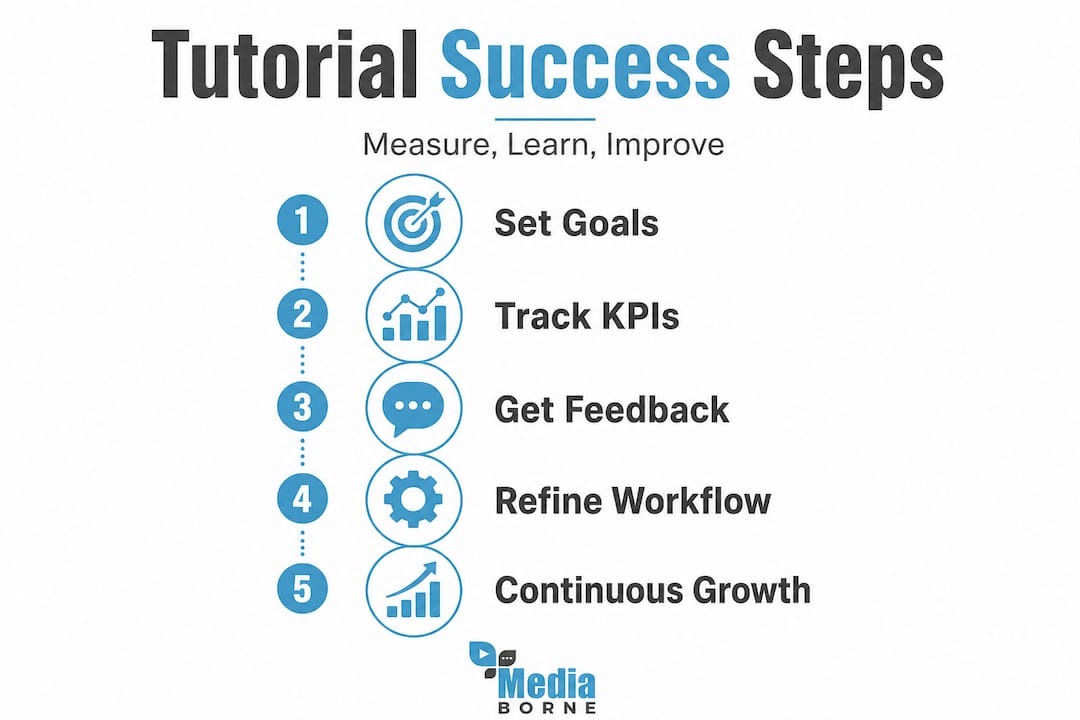
Publishing without measuring is the equivalent of running a campaign with the lights off. You might be moving, but you have no idea whether you are heading in the right direction. The metrics that matter most for tutorial content fall into four categories.
Core metrics to track:
- Reach: How many unique accounts saw the tutorial? This tells you about top-of-funnel visibility.
- Retention: What percentage of viewers watched past the halfway point? This reveals whether the content holds attention.
- Engagement rate: Likes, comments, shares, and saves relative to reach. High engagement signals resonance.
- Conversion: Did viewers take the desired next step? Click a link, fill in a form, or make a purchase?
The iterative improvement process works like this: review your metrics every week, identify the single biggest performance gap, form a hypothesis about why it exists, and test one change in the next tutorial. Repeat. Successful content teams treat their content strategy as a living document, updated regularly based on real data rather than assumptions.
Common mistakes to avoid:
- Measuring only likes and follower counts, which rarely correlate with revenue
- Ignoring qualitative feedback such as comments, DM replies, and customer service questions that reference specific content
- Publishing without a calendared plan, leading to feast-and-famine output that confuses the algorithm and the audience
- Failing to test different formats, lengths, or calls to action within the same content pillar
- Treating every tutorial as a standalone piece rather than part of a connected series
CRM-powered analytics are increasingly central to effective tutorial measurement. Publishing and tracking engagement in-CRM means you can connect social performance data directly to leads and customer records, giving you a clear picture of which tutorials actually drive commercial outcomes rather than just impressions.
Explore how content hubs benefits compound over time when tutorials are organised into discoverable libraries rather than scattered across a feed. A well-structured content hub turns individual tutorials into a long-term asset.
The surprising key to next-level tutorials: process over perfection
There is a persistent myth in content marketing that the best tutorials come from raw creative inspiration, that brilliant ideas arrive fully formed and the job is simply to capture them beautifully. In reality, the most consistent, high-performing tutorial creators are not the most inspired. They are the most disciplined.
We see this repeatedly: brands pour enormous energy into a single "hero" piece of content, wait anxiously for it to go viral, and then feel deflated when it performs modestly. Meanwhile, brands that commit to a documented workflow — consistent formats, weekly reviews, iterative improvements — build audiences steadily and reliably, without ever needing a viral moment.
The uncomfortable truth is that starting from scratch each time is not creativity. It is avoidance. It avoids the harder work of studying what performed well last week, understanding why, and doing more of it intentionally. Reinventing your tutorial approach for every post wastes creative energy that would be far better spent on refining delivery, production quality, or community engagement.
A robust media production checklist does not constrain creativity. It liberates it. When the structural decisions are already made, you can put all your energy into the parts that genuinely require creative thinking: the hook, the insight, the story.
Feedback loops are equally undervalued. The comments on a tutorial, the questions it generates, and the way customers describe your product after watching it are all data. Marketers who treat this as noise miss the most reliable signal they have about what their audience actually needs. Build the habit of reviewing qualitative feedback alongside quantitative metrics every single week.
Pro Tip: Prioritise continuous improvement over single-hit posts. A tutorial that performs at sixty percent and teaches you something is more valuable than a one-off hit that you cannot replicate.
Take your tutorials and content to new heights
With the right processes and mindset in place, the next step is pairing them with production quality that matches your ambitions.
Media Borne works with construction and e-commerce brands to produce tutorial content that does more than inform. It entertains, converts, and builds communities. From scripted product walkthroughs to on-site documentary-style build series, our professional video production team brings the technical quality and strategic thinking that transforms good ideas into measurable growth. If you are ready to see what that looks like in practice, explore our portfolio and case studies or discover how our social selling video services can connect your tutorials directly to commerce outcomes.
Frequently asked questions
What platforms are best for construction and e-commerce tutorials?
Instagram and LinkedIn work well for construction brands, while Instagram, Facebook, and TikTok are the strongest platforms for e-commerce tutorial content.
How often should I post tutorials on social media?
Consistency over frequency is the principle that matters most; aim for a reliable schedule such as once or twice a week rather than sporadic bursts of activity.
What are content pillars and why do they matter?
Content pillars are the four core themes of educate, entertain, inspire, and promote, and using them ensures your tutorials serve different audience needs rather than defaulting to constant self-promotion.
How do I measure if a tutorial is successful?
Track engagement, audience retention, and conversions using analytics, and measure results alongside direct feedback to understand which content genuinely resonates and drives action.
What is a common mistake when creating social tutorials?
The most common error is focusing on posting frequency rather than audience value, which produces volume without the engagement, trust, or commercial outcomes that actually matter.