

TL;DR:
- Branded content builds trust by providing value through entertainment or education rather than direct selling.
- Operational consistency, audience insight, and genuine relevance are key to successful branded content strategies.
- Overreliance on AI without human oversight risks producing inauthentic and generic content that dilutes brand identity.
Most marketing professionals assume branded content is simply advertising with a softer touch. It is not. Branded content delivers value through education, entertainment, or utility, reinforcing brand identity without direct selling. The distinction matters enormously because audiences have become extraordinarily skilled at tuning out promotional noise. When a brand produces content that genuinely entertains or informs, it earns trust rather than demanding attention. This guide unpacks the formal definition, contrasts branded content with traditional advertising, walks through proven methodologies, flags the operational risks that trip up even experienced teams, and shares best practices drawn from e-commerce and entertainment sectors.
Table of Contents
- Defining branded content: more than advertising
- Key methodologies: how brands deliver value with content
- Nuances and challenges: operational risks and AI pitfalls
- Best practices: maximising branded content impact
- Why branded content is misunderstood and what actually works
- Bring your branded content strategy to life
- Frequently asked questions
Key Takeaways
| Point | Details |
|---|---|
| Branded content builds trust | Value-driven branded content fosters long-term affinity, not just short-term sales. |
| Methods drive engagement | Audience-first strategy, influencers, and goal clarity are essential for branded content success. |
| Avoid common pitfalls | Operational inconsistencies, high costs, and AI misuse can undermine branded content impact. |
| Best practices boost ROI | Data-driven optimisation and authentic storytelling maximise branded content's return. |
Defining branded content: more than advertising
Branded content is a form of marketing where the content itself is the value proposition. Rather than interrupting a viewer with a product message, the brand becomes the reason someone chooses to watch, read, or listen. A documentary series funded by a sportswear brand, a podcast produced by a fintech company, or a short comedy series backed by a soft drink label are all examples. The audience engages because the content is genuinely interesting, and the brand benefits from the association.
Understanding how this differs from related formats is essential before you invest budget. Here is a quick comparison:
| Format | Primary goal | Audience relationship | Selling intent |
|---|---|---|---|
| Traditional advertising | Direct conversion | Interruptive | Explicit |
| Native advertising | Traffic and awareness | Blended into platform | Moderate |
| Branded content | Affinity and trust | Invited and engaged | Subtle or absent |
The table makes one thing clear: branded content sits at the far end of the trust-building spectrum. Branded content builds affinity and preference by delivering value beyond selling, which is precisely why it outperforms traditional formats on long-term loyalty metrics.
In practice, e-commerce brands use branded content to reduce the gap between discovery and purchase. An apparel brand that produces styling tutorials is not selling a jacket; it is helping someone dress well. The jacket sale follows naturally. Entertainment brands use it differently, building extended universes around their IP that keep audiences engaged between major releases. Explore our branded entertainment guide for deeper context on how this works across sectors.
Knowing when to use branded content versus a conventional campaign is equally important. Use branded content when your goal is long-term affinity, community building, or entering a new audience segment. Use conventional advertising when you need short-term conversion volume or are promoting a time-sensitive offer. The two approaches are not mutually exclusive; the strongest brand strategies run both in parallel.
"The brands winning attention in 2026 are not the loudest. They are the most useful and the most entertaining."
Key methodologies: how brands deliver value with content
Creating branded content that actually performs requires a structured approach, not creative improvisation. The starting point is always the audience. Before a single frame is shot or a word is written, you need to understand what your audience genuinely cares about, what problems they face, and what entertains them. Content built on this foundation connects. Content built on brand ego does not.
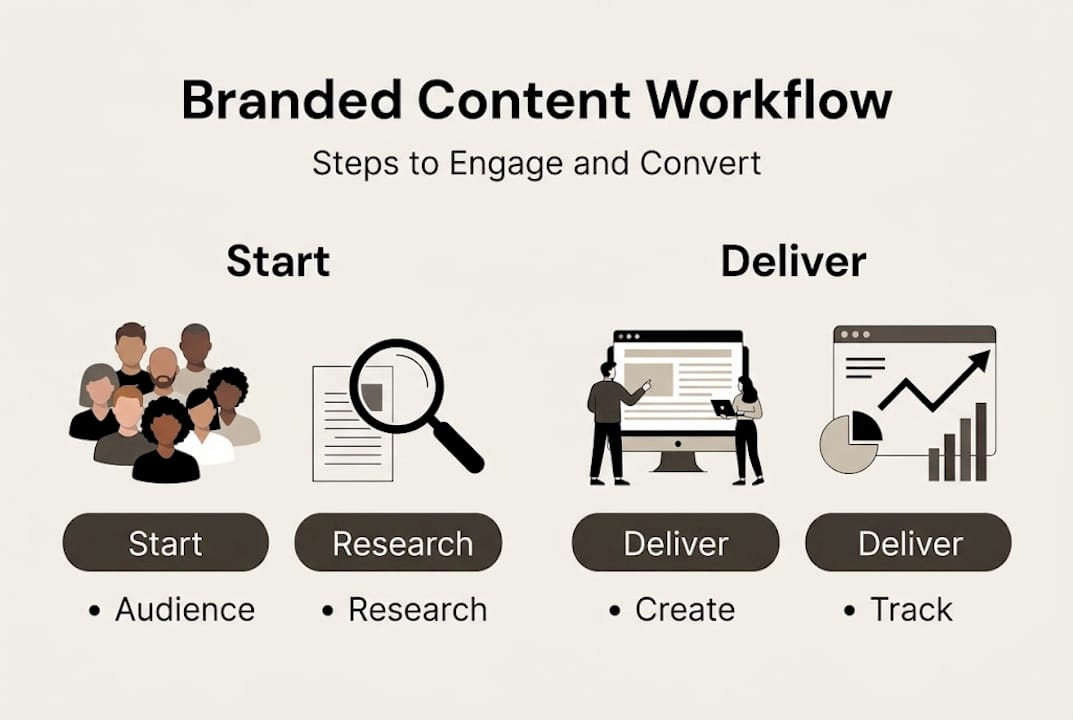
Research confirms this. Understanding audience values, delivering value first via entertainment or education, partnering with creators, and measuring impact rigorously are the methodologies that consistently produce results.
Here is how different content types perform across key outcomes:
| Content type | Engagement | Brand recall | Conversion influence |
|---|---|---|---|
| Documentary or mini-series | High | Very high | Moderate |
| Tutorial or how-to video | Moderate | High | High |
| Creator collaboration | Very high | High | High |
| Live social selling | High | Moderate | Very high |
| Editorial or long-form article | Moderate | Moderate | Moderate |
With that context in place, here is a practical framework for launching a branded content campaign:
- Define your audience insight. Identify the specific tension, aspiration, or interest your content will address. Be precise, not broad.
- Set content goals. Decide whether you are optimising for reach, engagement, community growth, or conversion. Each goal shapes format choices.
- Choose the right format. Match the format to the platform and the audience behaviour. Short-form video dominates TikTok; long-form storytelling thrives on YouTube.
- Partner with credible creators. Influencers and creators bring authentic audiences. Choose partners whose values align with your brand, not just their follower count.
- Measure and iterate. Track engagement, watch time, sentiment, and downstream conversions. Use this data to refine every subsequent piece.
Our content production guide and brand storytelling insights offer detailed frameworks for each of these steps. For broader context, enterprise content marketing research consistently shows that brands with documented content strategies outperform those without.
Pro Tip: The moment your branded content starts to feel like an advert, you have lost your audience. Prioritise relevance and consistency over promotional frequency. One piece of genuinely useful content outperforms ten mediocre promotional posts every time.
Nuances and challenges: operational risks and AI pitfalls
Branded content looks straightforward on a strategy slide. In production, the risks multiply quickly. The most common failure mode is not poor creative; it is operational inconsistency. A brand launches a compelling series, generates strong early engagement, then goes quiet for six weeks because internal approvals stalled or the production budget ran out. Audiences disengage, and the brand has to rebuild momentum from scratch.

Operational inconsistencies, high production costs, trend timing, and AI risks are the challenges that most frequently derail branded content programmes. Each one is avoidable with the right planning.
Here are the pitfalls you need to watch for:
- Inconsistent publishing cadence. Audiences build habits around content. Break the pattern and you break the relationship.
- Cultural mistiming. Producing content that references a trend after it has peaked signals that your brand is behind the curve, not part of the conversation.
- Data silos. When your content team, media buying team, and CRM operate separately, you lose the feedback loop that makes branded content improve over time.
- Over-reliance on AI for content generation. AI tools can accelerate production, but generic, templated output is immediately recognisable and erodes brand distinctiveness.
- Treating branded content as expensive noise. If leadership cannot articulate what the content is building toward, the budget will be cut at the first sign of pressure.
The AI point deserves particular attention. Many teams are now using generative AI to produce content at scale, and the results frequently look and sound identical to every other brand in the category. Human review, clear brand voice guidelines, and defined guardrails are not optional extras; they are the difference between content that builds equity and content that dilutes it. Read more about managing brand-led media risks to understand how to structure this oversight.
"Authenticity is not a style choice. It is an operational discipline."
Pro Tip: Before any piece of branded content is published, ask one question: does this serve the audience or the brand? If the honest answer is the brand, revise it.
Best practices: maximising branded content impact
The gap between branded content that performs and content that disappears is rarely about budget. It is about discipline, consistency, and a genuine commitment to audience value. These five practices, drawn from real-world e-commerce and entertainment successes, make the difference.
- Lead with audience insight, not brand messaging. Every successful branded content campaign starts with a clear understanding of what the audience wants to feel, learn, or experience. Build from there.
- Maintain a consistent publishing rhythm. Irregular content signals an unreliable brand. Set a cadence you can sustain and protect it as a business priority.
- Integrate analytics from day one. Do not wait until a campaign ends to review performance. Build dashboards that give you real-time feedback on what is resonating and what is not.
- Align content with brand values, not just trends. Chasing trends without a clear connection to your brand identity produces content that confuses audiences rather than building affinity.
- Test formats aggressively. What works on YouTube may not work on TikTok. What works for one audience segment may alienate another. Systematic testing is how you find your highest-performing formats.
Enterprise content marketing research confirms that operational consistency and cultural relevance are the two factors most strongly correlated with branded content success. Brands that treat content as a campaign rather than a capability consistently underperform.
Brands excelling in this space share common traits:
- They produce content audiences would seek out even without a brand logo attached.
- They treat creators as strategic partners, not distribution channels.
- They connect content performance to commercial outcomes, not just vanity metrics.
For practical guidance on production and commercial alignment, our resources on media production for ROI, social video strategy, and viral video strategies provide detailed frameworks for each stage.
Pro Tip: Integrate your analytics stack before you launch, not after. Knowing which content formats drive downstream conversions from week one shapes every subsequent production decision and prevents budget being wasted on formats that look good but do not convert.
Why branded content is misunderstood and what actually works
Most guides on branded content focus on creative execution. What they miss is the operational infrastructure that makes creative excellence sustainable. We have seen brands produce genuinely brilliant content, earn strong early traction, and then collapse the programme because no one built the systems to keep it running.
The uncomfortable truth is that branded content fails most often not because the creative was weak, but because the organisation was not built to sustain it. Cultural relevance and storytelling craft matter enormously. But without consistent publishing, cross-functional data sharing, and clear commercial alignment, even the best content becomes expensive noise.
What actually works is simpler than most strategies suggest: know your audience deeply, produce content they would genuinely choose to consume, and show up reliably. Our experience in short-form video confirms that the brands building real communities are not necessarily the ones with the largest budgets. They are the ones with the clearest sense of what their audience values and the discipline to deliver it consistently.
Bring your branded content strategy to life
Understanding the principles of branded content is one thing. Building the capability to execute it consistently, at quality, and with measurable commercial outcomes is another challenge entirely.
Media Borne specialises in exactly this. We work with e-commerce and entertainment brands to produce professional video content and branded media that builds audiences and drives conversions. Whether you are launching a new content programme or scaling an existing one, our team combines production expertise with marketing strategy to deliver results that go beyond views and likes. Explore brand partnership opportunities or discover how our social selling video solutions can connect your content directly to commercial outcomes.
Frequently asked questions
How does branded content differ from native advertising?
Branded content prioritises audience value and builds brand affinity through subtle or absent selling, while native advertising is direct marketing designed to blend into the visual format of a platform. The intent and the audience relationship are fundamentally different.
What are the most common mistakes brands make with branded content?
The most frequent errors include inconsistent publishing, overly sales-focused messaging, poor trend timing, and producing generic AI-generated content without human review or brand guardrails in place.
How can brands measure the ROI of branded content?
Brands should track engagement, reach, and conversions across each content piece and connect these metrics to downstream commercial outcomes such as purchase intent, customer acquisition cost, and lifetime value.
How does AI influence branded content creation?
AI can accelerate production workflows significantly, but without human oversight and defined brand guardrails, it produces generic, inauthentic output that weakens brand distinctiveness rather than building it.