

Most marketing budgets are built around campaigns that vanish the moment the spend stops. You run the ads, get the spike, then start again from zero. But the brands pulling ahead in 2026 are doing something fundamentally different: they're building content that compounds. Original entertainment IP, the kind that can be licensed, extended, and monetised across platforms, is quietly becoming one of the most powerful growth levers available to mid-sized enterprises. As content IP creates long-term ownable assets that compound value through licensing, merchandising, and ecosystem expansion, the question isn't whether to invest, it's how fast you can start.
Table of Contents
- What is content IP and why does it matter?
- How brands build and leverage content IP: real-world examples
- Content IP vs. campaign content: value, ROI, and growth curves
- How to create and scale valuable content IP
- Risks, challenges, and the evolving media landscape
- Unlock growth through content IP with Media Borne
- Frequently asked questions
Key Takeaways
| Point | Details |
|---|---|
| Asset ownership | Investing in content IP turns marketing efforts into long-term assets rather than short-term campaigns. |
| High ROI potential | Well-executed content IP regularly delivers higher ROI than traditional campaigns, with compounding value over time. |
| Brand defensibility | Proprietary IP gives brands a moat against competitors and AI-driven content saturation. |
| Scalable engagement | Multi-platform activations and partnerships expand reach and revenue for content IP holders. |
What is content IP and why does it matter?
Content IP, or intellectual property, refers to original creative assets that your brand owns outright and can control, licence, and build upon over time. Think of it as the difference between renting attention and owning it. A campaign is rented. A show, a branded format, a signature framework, or an original character is owned.
Traditional content is campaign output. It serves a brief, gets deployed, and is retired. Content IP is a strategic asset. It can be repackaged, sold, licensed to partners, and extended into new formats without starting from scratch. The distinction matters enormously when you're thinking about long-term brand equity rather than short-term conversion metrics.
Here's what makes content IP genuinely valuable for growth-focused enterprises:
- Ownable: No competitor can replicate your IP without legal consequence
- Scalable: One IP asset can generate revenue across film, merchandise, licensing, and live events
- Compounding: Value builds over time rather than depreciating after launch
- Platform-agnostic: Strong IP travels across TikTok, YouTube, streaming, and retail
"The most durable brands in media don't just make content. They own worlds that audiences return to repeatedly, and that partners pay to be part of."
The shift from campaign dependency to owning content IP is a structural one. It changes how you budget, how you brief agencies, and how you measure success. Understanding the strategic media asset advantages of this model is the first step toward building a content portfolio that works for you long after the initial investment.
How brands build and leverage content IP: real-world examples
The most instructive examples of content IP in action come from brands that treated entertainment as a business model, not a marketing add-on. Their results are hard to argue with.
Disney remains the gold standard. Decades-old characters continue to generate billions through theme parks, merchandise, and streaming. The original creative investment has been repaid thousands of times over. That's the compounding effect of IP at scale, and it's the model every brand should study.

Barbie in 2023 showed what happens when a brand treats its IP as a full entertainment vehicle. The film generated £1.1 billion at the box office from a £150 million marketing investment, with multi-platform activations and brand partnerships generating extraordinary media value far beyond the cinema release. It wasn't just a film. It was a cultural moment engineered through IP.
Happy Gilmore 2 demonstrated how multiplatform IP strategies can unite brands like Subway and Spotify for reach and relevance. The IP acted as a shared platform, giving partner brands access to an engaged audience they couldn't have built independently.
Here's how the key lessons translate for mid-market enterprises:
- Start with a universe, not a campaign: Build IP around a world or character that can expand, not a one-time message
- Identify partnership value early: Strong IP attracts co-investment from brands who want access to your audience
- Plan for cross-platform extensions: A podcast can become a show, a show can become a live event, a live event can become a product line
- Protect before you publish: Register trademarks and secure rights before any public launch
| Approach | Lifespan | Revenue streams | Partner appeal |
|---|---|---|---|
| Campaign content | 4 to 12 weeks | Single activation | Low |
| Content series | 6 to 18 months | Sponsorship, views | Moderate |
| Original IP | 5 to 20+ years | Licensing, merch, events, partnerships | High |
Building proprietary media assets requires upfront thinking about format, audience, and commercial architecture. Pairing that with strong social video activation ensures your IP reaches audiences where they already spend time. And when it comes to converting that attention, impactful video advertising built around your IP closes the loop between entertainment and commercial outcome.
Content IP vs. campaign content: value, ROI, and growth curves
The ROI comparison between content IP and campaign content is not even close once you extend the timeline beyond 12 months. The challenge is that most enterprise marketing teams are measured on quarterly cycles, which makes long-horizon investments feel risky. The data tells a different story.
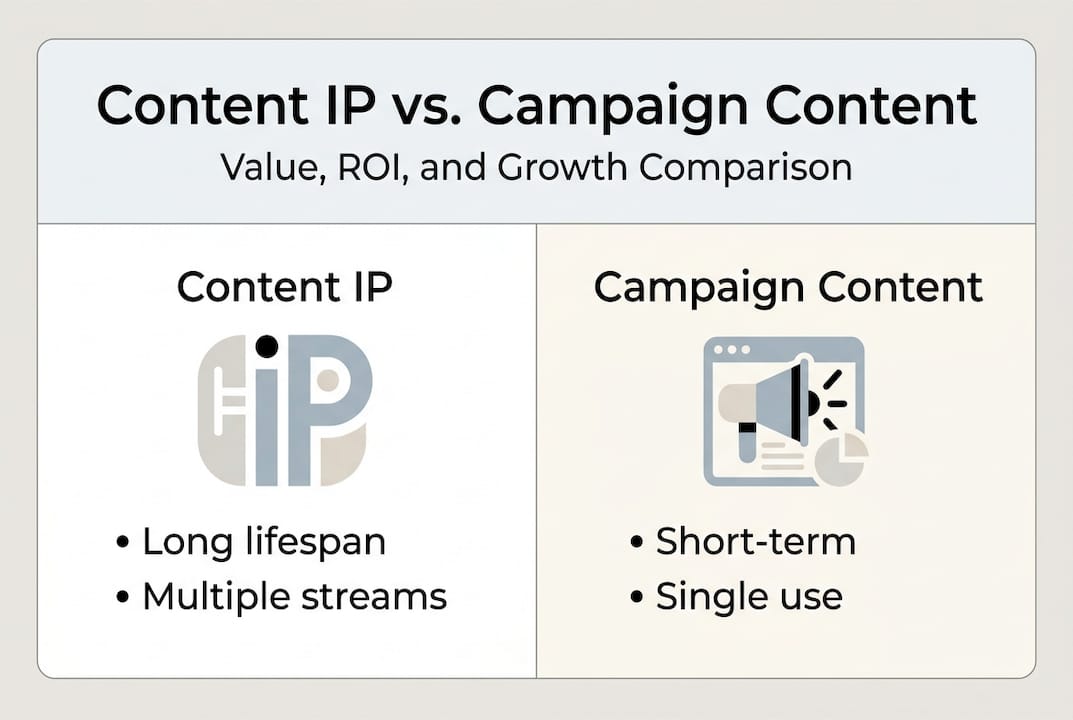
Content marketing ROI significantly outperforms traditional methods, with benchmarks particularly favourable for mid-sized enterprises that can move quickly and own their niche. The compounding effect accelerates once distribution is established and the IP has an audience.
For proprietary content IP specifically, ROI breaks even by month 7 and can reach 1,100% by month 36. That's not a projection. That's a documented return profile for well-structured IP assets with clear distribution and audience fit.
| Metric | Campaign content | Content IP |
|---|---|---|
| Break-even point | Immediate (if it works) | Month 6 to 9 |
| ROI at 12 months | 100 to 300% | 200 to 500% |
| ROI at 36 months | Negligible (asset retired) | 800 to 1,100% |
| Licensing potential | None | High |
| Partner co-investment | Rare | Common |
| Audience ownership | No | Yes |
The common missteps that undermine content investment strategies include:
- Treating IP like a campaign: Pulling investment before the compounding phase begins
- No distribution plan: Great IP with no audience pipeline generates nothing
- Ignoring licensing architecture: Failing to structure the IP for third-party commercial use
- Measuring too early: Judging IP ROI at month 3 is like judging a property investment after one rent payment
Pro Tip: Build your content IP business case around a 36-month model, not a 12-month one. Present the compounding curve to your board rather than a single-year projection. It reframes the conversation from cost to asset.
Exploring how ROI boost with content hubs works in practice gives you a practical model for structuring your IP ecosystem. And if you're evaluating content IP growth opportunities, the financial architecture matters as much as the creative.
How to create and scale valuable content IP
Building content IP that actually compounds requires more than a good idea. It requires a repeatable process, clear ownership, and a commercial architecture built in from the start.
Here's a practical three-step model:
- Identify and name the audience problem: The most durable IP is built around a tension your audience lives with. Name it specifically. A named problem becomes a platform. KPMG's research on future content business models confirms that developing proprietary frameworks and naming audience problems are foundational mechanics for IP that scales.
- Claim and protect the IP: Register the name, format, and visual identity before launch. File trademarks. Document the creative framework. Weak protection is the most common reason IP fails to generate licensing revenue.
- Package for reuse and extension: Structure the IP so it can live in multiple formats without losing coherence. A show format should work as a podcast, a live event, and a social series. Each extension compounds the original asset's value.
The IP flywheel works like this: original content builds an audience, the audience attracts partners, partners fund extensions, extensions grow the audience further. Cross-platform monetisation through licensing, partnerships, and merchandising becomes self-reinforcing once the flywheel is moving.
Pro Tip: Assign an internal IP champion from day one. Content IP dies in organisations where no one owns the commercial roadmap. This person bridges creative, legal, and commercial teams.
Common obstacles include under-protection (launching before trademarking), weak packaging (IP that can't be explained in one sentence), and lack of internal advocacy (no one fighting for the long-term budget). Addressing these early saves significant cost later.
Exploring brand partnership extensions is one of the fastest ways to accelerate IP value once the asset is established. Pairing that with social-ready video strategies ensures the IP reaches audiences in formats they actually engage with.
Risks, challenges, and the evolving media landscape
Content IP is not a guaranteed win. The upfront costs are real, the timelines are long, and the risks of overvaluation or poor execution are significant. Any honest assessment has to include these realities.
The high upfront costs and long ROI timelines are the most common barrier. Break-even at month 7 assumes competent execution, clear distribution, and audience fit. Without those, the timeline extends considerably. Boards that expect quarterly returns will struggle to support IP investment without a carefully constructed business case.
Valuation risk is equally important to understand. IP valuations are often best-case scenarios rather than real market value, particularly when distribution agreements or legal protections are not yet in place. Overestimating the value of an IP asset before it has an established audience is a common and costly mistake.
The AI dimension adds a new layer of complexity. Generic content is being commoditised rapidly. But proprietary IP, with its unique characters, formats, and audience relationships, is precisely what AI cannot replicate. This makes original IP a stronger moat than ever, but only if it's genuinely distinctive.
Key risks to manage:
- Underfunding the distribution phase: IP without an audience is worthless
- Skipping legal protection: Unregistered IP is vulnerable to copying and dilution
- Overvaluing early-stage assets: Treat valuations conservatively until distribution is proven
- Ignoring AI's effect on generic content: Invest in originality, not volume
"Strategic partnerships and robust legal protection are not optional extras in IP development. They are the foundation on which commercial value is built."
For enterprises serious about investing in media IP, the risk management framework is as important as the creative strategy. Get both right and the upside is substantial.
Unlock growth through content IP with Media Borne
If the case for content IP is clear but the path forward feels complex, that's exactly where Media Borne operates. We work with ambitious brands to develop, produce, and activate original entertainment IP that builds audiences and generates measurable commercial returns.
From end-to-end professional video production to structuring IP assets for long-term growth, we bring together creative production, marketing strategy, and commercial architecture under one roof. Whether you're exploring investment prospects in media IP or looking to activate existing assets through brand partnerships, we can help you build a content strategy that compounds rather than expires. Get in touch to explore what original IP could look like for your brand.
Frequently asked questions
What types of content can become content IP?
Content IP includes original films, branded shows, podcasts, unique frameworks, and signature campaigns. Anything uniquely associated with your brand and structured for licensing qualifies as ownable IP.
How soon can a mid-sized brand expect ROI from content IP?
Break-even typically arrives by month 7 for well-executed IP, with returns potentially exceeding 1,000% by month 36 when distribution and audience fit are strong.
What makes content IP more defensible than generic content in the AI era?
Proprietary IP carries unique characters, formats, and audience relationships that AI cannot replicate. As generic content is commoditised by AI tools, original IP becomes a stronger competitive moat, not a weaker one.
Are there risks or downsides to investing in content IP?
Yes. High initial costs, extended ROI timelines, and the risk of overestimated valuations are all real concerns. IP valuations often reflect best-case scenarios rather than proven market value, so expert legal and strategic guidance is essential from the outset.