

TL;DR:
- Branded entertainment requires a strategic focus on storytelling that builds emotional connections instead of direct selling. The journey involves goal setting, narrative design, quality production, collaboration, distribution, and measuring long-term loyalty. Successful brands treat content like media companies, investing in storytelling, original IP, and multi-channel engagement for lasting impact.
Most marketing professionals know branded entertainment exists. Far fewer understand what it actually demands. The instinct is to treat it as product placement with better lighting, a logo tucked into a storyline, a cameo that feels slightly less awkward than a TV spot. But that framing misses everything that makes branded entertainment genuinely powerful. When brands prioritise story over product, something shifts. Audiences stop tolerating content and start seeking it out. The journey from concept to loyal community is methodical, evidence-backed, and worth understanding in full. What follows is a stage-by-stage guide to help you move from fleeting impressions to genuine brand affection.
Table of Contents
- What is the branded entertainment journey?
- Mapping the six core stages
- Popular formats and distribution strategies
- Measurement, ROI, and evolving best practices
- Why successful branded entertainment means thinking like a media company
- Put branded entertainment strategy into action with expert support
- Frequently asked questions
Key Takeaways
| Point | Details |
|---|---|
| Strategic journey over ads | Branded entertainment is a multi-stage process that prioritises story and audience connection over product promotion. |
| Video leads engagement | Video content remains the most effective format for branded entertainment in 2026. |
| Emotional storytelling wins | Value-first, emotionally resonant stories drive deeper audience loyalty than overt advertising. |
| Measure for impact | Assess success using attention, brand lift, and long-term loyalty rather than short-term sales alone. |
| Brands as media studios | The next competitive edge comes from brands acting like media companies, creating original content and fostering cross-team collaboration. |
What is the branded entertainment journey?
Branded entertainment is not a campaign tactic. It is a strategic commitment to creating content where the story is the central experience, and the brand earns its place within it rather than forcing its way to the front. The product is not the hero. The audience's emotional experience is.
This distinction matters enormously when you compare it to traditional advertising. A TV spot interrupts. A branded entertainment piece invites. One demands attention; the other earns it. The branded content formats that perform best share a common trait: they offer genuine value to the viewer before they ask anything in return.
So what does the journey actually look like? The branded content production process follows six structured stages: define goals and audience, craft a compelling narrative with emotional arcs including conflict, emotion, and resolution, produce high-quality content that prioritises story over promotion, enable interdisciplinary collaboration between creatives and brand teams, distribute consistently across paid, owned, and earned channels, and measure success through time spent, brand lift studies, engagement, and long-term loyalty metrics.
Understanding the video storytelling process behind this framework is what separates brands that dabble in content from those that build genuine media assets.
Here is a quick comparison of how branded entertainment differs from traditional advertising:
| Factor | Traditional advertising | Branded entertainment |
|---|---|---|
| Primary goal | Drive immediate purchase | Build emotional connection |
| Audience relationship | Passive recipient | Active participant |
| Content value | Promotional | Informational or entertaining |
| Measurement | Impressions, clicks | Time spent, brand lift, loyalty |
| Longevity | Short campaign cycle | Long-term media asset |
The brands winning in this space are not treating content as a campaign bolt-on. They are building editorial calendars, investing in original IP, and thinking like media companies. Experts increasingly note that the lines between brand and studio are blurring, with forward-thinking organisations partnering with Hollywood talent and streaming platforms to produce content audiences actively choose to watch.
Key benefits of committing to this journey include:
- Deeper audience trust built through consistent, value-led storytelling
- Higher content longevity compared to traditional ad formats
- Stronger community formation around shared narrative experiences
- Greater earned media potential when content resonates organically
Mapping the six core stages
With the journey's overview established, let's explore the six stages step by step. Each one is critical for moving from idea to brand impact.
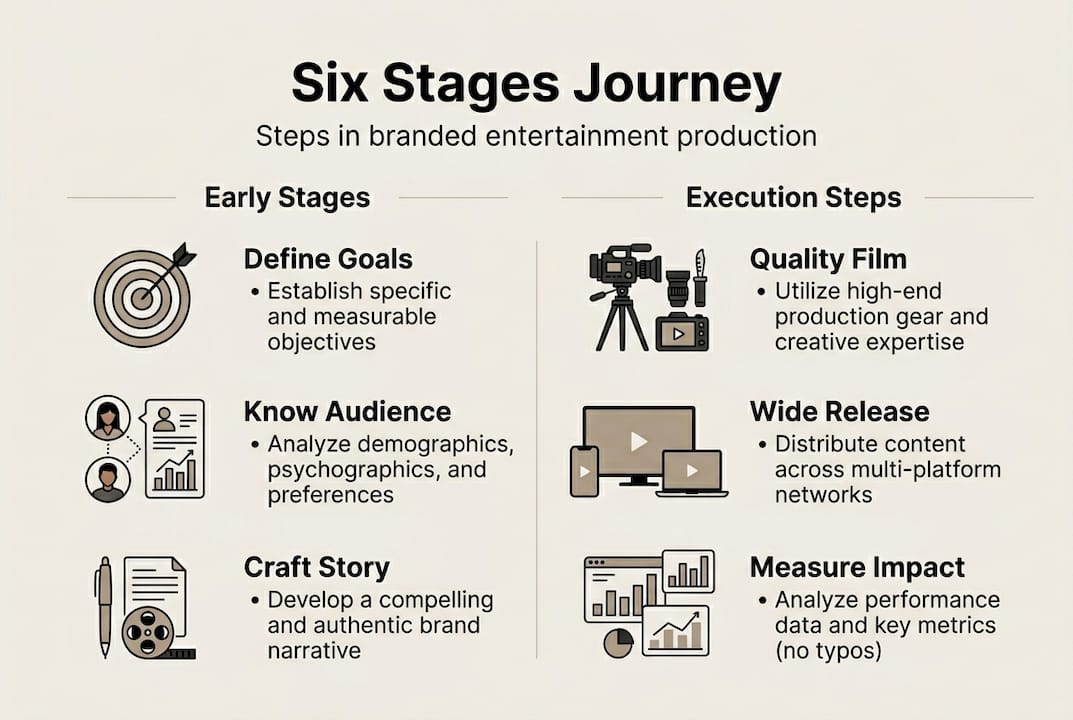
1. Goal and audience definition Before a single frame is shot or a script drafted, you need absolute clarity on what success looks like and who you are trying to reach. Vague objectives produce vague content. Define whether you are building awareness, shifting perception, or deepening loyalty, then research your desired community with the same rigour a media publisher would apply to its readership.
2. Narrative design Stories need conflict, emotion, and resolution. Without these three elements, branded content becomes a glorified brochure. The narrative arc must feel authentic to the audience's world, not constructed around the product's features. This is where most brands stumble: they write the brand brief first and the story second.
3. Quality production Audiences have been trained by Netflix and YouTube to expect high production standards. Poor audio, weak visuals, or clumsy pacing signals low investment and erodes trust. Corporate video production at a professional level is not a luxury; it is the baseline for credibility in this space.

Pro Tip: Allocate at least 30% of your content budget to post-production. Colour grading, sound design, and editing rhythm are what separate forgettable content from content people share.
4. Interdisciplinary collaboration Creative teams and marketing teams often speak different languages. Bridging that gap is not optional. The most effective branded entertainment comes from environments where storytellers have genuine creative freedom, and brand stakeholders understand that restraint is a strategic asset, not a concession.
5. Consistent multi-channel distribution Producing brilliant content and distributing it poorly is a common and costly mistake. Brand-led media strategies require a clear plan across paid, owned, and earned channels, with each channel serving a distinct role in the audience journey.
6. Measurement As expert views from industry leaders confirm, the metrics that matter here are different from standard campaign KPIs. Time spent, engagement depth, brand lift, and long-term loyalty indicators tell a richer story than click-through rates ever could.
| Stage | Common pitfall | What to do instead |
|---|---|---|
| Goal setting | Too broad or sales-focused | Define specific audience outcomes |
| Narrative design | Brand-first storytelling | Audience-first emotional arc |
| Production | Cutting quality to save budget | Invest in post-production |
| Collaboration | Siloed teams | Integrate creative and brand leads |
| Distribution | Single-channel focus | Coordinated multi-channel plan |
| Measurement | Vanity metrics only | Track attention and brand lift |
Popular formats and distribution strategies
With the journey framework in mind, now let's look at the creative vehicle: what formats and channels actually drive engagement.
The range of branded content formats available to brands today is broader than ever. Short films, video content both under and over two minutes, podcasts, games, interactive experiences, and product placements within premium content all serve distinct strategic purposes. Video, however, remains the dominant format for audience engagement across every major platform.
Why video? Because it combines visual storytelling, emotional music, performance, and narrative pacing in a way no other format can replicate. A well-produced short film can shift brand perception in four minutes. A podcast series can build parasocial loyalty over months. An interactive experience can turn passive viewers into active participants.
For distribution, the paid, owned, earned framework still holds. But the balance has shifted. Paid media drives discovery and reach. Owned channels, your website, your YouTube channel, your newsletter, build the relationship. Earned media, shares, press coverage, organic conversation, validates the content's cultural relevance. Authenticity lives in owned and earned. Paid simply opens the door.
Our short form video guide outlines how to match format to platform without sacrificing story quality. The principles are consistent: serve the audience's context, not your own convenience.
Pro Tip: Before choosing a format, ask where your audience already spends time and what content they are actively choosing to consume there. Then build something that belongs in that environment rather than disrupting it.
For brands investing in advertising campaign videos or social media video production, the format decision should always follow the audience insight, never the other way around.
"The brands that will define the next decade are not the ones with the biggest ad budgets. They are the ones building content audiences actively seek out."
The streaming era has permanently altered audience expectations. Brands that understand this are already building their own content studios, commissioning original series, and partnering with established creative talent to produce work that competes for attention on its own merits.
Measurement, ROI, and evolving best practices
Once content is live, the final journey stage is critical: measuring real-world impact and learning for continual improvement.
The metrics that matter in branded entertainment are not the ones your paid media team tracks by default. Key metrics include time spent with content, engagement depth, brand lift studies, and audience loyalty indicators measured over months, not days. These tell you whether your content is building something durable or simply generating noise.
Short-term engagement, views, shares, comments, signals that your content found its audience. Long-term brand capital, measured through brand lift studies and repeat audience behaviour, tells you whether it changed anything. Both matter, but they answer different questions.
On the channel side, paid media delivers the best discovery ROI, with 49% of marketers citing it as their top-performing channel for reach. But owned and earned channels are where authenticity compounds. A piece of content that earns organic shares or press coverage has passed a credibility test that no media spend can replicate.
Essential metrics to track:
- Average time spent per content piece
- Completion rate for video content
- Brand lift across awareness, consideration, and preference
- Earned media value from organic sharing and press
- Audience retention and return visit rates
- Long-term purchase intent shifts
Understanding marketing ROI from media production requires patience. The payoff from branded entertainment is rarely immediate. It accumulates. Brands that measure only short-term conversion will consistently undervalue their content investment and make decisions that undermine the long-term strategy.
A strong social video strategy integrates measurement from the outset, building feedback loops that inform the next piece of content before the current one has finished its distribution cycle. Explore the full range of content campaign strategies to see how this works in practice.
Why successful branded entertainment means thinking like a media company
Here is the uncomfortable truth most brand teams are not ready to hear: the biggest risk in branded entertainment is not producing bad content. It is producing good content and then reverting to sales-first messaging the moment a quarterly target looms.
Brands that are genuinely winning in this space have made a structural shift. They have invested in in-house creative talent, established editorial standards, and empowered cross-functional teams to prioritise the audience's experience over the brand's immediate commercial needs. They think of themselves as convenors of culture, not advertisers with a content arm.
As Anthony Freedman's perspective on the golden age of branded entertainment makes clear, the future belongs to brands willing to blur the line between studio and advertiser, partnering with Hollywood talent and treating storytelling as a core business competency, not a marketing experiment.
The brand-led media approach demands consistency. One brilliant piece of content does not build a community. A sustained editorial commitment does. Authentic stories win hearts over time, and that is the only timeline that matters for building lasting brand equity.
Put branded entertainment strategy into action with expert support
Understanding the branded entertainment journey is one thing. Executing it at a standard that genuinely competes for audience attention is another.
At Media Borne, we help brands move through every stage of this journey, from narrative development and professional video production to multi-channel distribution and measurable brand outcomes. Whether you are building your first content series or scaling an existing strategy, our team combines creative production with marketing intelligence to produce work that earns its audience. Explore brand partnership opportunities or find out how to sponsor digital content that already has the audience you want to reach.
Frequently asked questions
How is branded entertainment different from traditional advertising?
Branded entertainment prioritises compelling narratives and emotional connections over hard-selling, creating audience-first value rather than direct product promotion. Unlike traditional ads, story-first content earns attention rather than demanding it.
What is the most effective branded entertainment format in 2026?
Video dominates as the most engaging format, followed by interactive experiences and podcasts when used within integrated campaigns.
What are the key metrics for branded entertainment success?
Marketers use attention measured as time spent, engagement depth, brand lift studies, and long-term loyalty to assess success. Key metrics go well beyond clicks or impressions.
How do brands get started with in-house content studios?
Brands begin by investing in creative teams, leveraging audience insights, and collaborating across departments. The rising trend of in-house studios is being accelerated by streaming disruption and growing demand for original content.
Why is earned and owned media vital for authenticity?
Owned and earned channels build trust and credibility over time, while paid media supports initial discovery and reach. Owned and earned are where genuine audience relationships form.