

Many marketers treat content hubs like glorified blog categories, missing the strategic power they offer. When implemented correctly, content hubs can increase conversion rates by 60% and engagement by 66%, transforming how audiences interact with your brand. This article cuts through the confusion to explain exactly what content hubs are, why they matter for e-commerce and entertainment brands, and how to build them for maximum impact. You'll discover practical frameworks, performance benchmarks, and real-world case studies that demonstrate how structured content ecosystems drive measurable results.
Table of Contents
- Key Takeaways
- Understanding content hubs and their strategic role
- The impact of content hubs on e-commerce marketing success
- Leveraging content hubs in entertainment for sustained audience engagement
- Best practices and nuanced approaches to building effective content hubs
- Explore professional video production to enhance your content hubs
- Frequently asked questions about content hubs
Key Takeaways
| Point | Details |
|---|---|
| Thematic hub architecture | Content hubs centralise related material around themes, creating a navigable ecosystem that improves discoverability and topical authority. |
| Conversion uplift evidence | Case studies show notable rises in conversions and engagement, including a 60 per cent increase in conversions and a 66 per cent rise in engagement. |
| Audit content clusters | Audit your existing content to identify natural topic clusters of five or more related pieces to form your first hubs. |
| Ecommerce product hubs | Product led hubs help connect editorial and transactional experiences enabling shoppers to visualise complete solutions. |
Understanding content hubs and their strategic role
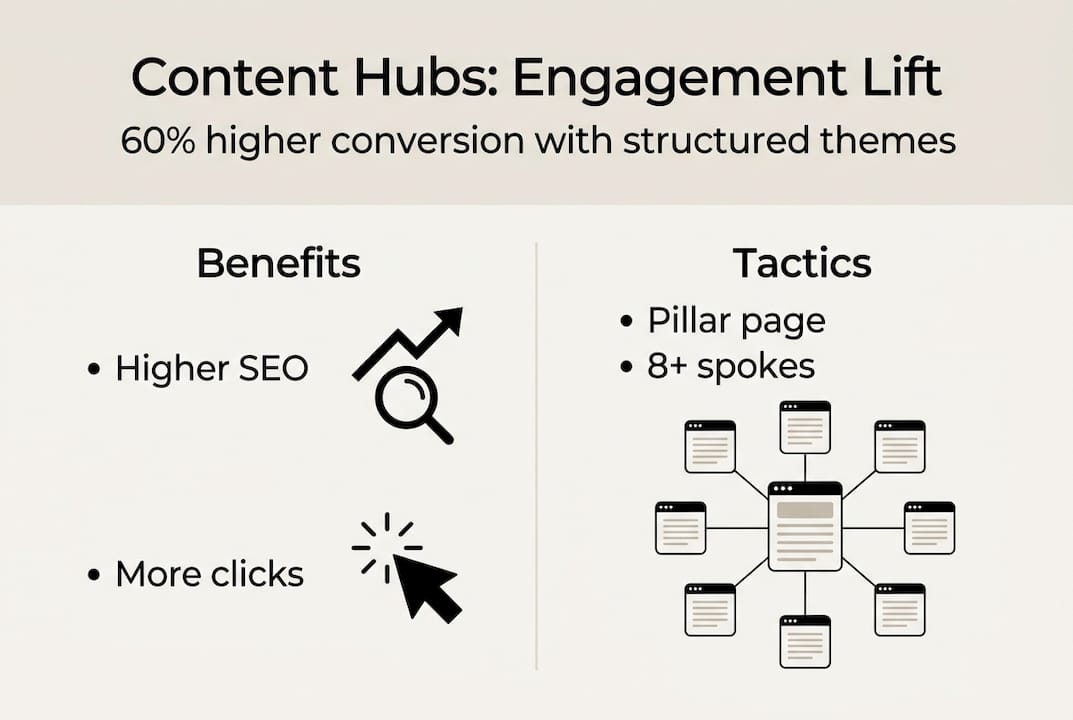
A content hub centralises related content around a core theme, creating a structured ecosystem where a pillar page acts as the hub and supporting articles serve as spokes. This differs fundamentally from traditional blogs, which publish isolated posts without deliberate thematic architecture. Where blogs scatter content across topics and dates, hubs create depth through intentional clustering.
The strategic advantage lies in thematic relevance. Search engines recognise topical authority when multiple pieces reinforce a central subject, improving rankings for competitive terms. Hub-spoke content models provide structured hierarchy that enhances AI search capabilities and content extraction, making your material more discoverable as search evolves beyond traditional keyword matching.
This architecture serves dual purposes. For awareness objectives, hubs establish thought leadership across broad topics. For conversion goals, they guide users through decision journeys with progressively detailed content. A skincare brand might create a hub on anti-ageing solutions, with spokes covering specific ingredients, routines, and product comparisons. Each spoke addresses different search intents whilst reinforcing the hub's authority.
Measurement becomes more sophisticated with hub structures. Rather than tracking individual post performance, you analyse cluster metrics: how users navigate between hub and spokes, which pathways lead to conversion, and where engagement drops. This reveals content gaps and optimisation opportunities invisible in traditional analytics.
Pro Tip: Audit your existing content to identify natural clusters. Look for topics where you've published 5+ related pieces. These clusters can become your first hubs with minimal additional investment.
The hub-spoke model also supports video production growth opportunities by providing clear frameworks for visual content integration. When you understand your thematic architecture, you can strategically deploy video where it adds most value, whether explaining complex concepts on hub pages or showcasing specific applications in spokes.
The impact of content hubs on e-commerce marketing success
E-commerce brands have demonstrated measurable returns from content hub strategies, moving beyond theoretical benefits to documented performance improvements. DFS's content hub increased conversion by 60% and engagement by 66%, proving that structured content directly influences purchase behaviour. The furniture retailer organised product content into lifestyle themes, helping customers visualise complete room solutions rather than browsing isolated items.
Product-led hubs integrate commerce and content seamlessly. Instead of separating editorial and transactional experiences, successful hubs weave them together. A hub on sustainable fashion might include styling guides, material explanations, brand stories, and shoppable collections. Each spoke serves discovery whilst maintaining clear paths to purchase.
| Brand | Hub Focus | Conversion Lift | Engagement Increase | Additional Benefit |
|---|---|---|---|---|
| DFS | Lifestyle room themes | 60% | 66% | Improved product visualisation |
| Very Group | Seasonal shopping guides | Contributed to 9% YoY sales growth | Not disclosed | Enhanced content team productivity |
| Fashion retailer (anonymised) | Sustainable materials | 45% | 52% | Stronger brand positioning |
Very Group achieved 9% year-over-year sales growth partly through content hub strategies that organised their vast product catalogue into navigable themes. The retailer found that hubs reduced content production overhead by providing reusable frameworks, allowing teams to scale output without proportional resource increases.

Product visualisation hubs particularly benefit considered purchases. When customers can explore products through multiple content formats, room settings, use cases, and comparison guides, all within a coherent hub structure, decision confidence increases. This reduces returns and support queries whilst improving conversion rates.
Pro Tip: Audit your hubs quarterly for spoke count and engagement metrics. Hubs with fewer than 8 spokes often underperform. Look for opportunities to expand successful hubs before launching new ones.
The social selling video production approach complements hub strategies by creating shoppable video content that can serve as engaging spokes. Live demonstrations, styling sessions, and product comparisons in video format keep users within your content ecosystem whilst moving them towards purchase decisions.
Leveraging content hubs in entertainment for sustained audience engagement
Entertainment brands face different challenges than e-commerce, requiring content strategies that maintain interest between major releases and build communities around properties. Entertainment hubs sustain engagement through recurring event content and community focus, creating year-round touchpoints rather than episodic spikes.
A television series might create a hub around character backstories, with spokes exploring individual arcs, fan theories, behind-the-scenes content, and interactive timelines. This structure keeps audiences engaged during production breaks whilst encouraging deeper exploration of the fictional world. User-generated content naturally integrates into this model, with fan contributions becoming valuable spokes.
| Aspect | E-commerce Product Hubs | Entertainment Evergreen Hubs |
|---|---|---|
| Primary goal | Drive product discovery and purchase | Sustain community and deepen engagement |
| Content refresh cycle | Seasonal or product launch driven | Continuous, event-anchored updates |
| Conversion metric | Sales, add-to-cart rates | Time on site, return visits, UGC contributions |
| Spoke content types | Product guides, comparisons, styling | Character deep-dives, theories, interactive experiences |
| Gating strategy | Minimal, prioritise SEO | Mix of open and exclusive community content |
Recurring events provide natural content refresh opportunities. Annual award shows, seasonal premieres, or franchise anniversaries become hub anchors, with spokes exploring historical context, predictions, and retrospectives. This evergreen approach means content remains relevant beyond immediate news cycles.
Community building distinguishes entertainment hubs from purely informational structures. Forums, comment sections, and user submissions transform passive consumption into active participation. When audiences contribute theories, artwork, or discussions, they invest in the hub's ongoing success, creating self-sustaining engagement loops.
Pro Tip: Align content spokes with recurring fan interests and franchise milestones. Map your editorial calendar to both official releases and community-created events like character birthdays or episode anniversaries.
The content campaign services model supports entertainment hubs by developing cohesive narratives across multiple formats and platforms, ensuring consistent thematic threads whilst varying content types to maintain freshness.
Best practices and nuanced approaches to building effective content hubs
Successful content hub implementation requires strategic planning and ongoing optimisation. Follow this framework to establish high-performing hubs:
- Identify core themes through audience research and search data analysis, looking for topics with sufficient breadth to support 8+ distinct spokes whilst maintaining tight thematic coherence.
- Determine hub gating strategy based on objectives: balance ungated hubs for SEO dominance and gated hubs for lead generation, recognising that mixing approaches within single hubs often dilutes effectiveness.
- Create comprehensive hub pillar pages that provide overview value whilst clearly signposting spoke content, ensuring users can navigate to specific interests without overwhelming them with options.
- Develop minimum 8 spokes before launch, as smaller clusters lack the depth to establish topical authority or provide meaningful user journeys through your content ecosystem.
- Implement cluster-level analytics to track hub performance holistically, measuring not just individual page metrics but pathway completion rates and cross-content engagement patterns.
- Establish refresh cycles appropriate to your content type, with product hubs requiring seasonal updates and evergreen hubs benefiting from continuous community-driven additions.
Gating decisions significantly impact hub performance. Ungated hubs maximise organic visibility, allowing search engines to index all content and users to access information freely. This approach builds top-of-funnel awareness and establishes thought leadership. Gated hubs sacrifice some discoverability for lead capture, requiring users to provide contact information for premium content access. Most brands benefit from maintaining both types, using ungated hubs for broad topics and gated hubs for specialised, high-value content.
Performance benchmarks help evaluate success. Benchmark aims include 15-20% bounce rate reduction and 68% session duration increase compared to non-hub content. These metrics indicate improved user engagement and content relevance. Conversion rate improvements vary by industry, but double-digit increases are achievable with well-structured hubs.
"Hub-spoke content models provide structured hierarchy that enhances AI search capabilities and content extraction, making your material more discoverable as search engines evolve beyond traditional keyword matching towards understanding topical relationships and content ecosystems."
Pro Tip: Continuously audit spoke alignment with user intent. Search behaviour evolves, and yesterday's perfect spoke may miss today's questions. Use search console data to identify gaps and opportunities within existing hubs.
The strategic content campaigns approach integrates hub planning with broader marketing objectives, ensuring your content architecture supports business goals rather than existing as isolated editorial projects.
Explore professional video production to enhance your content hubs
Video content transforms static hubs into dynamic experiences that capture attention and communicate complex ideas efficiently. Media Borne offers end-to-end professional video production services tailored for content marketing, creating films that elevate hub engagement whilst reinforcing your brand narrative.
Professional filming and editing bring abstract concepts to life. Product demonstrations, customer testimonials, and behind-the-scenes content work as powerful hub spokes, increasing session duration and encouraging social sharing. When strategically placed within hub architecture, video guides users through decision journeys more effectively than text alone.
Our strategic video marketing services complement hub content by developing cohesive campaigns across platforms, ensuring your video investments work harder through coordinated distribution. Combined with social selling video production capabilities, we help you create shoppable content that converts attention into revenue whilst building the community engagement that sustains long-term brand growth.
Frequently asked questions about content hubs
What is a content hub and how does it differ from a blog?
A content hub organises related articles around a central pillar page, creating deliberate thematic architecture. Blogs publish chronological posts without structured clustering. Hubs prioritise topical depth over breadth, establishing authority through interconnected content that serves specific user journeys rather than scattered interests.
How do content hubs improve SEO and engagement?
Hubs signal topical authority to search engines through thematic clustering, improving rankings for competitive terms. The structured hierarchy supports AI-driven search extraction, making content more discoverable. Users spend more time exploring interconnected spokes, increasing session duration and reducing bounce rates through clear navigation pathways.
What are the best practices for gating content in hubs?
Use ungated hubs for broad awareness topics where SEO value outweighs lead capture. Reserve gated hubs for specialised, high-value content targeting known prospects. Avoid mixing approaches within single hubs, as partial gating confuses users and dilutes both SEO and conversion effectiveness. Test gating thresholds to balance access and lead quality.
How many spokes should a content hub have for optimal results?
Launch with minimum 8 spokes to establish sufficient topical depth and provide meaningful user pathways. Successful hubs often expand to 15-20 spokes over time, though quality matters more than quantity. Each spoke must address distinct search intent whilst reinforcing the hub's central theme. Audit quarterly to identify expansion opportunities.
Can video content make a significant difference in my content hub?
Video dramatically increases engagement metrics, with users spending significantly longer on pages containing relevant video. Product demonstrations, tutorials, and storytelling formats work particularly well as hub spokes, communicating complex information efficiently. Professional production quality matters, as poor video can damage credibility. Explore video production investment insights to understand resource requirements and expected returns.