

TL;DR:
- Most brands overlook small optimizations that significantly improve video campaign performance.
- Authentic creator partnerships shorten shopper journeys and boost conversions.
- Consistent monitoring and iterative testing lead to sustained growth and better ROI.
Most marketing teams are leaving significant revenue on the table, not because their video content is bad, but because small, overlooked optimisations are quietly killing performance. The difference between a campaign that converts and one that drains budget often comes down to a handful of strategic adjustments: sharper targeting, smarter creative iteration, and a clearer understanding of how modern audiences actually move through a purchase journey. This guide walks you through a practical, step-by-step process for auditing, preparing, executing, and measuring video campaign optimisations, built specifically for e-commerce and entertainment brands that need results, not theory.
Table of Contents
- Assessing your current video campaign performance
- Preparing for optimisation: planning and resources
- Executing optimisations: practical steps to improve performance
- Measuring, verifying, and iterating for continuous improvement
- What most brands miss when optimising video campaigns
- Supercharge your campaigns with Media Borne
- Frequently asked questions
Key Takeaways
| Point | Details |
|---|---|
| Audit KPIs first | Pinpoint performance gaps by reviewing campaign metrics before making changes. |
| Leverage creator partnerships | UGC and creator collaborations build trust and accelerate sales, especially on YouTube. |
| Test and iterate | Continual A/B testing and optimisation are essential for sustained improvement. |
| Measure what matters | Focus on conversion-linked metrics and long-term growth, not just surface-level views. |
Assessing your current video campaign performance
Before you can improve anything, you need an honest picture of where your campaigns stand today. Many marketing teams skip this step and jump straight into creative changes, which is a bit like redecorating a house without checking the foundations first. A structured audit gives you the baseline data that makes every subsequent decision sharper and more defensible.
Start by pulling together your core performance metrics. These are the numbers that tell the real story:
- View duration: How long, on average, are viewers watching before they drop off?
- Watch percentage: What proportion of the total video length is being consumed?
- Click-through rate (CTR): Are viewers taking the next step after watching?
- Conversion rate: How many viewers are completing the desired action, whether that's a purchase, sign-up, or enquiry?
- Cost per view and cost per conversion: Are you getting value for your media spend?
Once you have these figures, compare them against industry benchmarks. The table below gives you a quick reference point:
| Metric | Strong performance | Average performance | Needs attention |
|---|---|---|---|
| Watch percentage | 50%+ | 30-49% | Below 30% |
| CTR (YouTube) | 5%+ | 2-4% | Below 2% |
| Conversion rate | 3%+ | 1-2% | Below 1% |
| View duration (60s video) | 40s+ | 20-39s | Below 20s |
One of the most important things to understand about modern video performance is that shopper journeys are rarely linear. Audiences move between streaming, search, and social platforms before making a decision. Demand Gen campaigns see 26% more conversions year over year on YouTube, precisely because the platform is built for this kind of nonlinear discovery. If your campaign analytics are only measuring last-click attribution, you are almost certainly undervaluing your video content's contribution to revenue.
For a broader view of what strong video performance looks like in practice, the video marketing tips resource covers engagement benchmarks across multiple formats and platforms. If you are rethinking your broader approach, exploring video-first marketing strategies will help you frame your audit findings within a more ambitious growth model.
Pro Tip: Use platform-native analytics tools such as YouTube Studio alongside third-party tools like Google Analytics 4 to cross-reference data. This combination surfaces discrepancies in attribution and gives you a fuller picture of how video is influencing conversion across touchpoints.
Preparing for optimisation: planning and resources
Once you have a baseline for success, effective optimisation starts with robust preparation. Rushing into creative changes without the right tools and team alignment is one of the most common reasons campaigns fail to improve despite significant effort.
Here is what you need in place before you begin:
- Editing and production software: Tools such as Adobe Premiere Pro, DaVinci Resolve, or CapCut for rapid iteration on creative assets
- Analytics platforms: YouTube Studio, TikTok Analytics, Google Analytics 4, and any paid attribution tools relevant to your stack
- Creative asset library: A bank of footage, graphics, and audio that can be quickly repurposed for testing
- Clear campaign goals: Defined KPIs that align with business objectives, not just vanity metrics
- Approval workflows: Streamlined processes so creative iterations can be tested quickly without bottlenecks
One of the most consequential decisions at this stage is choosing who produces and manages your content. The comparison below outlines the trade-offs:
| Approach | Speed | Cost | Trust factor | Best for |
|---|---|---|---|---|
| In-house team | Medium | Medium | Moderate | Brand consistency |
| Agency | Slower | Higher | High | Strategy and scale |
| Creator/UGC partners | Fast | Lower | Very high | Authenticity and reach |
For entertainment and e-commerce brands in particular, creator and UGC partnerships offer a distinct advantage. Creator partnerships on YouTube shorten the shopper journey by six days, which is a meaningful reduction when you consider the compounding effect across a large audience. The trust that comes from a credible creator endorsement is something a brand-produced ad simply cannot replicate at the same speed.
Building a strong social video strategy before you begin optimising ensures your efforts are directed by a coherent narrative rather than reactive tweaks. Understanding the video storytelling process is equally important, because the most technically optimised video in the world will underperform if the story it tells does not resonate. Effective branding through storytelling is what separates campaigns that build long-term equity from those that generate a short spike and disappear.

Executing optimisations: practical steps to improve performance
With resources in place, let's get into the hands-on steps that move the needle. The following process is designed to be repeatable, so you can cycle through it with each new campaign or creative refresh.
-
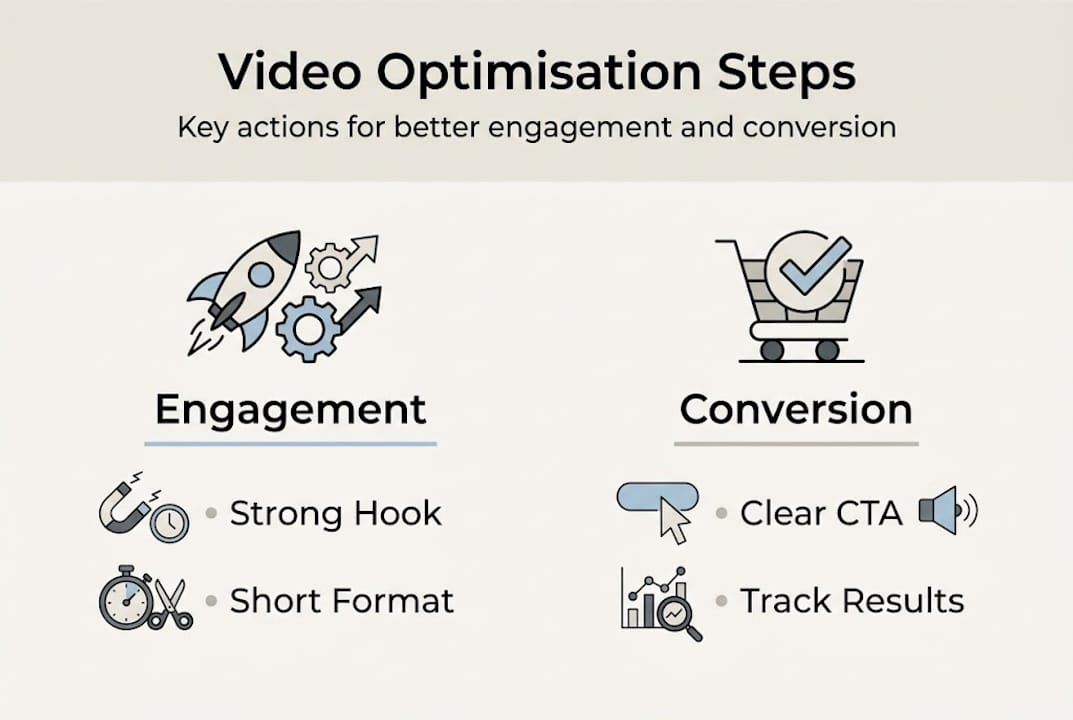
Audit your thumbnails and opening frames: The first three seconds of a video and the thumbnail image determine whether someone watches at all. Test multiple thumbnail variations using platform A/B tools. Strong thumbnails feature clear faces, bold text overlays, and high contrast visuals.
-
Refine your calls to action: A CTA buried at the end of a two-minute video is not working hard enough. Place CTAs at natural engagement peaks, typically around the 30-second mark and again at the close. Make them specific: "Shop the collection" outperforms "Click here" every time.
-
Sharpen your audience targeting: Revisit your custom audiences and lookalike segments. Exclude audiences who have already converted to avoid wasted spend, and layer in interest and intent signals that align with your campaign objective.
-
Run structured A/B tests: Change one variable at a time, whether that is the opening hook, the CTA, the music, or the video length. Testing multiple variables simultaneously makes it impossible to identify what actually drove a change in performance.
-
Diversify your formats: Short-form content (under 60 seconds) drives discovery; longer formats build trust and explain complex products. Use both strategically rather than defaulting to one.
-
Integrate creator and UGC content: Authentic creator content consistently outperforms polished brand ads for conversion. Demand Gen campaigns record 26% more conversions year over year, and creator-led content is a significant driver of that uplift.
For inspiration on formats that travel far, the viral video strategies guide covers the structural patterns that give content its best chance of organic reach. If YouTube is a primary channel, the YouTube for brands resource provides platform-specific optimisation tactics. And before you scale any campaign, reviewing your video workflow planning process will help you produce iterations faster without sacrificing quality.
Pro Tip: Set up conversion tracking at the video level, not just the campaign level. Knowing which specific creative drove a purchase gives you the granular data needed to double down on what works and cut what does not.
Measuring, verifying, and iterating for continuous improvement
Once improvements are in play, determining what works and what does not keeps campaigns performing at peak levels. The temptation after launching optimisations is to check results daily and make reactive changes. Resist this. Meaningful data takes time to accumulate, and premature decisions based on small sample sizes will lead you in the wrong direction.
Here is a structured cadence for reviewing performance:
- Daily: Monitor spend pacing and flag any unusual drops in delivery or CTR
- Weekly: Review watch percentage, view duration, and CTR trends across creative variants
- Fortnightly: Assess conversion data and cost per acquisition against targets
- Monthly: Conduct a full campaign audit, retire underperforming creatives, and plan the next test cycle
Common analysis mistakes to avoid include drawing conclusions from too small a sample (wait for statistical significance before declaring a winner), comparing performance across different time periods without accounting for seasonality, and ignoring assisted conversions in favour of last-click data.
"Entertainment brands using creator partnerships on YouTube not only boost trust but also shorten the shopper journey by nearly a week, which means faster revenue cycles and stronger return on creative investment."
The iteration loop is where compounding gains happen. Each test cycle teaches you something specific about your audience's behaviour, and that knowledge stacks over time. Brands that commit to this process consistently outperform those that treat optimisation as a one-off project. For a deeper look at how to connect campaign performance to broader business outcomes, the marketing ROI strategies guide is a useful reference. If you want to understand how social video specifically contributes to return on investment, social video marketing ROI breaks down the metrics that matter most.
What most brands miss when optimising video campaigns
Here is something most optimisation guides will not tell you: the brands that see the biggest long-term gains from video are not necessarily the ones with the best thumbnails or the most aggressive A/B testing schedules. They are the ones that invest in building genuine audience relationships through content that entertains and informs rather than simply sells.
Most teams get stuck in a short-term metrics loop, chasing CTR improvements while neglecting the trust and community signals that actually drive sustainable growth. A viewer who watches your content regularly, shares it, and advocates for your brand is worth ten times more than one who clicks an ad once and never returns.
For e-commerce and entertainment brands, this means treating creator and UGC partnerships not as a cost-efficient content hack but as a genuine community-building strategy. When audiences see people they trust talking about your brand, the conversion is almost incidental. The relationship does the heavy lifting.
The shift we advocate at Media Borne is moving from optimising for audiences to optimising with them. That means listening to comments, tracking which content formats generate genuine conversation, and feeding those insights back into your creative process. Video-first marketing done well is not about perfecting a single campaign. It is about building an audience that chooses to come back.
Supercharge your campaigns with Media Borne
If you are ready to move beyond incremental improvements and build a video strategy that genuinely drives growth, working with a specialist team makes the process significantly faster and more effective.
At Media Borne, we combine professional video production with entertainment-led strategy to help e-commerce and entertainment brands turn attention into measurable commercial outcomes. From campaign audits and creative iteration to social selling videos that convert at scale, we bring the expertise and creative firepower to make your video investment work harder. Get in touch to find out how we can help your next campaign perform at its best.
Frequently asked questions
What are the most important KPIs for video campaigns?
Key KPIs include view duration, watch rate, click-through rate, and direct conversion actions attributed to the video. These metrics together give you a complete picture of both engagement quality and commercial impact.
How do creator/UGC partnerships help entertainment brands?
Creator and UGC partnerships build audience trust quickly and, on platforms like YouTube, can shorten the shopper journey by six days, meaning faster conversions and a stronger return on content investment.
How often should video campaigns be reviewed and optimised?
Campaigns should be reviewed at least every two weeks, with a full monthly audit to retire underperforming creatives and plan the next round of tests based on current performance data.
Which platform drives the most conversions for nonlinear journeys?
YouTube leads in driving conversions through nonlinear shopper journeys, particularly with Demand Gen campaigns delivering 26% more conversions year over year compared to standard formats.
Recommended
- Social video strategy: drive 105% more engagement in 2026
- Top video marketing tips to boost engagement by 80%
- Advertising Campaign Videos: High-Impact Video Production
- Social video marketing for brand engagement and ROI
- Website Redesign Strategy that Attracts and Converts Visitors - Web Design Dubai - Website Design Company Dubai | NetSoft
- How to Grow AI Engine Engagement: A Step-by-Step Framework for AEO and SEO Success - 1on1 SEO