

Most brands still pour budget into paid advertising, yet the fastest-growing consumer brands have quietly shifted their approach. They now act as media publishers, producing content that entertains, informs, and builds genuine loyalty. This is not a trend. It is a structural change in how attention works. Brand-led media refers to brands producing their own high-quality, entertaining content the way media companies do, and the results are measurable. This article breaks down what brand-led media actually means, the frameworks that make it work, real-world case studies, and the honest risks you need to understand before committing.
Table of Contents
- What is brand-led media?
- Frameworks and methodology for brand-led media success
- Case studies: How leading brands build media empires
- Nuances, edge cases, and risks in brand-led media
- Why most marketers misunderstand brand-led media
- Explore your brand-led media opportunities
- Frequently asked questions
Key Takeaways
| Point | Details |
|---|---|
| Own your media platforms | Building content channels lets brands engage audiences directly, beyond paid ads. |
| Publish continuously | Consistent, audience-first publishing compounds results and boosts engagement. |
| Invest for the long term | Brand-led media often requires patience, sustained investment, and a measurement shift. |
| Measure what matters | Use trust, engagement, and CPA reduction as key proxies for success. |
What is brand-led media?
Brand-led media is the practice of a brand owning and operating its own content platforms rather than renting attention through paid channels. Instead of buying a 30-second slot, you build the show. Instead of sponsoring a podcast, you launch one. The brand becomes the publisher, the editor, and the audience builder all at once.
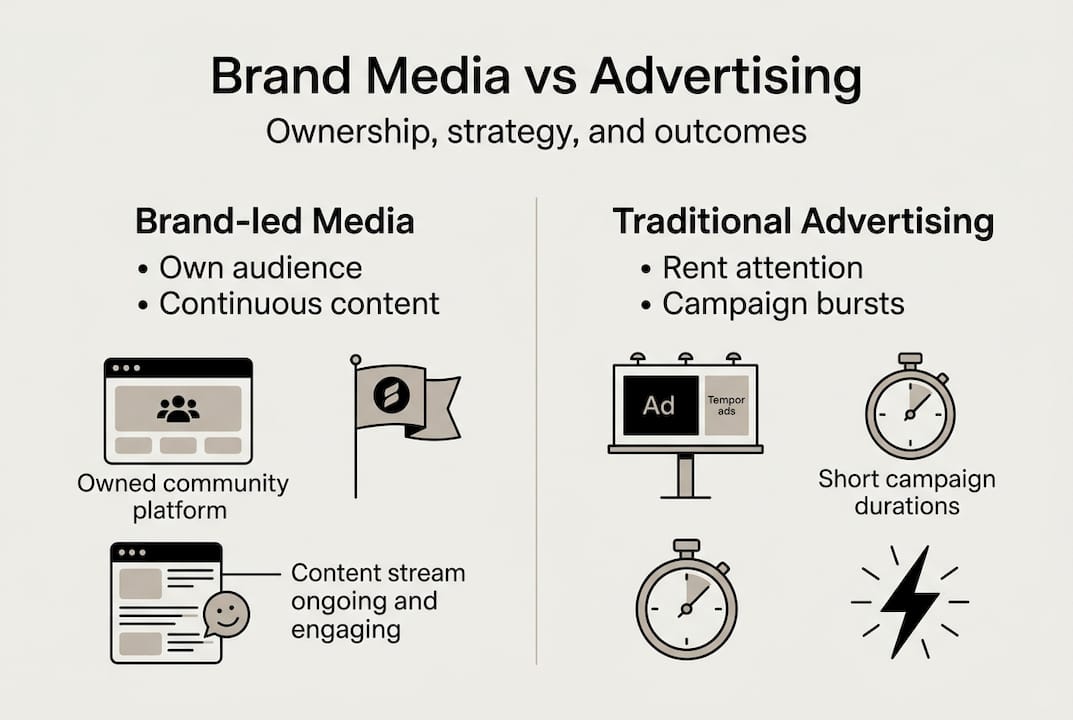
This is fundamentally different from traditional advertising. Advertising interrupts. Brand-led media attracts. The table below captures the core distinction:
| Traditional advertising | Brand-led media |
|---|---|
| Rented audiences | Owned audiences |
| Campaign-based bursts | Continuous publishing |
| Interruption model | Attraction model |
| Third-party channels | Owned platforms |
| Short-term visibility | Long-term community |
The most cited examples are instructive. Red Bull does not just sponsor extreme sports events, it produces them and distributes the content globally, reaching 257 million viewers monthly through Red Bull Media House. LEGO built movies and community platforms that turned customers into co-creators. The Michelin Guide started as a travel booklet to sell tyres and became one of the most trusted editorial brands in the world. Poosh, Kourtney Kardashian's lifestyle platform, functions as a full media brand with commerce built in.
Brands across categories are now creating podcasts, video series, and owned events with genuine journalistic value. The formats vary widely:
- Podcasts that explore industry topics relevant to the brand's audience
- YouTube series designed to educate or entertain, as explored in YouTube engagement for brands
- Short-form video built around platform-native formats, guided by a strong social video engagement strategy
- Live events that create community moments beyond the screen
- Editorial hubs and newsletters that build direct audience relationships
The common thread is ownership. When you own the content and the audience relationship, you are not at the mercy of algorithm changes or rising CPMs. Your social media video production becomes a long-term asset, not a disposable campaign.
Frameworks and methodology for brand-led media success
Having established what brand-led media encompasses, the next step is to understand the frameworks that drive its success. The most important shift is moving away from campaign thinking entirely.
Traditional marketing operates in bursts: a product launch, a seasonal push, a paid sprint. Brand-led media requires continuous publishing that builds audience trust over time. You are not creating a campaign. You are building a media habit for your audience.
The content pillar model is the most practical framework for structuring this. You identify three to five core topics that sit at the intersection of your brand's expertise and your audience's genuine interests. Everything you publish maps back to one of those pillars.

| Content pillar | Format examples | Audience goal |
|---|---|---|
| Education | Tutorials, explainers | Build trust and authority |
| Entertainment | Series, challenges, stories | Grow reach and loyalty |
| Community | User content, live Q&A | Deepen belonging |
| Conversion | Reviews, demos, offers | Drive purchase intent |
Founder storytelling is an underused pillar. Audiences connect with people before they connect with products. Putting a human voice at the centre of your content, whether through a video engagement strategy or editorial series, accelerates trust significantly.
Here is a step-by-step methodology to get started:
- Audit your audience — understand what they already consume, not just what they buy
- Define your content pillars — three to five topics you can own credibly
- Choose your primary platform — go deep on one before expanding
- Build a publishing cadence — consistency matters more than volume
- Integrate commerce naturally — let conversion follow trust, not lead it
- Track engagement proxies — use content hubs for engagement data to refine your approach
Pro Tip: Start with audience research before you produce a single piece of content. The brands that fail at brand-led media usually skip this step and build content they find interesting rather than content their audience actually wants.
Performance branding sits at the intersection of entertainment and conversion. The goal is not to choose between brand and demand. It is to build content that does both, over time.
Case studies: How leading brands build media empires
Now, let's move from frameworks to real-world examples, showcasing how pioneering brands actually build and scale brand-led media.
Red Bull is the benchmark. Red Bull Media House invests over $100 million annually in content production and has achieved a 65% market share in its category. The media arm generates $136 million in direct revenue and delivers 5.8 times the engagement of traditional advertising formats. This is not a marketing department producing content on the side. It is a fully operational media company that happens to sell energy drinks.
LEGO took a different route. By producing feature films and building community platforms where fans could submit and vote on new product designs, LEGO turned its customer base into a creative ecosystem. The result was a brand revival that no advertising campaign alone could have achieved.
Michelin is perhaps the most instructive long-term example. A tyre company produced a restaurant guide to encourage more driving, and that guide became a global cultural institution. The content served the audience first and the brand second, which is precisely why it worked.
"Brands that treat media as a business asset rather than a marketing cost build compounding value that advertising simply cannot replicate."
Key outcomes seen across leading brand-led media programmes include:
- Reduced cost per acquisition as organic audiences grow
- Higher market share in categories with strong content presence
- Increased engagement rates compared to paid formats
- Stronger brand recall driven by repeated, valuable touchpoints
- Community loyalty that buffers against competitive pressure
Despite these results, only 28% of marketers currently measure pipeline success directly from brand content. This is partly a measurement challenge and partly a mindset one. If you are investing in brand-led media, you need a different success framework from the start. Explore what that looks like for your brand through video production in the UK that is built around audience value, not just product messaging.
Nuances, edge cases, and risks in brand-led media
Having seen the upside and impact, it is crucial to address the nuanced risks and challenges that marketers must navigate when building brand-led media.
The most common challenges include:
- High upfront investment in production, talent, and distribution infrastructure
- Slow time to results since audience trust compounds over months, not weeks
- Measurement complexity when traditional attribution models do not apply
- Internal resistance from stakeholders expecting short-term ROI
- Authenticity erosion when AI-generated content replaces genuine editorial voice
The investment and measurement challenges are real. Brand-led media is capital-intensive and requires patience that most quarterly planning cycles do not naturally support. The temptation is to treat it like a campaign and pull the budget when results are not immediate.
The brand versus demand debate is also worth addressing directly. Some marketing teams treat these as competing budget lines. They are not. Brand-led media builds the conditions in which demand generation performs better. A warm, trusting audience converts at a lower cost. Maximising brand impact through media investment reduces the friction that paid channels have to overcome.
AI content presents a specific risk. As production costs fall and volume increases, the temptation to automate content creation grows. But audiences are increasingly skilled at detecting inauthenticity. The brands winning with boosting engagement with content hubs are those investing in genuine human creativity, not replacing it.
"Media is not a campaign. It is a business asset that requires the same long-term thinking as product development or distribution infrastructure."
Pro Tip: Use engagement rate as your primary success metric in the first 12 months. Direct revenue attribution will come, but trust and attention are the inputs that make it possible.
Why most marketers misunderstand brand-led media
The most common mistake we see is treating brand-led media as a content volume exercise. Brands produce a burst of videos, see modest results, and conclude the strategy does not work. What they have actually tested is a campaign dressed up as a media strategy.
Real brand-led media is audience-first publishing. The goal is not visibility. It is trust. Visibility fades when budgets stop. Trust compounds when content consistently delivers value. Start with audience research and clear objectives, and measure beyond clicks and impressions from day one.
The second misunderstanding is around ROI timelines. Marketers trained on performance channels expect results within weeks. Brand-led media operates on a different clock. The brands that succeed are those whose leadership understands they are building a media asset, not running a promotion.
Engagement and creativity are not soft metrics. They are the leading indicators of commercial outcomes. When audiences genuinely enjoy your content, they share it, return to it, and eventually buy from you. Building content hubs that serve your audience well is not a nice-to-have. It is the foundation of sustainable brand growth in a world where attention is the scarcest resource.
Explore your brand-led media opportunities
If the case studies and frameworks in this article have prompted you to think differently about your content strategy, the next step is understanding what brand-led media could look like for your specific brand and audience.
At Media Borne, we combine video production services with strategic thinking to help consumer brands build content that earns attention rather than buying it. Whether you are looking to invest in media production as a long-term business asset or explore brand partnership opportunities that put your brand inside entertainment people actually choose to watch, we can help you build the foundation. The brands growing fastest right now are not advertising more. They are publishing better.
Frequently asked questions
What is the main difference between brand-led media and traditional advertising?
Brand-led media focuses on entertaining, journalistic content owned by brands, while traditional advertising relies on paid campaigns and third-party channels. The key distinction is ownership: brand-led media builds audiences you control rather than renting attention you do not.
How can brands measure the ROI of brand-led media?
Brands use proxies like engagement rates, trust scores, and CPA reduction since direct sales attribution is often challenging with brand content. Treating media as a long-term business asset rather than a campaign changes which metrics matter most.
What types of content are most effective for brand-led media?
Podcasts, video series, and owned events are proven to engage audiences and compound long-term growth. Community-driven content that invites audience participation tends to outperform purely broadcast formats over time.
What are the risks involved in brand-led media?
Investment can be high, measurement is complex, and rapid results are rare. As noted in research on brand vs demand budgets, authenticity is also threatened by AI-generated content that replaces genuine editorial voice with volume.