

TL;DR:
- Shoppers today seek both quick access and genuine surprise, blending online and offline expectations.
- Brands that master curated content, storytelling, and integrated discovery strategies build stronger connections and grow.
Shoppers today want two things at once: to find what they need fast, and to be genuinely surprised along the way. That paradox sits at the heart of every modern shopping experience, and it is not going away. As retail spans TikTok feeds, physical aisles, AI assistants, and live-streamed product drops, the customer shopping journey has fractured into dozens of micro-moments. Marketing professionals who understand how to connect those moments through content, storytelling, and social commerce are the ones building brands that grow. The rest are just adding to the noise.
Table of Contents
- Understanding shoppers' blended expectations online and offline
- Leveraging AI and generative tools for trusted product discovery
- Connecting physical and digital discovery through integrated wayfinding
- Unlocking social commerce potential with live shopping formats
- Navigating the post-pandemic shopper journey: balancing efficiency and excitement
- Rethinking shopping experience strategies: beyond the convenience-excitement paradox
- Enhance your shopping experience with Media Borne services
- Frequently asked questions
Key Takeaways
| Point | Details |
|---|---|
| Blended shopper demands | Modern shoppers want efficient and engaging experiences simultaneously across channels. |
| Generative AI influence | AI-driven tools are trusted and pivotal in shaping confident purchase decisions. |
| Physical-digital link | Integrated wayfinding connects physical navigation to digital discovery to boost sales. |
| Social commerce uplift | Live shopping formats significantly increase conversion through interactive engagement. |
| Balanced strategies | Successful marketing combines curated curation, storytelling, and AI optimisation. |
Understanding shoppers' blended expectations online and offline
The single biggest misconception in retail marketing is that consumers have migrated online and left physical shopping behind. They have not. What has actually happened is more interesting: they carry digital expectations into physical spaces, and physical expectations into digital ones. They want the efficiency of online shopping tips applied to in-store visits, and the tactile excitement of browsing a well-curated shop floor applied to a product page.
The data paints a vivid picture. 78% of shoppers feel overwhelmed by too many online choices, only half find online shopping enjoyable, and 76% say it lacks excitement. That is not a conversion rate problem. That is a content and curation problem. Brands are presenting volume instead of value, and shoppers are switching off.
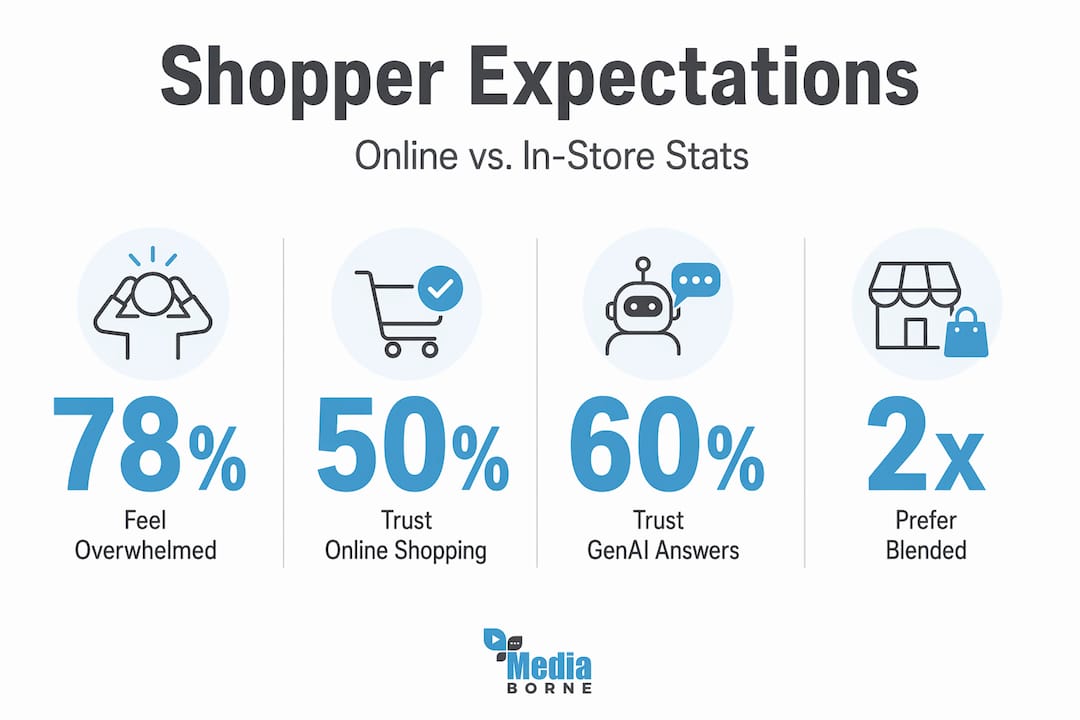
The fix is not a simpler website layout. It is a fundamentally different approach to how content guides the shopper through a decision. Consider what the best physical retailers do instinctively: they curate, they tell stories through display, and they create moments of discovery. That same logic needs to live inside your digital channels, and entertainment-led engagement strategies are one of the most direct ways to replicate it.
What shoppers now expect across both channels:
- Curated choices that respect their time and reduce decision fatigue
- Stories that give products meaning beyond specifications and price
- Personalised signals that show the brand understands their context
- Discovery moments that feel earned rather than algorithmically forced
- Consistent identity whether they encounter you on Instagram, in-store, or through a search engine
"The brands winning right now are not the ones with the most products or the biggest ad budgets. They are the ones who have mastered the art of making discovery feel effortless." This is the standard your content strategy needs to meet.
Storytelling in marketing is not a soft, brand-awareness luxury. It is the mechanism that transforms a product grid into a shopping destination. Pair it with structured content hubs boosting engagement and you begin to see how editorial thinking translates directly into commercial outcomes.
Pro Tip: Before auditing your product content, audit the emotional arc of your digital channels. Ask: does a shopper who arrives with low intent leave with genuine curiosity, or just a longer browser history?
Leveraging AI and generative tools for trusted product discovery
Generative AI has moved from a novelty to a trusted purchase touchpoint faster than most marketing teams have adapted. GenAI shopping use grew 35% in 2025, with over 60% of consumers expressing high trust in AI-generated results. That trust level rivals or exceeds what many brands have built over years of advertising. It demands attention.
The reason consumers trust AI for purchasing decisions is specific: AI gives them clear, unbiased comparisons without the sales pressure embedded in branded content. It synthesises fragmented product information into a coherent answer. If your product content is not structured to feed that synthesis cleanly, you are effectively invisible in a channel that is growing at pace.
Here is how to adapt your product content for AI-driven discovery:
- Write modular product descriptions. Short, factual, answer-ready blocks of text are easier for AI to extract and present than long narrative paragraphs. Each block should answer one question: what it is, what it does, who it is for, and what makes it different.
- Lead with comparative clarity. AI surfaces products that make comparison easy. Include explicit comparisons to your own product range and use consistent attribute labelling so AI can contextualise your offer.
- Invest in structured data markup. Schema markup for products, reviews, availability, and pricing gives AI crawlers the machine-readable signals they need to include you in generated results.
- Build trust signals into the copy itself. Third-party endorsements, verified reviews, and certification data carry weight when AI is assessing what to recommend.
- Audit regularly. AI models update constantly. A product page that surfaces well today may not in three months. Build AI-readiness into your quarterly content review cycle.
The brands that will dominate AI-assisted discovery are not necessarily the ones with the biggest catalogues. They are the ones whose product content is so clear and well-structured that an AI can act as their best salesperson.
The implications for media production and GenAI are significant. Video and visual content increasingly needs companion text that AI can read. A stunning product video with no structured description is a missed opportunity in every AI-powered channel.
Pro Tip: Run your top ten product pages through a generative AI tool and ask it to summarise the product and compare it to competitors. If the output is vague or inaccurate, your content is under-serving AI discovery and almost certainly under-serving human shoppers too.
Connecting physical and digital discovery through integrated wayfinding
Navigation rarely gets talked about in marketing strategy meetings, but it is one of the highest-leverage levers in improving store experience. Shoppers who cannot find what they are looking for do not just leave frustrated: they leave without buying, and they are unlikely to return. Navigation is not a facilities management problem. It is a conversion problem.
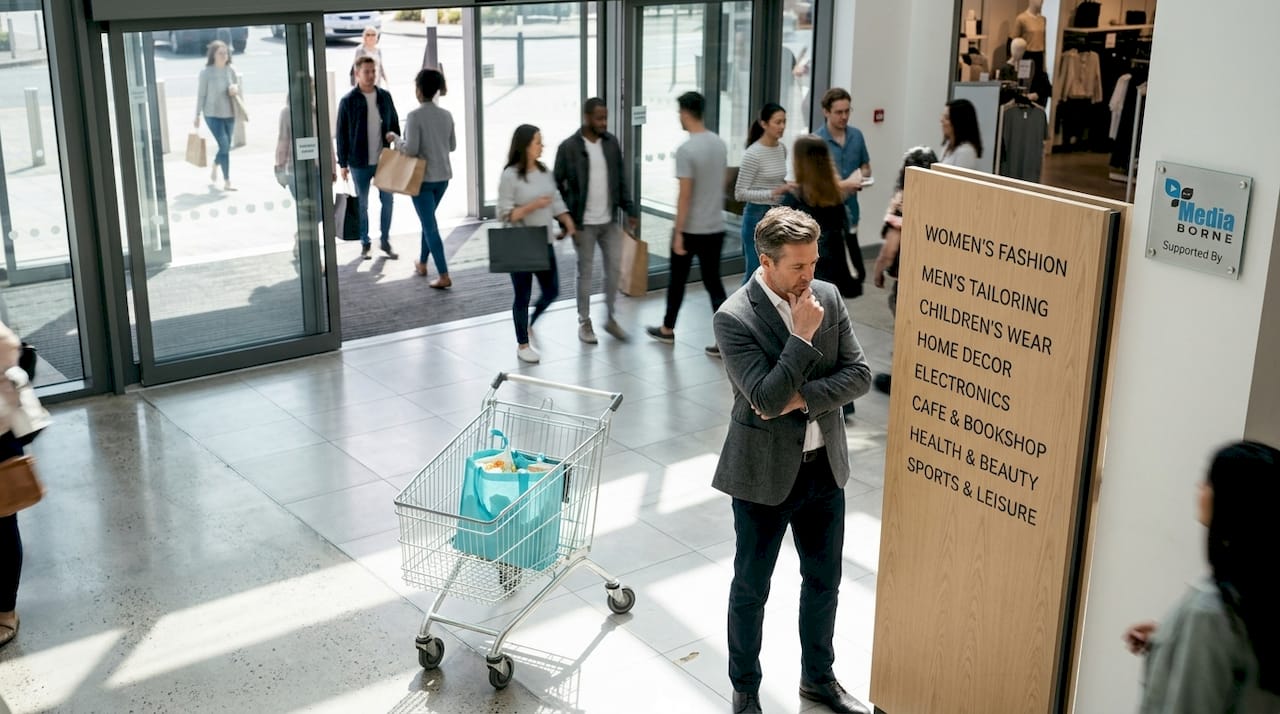
Real-time navigation and digital layers facilitate discovery and contextual promotions in physical retail environments in ways that static signage simply cannot. A digital wayfinding system linked to your promotional calendar can surface a relevant offer precisely when and where a shopper is most receptive to it. That is not a gimmick; it is applied behavioural logic.
The practical benefits of integrated wayfinding:
- Reduces the time shoppers spend searching, freeing attention for discovery
- Creates natural touchpoints for contextual promotions and product recommendations
- Generates movement data that informs category placement and store layout decisions
- Bridges the gap between online browsing and physical purchase by allowing shoppers to locate items they saved digitally
| Wayfinding approach | Shopper benefit | Marketing opportunity |
|---|---|---|
| Static signage only | Basic orientation | None |
| Digital maps (app-based) | Efficient navigation | Push notifications and offers |
| Integrated digital and physical | Frictionless discovery | Contextual, real-time promotions |
| AI-assisted personalised routing | Curated in-store journey | Personalised product surfaces |
The table above shows why integration is not optional for brands serious about enhancing retail experience. Every layer you add converts passive navigation into active engagement. Linking this infrastructure to your product discovery strategies means the insight you generate in-store feeds back into your digital channels, creating a loop rather than a dead end.
Pro Tip: Map your store visit as if you were a first-time shopper with a specific item in mind but no prior knowledge of the layout. Count how many friction points you encounter before you reach the product. Each one is a drop-off waiting to happen online and offline.
Unlocking social commerce potential with live shopping formats
Live shopping is the format that makes every other social commerce tactic look cautious by comparison. The numbers are hard to ignore: Instagram Live Shopping drives 5 to 8 times higher conversion rates than standard shoppable posts when product reveals, live interactions, and real-time offers are synchronised. That gap does not close over time. It widens as audiences become more conditioned to expect the energy of a live event.
What makes live shopping work is the same thing that makes great retail theatre work: scarcity, social proof, and immediacy. When a product drops in a live session, the clock is running, the comments are visible, and the presenter is responding in real time. Shoppers cannot defer the decision without losing it. That is not manipulation; it is good event design applied to commerce.
How to build a live shopping event that actually converts:
- Script the reveal sequence, not the whole session. Audiences can sense when a host is reading from a script. Plan your product reveals tightly, but let the conversation breathe.
- Synchronise inventory before you go live. A product that sells out mid-session with no live update destroys trust faster than any PR incident. Build a direct integration between your commerce platform and your live dashboard.
- Use comment interaction as social proof, not just engagement. When a host reads out a genuine comment from a viewer who just purchased, it triggers the social validation instinct in everyone watching.
- Tease before you go live. Your pre-event content drives your peak audience. A countdown, a behind-the-scenes clip, or a partial product reveal in the 24 hours before the session can double your opening viewership.
- Repurpose the live content immediately. The session does not end when you go offline. Clip the best reveals, the strongest testimonials, and the most engaging exchanges for post-event distribution.
Live commerce strategies are not a single channel tactic. They sit at the intersection of content production, community management, and commerce infrastructure, which is exactly why brands that treat it as a social media experiment rarely see the results that brands with production-level commitment do.
Pro Tip: The first 60 seconds of a live shopping session determine your audience retention for the entire event. Open with the most visually compelling product in your line-up, not the best value one. Attention first, conversion second.
Navigating the post-pandemic shopper journey: balancing efficiency and excitement
Post-pandemic consumer behaviour did not simply return to normal. It recalibrated. Shoppers have shifted to mission-driven shopping with less time spent browsing in-store but a persistent desire for discovery in both online and offline environments. The mistake many brands made was reading "less time in-store" as "less interest in experience." Those are not the same thing.
The shopper who spends 20 minutes in-store instead of 45 has not stopped wanting to be delighted. They are just less patient with friction. Your job is to remove the friction while preserving the delight. That is the brief in full.
Strategies that balance efficiency and excitement:
- Use content curation to pre-filter choices before the shopper enters the decision stage
- Build editorial moments into your category pages, not just your campaign landing pages
- Use entertainment-led social media to generate anticipation before a shopper ever arrives at the point of purchase
- Design your loyalty mechanics around discovery, not just repeat purchase
| Shopper expectation | Efficiency-first response | Excitement-first response | Balanced response |
|---|---|---|---|
| Too many choices | Filter and sort tools | Curated collections | Curated collections with editorial context |
| Lack of engagement | Faster load times | Immersive content | Fast-loading immersive micro-content |
| No personalisation | Recommendation algorithms | Tailored storytelling | Algorithmically triggered story content |
| Weak loyalty | Points programmes | Exclusive experiences | Exclusive early access with content reward |
A content strategy that only serves one side of this table is leaving conversions on the table. The brands building loyalty in the current environment are the ones who understand that efficiency and excitement are complementary, not competing.
Rethinking shopping experience strategies: beyond the convenience-excitement paradox
Here is the uncomfortable truth most retail marketing frameworks miss: treating convenience and excitement as separate strategic pillars is itself the problem. You see it everywhere. Efficiency KPIs in one team, brand and content in another. A CRO programme running parallel to an entirely separate brand storytelling effort. These functions rarely talk to each other, and shoppers pay the price with experiences that feel either clinical or chaotic.
The real opportunity is in the synthesis. When a product page loads in under two seconds, leads with a 15-second editorial video, and surfaces AI-ready structured content below the fold, it serves the mission-driven shopper and the discovery-seeking shopper simultaneously. That is not a compromise. It is a genuinely better product page.
The AI dimension makes this more urgent, not less. With over 60% of consumers expressing high trust in GenAI results, the content you publish today is being read, summarised, and presented by AI systems to shoppers who may never visit your website directly. If that content is structured only for human readers browsing sequentially, it will underperform in AI-mediated discovery. If it is structured only for machine parsing, it will feel sterile to the humans who do arrive.
The solution is to build content that reads like a knowledgeable friend and is structured like a database entry. Warm, specific, story-led copy at the surface. Clean, modular, attribute-rich data underneath. That duality is what innovative customer engagement strategies look like in practice, not in theory.
The brands that will define the next era of retail are not waiting for a single transformative technology to arrive. They are building the infrastructure to serve shoppers wherever attention lives, and producing the content quality to hold it. That is the real competitive advantage in 2026.
Enhance your shopping experience with Media Borne services
If the strategies in this article have clarified what your brand needs to do next, the practical question is how to produce content at the quality and volume those strategies require.
Media Borne's video production services are built for exactly this: creating editorial-grade content that serves both human engagement and AI discovery. If live shopping is the format you are ready to build around, our social selling video production team works directly with commerce platforms to produce live events that convert. For brands exploring physical and digital integration, our virtual and immersive video production capability turns product environments into interactive discovery experiences. Whichever channel is your priority, we build the content infrastructure to make it perform.
Frequently asked questions
How can marketing professionals reduce consumer overwhelm in online shopping?
By curating product selections to present fewer but better options combined with storytelling, rather than large unfiltered catalogues. With 78% of shoppers already feeling overwhelmed by choice online, editorial curation paired with narrative context is the most direct route to re-engagement.
What role does generative AI play in the modern shopping experience?
Generative AI acts as a trusted guide by providing clear, unbiased comparisons and personalised recommendations that help consumers gain confidence before purchasing. With more than 60% of consumers expressing high trust in GenAI results, brands that structure their content for AI-readiness will reach shoppers earlier and more credibly in the decision journey.
Why is integrating physical wayfinding with digital content crucial in retail?
Because seamless navigation removes the friction that causes shoppers to leave without buying, while simultaneously creating contextual moments for discovery and promotion. Navigation as the foundation of retail customer experience means every improvement to it compounds across dwell time, basket size, and return visits.
How do live social commerce formats affect conversion rates?
Live shopping formats with interactive product reveals, real-time engagement, and synchronised inventory consistently produce results well above standard shoppable posts. Instagram Live Shopping drives 5 to 8 times higher conversion rates, a gap that reflects how live events compress the consideration stage by combining social proof, scarcity, and immediacy in a single session.