

TL;DR:
- Effective product discovery now relies on entertainment-driven content formats like short videos, creator reviews, and live streams, rather than traditional catalogs. Bridging engaging social content with structured on-site taxonomy and attribution systems is essential for converting interest into sales. Investing in professional video and integrated brand strategies enhances discovery outcomes across platforms, resulting in measurable commercial growth.
Most e-commerce brands are still posting product shots on social media and wondering why the numbers stay flat. The problem isn't the product. It's the format. Social media commerce works best when content is native to the feed, not a digital leaflet dropped into someone's scroll. Audiences on TikTok, Instagram, and YouTube aren't in browsing mode the way they are on your website. They're in entertainment mode. Brands that understand this shift are not just getting more views — they're driving measurable product discovery that leads directly to sales.
Table of Contents
- What is product discovery in modern e-commerce?
- How entertainment drives discovery on social platforms
- Comparing platform outcomes: TikTok Shop vs Instagram Shopping
- Making discovery measurable: Attribution and the feedback loop
- Beyond social: On-site discovery and the core role of taxonomy
- Our perspective: Why product discovery must bridge entertainment and structure
- Power up your product discovery with professional video and social selling
- Frequently asked questions
Key Takeaways
| Point | Details |
|---|---|
| Native entertainment wins | Product discovery driven by native, entertaining social formats outperforms static listings. |
| Platform choice matters | Select platforms and content formats based on product type, price, and target demographic for highest conversion. |
| Measure everything | Operationalise discovery with attribution systems linking social content to sales and retention. |
| On-site discovery closes the loop | Sophisticated filters, taxonomy, and structured data increase conversion from discovery to purchase. |
| Blend creativity and rigour | Brands succeed by combining entertainment-led discovery with systematic back-end structure for best results. |
What is product discovery in modern e-commerce?
Product discovery is the moment a potential customer becomes aware of and interested in a product they weren't actively searching for. Historically, this happened through digital catalogues, paid search ads, and on-site browse navigation. You built a well-organised product listing, optimised for keywords, and hoped the right person landed on it. That model still has its place, but it's no longer the primary driver of discovery for most consumer categories.
In 2026, discovery is happening in feeds. It's happening through entertainment-led social media, creator reviews, and live shopping events. The customer journey now often starts with a thirty-second video that makes someone laugh or feel something, and ends with a purchase they weren't planning to make that morning.
The formats driving this shift include:
- Short-form video that demonstrates a product in an authentic, entertaining context
- Creator reviews that carry social proof and personal credibility
- Live shopping streams where hosts show products in real time and answer questions
- User-generated content (UGC) that makes real customers the storytellers
"Discovery is no longer just about catalogue navigation — native formats like creator reviews or live streams are now key."
Understanding this shift is the first step. The next is knowing how to build content that actually performs within these formats, because the platforms reward native behaviour heavily. Following social media growth principles and strong social video engagement strategies will help you build a content approach that feels natural on each platform rather than forced.
How entertainment drives discovery on social platforms
Once you understand that discovery now lives in entertainment formats, the logical next question is: which types of entertainment content actually move the needle? The answer is more nuanced than "make a funny video." Specific formats trigger specific behaviours, and knowing the difference shapes your entire content strategy.
Native, feed-integrated content is the foundation. Short, in-feed content consistently outperforms traditional listings, and participatory features like AR try-ons and polls boost purchase intent significantly. When a customer can virtually try on a product or vote on which colour to launch next, they move from passive observer to active participant. That shift in behaviour is enormously powerful.
Creator-led formats extend reach beyond your own following. Algorithms reward content tied to creator trends and feed visibility, meaning that a well-briefed creator can place your product in front of audiences you'd never reach through your own channel. The trust a creator carries with their audience transfers to your brand in a way that a paid ad simply cannot replicate.
Here's a comparison of how different entertainment formats perform across key discovery metrics:
| Format | Discovery reach | Purchase intent | Trust factor |
|---|---|---|---|
| Short-form native video | Very high | High | Medium |
| Creator review/unboxing | High | Very high | Very high |
| Livestream shopping | Medium | Very high | High |
| AR try-on or poll | Medium | High | Medium |
| User-generated content | High | High | Very high |
UGC in particular is underused by most brands. When real customers create content around your product, it does three things at once: it builds trust, it increases shareability, and it provides fresh creative material you can repurpose. Brands that build UGC into their product launch strategy consistently outperform those that don't.
The social video marketing ROI case for entertainment-led formats is strong. Combining high-quality social media video production with a deliberate distribution strategy produces compounding returns. And if you're building content hub engagement, entertainment formats serve as the top-of-funnel content that draws audiences into a wider ecosystem.
Pro Tip: Brief your creators with a clear product truth, one memorable detail that makes the product worth talking about. Then let them translate it into their own voice. Over-scripted content kills authenticity, and authenticity is precisely what drives discovery. For more on building creator content, explore advanced social content frameworks that balance creative freedom with brand consistency.
Comparing platform outcomes: TikTok Shop vs Instagram Shopping
Knowing that entertainment drives discovery is useful. Knowing which platform to prioritise for which product is where strategy gets precise. TikTok Shop and Instagram Shopping are not interchangeable, and the data makes that very clear.
Across 52 e-commerce brands, TikTok Shop averaged a 4.7% conversion rate compared to Instagram Shopping's 2.3%. That's a meaningful difference, but the context matters enormously. TikTok's strength is with 18 to 24 year olds and impulse-friendly products at lower price points. Instagram performs better for the 25 to 34 demographic and for products that require more consideration before purchase.
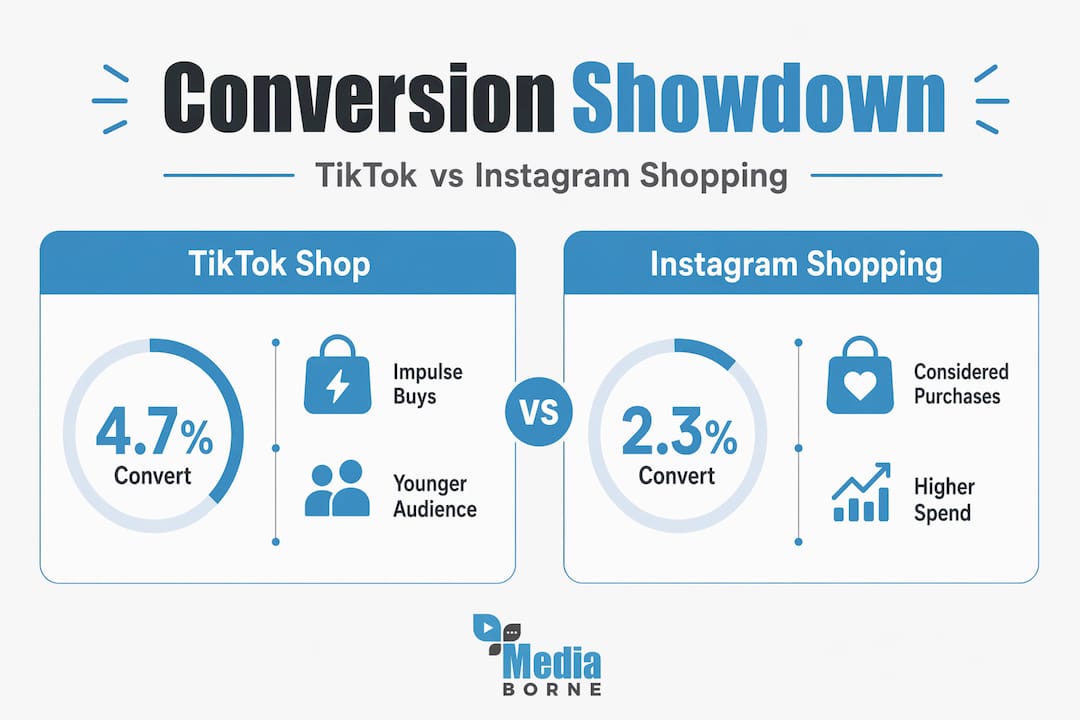
| Platform | Avg. conversion rate | Best product type | Core demographic | Strength |
|---|---|---|---|---|
| TikTok Shop | 4.7% | Impulse, novelty, lower price | 18 to 24 | Discovery speed, virality |
| Instagram Shopping | 2.3% | Lifestyle, aspirational, repeat | 25 to 34 | Brand aesthetics, retention |
This isn't a case of one platform winning. It's a case of choosing the right tool for the job. Consider the following when deciding where to prioritise your spend:
- Price point: Sub-£50 products tend to convert faster on TikTok; higher-ticket items often perform better on Instagram
- Category: Beauty, gadgets, and food perform exceptionally on TikTok; home, fashion, and wellness have stronger communities on Instagram
- Purchase frequency: First-time impulse buys suit TikTok; repeat-purchase relationships tend to build better on Instagram
- Creative capacity: TikTok demands higher content volume and faster iteration; Instagram rewards consistency and visual brand identity
Using platform-specific strategies that account for these differences is essential. If you're launching a new product in a category with strong viral potential, TikTok should anchor your initial discovery push. If you're building long-term brand equity with an audience that researches before buying, Instagram Shopping provides the infrastructure for that journey. For a detailed breakdown of how to implement these tactics, the TikTok e-commerce strategies guide covers the specific formats and posting approaches that drive results.
Making discovery measurable: Attribution and the feedback loop
Most marketing managers understand that discovery is important. Far fewer have a system that proves it's working and feeds those insights back into product and content decisions. This is where discovery programmes often fall apart: brilliant creative, no measurement.
The most effective approach is to treat discovery as a system that links signal capture, decision-making, and delivery across analytics. In plain terms, that means building a workflow where what you learn from social performance informs what you create next, which products you push, and how you optimise the on-site experience.
Here's a practical four-step process to build that system:
- Capture signals: Track which content formats, creators, and products generate the most saves, shares, and click-throughs across each platform.
- Categorise intent: Separate passive engagement (views, likes) from active intent (link clicks, saves, product page visits) so you're optimising for the right metric.
- Close attribution gaps: Track delayed behaviour such as social-to-search journeys and creator influence using UTM parameters, promo codes, and post-purchase surveys.
- Feed insights forward: Use what you learn to brief your next wave of creative, adjust your product prioritisation, and refine which platform gets which budget.
Attribution is not just a reporting exercise. It is the mechanism by which discovery earns its place in the marketing budget and proves that entertainment is a commercial investment, not a brand-building luxury.
The creator economy strategies that work best are built on this feedback loop. Creators who consistently drive attributed sales get more briefs and bigger budgets. Those who generate vanity metrics get rotated out. That kind of rigour, applied consistently, is what separates brands with growing discovery programmes from those chasing trends without commercial returns.
Strategic brand partnerships also play into this system. When you co-create discovery content with a complementary brand, you access their audience, their attribution data, and their creative assets simultaneously. For a broader view of how this connects to your marketing funnel insights, understanding the full journey from awareness to purchase helps you identify exactly where discovery is contributing.
Pro Tip: Set up a unique promo code for every creator and every platform. This creates clean, straightforward attribution even when customers don't click a direct link. It also gives you genuine data on which partnerships are driving revenue versus which are generating noise.
Beyond social: On-site discovery and the core role of taxonomy
Here's a scenario that plays out constantly across e-commerce brands. A customer watches a creator video, gets genuinely excited about a product, clicks through to the website, and then loses the thread entirely. The search returns irrelevant results. The filters don't match how they think about the product. They leave. The sale is lost, despite a perfect discovery moment on social.

Attribute-level matching, disciplined taxonomy, and structured data prevent exactly this kind of drop-off and directly increase conversion rates. Taxonomy, which is the way you categorise and label your products, is not just a navigation tool. It is a discovery tool. When your product attributes reflect the language and context customers bring from social, the on-site experience feels seamless rather than jarring.
Practical fixes for on-site discovery include:
- Audit your filters to ensure they reflect how customers actually describe products on social (not just how your buying team categorises them internally)
- Enrich product attributes with details that creators and customers are already using in content, such as skin type, occasion, or use case
- Implement structured data (schema markup) so search engines can surface the right products for discovery-intent queries that come from social research
- Create landing pages that mirror the creative context of specific campaigns, so the click-through experience continues the story the creator started
Pro Tip: Review your top-performing social content and note the specific words customers and creators use to describe your products. Then check whether those exact words appear in your filters, categories, and product descriptions. The gap between those two lists is your on-site discovery problem.
This step is often overlooked because it feels less exciting than producing a viral video. But without it, your social investment consistently underperforms at the point of conversion.
Our perspective: Why product discovery must bridge entertainment and structure
We see brands fall into two camps. The first invests heavily in creative, gets strong social engagement, and then loses customers the moment they hit the website because the on-site experience doesn't match the promise of the content. The second obsesses over taxonomy, filters, and SEO, builds a beautifully structured site, and then generates no meaningful traffic because their social content is indistinguishable from a product brochure.
Neither camp wins alone. The brands driving genuine growth understand that discovery is not a single moment — it's a system across touchpoints. Entertainment-first approaches unlock interest, generate awareness, and create the emotional context that makes a product worth wanting. But structure converts that interest. Taxonomy, attribution, and on-site experience complete the journey.
The uncomfortable truth is that most marketing teams are organised in a way that makes this integration difficult. Social teams optimise for engagement. E-commerce teams optimise for conversion. Product teams optimise for catalogue management. Each group is doing their job well, and yet the customer experience falls apart at every handover point.
Winning brands break those silos deliberately. They build shared KPIs between social and e-commerce. They brief creators with on-site context in mind. They use discovery insights to inform product development, not just content calendars. This is not a creative problem or a technical problem. It is an organisational problem dressed up as both, and solving it requires leadership that sees the full journey.
Power up your product discovery with professional video and social selling
If this article has made one thing clear, it's that the quality of your creative is a direct lever on the quality of your discovery outcomes. Scrappy content can work in the right context, but brands that invest in professional video production with a social-first strategy consistently outperform those that don't.
At Media Borne, we build professional video production and social selling video solutions that are designed specifically to drive product discovery on the platforms where your audience already spends their time. Our work sits at the intersection of entertainment and commerce, which means every piece of content we produce is built to attract attention and convert it. For brands looking to go further, our virtual immersive video services create the kind of interactive, high-engagement experiences that drive intent at the top of the funnel and confidence at the point of purchase. If you're ready to stop guessing and start building a discovery system that works, we'd like to help.
Frequently asked questions
What is the difference between native and traditional product discovery on social media?
Native discovery uses formats like creator videos and live streams that blend into feeds naturally, while traditional methods rely on separate listings that audiences tend to scroll past. Native, in-feed content consistently outperforms standalone listings for driving meaningful social discovery.
How can we measure the success of product discovery campaigns across social and site?
Use tracking links, promo codes, and post-purchase surveys to attribute conversions across platforms, then connect that data to on-site analytics for a full-funnel view. Discovery should link signal capture, content decisions, and delivery analytics as a unified feedback system.
What platform is best for product discovery: TikTok or Instagram?
TikTok Shop is often best for impulse buys and younger audiences, while Instagram Shopping tends to excel with higher-consideration purchases and users in the 25 to 34 age bracket. TikTok Shop drives higher conversion rates in impulse categories, while Instagram builds stronger long-term retention.
How does on-site discovery affect sales after social campaigns?
When filters, taxonomy, and structured data on your site reflect the language and context your social audience brings with them, click-throughs convert at a far higher rate. Well-structured taxonomy and filters prevent drop-off and directly raise conversion rates after social-driven traffic arrives.