

TL;DR:
- Audiences now prioritize entertainment over educational content, boosting engagement and virality.
- Brands like Duolingo succeed by leveraging memes, trend remixes, and cultural relevance on social media.
- Effective strategies combine entertainment-driven formats with platform-specific adaptation and agile iteration.
Informational content alone no longer cuts through the noise. Audiences scroll past polished blog posts and predictable brand updates without a second glance, yet they stop, watch, and share content that genuinely entertains them. Brands that have understood this shift are reaping extraordinary rewards. Duolingo's meme-led social strategy is perhaps the clearest example: by prioritising quirks and entertainment, the language app tripled its user base since 2021. This guide breaks down the mechanics of entertainment-led content strategy, contrasts different approaches, and gives you a practical framework for turning attention into measurable commercial outcomes on social media.
Table of Contents
- Why entertainment is reshaping content strategy
- Analysing top brand strategies: Entertainment-led vs education-driven
- Essential elements of a high-impact modern content strategy
- Using social media and video for exponential engagement
- The uncomfortable truth most experts won't tell you about content strategy
- Power your next strategy with creative experts
- Frequently asked questions
Key Takeaways
| Point | Details |
|---|---|
| Entertainment drives engagement | Brands prioritising entertainment in content see higher retention and virality than purely educational approaches. |
| Short-form video wins | Leveraging short, meme-friendly content on social media platforms boosts both user growth and brand awareness. |
| Mix strategy for full impact | Combine entertainment for reach and education for authority to maximise content ROI. |
| Frameworks beat guesswork | Structured planning and data-driven iteration help brands adapt to fast-changing media trends. |
| Be bold with content | The best results come from setting trends and daring to entertain, not just informing audiences. |
Why entertainment is reshaping content strategy
Audiences no longer come to brand channels expecting to be educated. They come expecting to be entertained. The shift is fundamental, and ignoring it is costly. When entertainment value drops, so does time-on-platform, and without time-on-platform, even the most carefully researched content becomes invisible.
The business outcomes from entertainment-driven strategies are hard to argue with. Consider what happens when a brand stops broadcasting and starts performing:
- Engagement rates spike when content feels spontaneous and culturally relevant
- Retention improves because audiences return for the next instalment, not just the next product launch
- Virality becomes achievable when the content itself is the reward, not the message behind it
- Community forms naturally around recurring formats, characters, and running jokes
Duolingo's numbers make this tangible. The brand tripled their user count by leaning into memes, absurdist humour, and culturally reactive content on TikTok. The result: 116 million monthly active users and $192.6 million in quarterly billings. That is not the outcome of a traditional content calendar.
"Audiences don't want to be spoken at. They want to be part of something worth watching."
This matters because it reframes what content strategy actually is. It is not just a publishing schedule. It is a creative and editorial decision about what kind of experience your brand offers. A well-executed social video strategy treats every piece of content as a performance opportunity, not just a communication touchpoint.
The brands winning in 2026 are also paying close attention to media production trends, adapting formats quickly rather than producing content in six-week cycles.
Pro Tip: When a cultural moment trends on your target platform, move within 24 hours. Remixing a trending audio or meme format with your brand's personality generates organic reach that no paid boost can replicate at the same cost.
Analysing top brand strategies: Entertainment-led vs education-driven
Not every brand should try to be Duolingo. But every brand should understand what Duolingo figured out, and then decide where on the spectrum they belong.
The two dominant approaches in modern content strategy are entertainment-first and education-first. Both work. Neither is universally superior. The difference lies in what you are optimising for.
| Dimension | Entertainment-first (e.g. Duolingo) | Education-first (e.g. LearningMole) |
|---|---|---|
| Primary goal | Virality, retention, brand love | Authority, trust, long-tail SEO |
| Formats | Memes, reaction videos, character-led shorts | Tutorials, explainers, long-form guides |
| Platform fit | TikTok, Instagram Reels, YouTube Shorts | YouTube, blog, LinkedIn, podcast |
| Growth model | Network effects and cultural momentum | Search visibility and referral traffic |
| Engagement type | Shares, comments, saves | Bookmarks, time-on-page, return visits |
Entertainment-prioritising brands excel at retention and virality, while education-centred brands rank strongly for authority and long-tail search. The smart move is understanding which is your primary growth lever right now.
"Don't pick a lane because it feels safer. Pick the lane that matches where your audience actually spends their attention."
Here is a numbered sequence for choosing your approach:
- Identify your primary growth objective: rapid awareness or sustained authority
- Audit where your target audience spends the most time online
- Assess your brand's existing personality and creative capacity
- Review competitor content performance across formats using platform analytics
- Choose a dominant mode, then test hybrid formats before committing fully
A short-form video guide can help you calibrate format decisions for social platforms, while a structured approach to content hubs supports the longer authority-building play.
Essential elements of a high-impact modern content strategy
Strategy documents are only as valuable as the execution frameworks inside them. In 2026, four elements separate high-performing content strategies from those that stall after the first quarter.
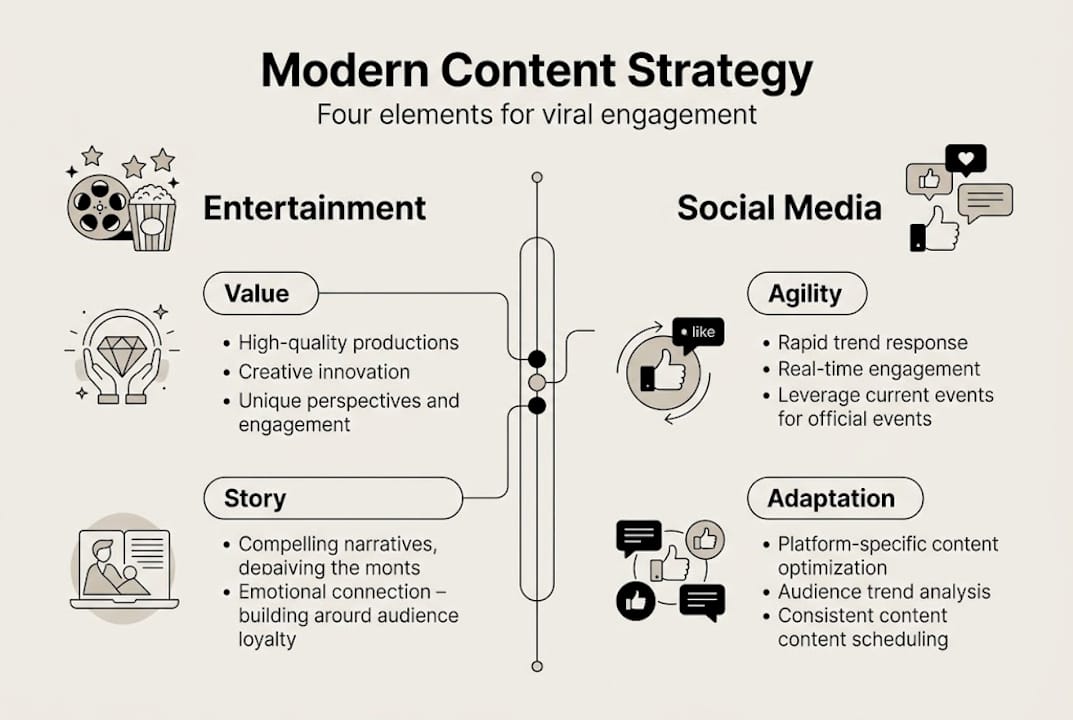
Entertainment value. Every content type, regardless of format, must have a reason for the audience to keep watching or reading beyond the first five seconds.
Platform-specific adaptation. A LinkedIn post and a TikTok video are not the same asset in different sizes. They require different tones, pacing, hooks, and calls to action.
Story arcs. Episodic content and serialised formats build habitual audiences. One-off posts get one-off attention.
Agile iteration. Short-form video and agile campaigns support higher engagement across social platforms precisely because they allow rapid testing and response.
| Content pillar | Best platforms | Core KPIs |
|---|---|---|
| Entertainment shorts | TikTok, Instagram Reels | Views, shares, completion rate |
| Authority articles | Blog, LinkedIn | Time-on-page, backlinks, organic traffic |
| Live formats | YouTube Live, TikTok Live | Peak viewers, comments, purchases |
| Community content | Instagram, Discord, YouTube | Replies, saves, community growth |
Here is a practical sequence for building your strategy:
- Define business goals: awareness, leads, sales, or retention
- Map your core audience segments and where they consume content
- Select two or three content formats that match your creative strengths
- Choose platforms based on audience behaviour, not personal preference
- Establish a publishing rhythm and stick to it for at least 90 days
- Monitor KPIs weekly and adjust formats based on what the data reveals
A thorough content production guide and current social media strategy tips can help you structure this process with more precision.
Pro Tip: Build feedback loops directly into your content calendar. Set aside time each fortnight to review audience comments, drop-off points in videos, and save rates. These signals tell you what the algorithm won't.
Using social media and video for exponential engagement
Social video is no longer a supporting channel. For most brands targeting under-45 audiences, it is the primary touchpoint. Getting it right requires more than good production quality. It requires a cultural sensibility that most traditional marketing teams are still developing.

Duolingo's rise offers the most instructive lesson available right now. The brand grew to 116 million monthly active users by mastering social video reactions, trend remixes, and absurdist character content on TikTok. The owl became a personality, not a mascot. That distinction matters enormously.
Here are the video content formats generating the strongest engagement for brands in 2026:
- Interactive short-form content: polls, response videos, and duets that invite audience participation
- Live Q&A sessions: real-time brand interaction that builds trust and community simultaneously
- Meme-driven formats: culturally reactive content that positions the brand as socially aware
- Behind-the-scenes content: human moments that reduce the distance between brand and audience
- Episodic series: recurring characters or segments that give audiences a reason to return
- Social selling formats: shoppable livestreams that convert entertainment into immediate commercial action
The mechanics of social media video production have evolved significantly. Audiences are sophisticated. They notice when content feels manufactured. Authenticity, speed, and cultural fluency now outperform high production values in most short-form contexts.
For brands looking to improve results from existing campaigns, optimising video campaigns is worth prioritising before creating more content. Volume without refinement is wasted effort.
Studying how to produce viral videos with a repeatable methodology gives your team a structured approach rather than hoping a video lands.
Pro Tip: Build your content calendar around platform-specific peak engagement windows. TikTok, Instagram, and YouTube each have distinct posting rhythms. Responding to comments within the first hour of publishing also signals to the algorithm that your content is generating genuine conversation.
The uncomfortable truth most experts won't tell you about content strategy
Most content strategy guides, including thorough and well-researched ones, share a common flaw. They encourage brands to spend more time on audience segmentation documents and less time on creative courage.
The brands generating the most attention in 2026 are not the ones with the most refined personas. They are the ones willing to be genuinely interesting. Duolingo did not succeed because their audience research was exceptional. They succeeded because someone decided to let the brand have a personality and back it with speed.
Authenticity and speed routinely outperform strategy documents. That is uncomfortable because it suggests that the answer is sometimes to act rather than plan. The brands investing in media production for brand growth are learning that the creative act itself is strategic.
Don't just join trends. Set them, and let fun be your competitive edge. The brands that will lead in this environment are the ones that stop asking "does this align with our brand guidelines?" first, and start asking "would a real person actually enjoy this?" first.
Power your next strategy with creative experts
If this guide has clarified what entertainment-led content strategy looks like in practice, the natural next question is how to actually build it within your organisation. Most marketing teams have the intent but lack the creative infrastructure and production speed to execute consistently at the level required.
At Media Borne, we help brands create content strategies and produce the entertainment-led formats that turn social media attention into measurable commercial results. From video production services designed for high-engagement social formats, to social selling video that converts audiences in real time, our team works with brands ready to stop interrupting entertainment and start becoming it. Get in touch to explore what bold, platform-native content could do for your growth.
Frequently asked questions
What is the most effective content strategy for social engagement in 2026?
Entertainment-led campaigns that leverage short-form social media videos are proven to drive the highest engagement and retention rates. Meme-rich content tripled Duolingo's user base, demonstrating the scale that entertainment-first strategies can achieve.
Should brands focus on short-form or long-form content in 2026?
Short-form excels at virality and audience engagement, while long-form content builds authority and supports organic search performance. The most effective strategies use both in complementary ways.
How can I adapt my brand's existing content for social media platforms?
Repurpose key content pillars into engaging, bite-sized formats tailored to each platform's trends and audience behaviour, prioritising hooks within the first three seconds.
What KPIs should I track in a modern content strategy?
Engagement rate, retention, shares, and video completion rate are now more critical than reach alone, as they reflect genuine audience interest rather than passive exposure.
Is entertainment suitable for B2B content strategy?
Yes, B2B brands consistently see better engagement and human connection with entertaining, personality-driven content, particularly on LinkedIn and YouTube formats.