

TL;DR:
- Brands succeed by creating valuable, ongoing content ecosystems instead of one-off ads.
- Content serves functions like education, community building, and direct conversion.
- Video, creator collaborations, and immersive media are key strategies for future engagement.
The brands winning audience attention right now are not the ones with the biggest ad budgets. They are the ones that have restructured their entire marketing approach around content. Short-form video, creator-led series, social storytelling, live commerce experiences: these are not add-ons to a campaign. They are the campaign. For marketing professionals and brand managers in entertainment and e-commerce, the shift is both urgent and genuinely exciting. This guide breaks down how content production drives audience engagement and conversion, what frameworks work in practice, and where the most forward-thinking brands are headed next.
Table of Contents
- Why content production matters: Moving from noise to impact
- Core functions of content production in brand and commerce growth
- How to align content production with engagement and conversion goals
- Future-proofing content: Video, immersive media, and creator collaborations
- What most guides get wrong about content production
- Expert support for next-level content production
- Frequently asked questions
Key Takeaways
| Point | Details |
|---|---|
| Content is a growth engine | Brands using owned, strategic content outperform those relying solely on traditional advertising. |
| Align with business goals | Effective content production links audience engagement directly to measurable conversions and retention. |
| Future trends matter | Video, immersive, and creator-led content are the fastest growing channels for 2026 and beyond. |
| Measure what matters | Tracking engagement, conversion, and retention yields the greatest content production ROI. |
Why content production matters: Moving from noise to impact
The average person now encounters thousands of brand messages every single day. Most of those messages are forgotten within seconds. Traditional interruption advertising, the 30-second spot, the banner ad, the sponsored post with no story attached, struggles to cut through precisely because it asks for attention without offering anything in return.
Content production flips that equation. When a brand produces something genuinely worth watching, reading, or sharing, it earns attention instead of buying it. That is a fundamentally different relationship with an audience, and it compounds over time in ways that paid media rarely does.
"Brands now act as media companies, leveraging creator and short-form strategies for engagement."
The most effective brands today are building owned content ecosystems: original series, recurring social formats, behind-the-scenes storytelling, and interactive community content. They are behaving less like product sellers and more like studios. This is what brand-led media looks like in practice, and it is producing measurable results across sectors.
Here is what separates brands that succeed with this model from those that do not:
- They prioritise depth of engagement over reach alone
- They build recurring formats, not one-off campaigns
- They treat their audience as a community to serve, not a demographic to target
- They produce content that reflects genuine insight into what their audience cares about
- They measure content performance against business outcomes, not just vanity metrics
One of the most common pitfalls we see is brands mistaking volume for strategy. Posting more content does not mean producing better content. In a saturated feed, the signal-to-noise ratio matters enormously. Brands that adopt branded content strategies built around a clear editorial perspective consistently outperform those chasing trend cycles without a coherent point of view.
Pro Tip: Before scaling your content output, audit your existing content for audience impact. Which pieces drove genuine engagement, conversation, or conversion? Build your production strategy around what already resonates, then amplify it.
Core functions of content production in brand and commerce growth
Content production is not a single activity. It serves distinct functions depending on where your audience sits in their relationship with your brand. Getting clear on these functions is what separates a scattergun content calendar from a genuine growth engine.

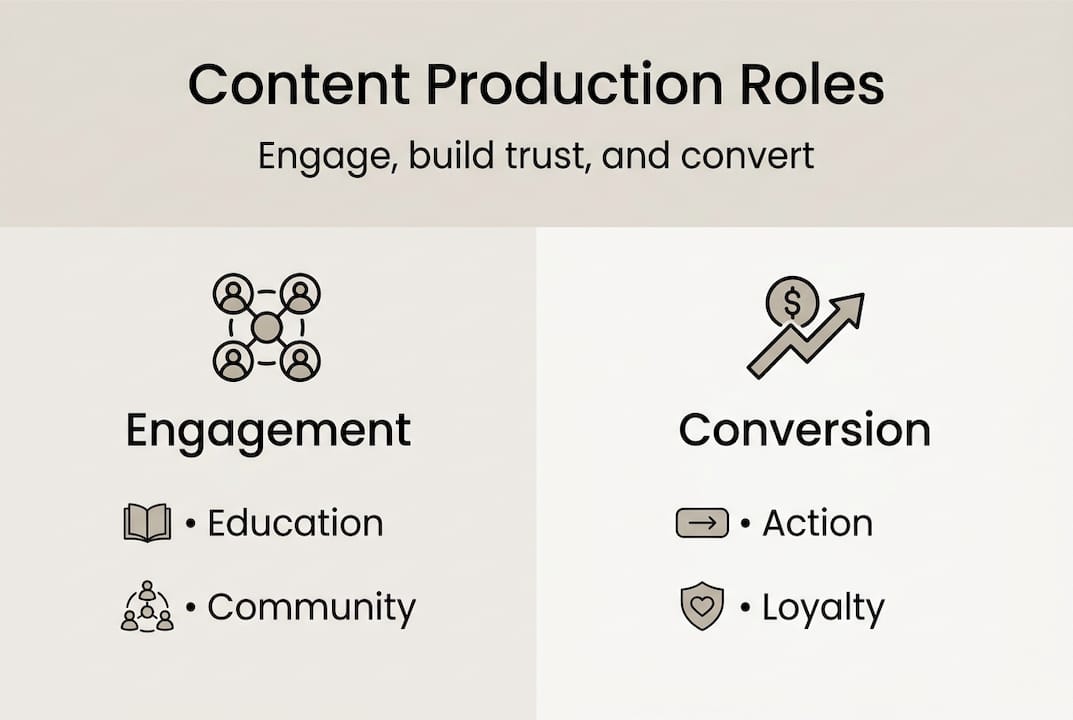
The three primary functions are education, community building, and conversion. Most brands overinvest in conversion-focused content and underinvest in the earlier stages that make conversion possible in the first place.
| Content type | Primary function | Business outcome |
|---|---|---|
| Long-form video / series | Community building | Brand loyalty, repeat engagement |
| Short-form social video | Awareness and discovery | Reach, follower growth |
| Blog and editorial content | Education and SEO | Organic traffic, trust |
| Live commerce / social selling | Conversion | Direct sales, basket value |
| Interactive and immersive content | Deep engagement | Time on site, brand affinity |
The marketing ROI from content production improves significantly when brands map content types to specific objectives rather than producing everything for a single vague goal. A documentary-style brand series does a different job to a 15-second TikTok. Both are valuable. But treating them interchangeably is where budgets get wasted.
What is particularly interesting is how brands that invest in content IP value are beginning to treat their studios as core infrastructure rather than a cost centre. NBC is a clear example. After restructuring their content strategy around in-house production capabilities and A/B testing user experience within their streaming app, they recorded measurable lifts in both viewership and audience retention. The content studio is now a strategic asset, not a line item to be trimmed.
Here is how to think about sequencing content production for commerce growth:
- Map your audience journey from first touchpoint to loyal customer
- Identify where audience drop-off occurs and which content type addresses it
- Assign a production format to each stage of that journey
- Establish baseline metrics for each content type before scaling
- Build in regular review cycles to iterate based on real performance data
Content production done at this level of intentionality transforms from a marketing support function into a genuine commercial driver.
How to align content production with engagement and conversion goals
Strategy without measurement is just guesswork. The brands that consistently outperform their peers on content are those that treat production as a testable, data-informed discipline rather than a creative exercise disconnected from commercial reality.
Start with your funnel. Each stage requires different content objectives and therefore different KPIs.
| Funnel stage | Content objective | Key metric |
|---|---|---|
| Awareness | Reach new audiences | Impressions, video views |
| Consideration | Build trust and interest | Time on page, saves, shares |
| Conversion | Drive action | Click-through rate, sales |
| Retention | Maintain relationship | Return visits, community growth |
The data on early engagement is particularly striking. Products with strong week-one engagement retain nearly 69% more users long term, and NBC's in-app content testing produced a 10% viewership lift alongside doubled retention rates. These are not marginal gains. They represent the compounding commercial value of getting early content experiences right.
This is precisely why strategic content planning needs to begin at the product and audience design stage, not as an afterthought once a campaign is already in motion.
For content teams looking to structure their approach practically, here is a working framework:
- Define SMART goals for each content format (specific, measurable, achievable, relevant, time-bound)
- Run controlled A/B tests on content variables: format, length, hook, posting time
- Use cohort analysis to understand retention patterns, not just snapshot engagement
- Build content hubs for conversion that aggregate your strongest performing content in one destination
- Review performance quarterly and reallocate production resources to what the data supports
Pro Tip: Do not wait for a full campaign to test. Even a single piece of content can be tested with two versions. Small, consistent tests build into significant strategic intelligence over time.
Future-proofing content: Video, immersive media, and creator collaborations
If you want to understand where content production is heading, watch where audience time is going. And right now, that means video. Short-form, long-form, live, interactive: video is not just dominant, it is accelerating.
But the real competitive edge is not simply producing video. It is producing video that earns a place in culture rather than interrupting it. That distinction matters enormously for brands in entertainment and e-commerce.
Here is where the most effective content investment is being directed in 2026:
- Short-form social video on TikTok and YouTube Shorts, optimised for discovery and shareability
- Creator partnerships with micro and mid-tier influencers who have genuine community trust
- Interactive and shoppable content that collapses the distance between inspiration and purchase
- Live social selling formats that combine entertainment with real-time commerce
- Serialised brand content that builds recurring audience habits around a format or character
Activation via creators and short-form content is particularly powerful for extending brand fandom into new communities. A creator with 80,000 highly engaged followers in a specific niche often drives more commercial value than a mass-reach placement with a fraction of the relevance.
Building a strong social video strategy requires understanding platform mechanics deeply, not just repurposing content across channels. A well-crafted short-form video guide can help teams produce formats that are native to each platform rather than retrofitted from longer productions. Once you have a library of content in market, the next priority is learning how to optimise video campaigns continuously based on performance signals.
Immersive and interactive content is the emerging frontier. Augmented reality experiences, choose-your-own-story formats, and gamified content are beginning to move from novelty to genuine engagement drivers, particularly for younger audiences.
Pro Tip: When entering a creator partnership, brief the creator on your brand's audience insight rather than your product features. Creators who understand why an audience cares about something produce far more effective content than those working from a product specification sheet.
What most guides get wrong about content production
Most content production advice focuses on tactics. Post more. Use trending audio. Batch your filming. These things are not wrong, exactly. But they miss the point.
The real question is not how to produce more content. It is how to produce content that builds something durable. Audience trust, brand affinity, community loyalty: these are not outcomes you can manufacture with a content calendar hack or a trending hashtag.
The brands we have seen produce genuinely outstanding results are those that treat content as a long-term asset, not a campaign expense. They think in terms of what their audience will still value six months from now, not what will capture attention this afternoon. That mindset shift changes everything: the formats chosen, the stories told, the creators partnered with, and the metrics used to measure success.
Measuring real ROI from content requires patience and the right attribution framework. The biggest trap is abandoning a content strategy before it has had time to compound. Attention, earned steadily through consistent, high-quality content, is the most valuable commercial asset a brand can build.
Expert support for next-level content production
If the frameworks in this guide resonate but the execution feels like a stretch with your current team and resources, that is a normal position for ambitious brands to be in. Production capability is a real barrier, and building it in-house takes time.
At Media Borne, we work with brands in entertainment and e-commerce to design and produce content that earns attention and drives measurable commercial outcomes. From video production services to creator-led formats and social selling videos, our team brings both creative and strategic depth to every project. Explore our project portfolio to see how we have helped brands build content ecosystems that genuinely convert. If you are ready to move beyond one-off campaigns, we would love to talk.
Frequently asked questions
How does content production differ from traditional advertising?
Content production creates sustained audience value and ongoing engagement, whereas traditional advertising typically delivers a single message within a fixed campaign window. Brands acting as media companies use content to build lasting relationships rather than interrupting audiences with one-off placements.
What metrics should brands track for content production success?
Brands should track engagement rates, retention, conversion, and content-attributed revenue across all funnel stages. The NBC example shows that structured testing produced a 10% viewership lift and doubled retention, demonstrating how content metrics connect directly to business outcomes.
Why is early engagement important for content retention?
Early engagement is the strongest predictor of long-term audience retention. Products with strong week-one engagement retain nearly 69% more users, making those first interactions critical to the overall content strategy.
What types of content are most effective for engagement in 2026?
Short-form video, creator partnerships, and interactive experiences consistently outperform static formats for audience engagement. Creators and short-form content are particularly effective at extending brand fandom into new communities and driving conversion.