

Most consumer brands are producing more content than ever, yet reaching fewer people who actually care. The social media landscape is noisier, faster, and more competitive than it was even two years ago. Getting cut through requires more than creativity. It demands a documented, repeatable strategy built around your audience and your goals. Brands with a documented content strategy are 414% more likely to report strong results than those who wing it. This guide walks you through a practical, step-by-step content production methodology designed to help consumer brands build genuine communities, drive meaningful engagement, and convert attention into commercial outcomes.
Table of Contents
- Clarifying your brand objectives and audience
- Building your content strategy and production framework
- Efficient creation and distribution: Batching, short-form video and visual storytelling
- Measuring success, learning, and iterating your content plan
- A reality check: What most guides won't tell you about content production
- Expert video production for next-level content
- Frequently asked questions
Key Takeaways
| Point | Details |
|---|---|
| Strategic goals first | Defining clear objectives and audience needs sets the foundation for effective content production. |
| Balance value and promotion | Use content pillars and the 80/20 or 70/20/10 rule to blend educational and promotional posts. |
| Efficiency through batching | Batch-produce content and repurpose assets to maximise impact and save time. |
| Measure and improve | Track performance and continuously improve your approach based on analytics and audience feedback. |
| Prioritise human creativity | Human-led, consistent execution outperforms trends or over-reliance on technology such as AI. |
Clarifying your brand objectives and audience
Every effective content programme starts with a deceptively simple question: what are we actually trying to achieve? It sounds obvious, but the majority of brands skip this step and jump straight to posting. The result is content that looks busy but moves nothing. Before you write a single brief or book a single shoot, you need to anchor your content to business goals.
Those goals might be growing brand awareness, increasing purchase frequency, launching a new product, or building a loyal community. The key is to be specific. "More engagement" is not a goal. "Increase comment rate by 20% over the next quarter" is. Once your objectives are clear, every content decision, from format to frequency, becomes easier to justify and measure.
Understanding your audience is the other half of this foundation. Solid audience analysis advice goes beyond demographic data. You want to know what your audience watches, shares, and talks about. What problems do they have that your brand can speak to? What tone of voice do they respond to? Use a mix of social listening tools, comment analysis, customer surveys, and platform analytics to build a genuine picture.
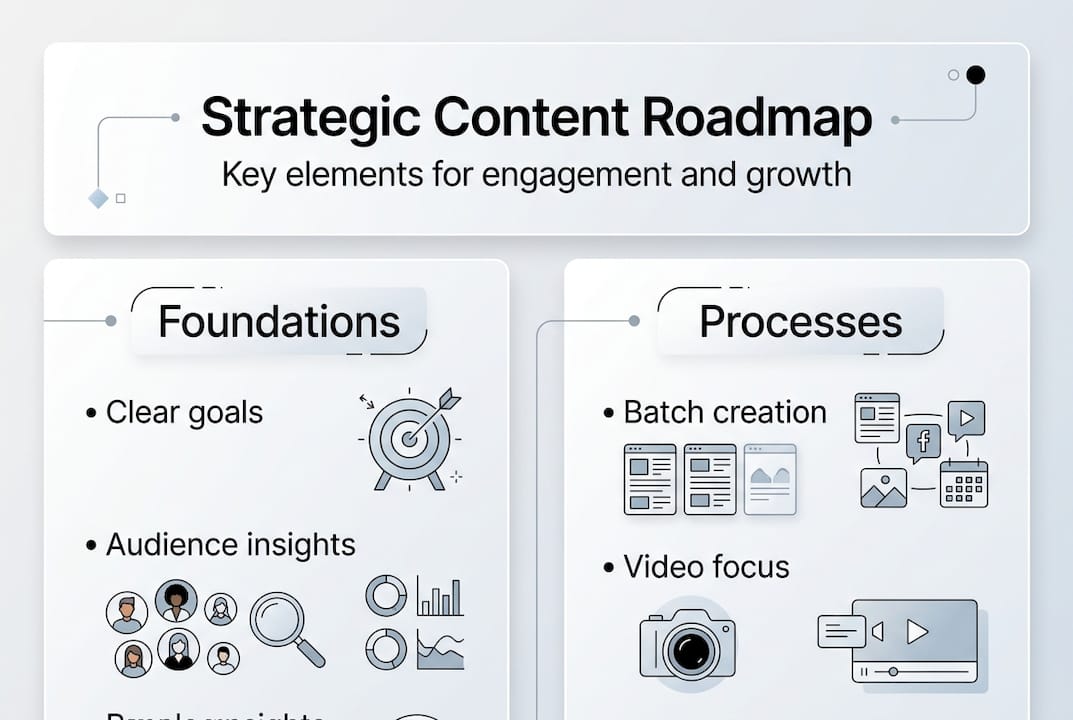
Once you have that picture, translate it into content pillars: three to five recurring themes that your brand will consistently own. These pillars act as guardrails, keeping your content focused and recognisable over time. A consumer food brand might build pillars around recipes, sustainability, behind-the-scenes production, and community stories. A fashion brand might focus on styling, values, cultural moments, and product drops.
As content production methodology confirms, defining goals and audience is the non-negotiable first step in any structured approach. Your pillars then inform which platforms make the most sense for your brand.
| Platform | Primary audience | Best content format | Relative ROI for consumer brands |
|---|---|---|---|
| 18 to 34 year olds | Reels, carousels, stories | Very high | |
| TikTok | 16 to 30 year olds | Short-form video | High and growing |
| 25 to 54 year olds | Video, community groups | High | |
| YouTube | Broad, 18 to 49 | Long and short-form video | High for discovery |
Pro Tip: Resist the urge to be on every platform at once. Pick two or three where your audience is most active and commit fully. Depth beats breadth every time. You can also explore using content hubs to organise your themes and make your content ecosystem more navigable for your audience.
Building your content strategy and production framework
With your goals and audience mapped, the next phase is to structure your content strategy into a workable, repeatable framework. This is where most brands either build real momentum or fall apart. The difference is almost always documentation and process.
Start with a content audit if you have existing material. What has performed well? What flopped? Look for patterns in format, topic, and timing. This gives you a baseline and prevents you from repeating mistakes. Then, using your content pillars, begin building a content calendar that maps themes to dates, campaigns, and platform-specific formats.
One of the most debated questions in content strategy is the right mix of value-led versus promotional content. Two models dominate:
| Model | Value or educational | Promotional | Experimental or community |
|---|---|---|---|
| 80/20 rule | 80% | 20% | Not specified |
| 70/20/10 rule | 70% | 20% | 10% |
The 80/20 content mix is the most widely adopted starting point. It keeps your feed useful and engaging rather than feeling like a catalogue. The 70/20/10 model adds a slice for experimental or community-driven content, which is particularly valuable if you are trying to build an active audience rather than just broadcast to one.
Here is a simple numbered workflow for setting up your production routine:
- Define your monthly content themes based on pillars and campaign calendar
- Brief all content formats (video, static, copy) at least two weeks in advance
- Schedule dedicated batching sessions to produce multiple assets in one go
- Review and approve content in a single weekly session
- Schedule posts using a platform tool and monitor performance in real time
Good planning of social content workflows is what separates brands that grow consistently from those that post reactively. And as industry data confirms, planning before execution is the foundation of outstanding ROI. A well-structured content marketing plan is the single most valuable document your team can build.
Pro Tip: Batch your content creation. Block out a full day or half-day each fortnight to produce multiple posts at once. You will save hours of context-switching and maintain a far more consistent posting schedule.
Efficient creation and distribution: Batching, short-form video and visual storytelling
A robust content plan is only useful if implemented efficiently. Here is how to turn your strategy into high-performing social posts at scale.
Batching is the single biggest productivity lever available to content teams. Rather than producing one post at a time, batching multiple posts in a single session lets you maintain creative momentum, reduce setup time, and stay ahead of your calendar. A brand that batches fortnightly will almost always outperform one that scrambles daily.

In terms of format, short-form video is the dominant force across every major platform right now. Instagram, Facebook, TikTok, and YouTube all prioritise it algorithmically, and consumer brands see the strongest ROI from Reels, TikToks, and YouTube Shorts. That does not mean abandoning carousels or static imagery. It means anchoring your strategy in video and supplementing with other formats.
Visual storytelling on social is a craft in itself. Here are the core principles that separate scroll-stopping content from forgettable posts:
- Hook in the first two seconds: the opening frame must earn the next five seconds of attention
- Prioritise authenticity over polish: real moments and genuine voices outperform overly produced content in most consumer categories
- Show, do not tell: demonstrate your product or values in action rather than describing them
- Use captions and text overlays: a significant proportion of social video is watched without sound
- End with a clear next step: every piece of content should have a purpose, whether that is a comment, a save, or a click
To boost video engagement consistently, your team needs both a creative eye and a systematic approach to production. Explore what high-impact social media videos look like in practice to benchmark your own output.
Pro Tip: Repurpose every asset across platforms. A single shoot can produce a TikTok, a Reel, a YouTube Short, a carousel, and a story series. Build repurposing into your brief from the start, not as an afterthought.
Measuring success, learning, and iterating your content plan
Launching content is just the start. To truly build a loyal community, you need a feedback loop that turns each campaign into learning for the next.
The metrics that matter most for consumer brands are not always the ones that look impressive in a deck. Vanity metrics like follower count tell you very little. Focus instead on:
- Engagement rate: comments, shares, and saves as a percentage of reach
- Reach and impressions: how far your content is travelling beyond your existing audience
- Share of voice: how your brand's conversation volume compares to competitors
- Conversion rate: how many content-driven visits result in a purchase or sign-up
- Saves and bookmarks: a strong signal that content has genuine utility or emotional resonance
Once you have data, the improvement cycle looks like this:
- Review performance weekly and monthly against your defined KPIs
- Identify your top three and bottom three posts and analyse the reasons
- Adjust your content mix, themes, or formats based on what the data shows
- Test one new variable per cycle, whether that is posting time, format, or hook style
- Document every change and its outcome so your learning compounds over time
"Brands with a documented content strategy are 414% more likely to report strong results."
As performance analysis guidance makes clear, the brands that grow fastest are those that treat every post as a data point. And strategy combined with analytics is what consistently drives outstanding ROI. Use tools like your platform's native analytics, alongside third-party dashboards, to build a clear picture. A strong video strategy for engagement and an understanding of YouTube for brand growth will help you iterate with confidence.
A reality check: What most guides won't tell you about content production
Here is the uncomfortable truth: most brands do not fail at content because they lack ideas or tools. They fail because they lack follow-through. The internet is full of frameworks, templates, and AI tools promising to solve the content problem. Very few of them address the real issue, which is consistency over time.
Human creativity, applied consistently and documented rigorously, is still the most powerful content engine available. Consumers actively prefer human-generated content, particularly when it comes to building trust and loyalty. AI has a genuine role in personalisation, scheduling, and automation. But the moment you outsource your creative voice entirely to a machine, you lose the one thing that makes your brand worth following.
Over-planning is also a real trap. Some teams spend so long perfecting their strategy document that they never actually ship content. The brands we see winning are those who document enough to stay aligned, then execute relentlessly and iterate fast. Your strategy is not a monument. It is a living document that gets better every time you review it.
The secret weapon is not a new platform or a viral trend. It is a team that shows up, learns from the data, and keeps going.
Expert video production for next-level content
Building a content engine that genuinely drives community growth and commercial results takes more than good intentions. It takes production quality, creative consistency, and the right strategic partnerships.
At Media Borne, our video production services are built specifically for consumer brands that want to scale their content impact without sacrificing quality. Whether you are looking to build a consistent social presence, explore social selling expertise, or simply see what is possible, our work speaks for itself. Browse our content success stories to see how we help brands turn attention into loyal audiences and measurable growth. Let us help you build content that earns its place in the feed.
Frequently asked questions
What are the first steps in content production for consumer brands?
Start by defining your objectives, identifying your audience, and auditing your existing content before structuring your plan. As structured methodology confirms, these foundational steps determine the quality of everything that follows.
How often should my brand publish content on social media?
Aim for a frequency that is consistent and sustainable rather than impressive on paper. A sustainable posting cadence supported by batching will always outperform sporadic bursts of activity.
What social platforms work best for consumer brands?
Instagram and Facebook deliver the highest ROI for consumer brands, with TikTok and YouTube also essential for short-form video reach. B2C ROI leaders show Instagram and Facebook each at 47.4%, making them the priority for most consumer categories.
Is AI-generated content more effective than human-produced content?
Consumers still show a clear preference for authentic, human-led creative work, particularly when it comes to building trust. Use AI for automation and personalisation, but keep your creative voice firmly human.