

Fragmented content workflows are quietly killing e-commerce growth. You publish sporadically, repurpose without strategy, and watch engagement flatline while competitors build loyal audiences. The fix is not more content. It is a smarter, structured process. A 6-layer workflow built for maximum ROI covers everything from strategy to refresh cycles, and it is the difference between content that converts and content that simply exists. This guide gives marketing teams a practical, entertainment-led roadmap to plan, execute, measure, and continuously improve content that genuinely moves the needle.
Table of Contents
- Understanding the content creation process in e-commerce
- Preparation: Building your content creation foundation
- Step-by-step: The e-commerce content creation workflow
- Innovative formats: Boosting engagement and conversions with entertainment-led content
- Measuring, optimising and refreshing your content process
- Supercharge your content with professional production and partnership
- Frequently asked questions
Key Takeaways
| Point | Details |
|---|---|
| Workflow structure drives ROI | A clear, layered process significantly boosts efficiency and conversion in e-commerce content creation. |
| Innovative formats perform best | Quizzes, polls, and interactive videos double engagement and deliver higher sales. |
| Measurement links to results | Connecting content tracking to sales ensures strategic decisions and better ROI. |
| Regular refresh maximises impact | Quarterly audits and updates keep your content relevant and high performing. |
Understanding the content creation process in e-commerce
A content creation process is not just a publishing schedule. It is the full system your team uses to move from a blank page to a piece of content that attracts, engages, and converts. In e-commerce, where buyer journeys are short and competition is fierce, that system needs to be airtight.
The 6-layer workflow covers strategy, production, and performance in a repeatable sequence. Each layer feeds the next, so nothing falls through the cracks. Without this structure, teams waste hours on content that never reaches the right audience at the right moment.
Here is what a well-built process looks like across its core stages:
| Stage | Key output |
|---|---|
| Strategy | Audience personas, revenue goals, topic clusters |
| Planning | Content calendar, briefs, platform assignments |
| Production | Written, video, and interactive assets |
| Distribution | Scheduled publishing across owned and paid channels |
| Performance tracking | Engagement, conversion, and buyer stage data |
| Refresh cycle | Updated or repurposed content based on analytics |
Every stage matters. Skipping distribution planning, for instance, means brilliant content sits unseen. Ignoring the refresh cycle means your best-performing pieces slowly decay in search rankings.
For teams producing video, building social video workflows into this structure is essential. Video is no longer optional in e-commerce content. It is the primary format for discovery and conversion on platforms like TikTok and YouTube. A strong video strategy for engagement should sit at the heart of your planning stage, not be bolted on as an afterthought.
Following calendar tracking best practices ensures your team stays aligned across formats and platforms without constant firefighting.
Preparation: Building your content creation foundation
With the main elements in mind, the next step is establishing the groundwork to ensure your content pipeline delivers results. Preparation is where most teams cut corners, and it shows in their output.
Start by picking your revenue goals and target segment. Then audit your assets and map buyer intent before writing a single word. This tells you what is working, what is missing, and where the biggest commercial opportunities lie.
Your content portfolio should follow a proven mix. Research recommends 40% discovery, 30% evaluation, 20% decision-support pages to cover every stage of the buyer journey. The remaining 10% can flex based on seasonal campaigns or new product launches.
Here is a practical toolkit for the preparation stage:
| Tool type | Examples | Purpose |
|---|---|---|
| Content calendar | Notion, Airtable, Trello | Topic, title, platform tracking |
| Analytics | GA4, Hotjar | Audience behaviour and performance |
| Design and editing | Canva, Adobe Premiere | Asset creation and brand consistency |
| SEO research | Ahrefs, Semrush | Keyword and intent mapping |
Building content hubs for engagement around your core product categories is one of the highest-ROI moves you can make at this stage. Hubs cluster related content together, boosting both search visibility and time on site.

Your social media strategy tips should also feed directly into your calendar, ensuring platform-specific formats are planned in advance rather than improvised.
The Shopify content marketing playbook offers additional frameworks for aligning content with commercial outcomes across different e-commerce categories.
Pro Tip: Map every planned topic to a specific revenue goal before it enters your calendar. If you cannot explain how a piece of content moves a customer closer to purchase, it probably does not belong in your pipeline.
Step-by-step: The e-commerce content creation workflow
Foundation established, it is time to dive into the actionable process that leading teams follow from start to finish. A 7-step framework built around goals, audit, intent, brief, production, distribution, and refresh gives your team a repeatable engine for consistent output.
- Set revenue-aligned goals. Define what success looks like in commercial terms, not just traffic or likes.
- Audit existing content. Identify gaps, underperformers, and hidden gems worth refreshing.
- Map buyer intent. Match topics to where customers are in their decision journey.
- Write detailed briefs. Include target keywords, format, tone, and conversion goal for every piece.
- Produce and review. Use templates to speed up creation without sacrificing quality.
- Distribute strategically. Publish across the right channels at the right times using your calendar.
- Measure and refresh. Track performance and update content on a scheduled cycle.
Different teams operate this workflow in different ways. Here is how the main approaches compare:
| Approach | Speed | Quality control | Scalability |
|---|---|---|---|
| Manual | Slow | High | Low |
| Semi-automated | Medium | Medium to high | Medium |
| AI-driven | Fast | Variable | High |
Assigning clear roles at each stage prevents the bottlenecks that stall most content teams. One person owns the brief, another owns production, and a third owns distribution. Overlap creates confusion.
Measurement should never be an afterthought. The teams that tie every piece of content to a specific conversion goal from the outset are the ones that consistently prove ROI and secure budget for more.
Pro Tip: Use a shared brief template with a mandatory "conversion goal" field. If the person writing the brief cannot fill it in, the topic needs rethinking before production begins.
For video-heavy workflows, video marketing tips and purpose-built advertising campaign videos can dramatically reduce production time while lifting quality. The structured workflow guide offers further detail on automating repeatable steps without losing creative control.
Innovative formats: Boosting engagement and conversions with entertainment-led content
With a clear workflow in place, you need modern formats that actually move the needle on engagement and conversion. Traditional blog posts and static product pages are no longer enough on their own.
Entertainment-led formats are outperforming conventional content across every metric. Interactive content delivers double the engagement and a 60% uplift in conversions compared to passive formats. That is not a marginal gain. That is a fundamental shift in what audiences expect.
Here are the formats delivering the strongest results right now:
- Quizzes and product finders: Casper's personalised quiz boosted sales by 40% and reduced returns by 25% by matching customers to the right product.
- Interactive video: Brands like Nike and Sephora use shoppable video to collapse the gap between discovery and purchase.
- User-generated content (UGC): Authentic customer content builds trust faster than any brand-produced asset.
- Polls and live Q&A: Real-time formats on TikTok and Instagram drive community and repeat visits.
- AR and AI-driven media: AI now powers over 50% of content creation in leading e-commerce brands, enabling personalisation at scale.
The numbers are striking. Interactive forms convert at 47.3% compared to just 2.8% for static equivalents. That gap alone justifies the investment in more dynamic formats.
Pro Tip: Start with one interactive format, a quiz or a poll, and measure its impact over 60 days before scaling. Small tests give you the data to justify bigger production budgets.
For brands ready to invest in high-quality interactive assets, social media video production and a refined interactive social video strategy are the fastest routes to measurable uplift.
Measuring, optimising and refreshing your content process
To guarantee return on your content investments, you must ensure consistent measurement and proactive evolution. Publishing without measuring is guesswork dressed up as strategy.
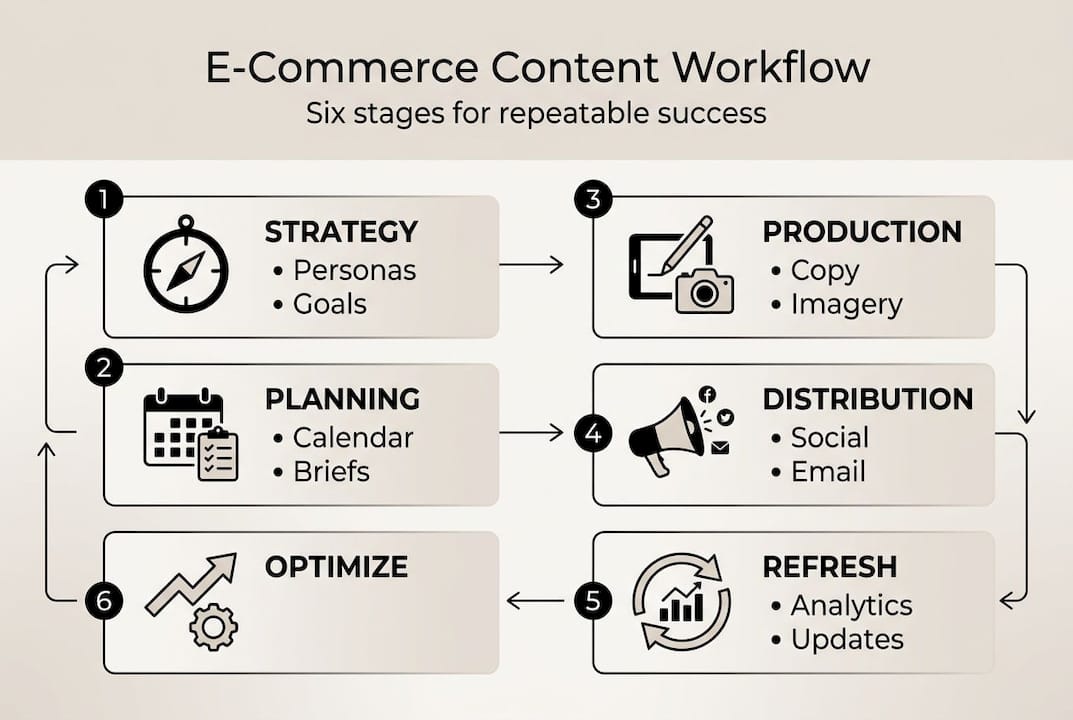
Measuring by cluster and buyer stage, then refreshing based on performance, is the key to long-term content value. It keeps your best assets working harder and surfaces the pieces that need attention before they drag down your overall results.
Focus on these core metrics:
- Conversion rate by content type and buyer stage
- Engagement rate (time on page, scroll depth, video completion)
- Organic traffic trends by topic cluster
- Assisted conversions showing content's role in multi-touch journeys
- Return on content investment across formats
Here is a quick reference for what to track and when:
| Metric | Review frequency | Action trigger |
|---|---|---|
| Conversion rate | Monthly | Below 2%: revise CTA or format |
| Organic traffic | Monthly | Declining 3+ months: refresh or consolidate |
| Engagement rate | Weekly | Below benchmark: test new format |
| Content ROI | Quarterly | Negative ROI: cut or repurpose |
Connecting your content calendar to conversion tracking with GA4 lets you tie specific topics and formats directly to completed sales. This is the evidence your leadership team needs to see.
Pro Tip: Set up GA4 conversion goals for each stage of your funnel, not just final purchase. This shows you exactly where content is accelerating or stalling the buyer journey.
Common optimisation pitfalls to avoid:
- Refreshing content based on gut feel rather than data
- Ignoring assisted conversions and attributing all value to last-click
- Treating all underperforming content the same rather than diagnosing the root cause
- Failing to update internal links when refreshing older pieces
Your social media strategy best practices should feed directly into your refresh cycle, ensuring platform algorithm changes are reflected in your content updates.
Supercharge your content with professional production and partnership
Building a structured, entertainment-led content process is one thing. Executing it at the quality and scale needed to compete in 2026 is another. That is where expert production support makes a genuine difference.
Media Borne works with e-commerce brands to bring these strategies to life through bespoke video production services, immersive 360 video production, and results-driven social selling video production. Whether you need a full content system built from scratch or a creative partner to elevate specific formats, the team combines production expertise with commercial strategy. The result is content that does not just look good. It converts. If you are ready to turn your content process into a genuine growth engine, exploring what a creative partnership looks like is a smart next step.
Frequently asked questions
What is the most effective content mix for an e-commerce site?
A balanced mix of 40% discovery, 30% evaluation, and 20% decision-support content ensures you are engaging buyers at every stage of their journey, not just at the point of purchase.
How can I track the impact of content on sales?
Connect your content calendar to conversion tracking in GA4 to directly tie specific topics and formats to completed sales and assisted conversions.
Do interactive formats really increase conversions?
Yes. Interactive content benchmarks show double the engagement and over 60% more conversions compared to static formats, making the investment straightforward to justify.
How often should e-commerce content be refreshed?
Review your analytics quarterly and refresh underperforming or outdated content based on performance clusters rather than arbitrary schedules.
Does AI really help with content creation in e-commerce?
By 2025, over half of content in leading e-commerce brands is powered by AI, improving both output volume and overall ROI significantly.