
TL;DR:
- In 2026, live, entertainment-driven social commerce replaces traditional direct sales, delivering significantly higher conversion rates.
- Consistent hosting, skilled presenters, and engaging content are essential to capitalize on this evolving sales landscape and reduce cart abandonment.
Direct sales used to mean door-to-door reps and catalogue orders. That picture is now so far from reality it borders on fiction. In 2026, direct sales is a live, interactive, entertainment-driven discipline happening in real time across TikTok, YouTube, and Instagram, and the numbers are extraordinary. Live shopping delivers conversion rates between 9% and 30%, compared with the 2% to 3% most e-commerce teams consider a success. This article walks you through the mechanics, the methodologies, and the strategic decisions that separate brands winning at social direct sales from those still waiting for their static product pages to convert.
Table of Contents
- The evolution of direct sales in e-commerce
- Key methodologies for high-conversion direct selling
- Live shopping and entertainment: Conversion benchmarks
- Audience targeting, platform choices, and risk management
- Scaling and sustaining innovation in direct sales
- Why direct sales is the future of e-commerce (and what most experts miss))
- Accelerate direct sales success with professional video and social selling support
- Frequently asked questions
Key Takeaways
| Point | Details |
|---|---|
| Social commerce drives results | Live shopping and entertainment formats can boost conversion rates up to 30% for e-commerce. |
| Consistency and hosting matter | Success hinges on running 3–5 value-driven live sessions each week with well-trained hosts. |
| Choose platforms strategically | Match your products and messaging to the right channels and blend owned and social media to reduce risk. |
| Scale with enablement tools | AI content, data-led targeting and sales enablement are critical for sustainable, large-scale direct sales. |
| Mitigate platform dependency | Diversify channels and capture data to protect against algorithm changes and platform risks. |
The evolution of direct sales in e-commerce
Now that we've seen the magnitude of sales shifts, let's define this new landscape.
Direct sales in e-commerce no longer means cutting out the middleman through a standalone website. Today it means owning the conversation with your customer at the point of discovery, consideration, and purchase, all at once, and usually while they're being entertained. Social commerce in 2026 relies on live shopping events, shoppable posts, and influencer integrations as its core mechanics, blending entertainment with real-time purchasing in ways that create urgency and social proof simultaneously.
This matters because urgency and social proof are two of the most powerful psychological triggers in purchasing behaviour. When a host demonstrates a product live, answers questions in real time, and tells viewers there are only 50 units remaining, you're not just advertising. You're creating an event. That event mentality is what separates modern direct sales from traditional e-commerce listings.
"The brands winning at direct sales in 2026 are not just selling products. They are producing experiences that happen to include a buy button."
The future of retail media is increasingly built around these entertainment-first touchpoints, with brands investing in owned content formats, live programmes, and social media engagement formats that keep audiences returning week after week.
Traditional vs. modern direct sales methods:
- Traditional: Phone-based outreach, print catalogues, in-person demos, static landing pages
- Modern: Live shopping streams, shoppable short-form video, influencer-led product reveals, interactive Q&A sessions, gamified limited-time offers
- Hybrid: Brand-owned live shopping on dedicated microsites combined with social amplification
The shift is not merely cosmetic. The mechanics of how people buy have fundamentally changed, and direct sales strategies that ignore entertainment do so at significant commercial cost.
Key methodologies for high-conversion direct selling
With the core channels clear, it's time to unpack which actions drive high conversion.
Successful direct selling via social is not spontaneous. It is a disciplined, repeatable system built around consistent presence, skilled hosting, and content that the platform algorithm rewards. The TikTok Shop live shopping playbook recommends hosting between three and five live sessions each week, incorporating product demonstrations, Q&A segments, limited-time offers, and user-generated content (UGC) to maintain algorithmic visibility and audience trust.
Here is a repeatable weekly framework that high-performing e-commerce brands use:
- Monday: Awareness session. Introduce new or restocked products with a demonstration-first format. Focus on storytelling and benefits rather than price.
- Wednesday: Community Q&A session. Let viewers drive the agenda. Answer questions live, address objections, and build trust with your audience by being transparent and responsive.
- Friday: Urgency and offers session. Run limited-time deals, bundle promotions, or exclusive live-only discounts. This is your highest-conversion slot if done consistently.
- Weekend: UGC and social proof. Repost customer reviews, unboxing videos, and community content. Use this as lower-effort but high-trust reinforcement between live sessions.
- Review and optimise. Each week, analyse peak viewer numbers, conversion rates, and average order values per session. Adjust hosting style, timing, and offer structure accordingly.
The quality of hosting matters more than most marketing teams expect. A skilled host builds rapport quickly, handles objections fluently, and maintains energy across a 60 to 90 minute session. Host skills and session cadence are consistently cited as top differentiators between brands generating modest results and those consistently achieving double-digit conversion rates.
Pro Tip: Integrate UGC directly into your live sessions. Feature customer photos, read out testimonials in real time, and invite viewers to comment their experience with your product. This creates a feedback loop that builds social proof while simultaneously signalling to the platform algorithm that your content is generating genuine engagement.
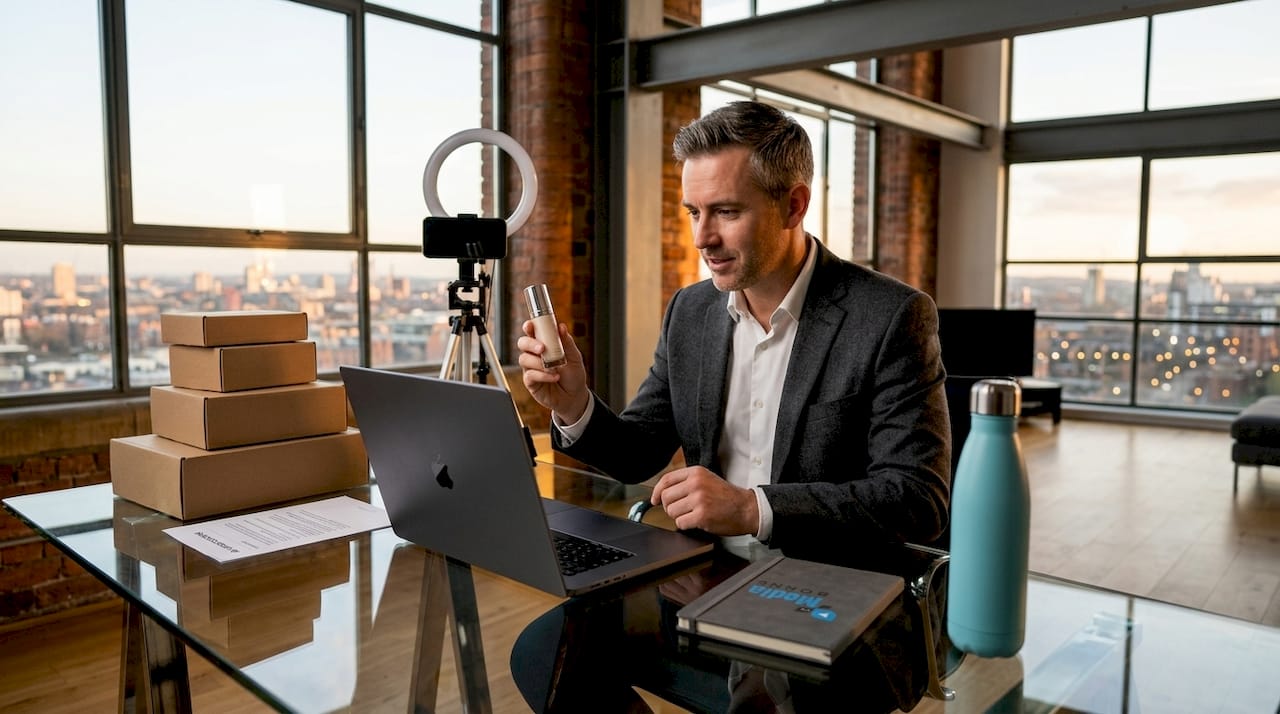
Your live commerce sales strategies and your TikTok engagement strategies should be designed together, not as separate playbooks. The best-performing brands treat them as one unified system.
Live shopping and entertainment: Conversion benchmarks
Once you've built the right routines, it's crucial to understand their quantitative impact.
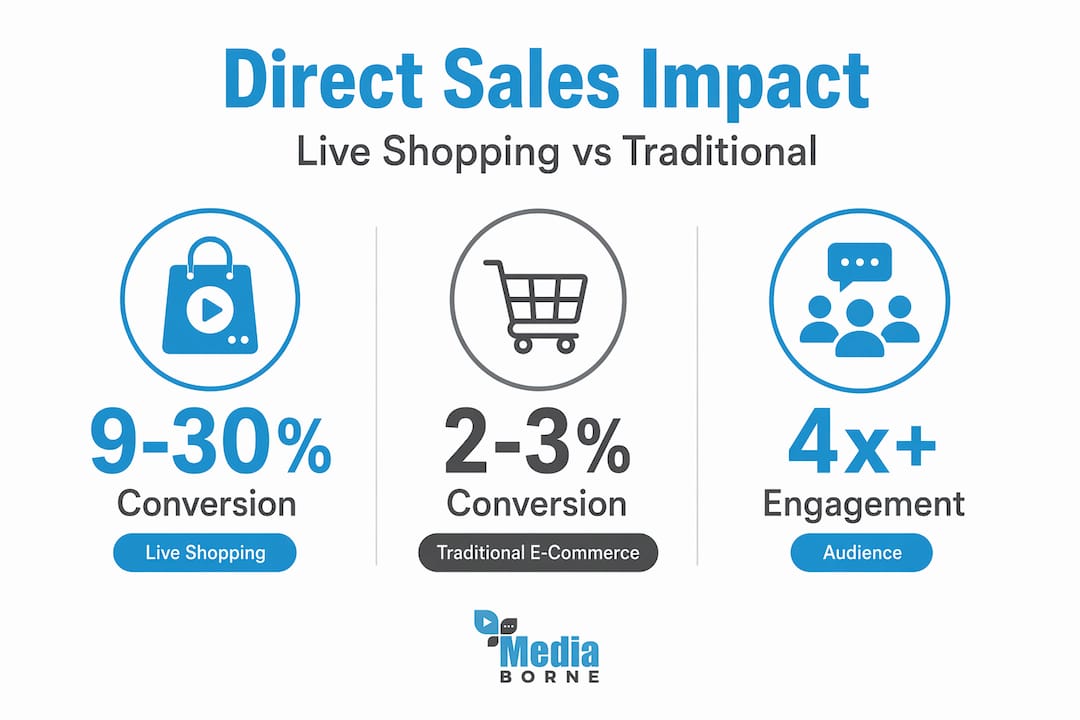
The data on live shopping performance is striking, and it becomes even more striking when you place it alongside traditional e-commerce metrics. TikTok live shopping boosts sales by 428% in comparable periods, with live sessions accounting for 30% to 40% of gross merchandise value (GMV) for brands that commit to a consistent cadence. Cart abandonment, which typically hovers around 70% in standard e-commerce, drops to just 12% during live shopping sessions.
| Metric | Traditional e-commerce | Live shopping |
|---|---|---|
| Conversion rate | 2% to 3% | 9% to 30% |
| Cart abandonment rate | 65% to 75% | Around 12% |
| Average session engagement | Under 2 minutes | 20 to 45 minutes |
| GMV contribution per session | Variable | 30% to 40% of total |
| Sales uplift vs. baseline | Baseline | Up to 428% on TikTok |
These figures reflect something that goes beyond optimisation tactics. They reflect a fundamentally different relationship between content and commerce. When someone watches a live shopping session, they are committing time, attention, and emotional investment. That investment makes purchasing feel natural rather than transactional.
"Live shopping sessions drive cart abandonment rates as low as 12%, compared to the industry average of over 70% for standard e-commerce checkout flows."
The reasons benchmarks vary across formats and platforms come down to three variables: engagement depth, urgency mechanics, and platform context. YouTube live sessions, for example, attract viewers already in a research mindset, which makes them excellent for higher-value items requiring explanation. TikTok's algorithm surfaces live content to cold audiences, making it more effective for discovery-led impulse purchases. Instagram tends to perform well for lifestyle and fashion categories where visual demonstration is the primary persuasion tool.
Podcast shopping data also shows a growing entertainment-commerce overlap, with audio-led product discovery driving measurable intent that converts through linked landing pages. Brands investing in live streaming for sales and YouTube for branded sales are already seeing these dynamics play out across their analytics.
Audience targeting, platform choices, and risk management
Knowing the numbers invites the next challenge: making the right strategic choices and managing risk.
Choosing the right platform is not simply a matter of where your audience currently spends time. It is about matching your product category, price point, and content style to the environment where those factors perform best. Platform dependency risks are real. Algorithm changes, fee structures, and data ownership issues can erode the commercial advantage of a purely social-native strategy overnight. Hybrid models that blend social reach with owned-channel infrastructure are the most resilient approach.
Platform matching guide:
- TikTok: Best for discovery-led categories, impulse price points under £100, and brands with strong visual or personality-driven content
- YouTube: Ideal for high-ticket items, technical products, and any category where education is a prerequisite to purchase
- Instagram: Strong for lifestyle, beauty, fashion, and home categories where aesthetic presentation is critical
- Brand-owned live channels: Essential for protecting customer data, avoiding platform fees, and maintaining direct communication with your most loyal buyers
The question of influencer-led versus merchant-led sessions is one that many e-commerce teams underestimate. Influencer-led sessions offer reach and credibility but come with higher costs, variable brand alignment, and dependency on a third party's audience. Merchant-led sessions offer full brand control and better data, but require investment in hosting talent and production quality. In China, merchant-led streams account for 40% of GMV, which suggests that brands with the right hosting capability can generate serious commercial volume without relying on external influencers.
Social channel resilience research consistently points to diversification as the primary defence against platform risk. No single channel, however well it performs today, is immune to change.
Pro Tip: Use behavioural targeting to segment your live shopping audience by past purchase behaviour, content engagement history, and product category interest. Brands that personalise their live session promotions using first-party data consistently outperform those broadcasting the same message to their entire following. This precision approach also reduces algorithmic dependence because your content converts efficiently enough to sustain itself on organic reach.
Supporting your brand-led sales with a clear data strategy from the outset ensures that every social interaction builds an asset you own, not just a metric on someone else's platform.
Scaling and sustaining innovation in direct sales
To make these gains sustainable, the next step is preparing for long-term growth and innovation.
Moving from a successful pilot to a scalable, high-volume direct sales operation requires systematising every element that produced the early results. The global direct selling market is projected to grow at a 7% compound annual growth rate to reach $439 billion by 2034, with 89% of top performers already relying on social media as a primary sales channel. US livestream commerce alone reached $14.64 billion in 2025. The brands scaling fastest are those treating direct sales as a media operation, not a promotional afterthought.
Here is a structured approach to scaling from test to sustained operation:
- Codify your best-performing formats. Identify the session structures, offer types, and hosting styles that produced the highest conversion rates during your pilot phase. Document these as repeatable templates.
- Invest in sales enablement tools. Sales enablement boosts win rates by 49% and improves quota attainment by 32%. AI content tools that reduce search and preparation time by 28% are now essential for teams running multiple live sessions each week.
- Build a content production pipeline. Pre and post-session content, short-form clips from live sessions, testimonial compilations, and platform-specific promotional assets all require a reliable production workflow. Ad hoc content creation breaks down at scale.
- Establish feedback cycles. Survey buyers immediately after live sessions. Monitor comment sentiment during streams. Feed these insights back into product selection, hosting style, and offer design within 48 hours of each session.
- Refresh formats quarterly. Audience fatigue is the silent killer of consistently strong live shopping programmes. Rotating hosts, introducing new segment formats, running themed seasonal events, and experimenting with collaborative sessions keep content feeling fresh.
Your video strategy for scaling and your innovative customer engagement approach need to evolve in lockstep as your live sales operation grows.
Pro Tip: Avoid the plateau trap by scheduling a quarterly format audit. Bring in a fresh host for one session per month, test a new segment type, and deliberately retire any format that has produced declining engagement for three consecutive weeks. Innovation at scale requires structured experimentation, not just execution.
Why direct sales is the future of e-commerce (and what most experts miss)
Here is the uncomfortable truth that most e-commerce advice glosses over: direct sales through social entertainment does not succeed because of tactics. It succeeds because it changes the psychological dynamic of the purchase.
When a customer watches a live session, they are not passively browsing. They are participating. They ask questions and get answers. They see other people buying. They feel the countdown on a limited offer. That shift from passive browsing to active participation is what drives a 12% cart abandonment rate instead of 70%. The entertainment is not a wrapper around the sale. It is the mechanism of the sale.
What most experts miss is that consistency and skilled hosting outperform sporadic, high-budget campaigns by a significant margin. A brand that runs three solid live sessions every week for six months will outperform a brand that runs one spectacular event per quarter. The algorithm rewards consistency. More importantly, audiences reward consistency. They come back because they trust the schedule, the host, and the experience.
The other blind spot is platform dependency. Too many e-commerce teams build their entire direct sales operation inside a single social platform, then discover that a fee change, an algorithm shift, or a policy update can halve their reach overnight. The brands we see succeeding long-term are those treating branded live streaming as both a social channel strategy and an owned media investment simultaneously.
Next-generation sales teams need to be as comfortable reading session analytics as they are presenting products on camera. Agility, data literacy, and the ability to iterate quickly are now core competencies for anyone serious about direct sales at scale.
Accelerate direct sales success with professional video and social selling support
The strategies in this article work best when the content quality matches the ambition behind them. A well-planned live shopping cadence built on shaky production, low-energy hosting, or inconsistent creative will always underperform its potential. Professional video content is not a luxury for this channel. It is the foundation that makes every other element perform at its best.
Media Borne works with e-commerce brands to develop and produce the kind of content that drives real commercial outcomes on social commerce channels. From professional video production services built for direct sales environments to dedicated social selling video strategies designed for TikTok, YouTube, and live channels, we help brands turn attention into revenue. If you're ready to move from testing direct sales to scaling it seriously, the right creative support makes the difference between modest results and industry-leading conversion rates.
Frequently asked questions
What is the conversion rate for live shopping in direct sales?
Live shopping delivers conversion rates between 9% and 30%, far surpassing the 2% to 3% average seen in traditional e-commerce environments.
How often should e-commerce brands host live sales sessions?
The optimal cadence is three to five live sessions per week, incorporating product demonstrations, real-time Q&A, and limited-time offers to maintain audience engagement and algorithmic visibility.
What are the main risks in relying on social platforms for direct sales?
Algorithm changes and data loss are the primary risks; adopting a hybrid model that combines social commerce with owned-channel infrastructure is the most effective mitigation strategy.
Which platforms are best for direct sales of high-ticket items?
YouTube is best suited for high-ticket product sales because its long-form format supports the educational content that buyers of premium products need before committing to a purchase.
How does sales enablement increase the effectiveness of direct sales?
Sales enablement tools boost win rates by 49% and quota attainment by 32%, while AI-powered content tools cut preparation time by 28%, making them essential for brands running high-frequency live sales programmes.