

Most brand managers treat YouTube as a place to park a product video and hope for the best. That instinct undersells the platform enormously. Second-largest search engine in the world, YouTube is where consumers actively look for answers, comparisons, and buying inspiration. For e-commerce brands, that intent is commercial gold. This guide covers channel optimisation, entertainment-led content formats, full-funnel integration, and how to measure what actually matters so you can turn YouTube from a passive asset into a genuine growth engine.
Table of Contents
- Why YouTube matters: search, discovery and buying power
- Core methodologies: optimisation and entertainment-led content
- Full-funnel integration: Shorts, longform and conversion
- Measuring effectiveness: beyond platform metrics
- Risks, challenges and actionable tips for brands
- Amplify your brand's YouTube success with expert media partners
- Frequently asked questions
Key Takeaways
| Point | Details |
|---|---|
| YouTube is a search engine | Brands benefit from YouTube’s reach for product search, discovery, and purchase influence. |
| Entertainment-led content wins | Consistent, entertaining videos drive higher engagement and conversions for e-commerce brands. |
| Hybrid funnels maximise results | Combining Shorts for discovery with longform video increases retention and conversion. |
| Measure beyond platform stats | True impact requires advanced metrics like MMM and tracking halo effects on other channels. |
| Avoid common pitfalls | Creative testing, intent alignment, and audience retention are crucial for YouTube success. |
Why YouTube matters: search, discovery and buying power
YouTube is not a social network in the traditional sense. It is a search engine with video results, and that distinction changes everything about how you should approach it. When someone types "best running shoes for flat feet" or "how to style a linen blazer," they are not browsing passively. They are in discovery mode, often one step away from a purchase decision. Brands that show up in those moments with the right content win attention that advertising alone cannot buy.
The scale is staggering. YouTube enables brands to build awareness, drive discovery, and influence purchase decisions through SEO-optimised video content. But the commercial impact goes further than most marketers realise. A Haus study across 190 campaign tests found that YouTube's true impact is 3.4x higher than platform metrics suggest, with 76% of sales coming from new customers and a 79% ROAS lift post-exposure. There is also a 99% halo effect on Amazon and retail channels.
Here is a snapshot of what those benchmarks mean in practice:
| Metric | Platform-reported | True impact (Haus) |
|---|---|---|
| ROAS | Baseline | 79% lift post-exposure |
| New customer sales | Varies | 76% of total sales |
| Retail/Amazon halo | Not measured | 99% uplift |
| True vs. reported impact | 1x | 3.4x higher |
For brand managers building a social video strategy, these numbers reframe YouTube from a brand awareness play into a full-funnel commercial channel. The key benefits for e-commerce brands include:
- High-intent audience: Users actively searching for products and solutions
- Evergreen discoverability: Well-optimised videos continue driving traffic for months or years
- Cross-channel halo: YouTube exposure lifts performance on Amazon, paid search, and retail
- New customer acquisition: The majority of YouTube-driven sales come from people who had not bought before
If you want to go deeper on the mechanics, video marketing tips covering SEO and audience targeting are a strong next step.
Core methodologies: optimisation and entertainment-led content
Knowing YouTube matters is one thing. Knowing how to make it work is another. The brands that consistently win on the platform share a few non-negotiable habits.
Consistency is the foundation. Weekly video publishing signals to both the algorithm and your audience that your channel is active and worth subscribing to. One viral video followed by silence does not build a channel. A steady cadence does.
SEO optimisation is equally critical. Every video title, description, and tag set should be built around the specific phrases your target audience is already searching. Think about the questions your customers ask before they buy, and answer them on camera. This is not about stuffing keywords. It is about matching your content to real search intent.
Format matters enormously. The most effective content types for e-commerce brands are:
- Tutorials and how-to videos: Show your product solving a real problem
- Unboxings: Build anticipation and social proof simultaneously
- Product demos: Let the product speak for itself in context
- Brand stories: Build emotional connection and trust over time
- User-generated content (UGC): Authentic customer voices outperform polished ads
Entertainment-led formats that match search intent consistently outperform traditional advertising formats in both engagement and conversion. The goal is to make content people choose to watch, not content they skip.
Here is how the main content types compare:
| Content type | Discovery potential | Conversion impact | Production effort |
|---|---|---|---|
| Shorts (under 60 seconds) | Very high | Medium | Low |
| Tutorials (5 to 15 minutes) | High | High | Medium |
| Longform reviews (15 minutes plus) | Medium | Very high | High |
| UGC reposts | Medium | High | Very low |
| Brand story films | Low | High | High |
Pro Tip: Before investing in longform production, test your concepts as Shorts. If a topic generates strong organic engagement in short form, it is a reliable signal that a deeper video on the same subject will perform well.
For brands looking to produce social media videos at scale, building a repeatable content system matters as much as individual video quality. Structured social video workflows reduce production time and keep your channel consistent. For more formal brand content, corporate videos can anchor your channel's credibility alongside entertainment-led formats.
Full-funnel integration: Shorts, longform and conversion
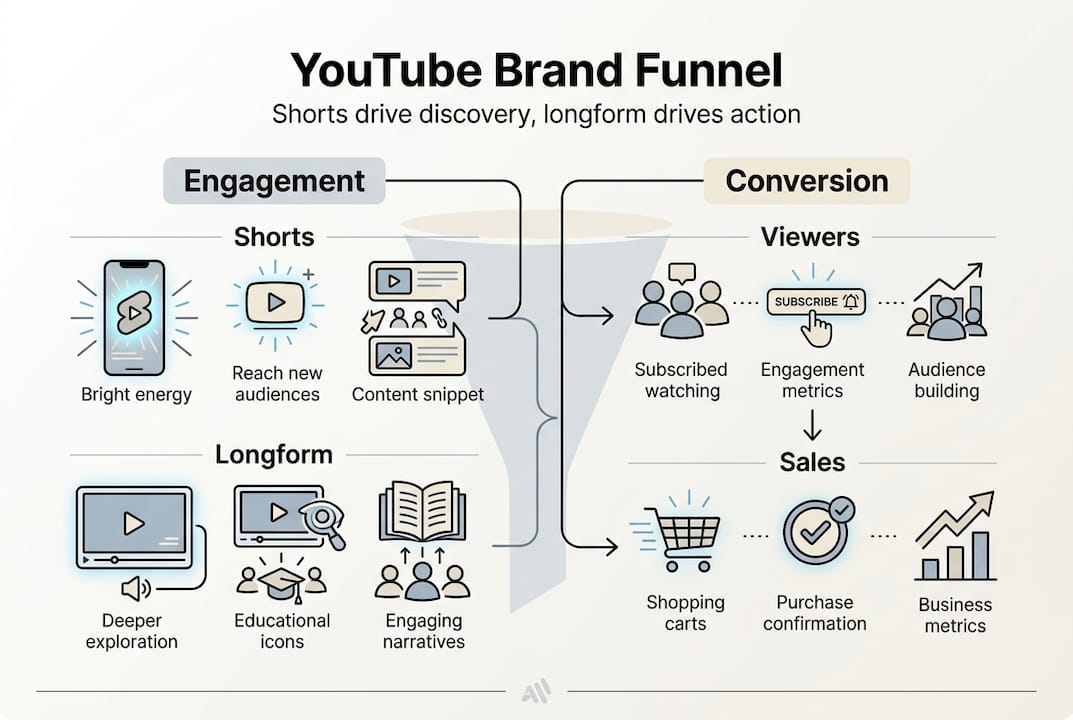
The most sophisticated YouTube strategies do not treat Shorts and longform as separate channels. They use them as a connected system.

Shorts act as the top of the funnel. They are fast, discoverable, and low-commitment for the viewer. A 45-second clip showing a product transformation or a quick styling tip can reach hundreds of thousands of people who have never heard of your brand. The goal at this stage is not conversion. It is curiosity.
From there, the bridge to longform is where the real commercial work happens. A viewer who watches your Short and then clicks through to a 10-minute tutorial is already far more engaged than someone who saw a display ad. That depth of engagement translates directly into purchase intent.
YouTube excels in high-intent search but requires a hybrid organic-paid approach. Test Shorts organically first, then scale the winners via Video Action Campaigns. This approach reduces wasted spend and gives you real performance data before committing budget.
Direct sales integration via Google Merchant Center takes this further. By linking your product catalogue to your YouTube channel, you can display shoppable product cards beneath your videos, turning a tutorial into a direct purchase moment. This is where entertainment-led strategies compound via evergreen SEO, creator partnerships, and connected TV shopping.
Key integration points to build into your channel structure:
- Link Shorts to related longform videos via end screens and pinned comments
- Use chapters in longform videos to improve retention and searchability
- Connect Google Merchant Center for shoppable video overlays
- Build playlists that guide viewers from discovery content to purchase-intent content
Pro Tip: Avoid YouTube's default ad settings. They optimise for reach, not intent. Manually set your targeting to focus on in-market audiences and custom intent segments built from your own search data.
For a broader view of how this fits into your overall social media strategy tips and how content hubs can anchor your YouTube presence within a wider content ecosystem, both are worth exploring.
Measuring effectiveness: beyond platform metrics
YouTube's native analytics will tell you views, watch time, and click-through rates. What they will not tell you is how much incremental revenue your channel actually generated. That gap is where most brands undervalue the platform.
The solution is marketing mix modelling (MMM) and incrementality testing. MMM is a statistical method that attributes revenue across all marketing channels, accounting for factors like seasonality and organic demand. Incrementality testing measures the lift in sales or conversions caused specifically by your YouTube activity, compared to a control group that was not exposed.
The results from these methods are consistently striking. The Haus study across 190 tests shows YouTube's true impact is 3.4x higher than platform metrics, with a 79% ROAS lift and a 99% halo effect on retail and Amazon. Prescient's MMM data shows halo effects at 46% and ROAS at 2x the channel-reported figure.
Real-world case studies reinforce this:
- Walmart holiday campaign: Lifted consideration 2% and search volume by 16%
- e.l.f. Cosmetics: Achieved a 5,000% increase in searches and a 25% revenue jump
- Volvo EX90: Delivered a 3.5x search lift through YouTube-led storytelling
- General shopper behaviour: 70% of shoppers bought a product after seeing it on YouTube
"Platform metrics alone will consistently understate YouTube's commercial contribution. Brands that measure incrementally discover a channel performing far beyond what dashboards suggest."
For brands investing in advertising campaign videos, building incrementality measurement into your campaign planning from the start is not optional. It is the only way to make confident budget decisions.
Risks, challenges and actionable tips for brands
YouTube rewards patience and precision. It also punishes common mistakes that are entirely avoidable.
The biggest risk is poor viewer retention. Average percentage viewed (APV) is the metric that matters most for channel growth. If viewers drop off in the first 30 seconds, the algorithm deprioritises your content regardless of how much you spend promoting it. Poor retention and default ad settings are the two most common causes of wasted YouTube budget.
Other pitfalls to avoid:
- Broad targeting: Reaching everyone means converting no one. Focus on in-market and custom intent audiences
- Inclusion over exclusion: Many brands over-rely on exclusion lists. Build your targeting around who you want to reach, not just who you want to avoid
- Ignoring halo effects: YouTube's lower direct ROAS compared to Meta does not mean it is underperforming. It means you are not measuring it correctly
- Inconsistent creative: One strong video does not build a channel. Consistent quality across formats does
Creative testing and intent alignment are the two levers that separate brands that grow on YouTube from those that stall. Test different hooks, formats, and calls to action systematically. Do not guess what works.
Pro Tip: Run a 30-day creative sprint. Publish four different video formats in one month, track APV and click-through rate for each, and double down on the format that performs best. This approach to driving more engagement is faster and cheaper than a single high-budget production.
Amplify your brand's YouTube success with expert media partners
Putting all of this into practice requires more than a strategy document. It requires production quality, creative consistency, and a team that understands how entertainment-led content converts. That is exactly what we build at Media Borne.
Our video production services are designed specifically for brands that want to grow through content, not just advertise through it. From Shorts to longform brand films, we produce content that earns attention and drives measurable outcomes. You can explore our portfolio and case studies to see how we have helped e-commerce brands build YouTube channels that perform beyond platform metrics. If social commerce is part of your growth plan, our social selling video production offering connects entertainment-led content directly to purchase moments.
Frequently asked questions
How does YouTube drive conversions for e-commerce brands?
YouTube drives conversions by functioning as a search engine for products, where users discover brands through SEO-optimised, entertainment-led video content that funnels directly into purchase decisions or website visits.
What are the best YouTube content formats for brand engagement?
Tutorials, product demos, unboxings, brand stories, and UGC are the most effective formats, particularly when matched to search intent and published on a consistent weekly schedule.
How do brands measure the true impact of YouTube campaigns?
Brands use MMM and incrementality testing to go beyond platform dashboards, capturing halo effects and new customer lift. The Haus study across 190 tests shows true impact is 3.4x higher than reported metrics.
What are common pitfalls in YouTube marketing for brands?
Poor retention and default ad settings are the most damaging pitfalls, alongside broad targeting and failure to account for cross-channel halo effects when evaluating ROAS.