

TL;DR:
- Building a platform alone does not guarantee success; understanding network effects is essential for growth. Strategic focus should be on managing multi-sided markets, active user engagement, and community-building features. Innovation through AI personalization and creator tools further accelerates platform value and sustainability.
Simply building a platform is not enough. Some of the most well-resourced companies in the world have launched ambitious marketplace and entertainment platforms only to watch them stagnate, haemorrhage users, and quietly fold. The uncomfortable truth is that platform success is not a function of size, budget, or brand recognition. It depends on mastering the underlying mechanics that make platforms self-reinforcing. For marketing professionals and brand strategists in e-commerce and entertainment, understanding those mechanics, particularly network effects, multi-sided market design, and community flywheel dynamics, is what separates growth from expensive guesswork.
Table of Contents
- What is platform strategy and why does it matter?
- Network effects: The engine of platform success
- Solving the chicken-and-egg challenge
- Innovative platform moves: Lessons from e-commerce and entertainment
- Advanced platform pivots and strategic pitfalls
- Why most platform strategies miss the mark (and how to get it right))
- Take your platform play further with expert video and content solutions
- Frequently asked questions
Key Takeaways
| Point | Details |
|---|---|
| Balance both sides early | Platforms must attract and engage both user groups to ignite self-sustaining growth. |
| Leverage network effects | The more users interact, the more valuable the platform becomes for everyone involved. |
| Innovate beyond basics | Success now often depends on features like AI personalisation, hybrid access, and community-driven design. |
| Beware common pitfalls | Mispricing, poor sequencing, or chasing hype without user focus frequently derail platform missions. |
| Continual adaptation wins | Ongoing adjustment to user feedback and market dynamics is crucial for lasting platform strategy success. |
What is platform strategy and why does it matter?
A platform strategy is fundamentally different from running a traditional linear business. In a linear model, a brand creates a product, sells it to a customer, and the value exchange ends there. A platform model, by contrast, creates the infrastructure for others to exchange value with each other. Think of a marketplace connecting buyers and sellers, or an entertainment platform connecting creators and viewers.
Platform strategies in e-commerce and entertainment rely on two-sided or multi-sided markets where network effects drive growth: more users on one side attract more on the other. That self-reinforcing loop is the engine. Without it, you have an expensive website. With it, you have a business that compounds.
For brands operating across platforms in media and entertainment, the stakes are especially high because audience attention is finite and loyalty is increasingly platform-dependent. Here is why platform strategy matters right now:
- Scalability without proportional cost increases, as value is co-created by participants
- Data leverage from user behaviour across multiple sides of the market
- Viral growth driven by participant referrals and organic word-of-mouth
- Value creation that compounds over time as more users join and contribute
One critical driver reshaping platform economics in 2026 is AI-powered personalisation. E-commerce platforms using AI to tailor discovery and recommendations are seeing measurable lifts in retention and conversion. This matters because building media user communities is no longer just about good content; it is about delivering the right content to the right participant at exactly the right moment in their journey.
| Platform type | How value is created | Example sectors |
|---|---|---|
| Two-sided marketplace | Buyers and sellers transact | E-commerce, freelance platforms |
| Content platforms | Creators produce for audiences | Entertainment, gaming, social media |
| Data platforms | Users generate data, brands leverage it | AdTech, analytics, retail media |
| Hybrid platforms | Combines multiple exchange types | Social commerce, gaming ecosystems |
Network effects: The engine of platform success
Network effects are not just a buzzword. They are the structural reason why dominant platforms become almost impossible to displace once they reach a tipping point. The core idea is straightforward: every additional user makes the platform more valuable for every existing user. But the type of network effect matters enormously.
| Type | How it works | Example |
|---|---|---|
| Direct (same-side) | More users on one side benefit each other | Social networks, messaging apps |
| Indirect (cross-side) | More users on one side benefit the other side | Marketplaces, gaming consoles |
| Data network effects | More usage generates better data and recommendations | Streaming, AI-powered search |
Understanding these distinctions is actionable, not academic. If you are running an e-commerce marketplace, adding more sellers directly benefits buyers through wider choice and competitive pricing. In entertainment, adding more content creators attracts more viewers, whose engagement data improves content recommendation for everyone.
Real examples make this concrete. On a gaming console platform, more players attract more game developers, who build more exclusive titles, which attract even more players. The cycle is self-sustaining. On an e-commerce marketplace, a growing buyer base incentivises more sellers to list, which increases selection and price competition, which draws more buyers.
Platforms that leveraged network effects successfully understood that the effect requires active management, not just passive growth. The risks are real. Managing multi-sided platforms reveals that platforms risk disintermediation (users bypass the platform entirely), multi-homing (users maintain accounts on competing platforms), and participation imbalance leading to churn. Success requires managing network effects, clustering similar users, and bridging across different user segments.
Platforms that ignore these risks grow complacent. A thriving marketplace can collapse surprisingly fast if sellers find it cheaper to transact off-platform, or if buyers migrate to a competitor offering better personalisation.
Pro Tip: Build community features that make your platform the social home of the interaction, not just the transactional venue. Forums, creator spotlights, user-generated content tools, and peer review systems all increase switching costs and reinforce positive network effects organically.
Solving the chicken-and-egg challenge
Once you understand network effects, the next problem becomes immediately obvious. If the platform only has value when enough people are on it, how do you attract the first users? This is the chicken-and-egg dilemma, and it has killed more promising platforms than any technical failure.

The two-sided marketplace strategy is clear on the mechanics: solve the problem by starting with one side, typically supply or high-value demand, subsidising the harder-to-acquire side, and ensuring liquidity through matching metrics like fill rate and time-to-match. In practical terms, that means choosing which side of your market creates the most compelling pull for the other, and investing disproportionately there first.
Here is a sequence that works across both e-commerce and entertainment contexts:
- Identify your high-value anchor side. For a marketplace, this is usually supply quality. For an entertainment platform, it might be a flagship creator or exclusive content that draws initial viewers.
- Subsidise or incentivise the harder side. Offer fee waivers, promotional visibility, or exclusive perks to attract the side less naturally motivated to join early.
- Create liquidity in a narrow niche. Rather than trying to serve everyone at launch, dominate a specific category or community where you can achieve genuine density quickly.
- Set clear matching metrics. Track fill rate (how often users find what they need) and time-to-match (how quickly a transaction or connection happens). These tell you if your platform is genuinely liquid or just busy.
- Use guarantees to reduce early-adopter risk. If sellers fear a thin buyer pool, a visibility guarantee or revenue commitment reduces their perceived risk of joining.
"Platforms face edge cases constantly: disintermediation, multi-homing, and participation imbalance can each stall growth. The platforms that survive their early phase are those that obsess over both sides simultaneously, even when resources force them to prioritise one." From managing multi-sided platforms.
Xbox's approach to its gaming ecosystem illustrates this well. Microsoft invested heavily in exclusive titles and developer relationships before its player base reached mass scale. The supply side (game developers) was cultivated through financial incentives, development tools, and publisher agreements. As the library of compelling games grew, player adoption followed naturally, accelerating the social platform user engagement loop that defines the platform today.
Pro Tip: Do not chase total user numbers in your first phase. A small pool of highly engaged, high-quality users generates far more useful data, more authentic social proof, and a stronger community signal than a large pool of passive sign-ups. The flywheel starts with quality, not quantity.
Innovative platform moves: Lessons from e-commerce and entertainment
With foundational mechanics in place, the question becomes what actually moves the needle for platforms competing in mature or crowded markets. The answer increasingly involves technological innovation layered on top of smart platform design.
In entertainment, Microsoft Xbox's strategy emphasises building a global platform that connects players and creators with flexible pricing models, deep social features, and multi-device access. The shift away from hardware-exclusivity towards a flexible, subscription-driven ecosystem reflects a broader understanding that value now lives in the community and the content library, not the physical console.
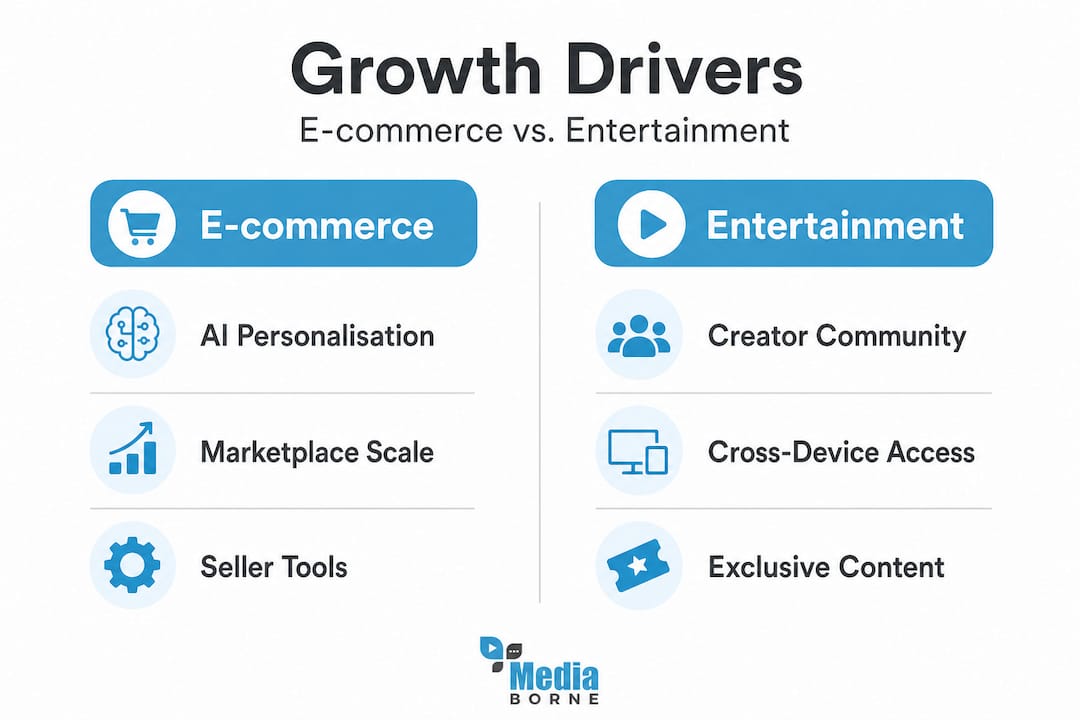
AI personalisation and hybrid cloud models are reshaping outcomes dramatically. In e-commerce, AI personalisation alone has been shown to boost revenue by 9.4%, while community-led growth strategies that turn users into creators generate powerful viral loops at near-zero acquisition cost.
| Innovation | Platform type | Outcome |
|---|---|---|
| AI-powered personalisation | E-commerce marketplace | Up to 9.4% revenue increase |
| Hybrid cloud-local compute | Gaming and entertainment | Reduced latency, broader device access |
| Creator monetisation tools | Entertainment and social | Higher creator retention and output |
| Social commerce integration | E-commerce | Direct conversion from community interaction |
| Subscription flexibility | Entertainment | Lower churn, higher lifetime value |
Community-led growth deserves special attention because it changes the economics of platform expansion entirely. When users become brand-driven platform expansion agents, whether through content creation, peer referrals, or community moderation, the platform captures value without proportional cost. This is why entertainment platforms that enable creator tools consistently outperform those that treat users purely as passive consumers.
- Flexible access models (device-agnostic, subscription-tiered) reduce barriers to participation and extend reach across demographic groups
- Creator toolkits embedded within the platform convert passive users into active contributors, deepening engagement and diversifying content supply
- Strategic partnerships in platforms amplify reach by connecting platform audiences with complementary brand ecosystems
Advanced platform pivots and strategic pitfalls
Transitioning from a product business to a platform business is genuinely one of the most complex strategic moves a brand can make. Most failures are not technical. They are organisational and strategic.
The single-product to platform shift demands sequenced decisions, a willingness to evolve your ideal customer profile, and integrated repositioning. One tactic worth noting is reverse-positioning: deliberately offering a product that appears less featured or premium than incumbents, targeting underserved segments who are over-served by existing options and would rather pay less for simplicity.
Common missteps to avoid:
- Mispricing one side of the market, often by undervaluing the supply side during growth phases, leading to quality collapse
- Mistiming the pivot, entering platform mode before achieving sufficient product-market fit on the core product
- Ignoring evolving user needs, particularly when rapid technological change shifts what participants actually value
- Underestimating architectural complexity, especially when scaling from a single product experience to a multi-sided ecosystem with governance requirements
Platform risk from architectural change is well-documented: while platforms promise winner-take-most dynamics through network effects, many fail due to mispricing, mistiming, or simple hubris. Traditional firms often succeed in platform transitions through deliberate "buy, build, or belong" strategies, acquiring relevant capabilities, building missing infrastructure, or partnering their way into stronger positions.
The emerging production trends in media offer a useful analogy. Brands that attempted to build entertainment platforms without understanding their audience's existing consumption habits failed not because of poor content, but because they misread what their users actually wanted from the experience. Platform design must start with genuine user insight, not product assumptions.
Why most platform strategies miss the mark (and how to get it right)
Here is an uncomfortable observation after working across entertainment and e-commerce brands: most platform strategies fail not because the technology was wrong, but because the team was solving for the platform they wished users needed rather than the one users actually wanted.
Conventional platform advice focuses heavily on network effect theory, growth hacking, and scaling levers. What it consistently underweights is the cultural dimension of platform adoption. Users do not join platforms because of clever incentive structures alone. They join because a platform makes them feel part of something, because it reduces genuine friction in their lives, or because their peers are already there. All three of those factors are rooted in human behaviour, not product architecture.
The most successful platform pivots we observe share one trait: they combine disciplined experimentation with a genuine obsession over user insight. They do not assume their initial hypothesis was correct. They build feedback mechanisms directly into the platform experience, treat early adopters as advisers rather than metrics, and iterate quickly when signals suggest a direction is wrong.
Chasing "network effect" as a goal in itself is backwards. Network effects are an outcome of delivering enough value to enough participants consistently. Case studies on platform growth repeatedly show that the brands reaching self-sustaining flywheel dynamics are those that nail the fundamental value proposition first and then amplify it through smart platform mechanics.
The other underrated pitfall is internal culture. Organisations accustomed to controlling a linear product experience often struggle with the loss of control that a platform model demands. You are no longer dictating the user experience. You are curating the conditions for others to create it. That requires leadership comfort with ambiguity and a culture of experimentation that most traditional product teams do not naturally possess.
Pro Tip: Before investing in platform infrastructure, run a structured experiment with a manually operated version of the exchange you want to automate. If you cannot generate genuine value for participants manually, the platform will not fix the underlying problem. Get the human mechanics right first.
Take your platform play further with expert video and content solutions
Platform strategy only compounds when the content fuelling it is sharp enough to hold attention and build communities worth belonging to.
At Media Borne, we help brands turn platform ambition into measurable audience growth through entertainment-led production and professional video production that works across multi-sided ecosystems. Whether you are seeding a new community, activating both sides of a marketplace, or building creator-driven formats that generate organic reach, our social selling solutions are designed to convert attention into commercial outcomes. If you are ready to think bigger about your platform's entertainment layer, explore growth opportunities with Media Borne and discover how branded content can become your most powerful platform mechanic.
Frequently asked questions
What is the biggest risk to launching a new platform in e-commerce?
The biggest risk is failing to create enough value for both sides quickly, leading to imbalanced growth and user churn. Managing this balance requires active oversight of network effects, participant clustering, and bridging strategies from day one.
How can platforms address the chicken-and-egg problem?
Start by focusing on one side, often supply or high-value demand, and subsidise or incentivise the harder-to-acquire side to seed early liquidity. Research on two-sided marketplaces recommends tracking fill rate and time-to-match as early liquidity indicators.
What makes entertainment platform strategies unique?
Entertainment platforms thrive by building social features, enabling flexibility across devices, and fostering creator communities to boost engagement. Microsoft Xbox's approach demonstrates how connecting players and creators through flexible pricing and multi-device access sustains long-term community growth.
How can AI personalisation impact e-commerce platforms?
AI personalisation increases user engagement and has been reported to boost revenue by up to 9.4% for marketplaces by improving content and product discovery for individual users.
Why do some platform strategies fail despite a strong initial launch?
Platform strategies can fail due to mispricing, mistiming, or an architecture that does not evolve with changing user needs. Platform risk research highlights that hubris and failure to adapt governance structures are as damaging as technical limitations.