

TL;DR:
- Most brand videos fail due to weak opening moments and lack of storytelling focus.
- Clear goals and audience insights are essential for creating effective, KPI-driven content.
- Authentic proof-driven content outperforms polished ads, especially in high-trust industries.
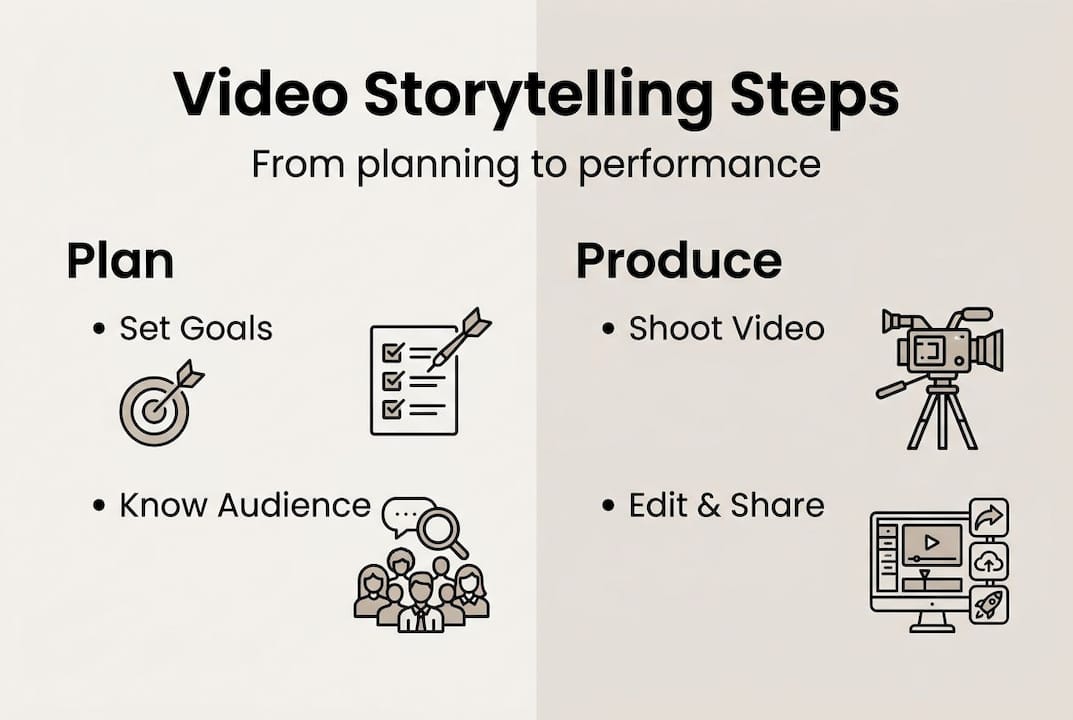
Most brand videos fail before the story even begins. They open with a logo animation, a generic voiceover, or a product shot that tells the viewer nothing about why they should care. The result is a drop-off within seconds and a budget that delivers little beyond vanity metrics. Watch time, engagement rate, and retention are the measures that actually signal whether your content is working, and most brands are losing on all three. This guide walks you through a structured video storytelling process that changes that, from goal-setting and narrative planning to production techniques and post-production iteration.
Table of Contents
- Understand your goals and audience
- Map out your narrative and content calendar
- Produce and capture: Techniques that boost engagement
- Edit, optimise, and iterate for results
- Why the best video storytelling comes from imperfect proofs, not polish
- Enhance your brand's storytelling with professional video support
- Frequently asked questions
Key Takeaways
| Point | Details |
|---|---|
| Set goals and know your audience | Clear objectives and audience insights are the foundation for effective video storytelling. |
| Plan a structured narrative | Use a content calendar and story arc to deliver consistent, compelling campaigns. |
| Hook viewers early | Draw attention in the first 15 seconds to maximise watch time and reduce drop-off. |
| Focus on proof over polish | Authentic, human-driven content outperforms highly polished videos, especially in high-trust sectors. |
Understand your goals and audience
Every video that performs well starts long before the camera rolls. It starts with a clear objective and a precise understanding of who you are speaking to. Without this foundation, even the most beautifully shot footage becomes noise.
Begin by defining what success actually looks like for your video. Are you building brand awareness in a new market? Demonstrating a product for an e-commerce audience? Driving enquiries for a construction project? Each goal demands a different format, tone, and call to action. Building a video marketing strategy means going beyond views and tying every decision to a business outcome.
Once your objective is clear, map your audience. Think about demographics, platform preferences, and the specific problems your viewers are trying to solve. A site manager watching a time-lapse on LinkedIn behaves very differently from a shopper browsing product videos on TikTok. Your video-first marketing approach must reflect those differences.
Here is a quick summary of common video goals and the metrics that matter most for each:
| Goal | Primary metric | Sample benchmark |
|---|---|---|
| Brand awareness | Views, reach | 10,000+ views per post |
| Product education | Watch time | 60-70% completion rate |
| Lead generation | CTR, conversions | 2-5% CTR |
| Community building | Shares, comments | 3-5% engagement rate |
For corporate video production, the most effective briefs always tie creative decisions to specific KPIs rather than leaving them open to interpretation.
- Define one primary goal per video
- Research platform-specific audience behaviour
- Set KPIs before scripting begins
- Review benchmarks for your industry, not just general averages
Pro Tip: Avoid vague goals like "go viral." Instead, write your success criteria as a specific, measurable outcome: "achieve a 65% watch-through rate on a 90-second product explainer within 30 days of publishing."
Map out your narrative and content calendar
Once objectives and audience insights are established, it is time to structure your narrative and ensure a consistent rollout. A strong story arc is not optional. It is the engine that keeps viewers watching and converts passive attention into action.
The most reliable narrative structure for brand video follows five stages: setup, problem, solution, proof, and resolution. This mirrors the way people naturally process decisions. You introduce context, surface a tension the viewer recognises, present your brand as the answer, demonstrate it working in the real world, and close with a clear next step. This approach is especially powerful in construction and e-commerce, where proof is everything.
Follow this process to build your narrative before production begins:
- Write a one-sentence objective for the video
- Draft a script outline using the five-stage arc
- Identify the emotional beats: where should the viewer feel curiosity, relief, or excitement?
- Create a storyboard, even a rough one, to visualise pacing
- Map the video to a content calendar with defined publish dates and platform targets
Consistency matters as much as quality. Strategic narrative planning with a content calendar prevents the feast-and-famine pattern that kills audience momentum. A useful content production guide will show you how to batch content and maintain a steady publishing rhythm.
| Approach | Ad-hoc releases | Scheduled narrative campaign |
|---|---|---|
| Audience retention | Low | High |
| Brand consistency | Inconsistent | Strong |
| Algorithm performance | Unpredictable | Favoured |
| Team workload | Reactive, stressful | Planned, efficient |
For brands that need to plan social video workflows across multiple platforms, a calendar is not a nice-to-have. It is the difference between a strategy and a series of accidents. Well-produced advertising campaign videos always begin with this level of planning.
Produce and capture: Techniques that boost engagement
With narrative and scheduling set, the next step is to bring your story to life through dynamic production techniques. This is where many brands either win big or waste their budget.
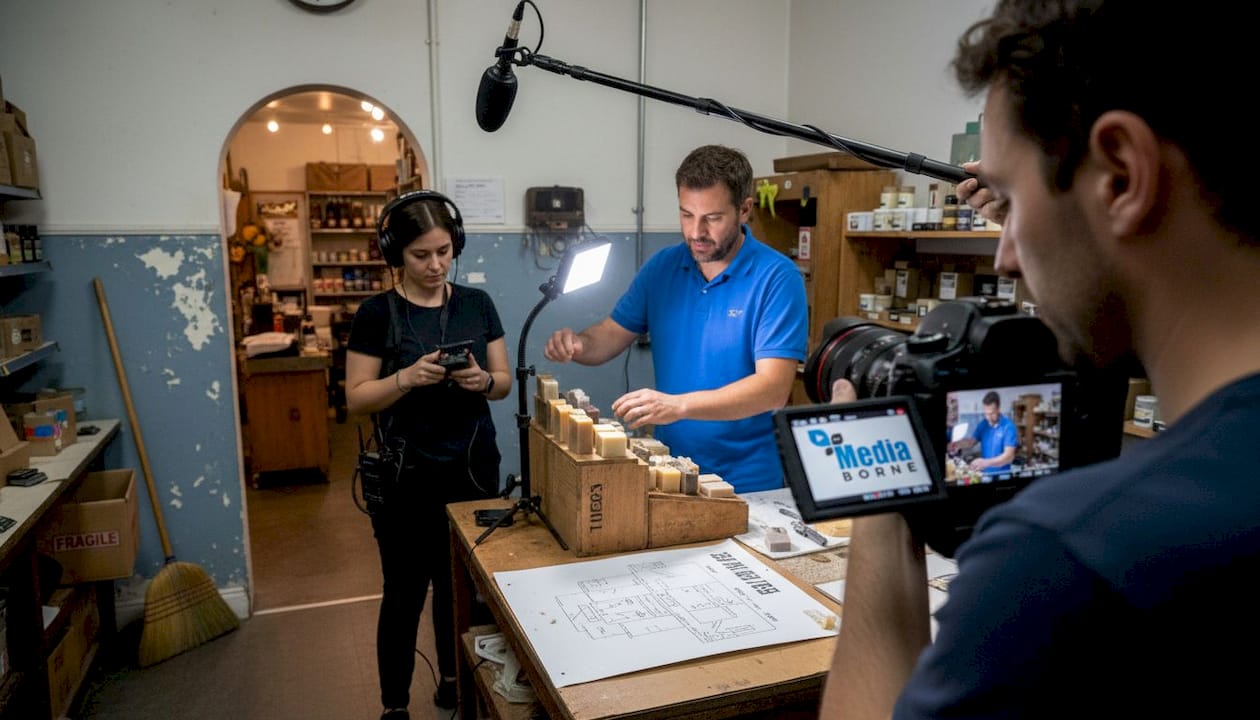
The first ten to fifteen seconds of any video are your most valuable real estate. Viewers decide almost immediately whether to keep watching. Open with a visual hook, a surprising statement, or a human moment that signals relevance. Avoid starting with your logo, a slow pan, or a lengthy introduction.
Follow this production process for consistently strong results:
- Set up your shot list based on the storyboard, prioritising the hook sequence first
- Capture authentic human moments: reactions, hands at work, real environments
- Shoot proof-driven formats such as time-lapses, live demonstrations, and before-and-after sequences
- Review footage daily and iterate quickly rather than waiting until the end of a shoot
- Collect testimonial snippets on location while energy and context are fresh
Time-lapse video production is particularly effective in construction and renovation contexts, where the transformation itself is the most compelling proof of capability. In e-commerce, product demonstrations filmed in real-use environments consistently outperform studio-only content.
"Retention drops sharply at 45 seconds when intros are weak. A 15-second hook that leads with conflict or transformation keeps viewers through the critical first minute."
Short-form video delivers 71% highest ROI across most campaign types, and understanding short form video ROI helps you decide where to invest your production budget. For practical video marketing tips that apply across formats, the principles of strong hooks and proof-driven content remain constant.
Pro Tip: Prioritise human elements over AI-generated visuals. Research shows 36% of consumers distrust content that feels entirely AI-produced. Real faces, real locations, and real moments build the credibility that converts.
Edit, optimise, and iterate for results
Once production wraps, attention turns to post-production, where raw footage becomes a strategic, data-driven asset. Editing is not just about making things look polished. It is about engineering the viewer experience to maximise retention and action.
Start with this editing and optimisation checklist:
- Trim any intro longer than 10-15 seconds
- Test at least two different hook sequences using A/B publishing
- Adjust pacing so no single shot lingers beyond its purpose
- Add captions: over 85% of social video is watched without sound
- End with a single, clear call to action rather than multiple options
- Export in vertical format for mobile-first platforms
Once your video is live, monitor these key video metrics consistently:
Watch time: Aim for 60-70% completion on explainer content. Anything below 40% signals a pacing or relevance problem.
Engagement rate: Track likes, shares, saves, and comments relative to views. A 3-5% engagement rate is a strong benchmark for brand content.
Retention at 45 seconds and 3 minutes: These are the two most common drop-off points. If you lose viewers at 45 seconds, your hook needs work. If you lose them at 3 minutes, your middle section is dragging.
CTR and conversion rate: For videos with a direct response objective, a CTR of 2-10% and a conversion rate above 1% indicate a well-aligned creative and offer.
60-70% watch time is the new standard for successful explainers. If your content is not hitting this, the data is telling you something worth listening to.
Use this data to build version two, then version three. Iteration is not a sign of failure. It is the process. Track your results through social video engagement strategies that account for platform-specific behaviour.
Why the best video storytelling comes from imperfect proofs, not polish
Here is something the production industry rarely says out loud: the most effective brand videos are rarely the most expensive ones. In construction and e-commerce especially, the obsession with cinematic polish often works against the very trust you are trying to build.
Audiences in high-consideration categories do not want to be impressed by production value. They want to see proof. A time-lapse of a real build site, a genuine customer unboxing a product in their kitchen, a site manager walking through a completed project on a phone camera. These formats consistently outperform polished studio ads because they answer the question viewers are actually asking: does this work in the real world?
Proof-focused content such as demos and time-lapses outperforms polished advertising in high-trust industries, and the gap is widening as audiences grow more sceptical of manufactured perfection. Time-lapse storytelling is one of the most underused tools in the construction marketer's kit, precisely because it shows work happening rather than claiming it.
The uncomfortable truth is that authenticity is a production decision, not an accident. The brands winning on video right now are choosing to show the messy middle, the real process, and the genuine reaction. That choice is more strategic than any lighting rig.
Enhance your brand's storytelling with professional video support
Putting this process into practice takes more than a good camera and a content calendar. It takes a team that understands how narrative, production, and platform behaviour interact to drive real commercial outcomes.
At Media Borne, we combine video production services with strategic storytelling to help brands in construction, e-commerce, and beyond create content that actually performs. From scripting and shooting to editing and social selling video, we handle the full process so your team can focus on the business. If you are ready to move from ad-hoc content to a structured, results-driven video strategy, get in touch with our team and let us build something worth watching.
Frequently asked questions
What are the most important video storytelling metrics?
Watch time, engagement rate, retention, CTR, and conversion rate are the core measures of video success, with a 60-70% watch time being the benchmark for strong explainer content.
How can I prevent viewers from dropping off early in videos?
Open with a compelling visual or statement within the first 10-15 seconds and avoid slow intros, as most drop-offs happen before the 45-second mark.
Should I use short-form or long-form videos for brand storytelling?
Short-form video yields 71% highest ROI for most campaigns, making it the stronger default choice, particularly on mobile-first platforms like TikTok and Instagram.
How do I combine AI tools without losing viewer trust in my videos?
Always anchor AI-assisted content with genuine human moments, since 36% of viewers distrust content that feels entirely machine-generated, and real people on screen remain the most reliable trust signal.
Recommended
- Corporate Video Production Services for Your Brand
- Video-first marketing: grow your audience and convert
- Social video marketing for brand engagement and ROI
- Brand power with short form video: guide for marketers
- Étapes branding agence : +25% conversion avec méthode 2026 - Vamyr Studio
- Smarter video management strategies for cost and quality