
TL;DR:
- Virality depends on emotional resonance and shareability rather than high production budgets.
- Creating content that evokes wonder, curiosity, or relatability encourages sharing beyond existing followers.
- Consistent success requires strategic planning, audience understanding, deliberate editing, and community engagement.
Most brand videos quietly disappear after a handful of views from existing followers. Yet when a video genuinely goes viral, the results are staggering: community growth, organic reach, and audience engagement that no paid campaign can replicate at the same cost. The gap between videos that vanish and those that explode is rarely budget. It is strategy, emotional intelligence, and production discipline. This guide walks you through the real mechanics of viral video production in 2026, from understanding what triggers shareability to testing and amplifying your content for maximum impact. Whether you run an in-house team or work with external creatives, these steps apply directly to your brand.
Table of Contents
- Understand what makes a video go viral
- Prepare to produce: tools, audience and planning
- Execute: creating the viral video step-by-step
- Test, measure and amplify
- A new way to think about viral video
- Take your viral video strategy further with Media Borne
- Frequently asked questions
Key Takeaways
| Point | Details |
|---|---|
| Emotion before promotion | Videos designed to spark emotional responses outperform direct sales content for virality. |
| Systematic planning matters | Success comes from strategic trend selection, hook engineering and understanding your audience. |
| Test, iterate, amplify | Real results require ongoing measurement, testing variants, and amplification through community and paid channels. |
| Authenticity over formula | The most shareable content emerges when brands take risks and create authentically, not just follow checklists. |
Understand what makes a video go viral
Virality is not a lottery. It follows patterns, and once you understand those patterns, you can engineer content that is far more likely to spread. The mistake most marketing teams make is assuming that polished production or a clever concept is enough. It rarely is.
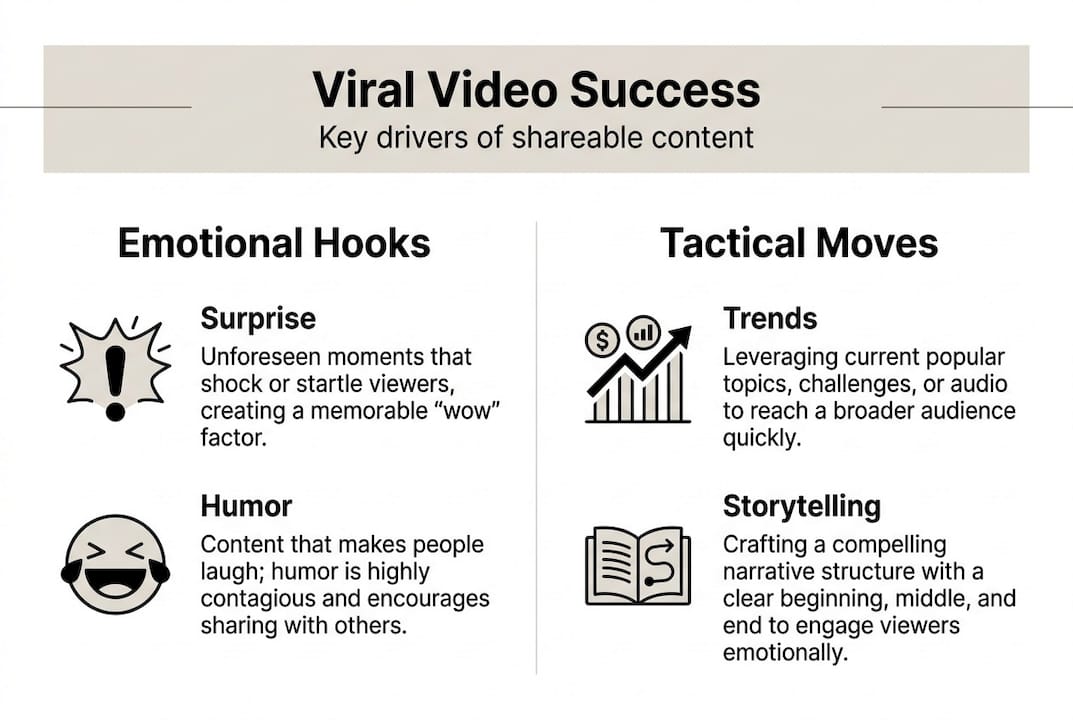
In 2026, the content genres gaining the most traction are sensory and experimental formats. Think immersive food preparation videos, unexpected transformations, and behind-the-scenes content that feels genuinely unscripted. These outperform traditional prank or stunt formats because they trigger a specific emotional response: wonder, curiosity, or deep relatability. Audiences do not share content because it is well-made. They share it because it made them feel something they want others to feel too.
The emotional engine behind virality is well-documented. Top-funnel engagement and emotional resonance are stronger viral triggers than direct sales pitches. This is the single most important insight for brand marketers to internalise. The moment your video starts selling, it stops spreading.
"People share what makes them look good, feel good, or belong to something. Your brand is a vehicle for that feeling, not the destination."
The core elements of a shareable video include:
- A hook within the first three seconds that creates an immediate information gap or emotional pull
- Relatability that makes viewers think "this is exactly me" or "I know someone who needs to see this"
- Social proof signals such as visible engagement, reactions, or community references within the content itself
- A clear emotional arc that resolves satisfyingly, even in under 60 seconds
Strong video engagement strategies always prioritise the viewer's emotional journey over the brand's message. The brands that understand this build communities. The ones that do not keep paying for reach that disappears the moment the budget stops. You can also explore video marketing tips and how brand engagement ROI connects directly to content that resonates rather than content that sells.

Prepare to produce: tools, audience and planning
Knowing what makes a video viral is one thing. Building the infrastructure to produce one consistently is another. Before a single frame is filmed, you need three things in place: the right tools, a clear picture of your audience, and a concept that fuses trending formats with a hook tailored to your specific community.
Production tools comparison
| Tool | Best for | Cost level |
|---|---|---|
| CapCut | Fast mobile editing, TikTok-native formats | Free / low cost |
| Adobe Premiere Pro | Professional-grade editing and colour grading | Mid to high |
| DaVinci Resolve | Colour correction, cinematic quality | Free / mid |
| Canva Video | Simple branded content, quick turnarounds | Low |
| Final Cut Pro | Mac-based professional editing | Mid |
Your tool choice should match your output volume and team skill level. A brand producing three to five short-form videos per week will get more value from CapCut or Canva than from a full Adobe suite.
Audience intelligence is where most brands underinvest. Before ideating concepts, review your platform analytics for:
- Peak engagement times and content formats your audience already responds to
- Comment sentiment to understand what your community finds funny, inspiring, or shareable
- Competitor content that is performing unusually well in your category
Pro Tip: Use TikTok's Creative Centre and YouTube's trending tab not just to spot trends, but to identify why those trends are resonating. The emotional trigger behind a trend is more replicable than the format itself.
Engineered systems that combine trends with hooks consistently boost the chances of virality. This means your planning process should always start with a trending format and then ask: what is the version of this that only our brand could make? That intersection is where viral concepts live. Solid content production planning and the right boost engagement tips will help you build a repeatable system rather than relying on one-off luck.
Execute: creating the viral video step-by-step
With your preparation done, the actual production process needs to be as deliberate as your strategy. Here is a step-by-step approach that works for brand teams of any size.
- Storyboard with shareability in mind. Every scene should serve the emotional arc. Ask yourself: what will make someone pause their scroll at this exact moment?
- Write your hook first. The first three seconds are not an introduction. They are a contract with the viewer. State or show the most compelling element of your video immediately.
- Film for the edit. Capture more footage than you think you need. Viral videos often come from unexpected moments that only appear when you review the full take.
- Edit for rhythm, not just clarity. Pacing matters enormously. Short cuts, unexpected sound design, and well-timed text overlays keep viewers watching and rewatching.
- Optimise for native platform behaviour. Vertical format for TikTok and Instagram Reels, captions always on, and no hard logo watermarks that signal "advertisement."
Raw vs. highly produced content
| Approach | Strengths | Weaknesses |
|---|---|---|
| Raw / lo-fi | Feels authentic, lower cost, faster to produce | Can lack visual impact at scale |
| Highly produced | Strong brand perception, cinematic quality | Can feel corporate, slower to produce |
| Hybrid | Balances authenticity with quality | Requires skilled editing judgement |
The hybrid approach is where most successful brand viral content sits in 2026. Methodical use of trends and creative hooks leads to better virality outcomes than either extreme.
Pro Tip: When editing for algorithms, prioritise watch-through rate above all else. A video that 80% of viewers watch to the end will be pushed far harder by platform algorithms than one with high initial views but low completion.
A strong video storytelling process is what separates forgettable content from content that spreads. If you want to see what this looks like in practice, explore social media video production approaches that are built around platform-native storytelling.
Test, measure and amplify
Posting your video is not the end of the process. It is the beginning of a feedback loop that, if managed well, can turn a single piece of content into a sustained growth engine for your brand community.
The metrics that matter most for viral video success are:
- Watch-through rate: The percentage of viewers who watch the full video. Anything above 60% is strong.
- Share-to-view ratio: The clearest signal that your content is resonating beyond your existing audience.
- Comments per view: High comment volume, especially in the first hour, signals strong algorithmic momentum.
- Saves: On Instagram and TikTok, saves indicate that viewers found the content genuinely valuable.
Measuring engagement and resonance is essential for iterating on viral content. Without this data, you are guessing. With it, you can make rapid, informed decisions about what to amplify and what to retire.
Amplification tactics that work in 2026 include:
- Paid seeding: A small paid boost in the first two to four hours can push a strong video past the algorithm's initial threshold, triggering organic distribution.
- Influencer resharing: Identify micro-influencers in your community who would genuinely find your content relevant. A reshare from a trusted voice carries far more weight than a paid placement.
- Community partnerships: Co-creating or co-distributing content with aligned brands or communities multiplies your reach without multiplying your budget.
Pro Tip: If a video is not gaining traction within 48 hours, do not immediately abandon it. Try re-posting with a different caption, a new thumbnail, or a trimmed version. Sometimes the concept is right but the packaging is off. Understanding content hubs and engagement can also help you build the kind of owned audience that amplifies your content naturally. A clear video workflow planning process ensures you can iterate quickly without burning out your team.
A new way to think about viral video
Here is the uncomfortable truth that most viral video guides will not tell you: following a checklist will only get you so far. The brands generating the most genuine virality in 2026 are not the ones with the most refined formula. They are the ones willing to be genuinely surprising, occasionally vulnerable, and deeply embedded in the communities they serve.
Engineering hooks and riding trends is table stakes. What actually separates breakout content from competent content is a brand's willingness to take creative risks that feel true to who they are. The most shared videos often emerge from moments of real participation, where a brand responds to a community moment in real time, or creates something that only makes sense to a specific audience.
The ROI from social video is highest when the content feels like it belongs to the community, not just the brand. That shift in ownership, from brand-controlled to community-embraced, is what turns a good video into a viral one. Stop asking "how do we go viral?" and start asking "what would our community genuinely want to share?"
Take your viral video strategy further with Media Borne
Building a consistent viral video engine takes more than a great idea. It takes production skill, platform intelligence, and a creative team that understands how entertainment and marketing intersect.
At Media Borne, we work with brands to develop social video content that is built to spread. From concept through to final cut, our team combines professional video production expertise with deep knowledge of what drives organic reach across TikTok, YouTube, and Instagram. Whether you need a single campaign or an ongoing content strategy, our social media video services are designed to turn your brand into content people actually want to watch and share. Get in touch to discuss how we can support your next viral campaign.
Frequently asked questions
What length should a viral brand video be?
Most viral videos perform best under 60 seconds, as shorter formats force creative discipline and keep viewers engaged from the very first frame to the last.
How quickly can a video go viral after posting?
Virality can begin within hours but peaks within 24 to 72 hours depending on platform algorithms, initial engagement velocity, and how well the content aligns with current trends.
Do high-budget videos go viral more often than simple ones?
Production value helps with brand perception, but sensory and experimental genres consistently outperform highly produced formats, meaning relatability and timing matter far more than budget.
What is the biggest mistake brands make with viral video attempts?
Emotional resonance outperforms direct sales pitches in viral content, so the most common pitfall is prioritising the brand's message over the audience's emotional experience.