

Most marketing teams assume that publishing more video content will automatically translate into more views, more leads, and more revenue. It won't. More video without strategy produces noise, not results. The brands winning right now are not the ones posting the most. They are the ones who have built a deliberate, video-first methodology that turns every piece of footage into a multi-channel growth engine. This guide breaks down exactly what that looks like, how to build it, and where most teams go wrong.
Table of Contents
- What is video-first marketing?
- Core components and workflow of a video-first strategy
- Benefits and challenges of a video-first approach
- Common pitfalls and misconceptions
- Measuring success: attribution and analytics
- Getting started: practical action plan for your team
- Power your video-first strategy with professional expertise
- Frequently asked questions
Key Takeaways
| Point | Details |
|---|---|
| Video leads content strategy | Video-first marketing means creating video as the core asset and adapting it across formats for bigger reach. |
| Authenticity over perfection | Genuine human video performs better than over-polished or AI-generated content for trust. |
| Measure and adapt | Success relies on continuous measurement, attribution integration, and refining your approach. |
| Avoid the quantity trap | Prioritising strategic integration prevents wasted effort on unplanned video production. |
| Industry fit matters | Video-first strategies need adaptation for sector, audience, and accessibility to maximise results. |
What is video-first marketing?
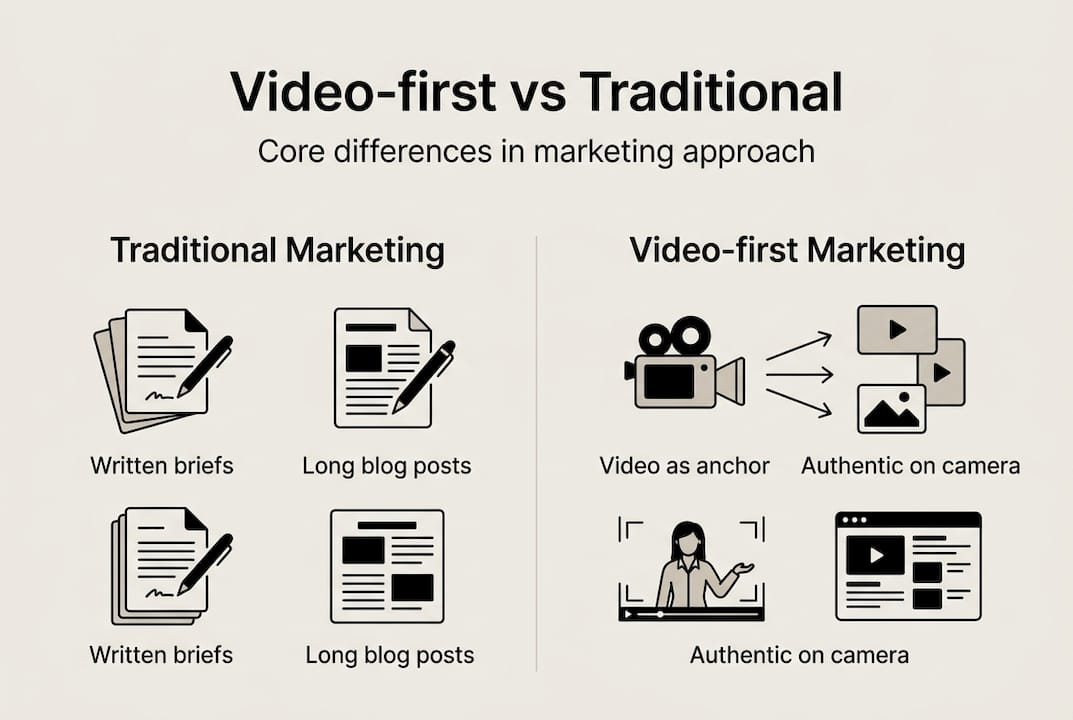
Video-first marketing is not simply a preference for video over other formats. It is a structured methodology where video is the primary content asset, and everything else, including blog posts, social captions, email copy, and podcast audio, is derived from it. Think of it as building a content factory where the camera is the starting point, not an afterthought.
Traditional mixed-media marketing treats each channel as a separate production effort. A blog post gets written, a social graphic gets designed, and occasionally a video gets made. Video-first flips this entirely. As video-first communication defines it, video becomes the primary format with all other content repurposed downstream. One well-planned shoot produces assets for weeks.
The strategic advantage is significant. When video leads your social video strategy, you create consistency across channels without multiplying your production workload. Your audience receives the same core message in the format that suits them best, whether that is a short TikTok clip, a YouTube deep-dive, or a written summary.
"Video-first is not about flooding every platform with footage. It is about making video the engine that powers your entire content ecosystem."
Here is how video-first compares to a traditional approach:
| Factor | Traditional marketing | Video-first marketing |
|---|---|---|
| Content starting point | Written briefs or static assets | Video shoot or live recording |
| Repurposing | Occasional and manual | Systematic and built into workflow |
| Channel consistency | Variable | High, driven by one source asset |
| Production efficiency | Lower, separate efforts per channel | Higher, one shoot feeds multiple formats |
| Audience engagement | Moderate | Significantly higher on social platforms |
For brands investing in social media video production, this shift from reactive to systematic is where the real return on investment begins. The video marketing tips that actually move the needle are almost always rooted in this kind of structural thinking.
Core components and workflow of a video-first strategy
Knowing the definition is one thing. Knowing how to execute it is another. A practical video-first workflow follows a clear sequence that maximises every minute of footage you capture.
An effective video workflow involves creating a long-form anchor video first, then cutting mid-length clips and short hooks, and designing every asset for mobile viewing from the outset. Here is how that looks in practice:
- Plan your pillar content. Identify one core topic or campaign message. Script or outline a 10 to 20 minute long-form video that covers it thoroughly. This becomes your anchor asset.
- Film with repurposing in mind. Shoot in vertical and horizontal formats where possible. Capture standalone moments, strong quotes, and clear demonstrations that can stand alone as shorter clips.
- Edit into content layers. From the long-form video, cut a 3 to 5 minute mid-length version for YouTube or LinkedIn, then extract 30 to 60 second hooks for TikTok, Instagram Reels, and YouTube Shorts.
- Add captions and design for silent viewing. Over 85% of social video is watched without sound. Captions are not optional; they are essential for reach and accessibility.
- Distribute across channels with platform-specific framing. The same clip needs a different caption and call to action depending on whether it lives on LinkedIn or TikTok.
- Repurpose into non-video formats. Transcribe the long-form video into a blog post. Pull key quotes for social graphics. Extract audio for a podcast episode.
For teams managing social video workflows at scale, this layered approach prevents the common trap of producing content that only lives in one place and then disappears.
Pro Tip: Before your next shoot, map out three content layers in advance: one long-form anchor, two mid-length cuts, and four short-form hooks. Brief your editor on all three before filming begins. This single habit can triple your content output from one production day without increasing your budget.
Authenticity matters more than polish here. Brands that invest in professional video production often find that well-structured, genuine content outperforms heavily produced but sterile campaigns.

Benefits and challenges of a video-first approach
The case for video-first is strong, but it is not without real obstacles. Understanding both sides helps you build a strategy that is sustainable, not just aspirational.
Key benefits:
- Higher engagement rates across social platforms compared to static content
- Stronger brand recall, as audiences retain significantly more information from video than text
- Greater shareability, which extends organic reach without additional spend
- Seamless omnichannel repurposing from a single production effort
- Deeper audience connection through storytelling and personality
For teams focused on boosting engagement with video, these advantages compound over time as your content library grows and your audience becomes familiar with your format.
Real challenges to plan for:
- Production costs can be significant, particularly for brands without in-house capability
- Skill gaps in filming, editing, and scripting slow down execution
- AI video tools are improving rapidly but AI limitations around authenticity, nuance, and trust remain real constraints
- Accessibility requirements including captions, transcripts, and audio descriptions are increasingly a legal expectation, not just best practice
Statistic to note: Viewers retain 95% of a message delivered via video compared to just 10% through text alone.
Human authenticity outperforms AI-generated video when it comes to building genuine trust with an audience. AI can accelerate editing, generate captions, and assist with scripting, but the human face, voice, and personality on camera remain irreplaceable for connection. Formats like immersive 360 video demonstrate how production innovation, when paired with authentic storytelling, creates experiences that audiences remember.
Pro Tip: If budget is a constraint, prioritise authenticity over production value. A well-lit, clearly spoken video filmed on a modern smartphone will outperform an over-produced but impersonal corporate piece almost every time.
Common pitfalls and misconceptions
Even teams with the right intentions can undermine their video-first strategy through predictable mistakes. Here are the ones we see most often.
Pitfalls to avoid:
- Chasing volume without strategy. Posting daily video content with no clear narrative or audience intent leads to fatigue, not growth. Your audience will disengage faster than the algorithm rewards you.
- Assuming video replaces all other content. Video alone is insufficient without supporting multi-format content for SEO and authority building. Search engines still rely heavily on text. Video without written context limits your discoverability.
- Prioritising virality over authority. A viral moment can spike your metrics for a week. A consistent, well-positioned content strategy builds brand equity for years. These are not the same goal.
- Ignoring content hubs. Video performs significantly better when it is embedded within content hub strategies that provide context, related reading, and clear conversion pathways.
- Skipping the brief. Producing video without a clear audience, message, and call to action is the single fastest way to waste a production budget.
Pro Tip: For every video you publish, pair it with at least one supporting text asset, whether that is a blog post, a LinkedIn article, or a detailed caption. This combination serves both your audience and search engines simultaneously.
The brands that build lasting authority through video are the ones treating it as part of a broader content ecosystem, not a standalone channel. Professional production support can help structure this from the outset, particularly for teams new to the methodology.
Measuring success: attribution and analytics
Investment in video-first marketing only makes sense if you can demonstrate its impact. That requires connecting your video performance data to actual business outcomes, not just vanity metrics.
Start by mapping your key performance indicators across the customer journey. Awareness metrics include views, reach, and watch time. Consideration metrics include click-through rates, website visits from video, and time on page. Conversion metrics include leads generated, sales attributed, and return on ad spend.
Video must be mapped to attribution systems like HubSpot to demonstrate performance across the full funnel. Without this integration, you are measuring activity rather than impact. Here is a practical framework:
| Video metric | What it measures | Business outcome it maps to |
|---|---|---|
| Watch time and completion rate | Content relevance and quality | Audience retention and brand recall |
| Click-through rate | Call to action effectiveness | Lead generation and traffic |
| Social shares and saves | Content value and resonance | Organic reach and brand advocacy |
| Conversion from video landing page | Direct commercial impact | Revenue attribution |
| Return viewer rate | Audience loyalty | Customer lifetime value |
For content hub attribution insights, integrating video data with your CRM allows you to track which specific pieces of content influenced a prospect's decision at each stage. This level of visibility transforms video from a creative expense into a measurable growth lever.
Review your metrics monthly and use the data to refine both your content topics and your distribution approach. The teams that improve fastest are the ones treating analytics as a creative brief, not just a reporting exercise.
Getting started: practical action plan for your team
Theory without execution is just reading. Here is a concrete action plan your team can begin implementing this week.
- Audit your current content. Identify your three best-performing pieces of content across any format. These topics are your first video briefs.
- Define your audience and message. Before filming anything, clarify who you are speaking to, what problem you are solving, and what action you want them to take.
- Build a simple production schedule. Commit to one pillar video per month to start. Consistency beats volume at this stage.
- Set up your repurposing workflow. Assign clear roles: who films, who edits, who writes the supporting text, and who schedules distribution.
- Choose your primary platforms. Do not try to be everywhere at once. Pick two platforms where your audience is most active and master those first.
- Integrate analytics from day one. Connect your video platforms to your CRM before you publish. Retrofitting attribution is significantly harder than building it in from the start.
- Test and iterate quickly. Publish, measure, and adjust within the first 30 days. Early data is more valuable than a perfect strategy that takes six months to launch.
A video-first approach should always be tailored to your specific audience and adapted for your industry context. What works for a consumer brand on TikTok will look very different from a B2B brand using corporate video planning for LinkedIn and sales enablement.
If your team lacks the internal capacity or specialist skills to execute this well, partnering with an experienced production and strategy team is often the fastest route to results.
Power your video-first strategy with professional expertise
Building a video-first strategy from scratch takes time, skill, and the right creative infrastructure. If your team is ready to move faster and with more confidence, working with specialists who live and breathe this methodology makes a measurable difference.
At Media Borne, we combine creative production with marketing strategy to help brands build content ecosystems that actually convert. From full-scale video production services to social selling video formats designed for platforms like TikTok and YouTube, we help you turn attention into commercial outcomes. Whether you are starting from zero or scaling an existing approach, we can help you build something that lasts.
Frequently asked questions
How is video-first marketing different from traditional video marketing?
Video-first treats video as the primary content asset from which all other formats are repurposed, whereas traditional marketing often produces video as one of several parallel efforts with no central role.
Do all industries benefit from video-first marketing?
Most industries gain real value from video-first, but not all without adaptation. Regulated sectors, niche B2B markets, and brands with limited production budgets may need to adjust the approach to suit their specific constraints and audience expectations.
What is the biggest mistake brands make with video-first marketing?
Focusing on volume rather than strategy. Over-reliance on video without supporting text content limits SEO performance and undermines the authority-building that drives long-term growth.
How does AI impact video-first marketing in 2026?
AI accelerates production tasks like editing, captioning, and scripting, but human authenticity outperforms AI-generated video when it comes to building genuine audience trust and emotional connection.