

TL;DR:
- Multi-use content involves transforming one core asset into multiple native formats for different platforms, expanding reach efficiently. This strategy is essential as audiences are fragmented across social media, and platform algorithms favor native, adapted content over cross-posted links. Building a systematic, platform-native repurposing workflow reduces time and costs while increasing consistent multi-channel visibility.
Multi-use content is defined as the practice of repurposing one core content asset into multiple native formats tailored for different platforms and audiences. This is not a minor efficiency trick. It is the central strategy separating brands that sustain consistent visibility from those that exhaust their teams producing content that reaches a fraction of their potential audience. With 94% of marketers now engaging in content repurposing and 46% finding it outperforms net-new content, the case for building a multi-use content system is no longer debatable. The industry term for this practice is content repurposing, and understanding why multi-use content matters begins with recognising that your audience is not in one place.
Why multi-use content matters for audience reach
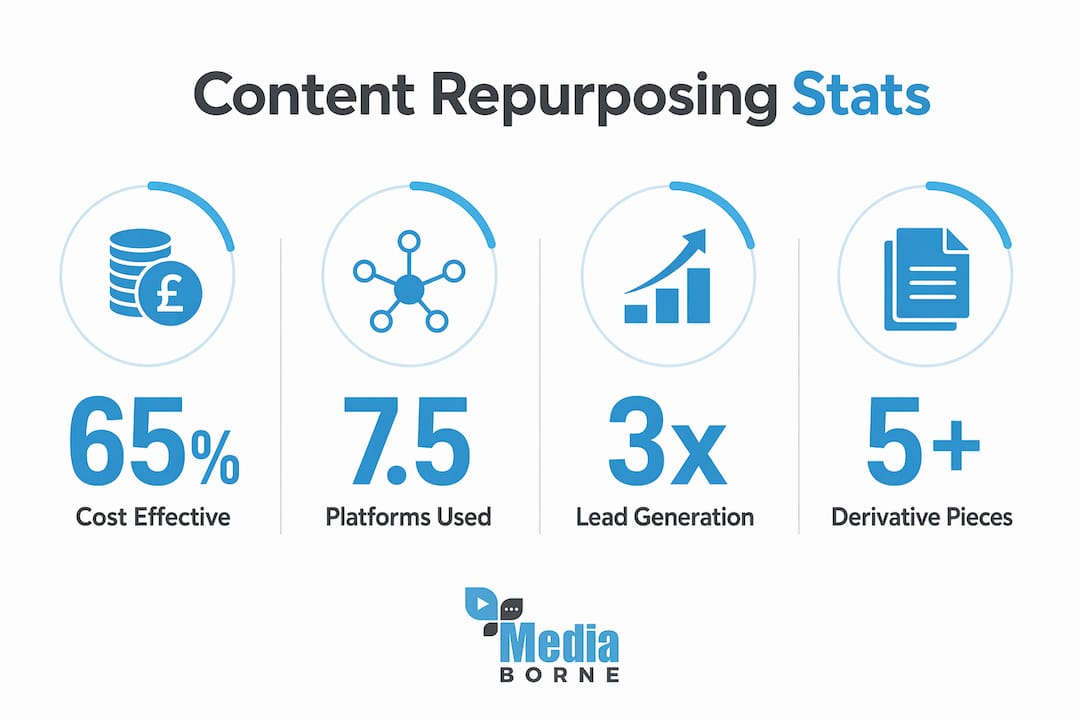
The average person uses 7.5 social media platforms, each with distinct content expectations and consumption styles. That single statistic reframes the entire problem. If you publish exclusively on LinkedIn, you are structurally invisible to the portion of your audience that lives on TikTok, YouTube, or Instagram. Multi-use content strategies solve this by converting one anchor asset into platform-native formats that meet people where they already are.

The critical distinction here is between cross-posting and genuine repurposing. Cross-posting means copying the same caption and image across platforms. Repurposing means adapting the format, tone, length, and structure to match what each platform's audience expects. A 2,000-word LinkedIn article becomes a 60-second TikTok explainer, a carousel post on Instagram, a short-form email newsletter, and a YouTube Shorts clip. Each piece carries the same core message but speaks the native language of its platform.
This matters for reach because digital media consumption is fragmenting further every year. Audiences do not migrate to one platform. They layer platforms, using each for a different purpose and mood. A marketer who understands this does not ask "where should we post?" but rather "how do we show up everywhere our audience already is?"
| Platform | Preferred Format | Repurposing Angle |
|---|---|---|
| Long-form text, carousels | Extract key arguments as standalone posts | |
| TikTok | Short vertical video, 15–60 seconds | Pull the single strongest insight from a longer video |
| Instagram Reels | Visual hooks, face-to-camera | Clip the most visually engaging 30 seconds |
| YouTube | Long-form video, tutorials | Use as the anchor asset; repurpose everything else from it |
| Email newsletter | Conversational prose | Summarise the core argument in 200–300 words |
Pro Tip: Build your content calendar around one anchor asset per week, then map derivative formats to each platform before you film or write anything. Planning the repurposing workflow before creation saves significant editing time later.
How do platform algorithms reward native content?
Platform algorithms in 2026 actively penalise cross-posted links and reward content optimised for format-specific signals. This is not a theory. LinkedIn suppresses posts containing external URLs, reducing their reach by 40–50% compared to native text posts. TikTok's algorithm rewards caption placement and early retention. Instagram Reels prioritise early hooks and face visibility. YouTube rewards watch time and click-through rate from thumbnails.
Each platform has built its algorithm to keep users on-platform for as long as possible. Content that tries to pull users away, via external links, or that ignores platform-specific formatting signals, gets throttled. The result is that identical content distributed across platforms without adaptation consistently underperforms native content by a significant margin.
The solution is what practitioners call platform-native repurposing. This means:
- LinkedIn: Use line breaks to increase dwell time. Write in short paragraphs. Lead with a strong first line that does not get cut off.
- TikTok: Open with a hook in the first two seconds. Place key information in captions. Use trending audio where relevant.
- Instagram Reels: Show a face within the first three seconds. Use text overlays to retain viewers watching without sound.
- YouTube: Front-load value in the first 30 seconds. Use chapters to improve session depth.
Understanding how platforms control information flow is not optional for marketers in 2026. It is the operating environment. Repurposing content with algorithm logic in mind is what separates creators who grow from those who plateau.
Pro Tip: Never post a YouTube link directly to LinkedIn or TikTok. Upload the video natively to each platform. Native uploads receive significantly higher distribution than external links on every major platform.
Does repurposing content actually save time and money?
Content repurposing is 65% of marketers' most cost-effective strategy, and the workflow data explains why. Creating a 3,000-word blog post or a 10-minute video from scratch typically takes 4–6 hours. Repurposing that asset into five or more derivative pieces adds only 3–4 hours of additional work. That drops the marginal cost per content piece to roughly one hour each.
The maths compound further when you factor in AI and editing tools. In 2026, repurposing tools have reduced editing time for platform-native outputs from 15 hours to approximately 30 minutes per asset. Tools like Postory automate transcript extraction, caption generation, and format resizing. This has fundamentally shifted the economics of content production in favour of repurposing over constant fresh creation.
| Task | Fresh Creation | Repurposing |
|---|---|---|
| Core asset production | 4–6 hours | 4–6 hours (once) |
| Derivative pieces (x5) | 20–30 hours | 3–4 hours |
| Total time for 6 pieces | 24–36 hours | 7–10 hours |
| Marginal cost per piece | High | Approximately 1 hour |
Content marketing already costs 62% less than traditional marketing and generates roughly three times as many leads. Repurposing amplifies that advantage further by multiplying the number of assets produced from a fixed investment in one anchor piece. For teams with limited budgets, this is not a nice-to-have. It is the only model that makes consistent, multi-platform output financially viable.
Pro Tip: Use a social video scheduling guide to batch your repurposing sessions. Produce your anchor asset on Monday, repurpose on Tuesday, and schedule the full week's content in one sitting.
What are the most common repurposing mistakes?
The most common failure in multi-use content strategies is the copy-paste mentality. Repurposing fails when it relies on simple duplication across platforms without adaptation. Posting the same 500-word caption on LinkedIn, Instagram, and Facebook does not constitute a multi-use strategy. It constitutes lazy distribution, and algorithms punish it accordingly.
The correct approach is atomisation. Atomisation means breaking a single anchor asset into individual, focused pieces, each isolating one specific insight for one specific platform and audience. A podcast episode on content strategy does not become five identical clips. It becomes a LinkedIn post on one counterintuitive finding, a TikTok on the most surprising statistic, an Instagram carousel walking through a three-step framework, an email summarising the guest's single best piece of advice, and a YouTube Short teasing the full episode. Each piece stands alone. Each is complete in itself.
Sustainable repurposing also requires restraint. According to Buffer and SocialRevver, consistent small-scale repurposing outperforms massive multi-platform output attempts over the long term. Trying to be everywhere at once leads to burnout and declining quality. The better approach is to select two or three platforms where your audience is most active, repurpose consistently for those channels, and expand only when the workflow is stable.
- Choose your anchor format based on your strongest production skill (video, writing, audio).
- Identify the two or three platforms where your audience is most engaged.
- Extract one insight per derivative piece. Never try to compress the full argument into every format.
- Review performance monthly and retire formats that consistently underperform.
Pro Tip: Treat your best-performing posts as repurposing signals. If a LinkedIn post on a specific topic generates strong engagement, that is your cue to build a full anchor asset around that idea and repurpose it across every channel.
How to create a multi-use content system that works
Building a content production system for multi-use output follows a clear sequence. The process is repeatable once established, and the tools available in 2026 make it accessible to solo creators and large teams alike.
- Select your anchor asset. Choose a format you can produce with quality: a long-form video, a podcast episode, or a detailed written piece. This is the source material for everything else.
- Identify your core insights. Pull out five to seven distinct points, statistics, or arguments from the anchor asset. Each one becomes the basis for a derivative piece.
- Map insights to platforms. Assign each insight to the platform where it fits best. A visual framework goes to Instagram. A counterintuitive claim goes to LinkedIn. A short demonstration goes to TikTok.
- Adapt format and tone. Rewrite captions, re-edit video clips, and resize visuals for each platform's specifications. Do not simply copy and paste.
- Schedule and publish. Use tools like Postory, Buffer, or Later to schedule derivative pieces across the week. Spread them out to maintain consistent presence without flooding any single platform.
- Measure and iterate. Track reach, engagement, and saves per platform. Double down on formats and topics that perform. Cut what does not.
Marketing research shows people need 7–10 exposures to a message before it registers. Repurposing is not repetition for its own sake. It is the mechanism by which a single idea reaches enough people, enough times, across enough contexts, to actually land. A content strategy built around entertainment and multi-use distribution compounds this effect by making each exposure feel native and relevant rather than recycled.
Pro Tip: Keep a repurposing log: a simple spreadsheet tracking which anchor assets have been repurposed, into which formats, and on which dates. This prevents duplication and reveals gaps in your distribution coverage.
Key takeaways
Multi-use content works because it converts one production investment into multiple platform-native assets, multiplying reach while reducing the marginal cost and time per piece.
| Point | Details |
|---|---|
| Audience fragmentation demands multi-platform presence | The average person uses 7.5 platforms, so single-channel publishing misses the majority of your audience. |
| Algorithms reward native formats | LinkedIn, TikTok, and Instagram all suppress cross-posted links; native uploads consistently outperform them. |
| Repurposing cuts marginal content cost to roughly one hour per piece | A single anchor asset repurposed into five pieces takes 7–10 hours total versus 24–36 hours for fresh creation. |
| Atomisation beats copy-pasting | Each derivative piece should isolate one insight and adapt it fully to its platform's format and audience expectations. |
| Sustainable scale beats volume | Consistent repurposing across two or three key channels outperforms attempting to cover every platform simultaneously. |
The shift i keep seeing brands miss
I have watched a lot of brands invest heavily in content production and then distribute it as if the platforms are interchangeable. They film a great video, post it to YouTube, drop a link on LinkedIn, and wonder why the numbers are flat. The content is not the problem. The distribution logic is.
What changed my thinking was watching smaller creators with a fraction of the budget consistently outperform well-resourced brand accounts. The difference was almost always the same: those creators understood that each platform is a distinct audience with a distinct context. They were not posting content. They were having different conversations about the same idea, in the language each platform's audience actually responds to.
The mindset shift from "how do we produce more?" to "how do we get more from what we already produce?" is the most commercially significant change a content team can make. It is not about working harder. It is about building a system where one great piece of work does the job of ten mediocre ones. That is what a genuine multi-use content strategy delivers, and in 2026, with the tools and data available, there is no credible reason not to build one.
— Stephen
Build your multi-use content foundation with media borne
The most effective multi-use content systems start with a high-quality anchor asset. Without strong source material, repurposing produces diminishing returns across every derivative format.
Media borne produces professional video content built specifically for multi-platform distribution. Every production is planned with repurposing in mind: the right framing, the right length, and the right structure to generate strong derivative assets for TikTok, LinkedIn, Instagram, and YouTube. If you are serious about building a content system that compounds over time, the anchor asset is where it starts. Media borne's social media video production services give you the foundation to repurpose with confidence.
FAQ
What is multi-use content?
Multi-use content is a single core asset repurposed into multiple platform-native formats tailored for different audiences and channels. The industry term for this practice is content repurposing.
Why does content repurposing matter for reach?
The average person uses 7.5 social media platforms, each with distinct content expectations. Repurposing allows one message to reach fragmented audiences across multiple channels in formats they actually engage with.
How many derivative pieces should one anchor asset produce?
Experts recommend creating at least five derivative pieces from every long-form anchor asset. This drops the marginal creation time to approximately one hour per piece.
Does repurposing hurt content quality?
Repurposing only reduces quality when it relies on copy-pasting without adaptation. Successful repurposing adapts format, tone, and structure for each platform, which maintains and often improves relevance for each specific audience.
Which tools support multi-use content workflows?
Postory, Buffer, and Later are widely used for scheduling and repurposing. AI-assisted editing tools have reduced platform-native output time from 15 hours to approximately 30 minutes per asset in 2026.