

TL;DR:
- Short-form videos under 60 seconds deliver the highest engagement and ROI across social platforms.
- Authentic, human-led videos outperform highly polished content by building trust and emotional connection.
- Strategic, audience-focused video planning and platform adaptation are essential for maximizing conversions.
Not all video is created equal, and the data makes that uncomfortable for most marketing teams. Short-form video under 60 seconds consistently delivers the highest engagement and ROI across social platforms, yet many brands still pour budget into long, polished productions that audiences scroll past without blinking. The gap between what marketers assume works and what actually converts is wider than most realise. This guide cuts through the noise, showing you why video content is non-negotiable in 2026 and, more importantly, how to deploy it with the kind of precision that turns views into measurable commercial outcomes.
Table of Contents
- Why video content matters: Data-driven impact
- Video content types and what actually converts
- Strategic implementation: Making video work for your brand
- Maximising ROI: Advanced tactics for engagement and conversion
- Our perspective: Why originality and intentionality win the video race
- Next steps: Unlock your brand's video growth
- Frequently asked questions
Key Takeaways
| Point | Details |
|---|---|
| Short-form video wins | Video under 60 seconds brings the highest ROI and engagement for most brands. |
| Authenticity outperforms polish | Human-led, honest content drives more trust and conversions than AI or over-produced alternatives. |
| Strategy is essential | A planned, brand-aligned video strategy beats a scattergun approach every time. |
| Personalisation boosts results | Personalised and platform-specific videos result in higher click-through and conversion rates. |
| ROI goes beyond volume | Success comes from intentional, original content—not simply producing more videos. |
Why video content matters: Data-driven impact
The numbers behind video marketing are not just impressive. They are genuinely hard to ignore. Short-form video delivers 2.5x higher engagement than longer formats, with 48.6% of marketers ranking it as their top-performing content type for ROI. A further 83% cite video as the single most effective format in their entire content mix. These are not marginal gains. They represent a structural shift in how audiences consume branded content.
Video also enjoys a natural advantage on social platforms because algorithms reward content that keeps users watching. A well-crafted 30-second clip can reach ten times the audience of a static post with identical targeting. That algorithmic lift compounds over time, making social video engagement one of the most cost-efficient levers available to marketers today.
Perhaps the most striking benchmark comes from email. Adding video to an email campaign raises click-through rates by up to 300%. That is not a small uplift. It is the difference between a campaign that pays for itself and one that transforms a quarter's performance.
Short-form content now dominates brand engagement, outpacing every other format for both reach and conversion efficiency.
Key metrics proving video's impact:
- Short-form video generates 2.5x higher engagement than long-form equivalents
- 83% of marketers rate video as their most effective content format
- Email featuring video sees up to 300% higher click-through rates
- Video posts receive significantly more shares than text or image content
- Social algorithms actively prioritise video, increasing organic reach
| Metric | Video content | Static content |
|---|---|---|
| Average engagement rate | High | Low to medium |
| Algorithm visibility | Prioritised | Standard |
| Email CTR uplift | Up to 300% | Baseline |
| Shareability | Very high | Low |
| ROI ranking by marketers | No. 1 format | Lower ranked |
For video marketing tips that translate these numbers into practical action, understanding the data is only step one. The real question is which type of video you should actually be making.
Video content types and what actually converts
Knowing that video works is useful. Knowing which video works for which goal is what separates brands that grow from brands that simply stay busy. The landscape of video formats has expanded considerably, and each serves a distinct purpose.
| Video type | Best for | Audience stage | Key strength |
|---|---|---|---|
| Short-form (under 60s) | Awareness, engagement | Cold to warm | Algorithmic reach, shareability |
| Long-form (30+ min) | High-intent leads, education | Warm to hot | Depth, trust-building |
| Live video | Community, real-time offers | Warm | Authenticity, urgency |
| Shoppable video | Direct conversion | Hot | Frictionless purchase path |
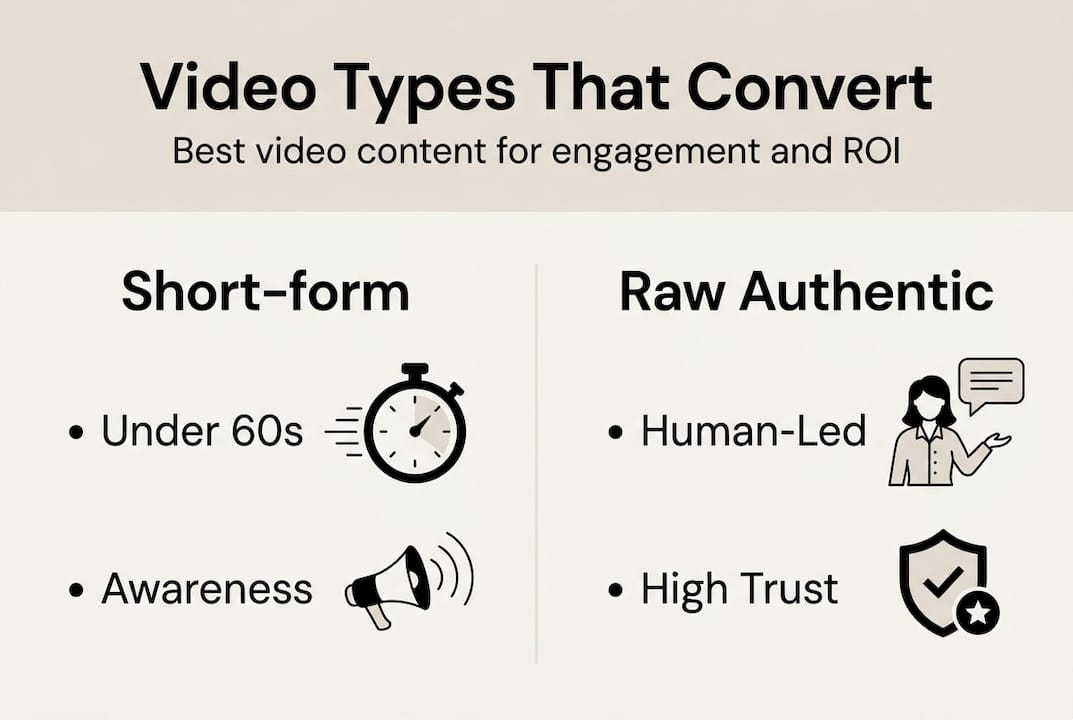
One of the most counter-intuitive findings in recent research is that raw, human-led video consistently outperforms highly polished, AI-generated content. Audiences have developed a finely tuned sense for inauthenticity, and over-produced content often triggers scepticism rather than trust. A founder talking candidly to camera in natural light will frequently outperform a glossy brand film that cost ten times as much to produce.

This does not mean quality is irrelevant. It means that emotional authenticity carries more weight than production value in most contexts. The brands winning on TikTok and Instagram Reels are not the ones with the biggest production budgets. They are the ones with the clearest point of view.
The other critical insight is that no single format is sufficient on its own. A short-form video guide will tell you how to nail a 30-second clip, but sustainable growth comes from a multi-format ecosystem where each video type plays a defined role in the customer journey.
Pro Tip: Before producing any video, ask what human truth or genuine emotion you want the viewer to feel. That answer should shape the format, length, and style far more than any trend or template.
Video content types and their best use cases:
- Short-form clips: Top-of-funnel awareness, product teasers, trend participation
- Long-form content: In-depth tutorials, thought leadership, product deep-dives
- Live video: Q&A sessions, product launches, community events
- Shoppable video: Direct-response campaigns, seasonal promotions
- Behind-the-scenes: Brand trust, culture-building, humanising the team
For strategic video planning that maps each format to a clear objective, the next step is building the operational framework that makes it all work.
Strategic implementation: Making video work for your brand
Understanding video type effectiveness is just the start. Deploying content strategically is how real results are achieved. The most common mistake we see is brands producing video in reaction to trends rather than in service of a defined goal. Volume without intent is noise.
Strategy matters more than sheer output. A brand publishing two carefully crafted videos per week, each mapped to a specific stage of the funnel, will consistently outperform a competitor flooding channels with daily content that lacks purpose.
Here is a practical blueprint for building an effective video campaign:
- Define your objective first. Are you building awareness, driving engagement, or converting buyers? Each goal demands a different format and platform.
- Map video types to funnel stages. Short-form for discovery, long-form for consideration, shoppable or live for conversion.
- Identify your audience's core pain points. Every video should address a specific frustration or desire your audience actually has.
- Choose platforms based on audience behaviour. Where your audience already spends time matters more than where you feel comfortable producing content.
- Set measurable KPIs before you shoot. Views, watch time, click-through rate, and conversion rate should all be defined in advance.
- Review and iterate. Treat each video as a data point. What resonated? What fell flat? Build on the evidence.
Pro Tip: Build a simple content matrix that plots each video idea against a funnel stage and a specific audience pain point. If a video idea does not fit cleanly into that matrix, it probably does not belong in your strategy.
Storytelling sits at the heart of every high-performing video campaign. Brand video storytelling is not about telling your brand's story. It is about making your audience the protagonist and showing how your brand helps them win. That shift in perspective is what creates emotional resonance and long-term brand lift. For a deeper look at how this connects to video ROI strategies, the evidence consistently points back to intentional, audience-first content.
Maximising ROI: Advanced tactics for engagement and conversion
By grounding your output in strategy, your brand can now capitalise on leading-edge video tactics for the best possible returns. These are the moves that separate competent video marketers from exceptional ones.
Personalisation is one of the most powerful levers available. Personalised video increases conversions by up to 3x compared to generic content. When a viewer sees their name, their industry, or their specific challenge reflected in a video, the psychological impact is immediate. Attention sharpens. Trust accelerates.
Platform nuance is equally critical. What performs on LinkedIn, where audiences expect professional insight and measured delivery, will almost certainly miss on TikTok, where energy, speed, and cultural relevance dominate. Repurposing content across platforms without adapting it to each platform's native language is one of the most common and costly mistakes in video marketing.
Shoppable and live video formats are achieving conversion rates between 9% and 30%, making them among the highest-performing formats available to brands today.
For social video marketing ROI and video workflows for ecommerce, the tactical detail matters enormously.
Five advanced tactics for rapid improvement:
- Use personalised video in email sequences to dramatically lift conversion rates
- Adapt content natively for each platform rather than simply reposting the same clip
- Invest in shoppable video formats to reduce friction between discovery and purchase
- Use live video for time-sensitive offers to create genuine urgency
- A/B test thumbnails, opening frames, and captions to optimise watch time
For advanced video marketing tips that go further into platform-specific execution, the common thread across every high-performing tactic is intentionality. Every creative decision should trace back to a specific audience behaviour you are trying to influence.
Our perspective: Why originality and intentionality win the video race
Here is the uncomfortable truth most video marketing guides will not tell you. More content is not the answer. The internet is not short of video. It is short of video worth watching.
We have seen brands triple their posting frequency and watch engagement drop. The reason is almost always the same. They are producing content for the algorithm rather than for the person on the other side of the screen. Algorithms change. Human psychology does not.
The brands building genuine, lasting audiences in 2026 are not the ones publishing the most. They are the ones with the clearest creative point of view, the most honest voice, and the most consistent commitment to making something that earns attention rather than demanding it.
Authentic brand storytelling is not a content tactic. It is a strategic posture. It means treating every video as a crafted asset with a defined purpose, not a commodity to be produced at volume. In a saturated market, originality and intentionality are not nice-to-haves. They are the only sustainable competitive advantage.
Next steps: Unlock your brand's video growth
Putting these insights into practice requires more than good intentions. It requires the right production capability, strategic thinking, and platform expertise working together.
At Media Borne, we combine professional video production with entertainment-led marketing strategy to help brands build video ecosystems that genuinely convert. Whether you need immersive video services that push creative boundaries or social selling video production built for direct commercial outcomes, our team brings the strategic intent and production craft your brand needs. If you are ready to stop producing content for its own sake and start building video assets that drive measurable growth, we should talk.
Frequently asked questions
What type of video content delivers the highest ROI?
Short-form video under 60 seconds delivers the highest engagement and ROI for most marketers, making it the priority format for brands looking to maximise returns on social platforms.
Does polished or raw video content perform better?
Raw, human-led video typically outperforms highly polished or AI-generated content because audiences respond more strongly to authenticity and genuine emotional connection than to production value alone.
How does video boost email marketing performance?
Adding video to email campaigns can increase click-through rates by 300%, making it one of the most impactful and underused tactics in email marketing.
Is live or shoppable video worth the investment?
Yes. Shoppable and live video formats routinely achieve conversion rates between 9% and 30%, making them among the most commercially effective video formats available to brands today.