
TL;DR:
- Multiplatform content involves creating and adapting content for three or more channels to grow audiences faster and sustainably. It emphasizes native formatting, a structured hub-and-spoke workflow, and tailored adaptation to avoid penalization and burnout. Successful strategy relies on quality production, careful planning, and applying the 80/20 value-to-promotion rule across platforms.
Multiplatform content is defined as the deliberate creation and publishing of coordinated content across three or more platforms, with each piece adapted to fit the native format, audience, and algorithm of that specific channel. Brands using this approach experience 3x higher audience growth compared to single-platform peers. That figure alone explains why content creators, marketers, and brand strategists are treating cross-platform content as a core discipline rather than an afterthought. Platforms like TikTok, YouTube, LinkedIn, and Instagram each carry distinct audiences and content cultures. Tools like PostKit and frameworks like the hub-and-spoke model exist precisely to make publishing across all of them sustainable and consistent.
What is multiplatform content and how does it work?
Multiplatform content is not simply posting the same update everywhere. It is the practice of building one coherent brand narrative and then expressing it differently on each platform to match how that audience consumes content. A long-form YouTube documentary becomes a 60-second TikTok clip, a LinkedIn thought-leadership post, and an Instagram carousel. The message stays consistent. The format, tone, and hook change entirely.

The industry term most professionals use alongside this concept is cross-platform content strategy, though multiplatform content has become the widely recognised shorthand. Both describe the same discipline: coordinated, adapted publishing across multiple digital channels. The distinction matters because it separates genuine strategy from simple cross-posting, which is a common and costly mistake.
Meeting audiences on their preferred channels rather than expecting them to find you on a single owned platform is the core logic behind multiplatform content. Brands that do this well stay top-of-mind across the daily digital habits of their audience, rather than competing for attention in one crowded feed.
How does multiplatform differ from multichannel and omnichannel?
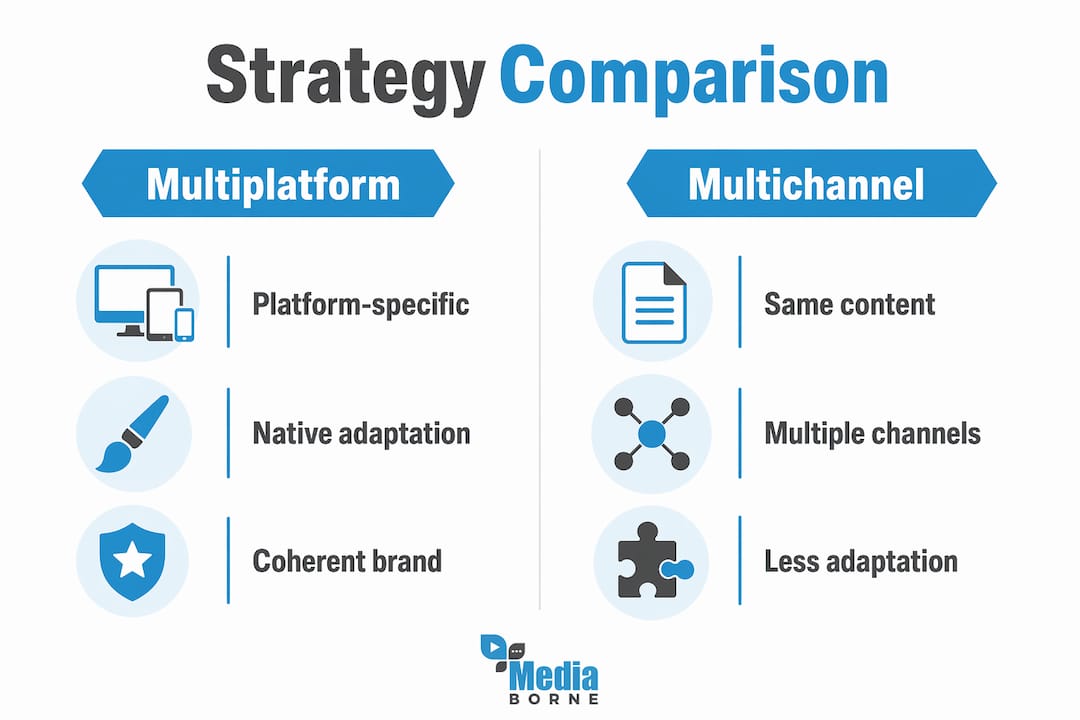
These three terms are frequently confused, and the confusion leads to poor strategy. Each approach has a fundamentally different focus: multiplatform centres on platform-specific adaptation, multichannel on distribution breadth, and omnichannel on a seamless user experience across all touchpoints.
Here is a clear comparison:
| Strategy | Primary Focus | Content Approach | Typical Use Case |
|---|---|---|---|
| Multiplatform | Platform-specific adaptation | Native formats per channel | Creators, brand storytelling |
| Multichannel | Distribution breadth | Central source, pushed out | E-commerce, news publishers |
| Omnichannel | Unified user experience | Consistent journey across touchpoints | Retail, customer service |
The practical difference shows up in execution. A multichannel strategy might push the same blog post to email, social, and a website simultaneously. A multiplatform strategy takes that same blog post and rebuilds it as a TikTok script, a LinkedIn article, and a YouTube short. Omnichannel goes further still, ensuring that a customer who sees a TikTok ad, clicks through to a website, and then receives an email all experience a connected, coherent journey.
Cross-posting without adaptation is the most common mistake in this space. Algorithms penalise duplicate content, particularly when watermarks from rival platforms are visible. A TikTok watermark on a Reels video signals to Instagram's algorithm that the content was not created natively, and reach suffers as a result.
What frameworks make multiplatform content scalable?
The hub-and-spoke model is the most practical framework for creating cross-platform content without burning out. It works by producing one central content piece and then adapting it into multiple platform-native formats, each treated as a spoke radiating from that hub.
A typical weekly workflow for a small team or solo creator looks like this:
- Monday: Record or write the hub content piece. This might be a long-form YouTube video, a podcast episode, or a detailed blog post.
- Tuesday: Extract the strongest insight and write a LinkedIn post. Adapt the hook for a professional audience.
- Wednesday: Cut a 60-second highlight clip for TikTok or Instagram Reels. Write a new hook that works for a scroll-based feed.
- Thursday: Create an Instagram carousel summarising the key points with visual slides.
- Friday: Schedule a short-form tweet thread or X post pulling out three quotable lines.
This workflow takes approximately 3–4 hours weekly and produces five publishing actions from a single creative effort. That efficiency is the entire point of the model.
Treating all platforms equally without adaptation leads to burnout and a diluted brand voice. The hub-and-spoke approach prevents this by concentrating creative energy on one strong piece, then repurposing with intention rather than duplication.
AI tools like PostKit can automate parts of this process, generating platform-native captions, reformatting copy, and scheduling posts across channels from a single dashboard. For teams managing multiple clients or content streams, this kind of automation is not optional. It is the difference between a sustainable operation and a chaotic one.
Pro Tip: Plan your hub content at the start of each week with the spoke formats already mapped. Knowing in advance that a YouTube video will become a TikTok clip, a LinkedIn post, and a carousel forces you to record with those formats in mind, saving significant editing time later.
How do you adapt content natively for each platform?
Native adaptation is the skill that separates effective multiplatform content from lazy cross-posting. Each platform has its own culture, pacing, and audience expectation. Ignoring those differences means your content feels out of place, and out-of-place content gets ignored.
Here is how native adaptation works across the major platforms:
- TikTok: Lead with a strong visual or spoken hook in the first two seconds. Use trending audio where relevant. Captions should be conversational and direct. Hashtags should mix broad and niche terms.
- LinkedIn: Open with a bold claim or a counterintuitive statement. Write in short paragraphs with line breaks. The audience expects professional insight, not entertainment. Avoid heavy use of hashtags.
- Instagram Reels: Prioritise visual quality and pacing. Text overlays should be minimal and readable. The hook must work without sound, as many users scroll on mute.
- YouTube: Invest in a strong thumbnail and title. The first 30 seconds must justify why the viewer should stay. Longer content performs well here if the depth is genuine.
- X (formerly Twitter): Compress ideas to their sharpest form. Threads work well for step-by-step content. Engagement comes from opinions and responses, not polished production.
Success in cross-platform content depends on tailoring hooks, formats, and engagement style to each channel rather than distributing identical content. This is not just a best practice. It is an algorithmic requirement on most major platforms.
Pro Tip: Before adapting any piece of content, write down the one thing you want the audience on that specific platform to feel or do. A LinkedIn reader should feel informed. A TikTok viewer should feel entertained or surprised. That single intention shapes every adaptation decision.
For a deeper look at how short-form video formats perform across platforms, Media borne's guide covers the specifics in detail.
What are the measurable benefits of multiplatform content?
The benefits of multiplatform content are both quantitative and strategic. The headline figure is clear: brands using a true multiplatform strategy grow their audiences three times faster than those publishing on a single platform. That growth compounds over time as each platform builds its own community that feeds back into the broader brand ecosystem.
Beyond raw audience numbers, the strategic benefits include:
| Benefit | What It Means in Practice |
|---|---|
| Increased brand visibility | Your content appears in multiple feeds, increasing the chance of discovery |
| Reduced platform dependency | No single algorithm change can eliminate your entire reach |
| Stronger audience trust | Consistent presence across platforms signals credibility and commitment |
| Higher engagement rates | Native content outperforms cross-posted content on every major platform |
| Broader demographic reach | Different platforms attract different age groups and professional segments |
Following the audience where they spend time prevents the single biggest risk in content marketing: building an audience on a platform you do not control. When TikTok faces regulatory pressure or Instagram changes its algorithm, brands with multiplatform presence absorb the impact. Brands dependent on one channel do not.
Engagement uplift is harder to quantify universally, but the pattern is consistent. Native content that respects a platform's format and culture earns more comments, shares, and saves than repurposed content that was clearly built for somewhere else. Audiences notice the difference even when they cannot articulate why.
Understanding digital media consumption patterns in 2026 is also worth your time, as audience behaviour across platforms continues to shift in ways that affect where you should be publishing.
How do you implement a multiplatform strategy without burning out?
Starting a multiplatform content strategy does not mean launching on six platforms simultaneously. The most sustainable approach begins with one hub platform and expands deliberately.
- Choose your hub platform based on where your existing audience is largest or where your content format is strongest. For most brands, this is YouTube, a podcast, or a long-form blog.
- Select two spoke platforms that align with your audience demographics. If your hub is YouTube and your audience skews professional, LinkedIn and X are logical first spokes.
- Build the adaptation workflow before you scale. Document how each hub piece becomes each spoke piece. Consistency in process prevents inconsistency in output.
- Apply the 80/20 rule across all platforms. Eighty per cent of your content should deliver value and twenty per cent can promote your products or services. Ignoring this balance exhausts your audience and reduces engagement across every channel.
- Review performance monthly and cut platforms that are not delivering. Presence for its own sake is not a strategy.
Pro Tip: Use a simple content calendar in Notion or Airtable to map hub content to spoke formats before the week begins. This single habit eliminates the most common cause of inconsistent publishing: deciding what to post on the day you need to post it.
For broader thinking on customer engagement across digital media, Media borne's resources offer practical frameworks that complement this approach.
Key takeaways
Multiplatform content works because native adaptation, consistent brand voice, and a structured hub-and-spoke workflow combine to grow audiences faster and more sustainably than single-platform publishing ever can.
| Point | Details |
|---|---|
| Define it correctly | Multiplatform content means adapting content natively for each platform, not cross-posting the same piece everywhere. |
| Use the hub-and-spoke model | One hub piece produces five platform-native formats in 3–4 hours per week, making the strategy sustainable for small teams. |
| Avoid algorithm penalties | Cross-posting with watermarks or identical copy reduces reach on most major platforms, including Instagram and TikTok. |
| Apply the 80/20 rule | Eighty per cent value content and twenty per cent promotional content sustains audience interest across all channels. |
| Start small and expand | Begin with one hub platform and two spokes before scaling, to build a repeatable workflow before adding complexity. |
Why most brands get multiplatform content wrong
The most common mistake I see is brands treating multiplatform content as a distribution problem rather than a creation problem. They take one piece of content and blast it everywhere, then wonder why engagement is flat. The issue is not the volume of platforms. The issue is that the content was never built to live on those platforms in the first place.
I have seen this play out repeatedly with brands that invest heavily in a polished YouTube series and then post the same long-form video to TikTok, LinkedIn, and Instagram without any adaptation. The YouTube audience responds well. Every other platform ignores it. The conclusion they draw is that those platforms do not work for their brand. The real conclusion should be that their adaptation process does not work.
The hub-and-spoke model changed how I think about content production entirely. When you plan a hub piece with the spokes already mapped, the creative decisions you make during production are different. You frame soundbites more deliberately. You structure arguments so they can be extracted cleanly. You think about what a LinkedIn reader needs versus what a TikTok viewer wants, before you hit record.
Sustainability is the other thing most guides underplay. Multiplatform content is not a sprint. The brands that win are the ones still publishing consistently six months in, not the ones who launched on eight platforms in January and burned out by March. Pick fewer platforms. Adapt properly. Show up every week.
— Stephen
Elevate your multiplatform content with professional production
The quality of your hub content sets the ceiling for every spoke format that follows from it. Poorly filmed video, weak audio, or flat visual storytelling limits what you can extract and adapt, regardless of how strong your distribution strategy is.
Media borne works with brands to produce high-quality video content built specifically for multiplatform use. From filming and editing to format planning across TikTok, YouTube, and Instagram, the production process is designed to generate maximum spoke content from every hub piece. If your content strategy is sound but your production quality is holding back your reach, that is the gap Media borne is built to close.
FAQ
What is multiplatform content in simple terms?
Multiplatform content is the practice of publishing coordinated, adapted content across three or more platforms, with each piece tailored to fit the format and audience of that specific channel. It is distinct from simply posting the same content everywhere.
How does multiplatform content differ from cross-posting?
Cross-posting means distributing identical content across platforms without adaptation. Multiplatform content involves rebuilding or reformatting each piece natively for each platform, which performs significantly better with both audiences and algorithms.
What is the hub-and-spoke model for content?
The hub-and-spoke model involves creating one central content piece and adapting it into multiple platform-native formats. A single hub piece can produce five publishing actions in approximately 3–4 hours per week.
Which platforms should a multiplatform content strategy include?
The right platforms depend on your audience, but TikTok, YouTube, LinkedIn, and Instagram cover the broadest range of demographics and content formats for most brands and creators in 2026.
What is the 80/20 rule in multiplatform content?
The 80/20 rule means that eighty per cent of your content across all platforms should deliver genuine value to your audience, with only twenty per cent used for direct promotion. Brands that ignore this ratio see engagement decline across every channel over time.