
TL;DR:
- Short-form video has become dominant, requiring creators to focus on effective hooks and platform-specific strategies. Achieving success depends on engaging viewers within the first three seconds, matching technical specs, and maintaining consistency within a niche. Tracking retention metrics and refining hooks through testing are essential to improving reach and engagement over time.
Short-form video is not just competing with other content formats. It has won. For content creators and marketers, that means the challenge is no longer whether to invest in it but how to do it well enough to stand out. This guide to maximising short-form video covers everything that actually matters: platform mechanics, scroll-stopping hooks, posting strategy, and how to read your data honestly. No generic advice. Just what works, and why.
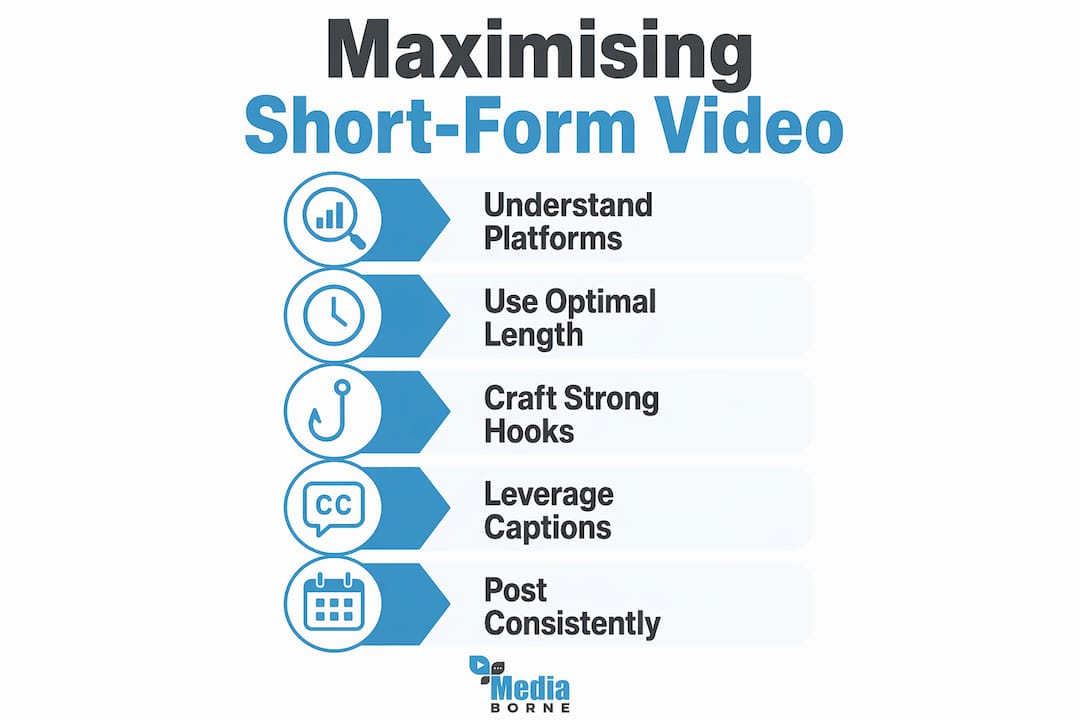
Key takeaways
| Point | Details |
|---|---|
| Hook in the first three seconds | The opening moment determines whether viewers stay or scroll; make every frame count. |
| Match specs to each platform | Vertical 9:16 format, correct lengths, and safe zones differ across TikTok, Reels, and Shorts. |
| Captions are non-negotiable | A significant portion of views happen muted, so burned-in text retains more of your audience. |
| Post consistently within a niche | Algorithms classify your content faster when you stay focused and publish regularly. |
| Measure retention, not just views | Average percentage viewed and drop-off points tell you far more than raw view counts alone. |
Your guide to maximising short-form video on every platform
Before you film a single frame, you need to understand the rules of each platform you are publishing on. TikTok, Instagram Reels, and YouTube Shorts all have distinct technical requirements, and ignoring them will quietly suppress your reach regardless of how good your content is.

Video length and format standards
The vertical 9:16 aspect ratio is the baseline for all three platforms. Beyond that, optimal length varies. TikTok performs well with videos between 21 and 34 seconds for entertainment content, though educational formats can stretch to 60 or even 90 seconds. YouTube Shorts caps at 60 seconds. Instagram Reels best practices in 2026 recommend keeping videos under three minutes, with the strongest engagement typically occurring under 60 seconds.
Safe zones matter too. Avoid placing critical text or faces near the edges of the frame, as UI overlays on every platform will obscure them. Shoot with the centre third of the frame as your primary visual area.
Metadata and hashtag strategy
| Platform | Hashtag cap | Caption approach | Key metadata tip |
|---|---|---|---|
| TikTok | 5 hashtags | Keyword-led caption | Place the primary keyword in the first sentence |
| Instagram Reels | Up to 30 | Mix of broad and niche | Use keyword-rich alt text on the thumbnail |
| YouTube Shorts | No formal cap | Title and description | Front-load keyword in the title |
TikTok enforces a hard five-hashtag cap since August 2025, making precise, relevant hashtags far more valuable than stuffing. Start your caption with the keyword your audience is likely to search, then add hashtags at the end.
Beyond hashtags, think about how the algorithm reads your content. Titles, descriptions, and spoken words are all indexed. If you say the keyword aloud in your video, platforms can use that audio data alongside your metadata to improve discovery and classification.
Crafting hooks and content structures that hold attention
The average viewer decides whether to keep watching within the first one to three seconds. That is the hook window. Miss it, and the algorithm receives a signal that your content is not worth distributing further.
Strong hooks share a few characteristics. They create tension immediately. They raise a question the viewer needs answered. And they do it visually, not just through narration.
The curiosity loop structure
Curiosity loops open tension by withholding the answer to a question the viewer has just been made to care about. A video that opens with "You are losing sales because of this one mistake" forces the viewer to stay until the mistake is revealed. The payoff at the end of the loop is what drives completion rates and replays.
The most effective short-form content follows a simple arc: present a problem or surprising claim, introduce an obstacle or complexity, then resolve it with clarity. This works equally well for entertainment, education, and product content.
Captions, silent viewing, and overlays
A large portion of TikTok views happen muted, making captions critical for engagement. This is not optional for most audiences. Burned-in captions that sync with speech keep viewers watching longer, especially in contexts where audio is off by default, such as public transport or the office. Meta Reels ads achieve 12% better silent view retention with bold, burned-in captions and properly framed safe-zone video.
Overlays serve a secondary function too. Text on screen gives viewers a second layer of information to process, which slows the impulse to scroll. Use them sparingly but deliberately.
Pro Tip: Film a version of your hook without any spoken intro. Start mid-action or mid-sentence. Compare watch time with your standard opening. The mid-action version almost always wins.
Avoid these common structural mistakes:
- Opening with a logo, intro card, or "welcome back"
- Burying the core idea after 10 or more seconds of context-setting
- Using a hook that does not connect to the body of the video
- Relying entirely on audio when most viewers will not hear it
- Starting with a slow pan or establishing shot instead of direct subject engagement
Posting strategy and engagement tactics that work
Consistency is the most underestimated variable in short-form growth. Posting two to five times per week significantly increases TikTok engagement compared to once weekly because the algorithm needs repeated signals to understand and classify your content. One video is not enough data. A week of consistent, thematically focused content is.
Niche focus compounds this effect. When every video on your account covers a related subject, the algorithm can push your content to the same pool of interested viewers. Accounts that mix unrelated topics confuse the classification system and receive inconsistent distribution as a result.
How to drive engagement beyond the view count
Engagement signals that matter most to algorithms, in rough order of weight:
- Shares (the strongest signal across all platforms)
- Saves (especially on Instagram Reels, where saves boost on-platform performance significantly)
- Comments (particularly on TikTok, where replying to comments creates video replies that extend reach)
- Replays and loops
- Likes (least weighted but still counted)
Your call to action should match the type of content. Educational content lends itself to saves: "Save this for the next time you need it." Opinion content drives comments: "Tell me if you agree." Series content drives follows and shares, particularly when you use part-numbered formatting.
Short-form series content triggers binge-watching and subscriber boosts because platforms actively serve subsequent parts to viewers who watched earlier episodes. Part 1, Part 2 sequencing is one of the most reliable growth mechanics available right now.
Pro Tip: Reply to every comment in the first two hours after posting. On TikTok especially, comment activity in that window signals to the algorithm that the content is generating conversation, which accelerates distribution.
Using AI tools without losing your edge
AI tools improve content performance when used to test hook variants and identify patterns in successful videos. What they cannot do is replace the human instinct for what feels real. Use AI to generate three or four different opening lines, then choose the one that sounds most like you. The tool handles volume; you handle authenticity.
For effective short video optimisation tips, treat each video as one focused idea. Trying to cover multiple points in a single 30-second clip is one of the most common reasons for poor retention.
Measuring success and improving over time
Views are a vanity metric. The numbers that actually tell you something are average percentage viewed, the ratio of completed views to swipe-aways, and the point in your video where viewers drop off.
YouTube Shorts distributes better when videos achieve 70% or higher average viewed completion. Below 50% is a clear signal that the hook is not working or the content loses relevance too quickly. Most platforms surface similar retention data in their native analytics, and reading it honestly is the fastest way to improve.
What your retention graph is actually telling you
| Drop-off pattern | What it means | How to fix it |
|---|---|---|
| Sharp drop at seconds 1 to 3 | Weak hook; viewer not compelled | Test a different opening line or visual |
| Drop at seconds 8 to 12 | Hook worked but content did not follow through | Tighten the mid-section; cut filler |
| Gradual decline throughout | Pacing issue; content is too slow | Increase visual or spoken pace; trim length |
| High replay rate | Strong loop structure or unresolved tension | Identify the pattern and replicate it |
Build a simple testing cycle. Release two or three hook variants for the same core idea across separate videos in the same week. Check retention at the 48-hour mark. Keep the structure that performs. Discard or revise what does not.
Over-editing content reduces authenticity, which negatively impacts performance on platforms like TikTok where audiences are highly attuned to what feels scripted versus genuine. The most effective video marketing strategies often involve less polish, not more.
What I have actually learned from short-form video
I have worked with enough brands and creators to say this plainly: most people focus on the wrong thing. They agonise over production quality, posting time, and trending audio when the single biggest lever is the hook. Get the first three seconds wrong and nothing else matters. Get it right and a video shot on a phone in natural light will outperform a studio production every time.
The other thing I have seen consistently is that niche confusion kills growth quietly. Brands that try to reach everyone with a single account end up reaching no one effectively. The accounts that grow fastest pick a lane and stay in it long enough for the algorithm to understand them. That takes patience that most marketing teams do not have.
I am also wary of how AI tools are being positioned right now. They are genuinely useful for generating hook variants and analysing performance patterns. But I have seen brands hand over creative decisions entirely to AI-generated scripts, and the content feels hollow. Audiences notice. The brands that produce viral videos consistently are the ones using AI as a research assistant, not a creative director.
Finally, on patience. Short-form growth is not linear. A video can sit at 400 views for three weeks and then get pushed to 400,000. The algorithm revisits content. Quitting too early is the most common reason creators and marketers do not see returns.
— Stephen
Take your short-form content further with Media Borne
If you are ready to move beyond trial and error, professional support makes a measurable difference to the quality and consistency of your output.

Media Borne specialises in creating short-form video content that is built for platforms and engineered to perform. From scroll-stopping hooks to post-production polished for silent viewing, the team understands what makes content travel. Whether you need a single high-impact series or an ongoing content programme, explore Media Borne's video production services to see how professional filming and editing translates directly into engagement and reach. You can also browse the project portfolio for examples of work across brand and entertainment formats.
FAQ
What is the best video length for TikTok in 2026?
TikTok performs best with videos between 21 and 60 seconds for most content types, though educational formats can extend to 90 seconds. The key is that every second earns its place in the edit.
How many hashtags should you use on TikTok?
TikTok enforces a hard cap of five hashtags since August 2025. Use relevant, targeted hashtags and lead your caption with a keyword rather than relying on hashtag volume for discovery.
Why do captions matter on short-form videos?
A large share of views across TikTok and Instagram Reels happen with the sound off. Burned-in captions keep viewers watching and improve retention, particularly for mobile audiences in public settings.
How do you measure whether a short-form video is performing well?
Track average percentage viewed and the ratio of completed views to swipe-aways rather than focusing on raw view count. A 70% or higher completion rate signals strong performance to platform algorithms.
How often should you post short-form video content?
Posting two to five times per week significantly outperforms once-weekly publishing because consistent output helps the algorithm classify your content and serve it to the right audience reliably.