

TL;DR:
- Organic reach remains vital for brands that focus on engagement and community building rather than solely promoting content.
- Understanding platform algorithms and consistently producing engaging formats like reels, carousels, and short videos can significantly boost visibility without paid promotion.
Organic reach is not dead. It has simply become more demanding. Brands that treat social media as a broadcast channel are watching their numbers shrink, while those who understand modern engagement signals are quietly building audiences at scale without spending a penny on paid promotion. Organic reach refers to the number of unique people who see your content without paid amplification, and for e-commerce and entertainment brands, it remains one of the most powerful growth levers available. This article breaks down the frameworks, benchmarks, and practical tactics that actually move the needle in 2026.
Table of Contents
- What is organic reach and why does it matter?
- Benchmarking: what does strong organic reach look like in 2026?
- Key drivers: how algorithms amplify organic reach
- Winning strategies: practical tactics for boosting organic reach today
- Why organic reach isn't dead: a Borne perspective
- Boost your brand's reach with expert video strategy
- Frequently asked questions
Key Takeaways
| Point | Details |
|---|---|
| Organic reach builds trust | Unpaid content fuels community and credibility in a way sponsored posts cannot match. |
| Benchmarks set realistic goals | Evaluating your numbers against industry data helps you focus improvement efforts. |
| Algorithms reward interaction | Optimising for engagement signals like comments, shares, and retention increases your reach. |
| Short video wins in 2026 | Reels, carousels, and UGC collaborations drive the highest discovery and growth on key platforms. |
| Blend organic with paid | Combining organic and paid strategies protects your brand from rising ad costs and algorithm shifts. |
What is organic reach and why does it matter?
Organic reach is not simply about impressions. It is about genuine, unpaid visibility driven by how platforms decide to distribute your content. According to platform mechanics, organic reach relies on algorithms prioritising engagement signals like comments, shares, saves, watch time, and recency to keep users on-platform. When your content triggers those signals, the algorithm rewards you with broader distribution. When it does not, your post quietly disappears.
For e-commerce and entertainment brands, this distinction is significant. Paid advertising pushes your content in front of people who may or may not want it. Strong organic reach, by contrast, reaches people actively responding to content they find valuable or entertaining. That difference in context builds something paid simply cannot manufacture: trust.
The business outcomes that flow from strong organic reach are substantial:
- Community growth: Consistent organic visibility builds an audience that returns by choice, not because of retargeting.
- Brand credibility: High-engagement organic content signals authority to both platforms and prospective customers.
- Non-follower discovery: Platforms like TikTok and Instagram actively push strong content beyond your existing audience, unlocking new pools of potential buyers.
- Long-term retention: Organic communities tend to have lower churn than audiences built purely through paid campaigns.
- Cost efficiency: Every piece of organic content that performs well delivers returns without a direct media spend attached to it.
Understanding media production ROI becomes critical here because the production investment in organic content compounds over time in a way that paid spend does not. A well-produced Reel or carousel can continue driving discovery weeks after publication. A paid ad stops the moment you stop funding it.
It is also worth noting that video formats for marketers have diversified enormously, meaning the question is no longer just whether to post video but which format serves your goals on each platform.
Benchmarking: what does strong organic reach look like in 2026?
Before you can improve your organic reach, you need to know where you stand relative to the market. Too many marketing teams chase arbitrary goals or panic over declining numbers without understanding whether their performance is actually below par for their sector.
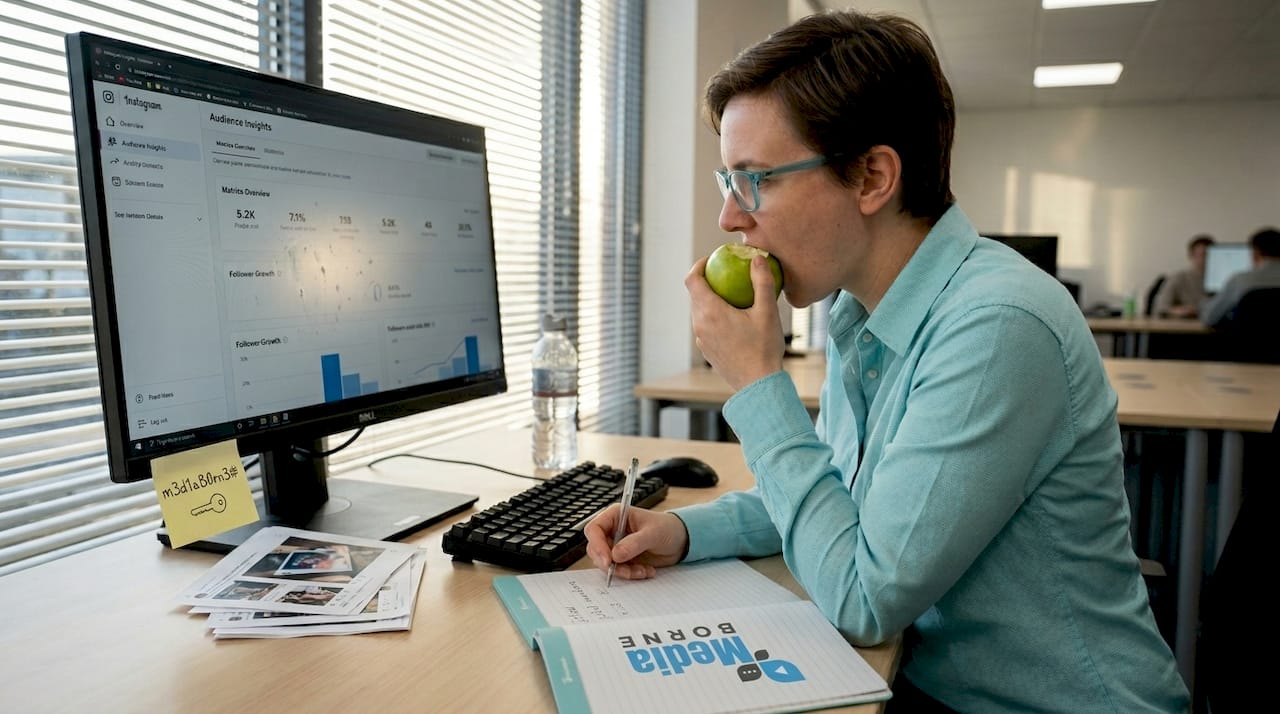
Industry benchmarks for 2026 from Hootsuite show that entertainment and media brands see Instagram carousels achieving 3.2% engagement and Reels at 2.7%. Posting frequency also has a measurable impact, with the highest engagement recorded at 13 Instagram posts per week (3.70%), 10 TikTok posts per week (1.81%), and 2 LinkedIn posts per week (2.51%). Instagram follower growth sits at roughly 1.82% per week for high-performing accounts.
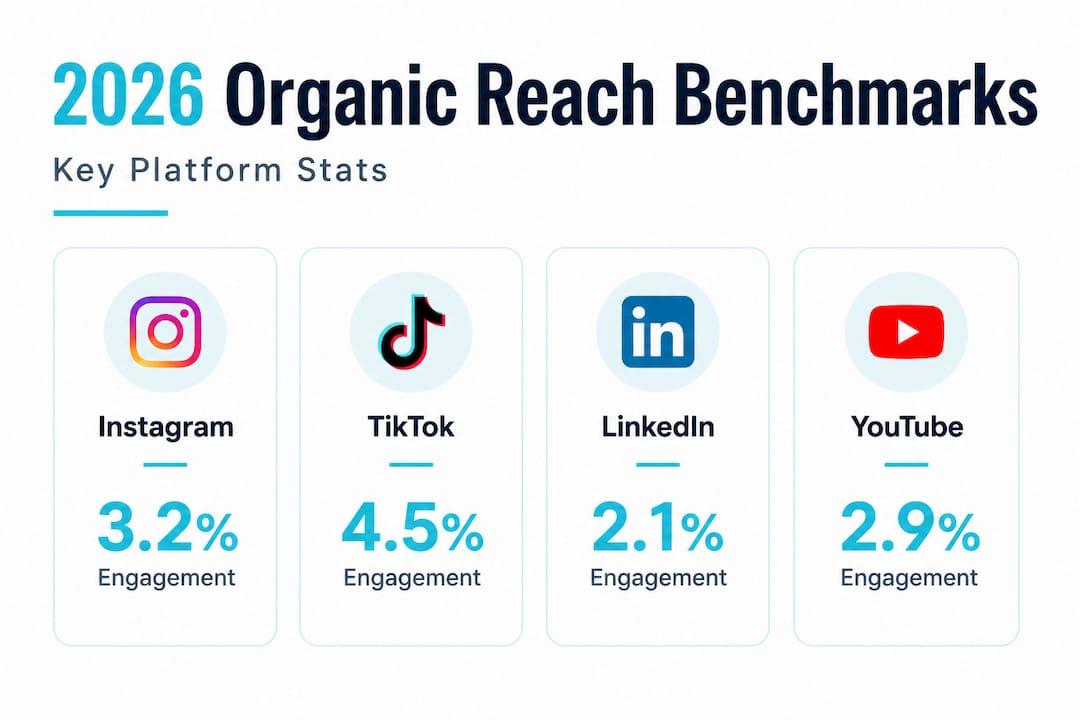
| Platform | Best format | Avg. engagement rate | Optimal posting frequency |
|---|---|---|---|
| Carousels | 3.2% | 13 posts/week | |
| Reels | 2.7% | 13 posts/week | |
| TikTok | Short-form video | 1.81% | 10 videos/week |
| Thoughtful text/video | 2.51% | 2 posts/week |
These numbers matter for context, but they come with important caveats. Your sector, audience size, and how long you have been consistently producing content all affect what is realistic for your account. A brand with 500 followers and six months of posting history will not hit the same benchmarks as an established entertainment channel with 200,000 engaged followers.
There is also a meaningful gap between what is possible in viral moments and what is sustainable as a strategy. Chasing outlier performance is a trap that wastes creative resource and demoralises teams.
Pro Tip: Rather than fixating on platform averages, benchmark against your own historical performance. A 15% improvement in your average engagement rate over two months is more meaningful and actionable than matching an industry figure from a brand in a different context. Use engagement strategy tips to build a framework for tracking your own progress.
Posting frequency and format choice are deeply connected. Brands that post sporadically in inconsistent formats signal to algorithms that they are not reliable content sources. Consistency trains the algorithm, and it also trains your audience to expect and look for your content. TikTok marketing success depends heavily on this rhythm, particularly given how quickly TikTok's For You Page rotates content.
Key drivers: how algorithms amplify organic reach
Understanding what algorithms reward gives you a framework for building content that works with the platform rather than against it. Each major platform uses broadly similar signals, but the weighting differs meaningfully.
| Platform | Primary algorithm signals | Best-performing format | Recommended frequency |
|---|---|---|---|
| Saves, shares, comments, watch time | Carousels, Reels | 13 posts/week | |
| TikTok | Watch-through rate, replays, shares, follows | Short-form video (under 60 sec) | 10 videos/week |
| Comments, dwell time, shares, reactions | Thought leadership posts, native video | 2 posts/week |
"The most significant shift in organic reach is the rise of non-follower distribution. Platforms like TikTok were built on it, and Instagram has moved decisively in the same direction through Reels. Brands willing to invest in short-form video creativity are accessing audiences far beyond their existing communities." This shift represents perhaps the biggest untapped opportunity for brands that have previously relied on follower-based reach.
Platforms prioritise content that keeps users on the platform. Every signal, whether it is a save on Instagram or a replay on TikTok, tells the algorithm that your content is worth showing to more people. This is why passive, broadcast-style posts underperform. They generate impressions but not the interactions that trigger broader distribution.
Here is a step-by-step process for optimising content for each signal:
- Timing: Post when your specific audience is most active, not just at generic "best times." Platform analytics show you your audience's peak activity windows.
- Format selection: Choose the format the platform currently favours. In 2026, Reels and carousels on Instagram, short-form video on TikTok, and substantive text or native video on LinkedIn consistently outperform other formats.
- Opening hook: The first two seconds of a video or the first line of a caption must earn attention immediately. Weak openings kill distribution before the algorithm has a chance to amplify.
- Interactive CTAs: Prompts that invite specific responses, such as "drop your answer below" or "save this for later," directly feed the signals algorithms use to measure value.
- Social SEO: Use relevant keywords in captions, alt text, and hashtags. Instagram and TikTok increasingly function as search engines for younger audiences.
- Community response: Replying to comments, particularly in the first hour after posting, signals to the algorithm that your content is generating genuine conversation.
For engagement-driving formats, the data consistently points to formats that invite participation rather than passive consumption. Strategic video marketing sits at the intersection of entertainment and commerce, and it is where organic reach most reliably converts into commercial outcomes. Explore video content tips to sharpen how you open, structure, and close each piece of content.
Winning strategies: practical tactics for boosting organic reach today
Theory is useful. What marketing professionals in e-commerce and entertainment brands actually need are tactics they can implement this week. Here are the approaches that consistently drive organic growth for brands operating in competitive, attention-rich environments.
Timing and frequency optimisation
- Post during your audience's active windows, identified through native analytics, not generic guides.
- Maintain a consistent schedule. Algorithms reward reliability and so do audiences.
- Use platform-best formats for each channel: Reels and carousels for Instagram, native short-form video for TikTok, thoughtful posts for LinkedIn.
Interactive content and community signals
- Ask genuine questions that your audience actually wants to answer.
- Use polls, quizzes, and "this or that" formats to generate fast, low-friction engagement.
- Respond to every comment in the first 60 minutes after posting. This signals active community management and triggers broader distribution.
User-generated content and collaborations
- Invite customers and fans to create content featuring your brand. UGC carries authenticity that branded content cannot replicate.
- Partner with creators whose audiences align with your target customer. Collaborative posts on Instagram expose your brand to entirely new follower bases without paid spend.
- Run campaigns that incentivise sharing and tagging, creating organic amplification loops.
Social SEO for discoverability
Pro Tip: Treat every caption as a search result. Instagram and TikTok now index captions, alt text, and spoken words in videos. Integrate relevant keywords naturally into your captions, include descriptive alt text on all images, and use specific rather than generic hashtags. A fitness brand gets better results from "#homegymsetup" than "#fitness."
Platform-specific adaptations
On TikTok, entertainment value is the currency. Trend participation, original audio use, and fast-paced storytelling drive discovery. On Instagram, aesthetic quality and carousel depth (encouraging multiple swipes) matter enormously. On LinkedIn, vulnerability and professional insight outperform promotional content by a significant margin.
Explore innovative media trends to understand which formats are gaining traction now. Building content hubs for engagement can also help you organise and repurpose organic content across channels more efficiently.
Blending organic with paid, SEO, and email
Organic reach builds trust and community in ways that paid cannot replicate, but the two work best together. Use paid to amplify your highest-performing organic content. Use email to drive audiences back to your social platforms. Use SEO to capture search intent and funnel those audiences into your social communities.
For e-commerce and entertainment brands specifically, short-form video growth is the most direct bridge between organic reach and purchase intent. And exploring types of social media video can help you identify formats you have not yet fully exploited.
As customer acquisition costs through paid channels continue to rise, the brands that have invested in organic reach enjoy a natural cost advantage. Every loyal community member is an organic distribution asset.
Why organic reach isn't dead: a Borne perspective
There is a recurring narrative in marketing circles that organic reach is finished. Some voices point to LinkedIn organic reach dropping by 70 to 80% as evidence that the organic era is over. We disagree, strongly, and here is why.
The brands declaring organic dead are largely the ones who treated it as a free version of paid advertising. Post often enough, reach enough people, convert enough customers. That model is genuinely finished. But the brands who understand organic reach as an entertainment and community-building discipline are thriving.
TikTok was built on non-follower reach. Instagram shifted its algorithm decisively toward Reels and interest-based discovery. Neither platform is rewarding broadcast content, but both are actively surfacing creative, engaging, entertainment-led content to massive audiences that have never heard of the brand posting it. That is an extraordinary opportunity, and most brands are not taking it seriously enough.
Where we see brands go wrong is not in their platform choices or their posting frequency. It is in their creative approach. Algorithm-chasing, posting whatever is trending without genuine brand connection, produces short spikes and no lasting community. Audiences can sense when a brand is performing for the algorithm rather than for them.
The second common pitfall is neglecting newer formats too long. Brands that waited two years before seriously investing in Reels gave up two years of non-follower discovery. The same risk exists today with formats like short-form documentary content and live social selling.
Our view is that organic reach is the backbone of long-term brand equity. Paid media buys attention. Organic content earns it. And earned attention, particularly through entertainment-led formats, builds the kind of trust that makes audiences choose you over competitors without a promotional nudge. Video strategy for engagement sits at the heart of how we help brands build that kind of durable, compounding visibility.
The brands that will dominate their categories in three years are the ones investing in organic community building right now, while their competitors continue to spend more on paid for diminishing returns.
Boost your brand's reach with expert video strategy
If the frameworks and tactics in this article have clarified what is possible, the next step is putting them into practice with the right creative partner.
At Media Borne, we build entertainment-led content that performs organically across TikTok, Instagram, and LinkedIn. Our video production services are designed specifically for brands that want to grow through attention rather than interruption. We combine social selling video with strategic content distribution to turn organic audiences into measurable commercial outcomes. Whether you need a full content campaign or a focused organic growth strategy, our team builds formats that platforms actually reward. Let's build something your audience wants to watch, share, and buy from.
Frequently asked questions
Why has organic reach declined so much in recent years?
Social platforms continuously update algorithms to prioritise personal connections and user retention, making passive, brand-driven posts less visible unless they drive active engagement such as comments, saves, and shares.
What is the single most important factor to improve organic reach in 2026?
Consistently publishing in best-performing formats is key. Instagram carousels achieve 3.2% engagement and accounts posting 13 times per week see the highest overall reach. Sparking genuine conversation amplifies that further.
Should my brand focus more on paid or organic social growth?
A balanced approach works best. Organic builds trust and community retention, while paid accelerates discovery. As customer acquisition costs rise, organic reach becomes an increasingly cost-efficient long-term asset.
How often should I post to maximise organic reach on Instagram and TikTok?
Benchmarks show that 13 Instagram posts and 10 TikTok videos per week deliver the highest engagement rates for entertainment and media brands in 2026. Consistency matters as much as volume.