
TL;DR:
- Creator marketing focuses on authentic content creation for long-term brand assets.
- It involves collaborative partnerships, differing from influencer marketing's audience reach focus.
- Effective strategies include giving creators creative freedom and building long-term relationships.
Influencer marketing and creator marketing are not the same thing, and conflating the two is costing brands real growth. While influencer campaigns chase reach and follower counts, creator marketing builds something far more durable: authentic, entertainment-driven content that audiences actually want to engage with. The brands pulling ahead in 2026 are not simply paying someone with a large following to post a photo. They are building genuine creative partnerships that produce scalable assets, spark community, and convert attention into revenue. This guide breaks down exactly what creator marketing is, how to build a strategy around it, and how to avoid the mistakes that quietly drain your budget.
Table of Contents
- What is creator marketing and why does it matter?
- Building an effective creator marketing strategy
- Key differences: Creator marketing vs influencer marketing
- Best practices and pitfalls in creator partnerships
- The uncomfortable truth about creator marketing
- Drive growth with professional video and creator content
- Frequently asked questions
Key Takeaways
| Point | Details |
|---|---|
| Creators are not influencers | Creator marketing prioritises content quality and brand collaboration, while influencer marketing is about reach. |
| Entertainment drives ROI | Raw and relatable creator content outperforms polished traditional ads for engagement and conversions. |
| Creative freedom is essential | Brands see better results when they give creators space for authentic output instead of strict briefs. |
| Repurposing content boosts value | Most brands use creator content in multiple formats, which enhances campaign returns across channels. |
What is creator marketing and why does it matter?
At its core, creator marketing involves brands partnering with content creators to produce authentic, entertainment-driven content that achieves marketing goals like awareness, engagement, and sales. That sounds straightforward, but the landscape is more nuanced than most marketers realise.
Creator relationships take several distinct forms, each with a different commercial logic:
- Affiliates: Creators earn commission on sales they drive, keeping incentives aligned with performance.
- Brand ambassadors: Long-term relationships where the creator becomes a recognisable face for the brand over time.
- Creative collaborators: Creators who co-develop content concepts, campaigns, or even products with the brand.
- UGC creators: Producers of user-generated content specifically designed to be repurposed in paid advertising and owned channels.
Understanding which type of relationship you need before you begin outreach is one of the most underrated strategic moves in creator marketing. Brands that blur these categories tend to end up with content that fits no brief and serves no clear purpose.
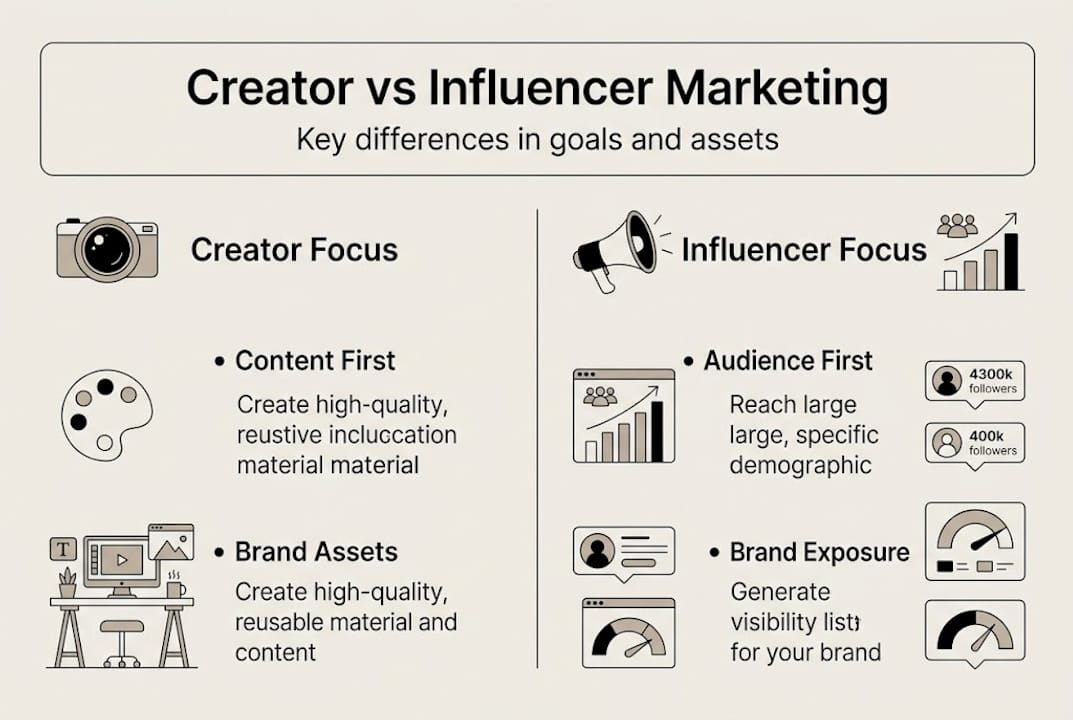
So how does this differ from the traditional influencer model? Influencer marketing is primarily about borrowing someone else's audience. Creator marketing is about building brand-owned content assets through people who are skilled storytellers and media producers in their own right. The distinction matters enormously when it comes to long-term value.
Here is a quick comparison:
| Factor | Creator marketing | Influencer marketing |
|---|---|---|
| Primary goal | Content production and assets | Audience reach and endorsement |
| Ownership | Brand retains content rights | Creator controls distribution |
| Key metric | Engagement quality and repurposing value | Reach, impressions, follower count |
| Relationship type | Collaborative production | Transactional promotion |
| Best for | Scalable ads, UGC, brand storytelling | Top-of-funnel awareness campaigns |
The commercial case for creator marketing is compelling. 77% of brands now repurpose creator content in their paid advertising, often outperforming traditional creative on cost and conversion. This is because creator content carries an authenticity signal that polished studio production simply cannot replicate. Audiences have become extraordinarily good at identifying and ignoring content that feels like an advert. Creator content sidesteps that defence entirely.
For brands investing in brand-led media strategies, creator marketing is not a bolt-on tactic. It is a fundamental shift in how content is originated and distributed.
Building an effective creator marketing strategy
Knowing what creator marketing is gets you to the starting line. Building a strategy that actually performs is a different challenge entirely. Here is a framework that works across industries and platforms.
- Research and align creators by type, tier, and niche. Start with your audience, not your budget. Who are they watching, and why? Nano and micro creators (typically 1,000 to 100,000 followers) often deliver better engagement rates than macro influencers at a fraction of the cost.
- Select platforms based on your content format. TikTok and Instagram dominate for entertainment-led content in 2026. YouTube suits longer-form storytelling and tutorials. Choose platforms where your audience already spends time.
- Write briefs that inform without dictating. The brief should communicate your brand values, the campaign objective, and any non-negotiables around messaging. Leave the creative execution to the creator. This is where most brands go wrong.
- Collaborate during creation. Review content as a partner, not a client approving an invoice. Early feedback loops produce better work and stronger relationships.
- Set KPIs before you launch. Measure performance using engagement rates, conversions, and ROI so you can iterate with data rather than gut feeling.
Pro Tip: Do not evaluate creator content by the same aesthetic standards you apply to your studio production. Raw, unpolished content frequently outperforms high-budget creative on social platforms because it feels real. Judge it by engagement signals and conversion data instead.
Platform selection and creative freedom are the two levers that most directly determine campaign success. Staying current with media production trends helps you make smarter choices about formats before they peak. And solid strategic planning for content ensures your creator campaigns connect coherently to wider brand goals rather than existing as isolated activations.
The most effective creator strategies are not one-off campaigns. They are rolling programmes that build creative momentum and compound audience familiarity over time.
Key differences: Creator marketing vs influencer marketing
This is the question we hear constantly, and the confusion is understandable. The terminology overlaps, platforms blur the lines, and many practitioners use the terms interchangeably. But the distinction is commercially significant.
Creator marketing focuses on content production and UGC for repurposing as brand-owned assets, whereas influencer marketing leverages personal audience reach for endorsements. That single distinction changes almost everything about how you plan, brief, and measure a campaign.

Here is how the two approaches compare across key dimensions:
| Dimension | Creator marketing | Influencer marketing |
|---|---|---|
| Core value | Content as a scalable asset | Audience trust and reach |
| Cost model | Per deliverable or retainer | Per post or per reach milestone |
| Funnel position | Mid and bottom funnel | Top of funnel |
| Brand control | Higher (brand owns content) | Lower (creator owns channel) |
| Long-term value | High (content repurposed in ads) | Variable (diminishes post-campaign) |
Practically speaking, you reach for influencer marketing when you want to put your brand in front of a new audience quickly. You reach for creator marketing when you want content that works harder over time across your paid, owned, and earned channels.
"The creator vs influencer debate often obscures a simpler truth: brands need both, but they need to know which tool they are picking up and why." Explore the expert debate on creators vs influencers for more nuanced industry perspectives.
For branded content best practices and maximising the asset value of every piece of creator output, the content rights conversation needs to happen before any brief is issued. And if your strategy leans heavily on video storytelling for brands, creator-produced video is consistently among the highest-performing formats available to modern marketing teams.
Best practices and pitfalls in creator partnerships
Understanding the theory is one thing. Getting consistently strong results from creator relationships requires attention to a different set of details.
What actually works:
- Give creators genuine creative latitude. Avoid rigid briefs that treat creators like ad agencies executing a pre-written script. Their audience trusts them precisely because their voice is their own.
- Prioritise niche relevance over follower count. A creator with 8,000 deeply engaged followers in your exact category will often outperform one with 500,000 loosely connected ones. Check comment depth and conversation quality, not just numbers.
- Repurpose creator content systematically in paid media. Content produced by creators outperforms traditional ads when used in social advertising, often at lower production cost and higher conversion rates.
- Build long-term partnerships where possible. Repeated collaboration deepens creator understanding of your brand, which shows up in the quality and authenticity of the content.
Common pitfalls to avoid:
- Over-prescriptive briefs that strip out the creator's natural voice
- Focusing on vanity metrics like reach and impressions instead of engagement and conversion
- Treating each campaign as isolated rather than building cumulative brand equity
- Ignoring content rights and usage agreements until after content is produced
Pro Tip: When reviewing creator content for paid amplification, look for posts that already have strong organic engagement. These are your best signals for what will perform in paid placement because the algorithm has already validated them.
Investing in media production for ROI means thinking beyond the individual post and considering how each piece of creator content contributes to a larger content ecosystem that works for your brand long after the campaign ends.
The uncomfortable truth about creator marketing
Here is what most articles on this topic will not tell you: the majority of creator marketing campaigns fail not because of poor creator selection or budget constraints, but because brands cannot bring themselves to let go of control.
There is a deep institutional instinct in marketing to over-brief, over-approve, and over-polish. It comes from decades of broadcast advertising where every word was scrutinised by legal, compliance, and brand teams before it reached a screen. Creator marketing demands the opposite. The content that wins on TikTok and Instagram is often messy, spontaneous, and deeply personal. It wins precisely because it does not look like an advert.
The brands consistently outperforming in this space treat their creators as genuine collaborators, not contractors to be managed. They invest time finding people who actually move the needle in their specific niche, and then trust those people to interpret the brief through their own lens. That trust is not naïve. It is strategic. Staying close to social video strategy insights confirms what the data shows: entertainment, not polish, is what the algorithm rewards in 2026.
Drive growth with professional video and creator content
Putting creator marketing into practice requires more than strategic clarity. It requires production capability, platform knowledge, and the kind of creative direction that turns a good brief into content that actually converts.
At Media Borne, we combine video production services with deep platform expertise to help brands build creator content programmes that scale. Whether you need polished brand films or raw social selling video solutions designed for TikTok and Instagram, we produce content that earns attention rather than interrupting it. If you are ready to move from strategy to execution, explore everything we offer at Media Borne and find out how entertainment-led content can become your brand's most powerful growth engine.
Frequently asked questions
What is the main difference between creator and influencer marketing?
Creator marketing focuses on content production for repurposing as brand-owned assets, while influencer marketing centres on audience reach and direct endorsements. The key distinction is who owns the value: the content itself or the creator's personal platform.
Which platforms are best for creator marketing in 2026?
Instagram and TikTok deliver the strongest ROI for entertainment-based creator content, but diversifying across platforms improves overall reach and reduces dependency on any single algorithm.
How do you measure the success of a creator marketing campaign?
Track KPIs like engagement rates, conversions, and ROI rather than vanity metrics like impressions. Conversion data from repurposed content in paid ads is often the clearest signal of real performance.
Should brands give creative freedom to creators?
Yes. Avoiding rigid briefs and treating creators as genuine collaborators consistently produces more authentic content and stronger engagement than tightly scripted approaches.