
TL;DR:
- In 2026, original content now serves as a vital source for AI citations, surpassing discoverability.
- Producing proprietary data, first-hand insights, or documented case studies distinguishes content from commodity material, which AI systems penalize.
Original content is defined as any material that presents proprietary data, first-hand experience, or unique insight that cannot be replicated or synthesised by aggregating existing sources. In 2026, the role of original content has shifted from a discoverability tool to a primary citation source for AI systems and search engines. Platforms like Google's AI Overviews, Perplexity, and ChatGPT now select sources based on information value rather than keyword density. Tools like Yoast and Grammarly can polish your prose, but they cannot manufacture the proprietary perspective that makes content worth citing. Sprout Social's research confirms that original content builds persistent digital assets and audience loyalty in ways that trend-driven content simply cannot.
What is the role of original content versus commodity content?
Original content and commodity content are not just different in quality. They are structurally different products that serve entirely different functions in modern marketing.

Commodity content is any material that duplicates what others have already published. Generic listicles, recycled how-to guides, and summaries of widely available research all fall into this category. The information exists elsewhere, and your version adds no new data point, no unique perspective, and no verifiable first-hand account. AI retrieval systems recognise this pattern immediately.
Original content, by contrast, contains at least one element that cannot be found anywhere else. That element might be:
- Proprietary survey data collected from your own audience
- A documented case study with specific, named outcomes
- A counterintuitive finding from internal testing
- An expert perspective grounded in direct professional experience
- A comparison built on a defined, transparent methodology
The distinction matters because commodity content fails AI citation and is now actively penalised in AI-driven search environments. Non-commodity content, by contrast, is rewarded precisely because it offers something extractable and verifiable.
Consider the difference between a post titled "10 tips for better email marketing" (sourced from other blogs) and a post titled "What we found after auditing 200 email campaigns for B2B SaaS brands." The second contains a specific dataset, a defined scope, and a named context. AI systems can cite it. The first is invisible.
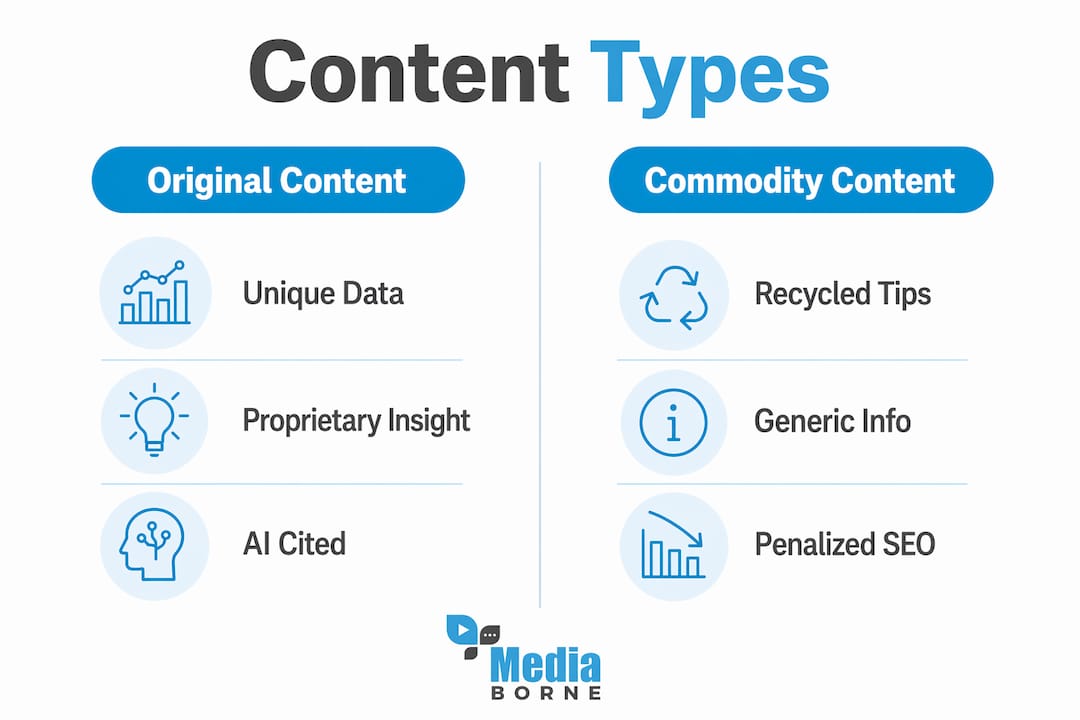
| Content type | Characteristics | AI citation outcome |
|---|---|---|
| Commodity content | Recycled tips, generic summaries, no original data | Penalised or ignored |
| Non-commodity content | Proprietary data, first-hand accounts, expert judgement | Prioritised and cited |
This table is not theoretical. AI systems select sources based on information value, prioritising unique data and documented outcomes over repeated ideas. The implication for content teams is direct: producing more commodity content does not increase visibility. It dilutes it.
How does original content impact SEO and AI citations in 2026?
The SEO rules that governed content strategy for the past decade have been replaced. Volume and keyword formatting no longer determine ranking. Information density and originality do.
Google's algorithm now incorporates what researchers describe as an Information Gain Score, which measures how much new, verifiable information a piece of content adds to the existing web. A post that simply repackages what three competitors have already published scores poorly, regardless of its word count or technical optimisation. This is why great content no longer works in the traditional sense. The definition of "great" has changed.
Two concepts define the current environment for content marketers.
Citation Invisibility occurs when content lacks unique, extractable data, preventing AI models from using it as a source even when it ranks in search. A page can sit on page one of Google and still be completely absent from every AI overview, because it contains nothing worth quoting. This is the gap many content teams have not yet registered.
The Volume Paradox describes the counterintuitive finding that fewer, higher-density posts with original data generate more AI citations than high volumes of commodity content. Publishing 40 generic posts per month actively reduces brand visibility in AI environments by flooding the web with undifferentiated material that trains models to associate your domain with low information value.
"The role of original content has shifted from keyword discovery to becoming a citation source for AI-driven summarisation. Brands that do not produce verifiable, first-hand content are effectively invisible to the systems that now mediate search."
Pro Tip: Before publishing any piece, ask one question: does this contain at least one data point, finding, or perspective that cannot be found on any other page? If the answer is no, the content will not be cited by AI systems regardless of how well it is written or optimised.
AI overview panels and featured snippets favour direct, specific answers over lengthy general articles. Short, focused content with original insight consistently outperforms long, generic guides. This is a structural shift that rewards content creators who invest in research and documentation over those who invest purely in volume and formatting.
What are the real benefits of original content for brand growth?
The importance of original content extends well beyond search rankings. The compounding effects on audience trust, social engagement, and long-term brand equity are where the real commercial value accumulates.
Newsletters featuring original research demonstrate 3.1 times more subscriber forwards than those with curated roundups. That multiplier is not just a vanity metric. Each forward is a qualified referral from a trusted source, reaching an audience that your paid media budget cannot buy. Original content creates a distribution flywheel that grows without additional spend.
Brands relying on trend-based content face engagement declines exceeding 60% due to algorithmic shifts prioritising niche community engagement. This is the hidden cost of a trend-chasing strategy. Short-term traffic spikes from viral formats do not build the kind of audience that converts, subscribes, or advocates. Original, human-led storytelling is what rebuilds reach once algorithmic favour shifts.
The long-term benefits of producing unique content include:
- Backlink accumulation. Original research and proprietary data attract inbound links from journalists, analysts, and other content creators who need a citable source. These links compound over time and require no outreach budget.
- Community formation. Audiences that return for your specific perspective, data, or methodology develop a loyalty that platform algorithms cannot disrupt. They follow you, not the topic.
- Brand authority. 89% of marketers identify original research as the top differentiator for brand distinction and reader trust. Authority built on proprietary insight is durable in a way that SEO-optimised commodity content is not.
- Digital asset creation. A well-documented case study or original dataset does not expire. It continues to attract citations, links, and traffic years after publication. Trend content has a shelf life measured in days.
You can explore how media production drives ROI through original storytelling formats that build this kind of compounding brand value over time.
How to create original content that AI systems will cite
Producing non-commodity content does not require a research department or an enterprise budget. It requires a deliberate shift in how you collect, document, and present information.
Start with what you already have. Small but credible datasets such as 50 competitor audits or a year of internal performance data, summarised responsibly, establish a source-of-truth function that generic summaries cannot replicate. You do not need 10,000 survey responses. You need one dataset that no one else has documented.
Practical steps for building an original content infrastructure:
- Document your failures as well as your wins. Counterintuitive findings and documented failures are among the most cited content types because they contain information that cannot be synthesised from positive-outcome summaries.
- Conduct modest primary research. Survey your existing audience, audit a defined set of competitors, or analyse a year of your own campaign data. Publish the methodology alongside the findings.
- Build comparison pages with transparent criteria. Comparison content built on a defined, documented methodology is non-commodity by definition. Generic "best of" lists without methodology are commodity content.
- Collaborate with named experts. An attributed quote from a practitioner with specific experience adds a verifiable, first-hand element that AI systems can cite and that readers trust.
- Choose formats that carry original data. Research reports, case studies, and methodology-driven best lists all outperform generic how-to guides in AI citation environments.
Pro Tip: Invest in content IP development as a long-term asset strategy. A single original study, published and updated annually, can generate more citations, backlinks, and brand authority than 200 generic posts combined.
Non-commodity content demands more organisational effort than generic content. The payoff is higher quality citations, stronger audience relationships, and business outcomes that compound rather than decay. The media production trends shaping 2026 confirm that brands investing in original formats are consistently outperforming those relying on templated content at scale.
Key takeaways
Original content is the only content type that AI retrieval systems are programmed to prioritise, making it the single most important investment for brand visibility and long-term marketing performance in 2026.
| Point | Details |
|---|---|
| Original vs commodity content | Non-commodity content contains proprietary data or first-hand insight; commodity content is penalised by AI systems. |
| Citation Invisibility risk | Content without unique, extractable data is ignored by AI overviews even when it ranks in search. |
| Volume Paradox | Fewer, high-density original posts generate more AI citations than high volumes of generic content. |
| Compounding engagement value | Newsletters with original research receive 3.1 times more forwards, building distribution without additional spend. |
| Practical starting point | Small credible datasets, documented failures, and expert attribution are sufficient to produce citable, non-commodity content. |
Why I think most content teams are solving the wrong problem
Most content teams I speak with are optimising for the wrong metric. They are measuring output volume, keyword rankings, and session duration. None of those numbers tell you whether your content is being cited by AI systems or building the kind of audience loyalty that survives an algorithm update.
The uncomfortable truth is that the majority of content published in 2026 is structurally invisible to the systems that now mediate discovery. It is not badly written. It is not poorly formatted. It simply contains nothing that an AI model would choose to quote, because it contains nothing that cannot be found in a dozen other places.
What I have found actually works is treating every piece of content as a potential source document rather than a traffic vehicle. That means asking, before you write a single word, what verifiable, first-hand information this piece will contain that no other page currently offers. If you cannot answer that question, you are producing commodity content, regardless of how well it performs on a readability score.
The shift is harder than it sounds. It requires content teams to move from being skilled writers to being skilled researchers and documenters. It requires organisations to share internal data, acknowledge failures, and invest in primary research rather than repurposing what competitors have already published. But the brands that make this shift are building citation assets that compound over years. The brands that do not are producing content that is increasingly invisible to the audiences they are trying to reach.
— Stephen
Bring your original content to life on screen
Original research and proprietary insight are the foundation of citable content. Video is the format that makes that content impossible to ignore. At Media Borne, we produce original video content that translates your data, case studies, and expert perspectives into formats built for TikTok, YouTube, and live social selling. A well-produced video case study carries the same citation value as a written one, with significantly higher engagement and shareability. If you are ready to turn your original content strategy into a media asset, explore our video production services and find out how professional filming and editing can amplify the reach of your most important ideas.
FAQ
What is original content in marketing?
Original content is any material containing proprietary data, first-hand experience, or unique insight that cannot be replicated by aggregating existing sources. It is the content type prioritised by AI systems and search engines for citations and visibility.
Why does original content attract more backlinks and shares?
Original research and proprietary data give other creators and journalists a citable source they cannot find elsewhere. Newsletters featuring original research receive 3.1 times more forwards than curated roundups, creating a compounding distribution effect.
How does original content impact SEO differently in 2026?
Search algorithms now measure Information Gain Score, rewarding content that adds verifiable new information to the web. Generic content that duplicates existing sources scores poorly regardless of word count or keyword optimisation.
What counts as original content if you have no research budget?
A credible original dataset can be as modest as 50 competitor audits or one year of internal campaign data. Documented failures, attributed expert quotes, and comparison pages with transparent methodology all qualify as non-commodity content.
What is Citation Invisibility and why does it matter?
Citation Invisibility occurs when content lacks unique, extractable data, preventing AI models from using it as a source even if it ranks on page one of Google. It is the primary reason well-written content fails to appear in AI overviews and featured snippets.