
TL;DR:
- Explainers are essential content pieces that clarify complex topics and build audience trust. They support SEO and AI search by using structured, question-based formats and regular updates. Brands that treat explainers as dynamic assets outperform competitors and improve online visibility.
Explainers are concise content pieces designed to clarify complex topics, and the role of explainers in content strategy has shifted from optional supplement to structural necessity. Brands like Grammarly and agencies such as TAL Agency have built audience trust by making explainers central to their content ecosystems, not peripheral additions. Whether you are producing animated videos, micro-explainers for TikTok, or long-form SEO articles, explainers now serve double duty: they build audience understanding and feed AI-driven search models that increasingly determine who gets found online.
How explainers enhance audience understanding and engagement
Explainers work because they remove the cognitive load that stops audiences from engaging with complex content. When a reader or viewer has to work too hard to understand something, they leave. Explainers solve that problem at the point of friction.

The mechanics are straightforward. A well-built explainer uses structure, visual cues, and narrative to guide the audience from confusion to clarity. This is not just good editorial practice. It directly affects conversion. B2B explainer content supports every stage from initial discovery through to RFQ submission, building buyer confidence at each touchpoint. That finding matters because it proves explainers are not just top-of-funnel awareness tools. They carry weight throughout the entire customer journey.
The engagement benefits are equally concrete:
- Retention: Structured explainers with a clear opening claim, supporting evidence, and a resolution hold attention longer than unstructured content.
- Trust: Successful explainers demonstrate knowledge without overselling the brand, which is precisely why journalists and buyers seek them out.
- Shareability: Content that makes someone feel smarter gets shared. Explainers are the format most likely to produce that effect.
- SEO signals: Time-on-page and low bounce rates, both driven by clarity, are ranking signals that explainers naturally improve.
Pro Tip: Before writing any explainer, write one sentence that completes this prompt: "After reading this, my audience will understand that..." If you cannot complete it cleanly, the brief is not ready.
The role of visuals in content is particularly pronounced in explainer formats. Animated explainer videos, diagrams, and annotated screenshots reduce the time it takes for an audience to grasp an abstract concept. Pairing visual structure with clear prose is not a stylistic choice. It is a strategic one.
What types of explainer content exist and how do they differ?
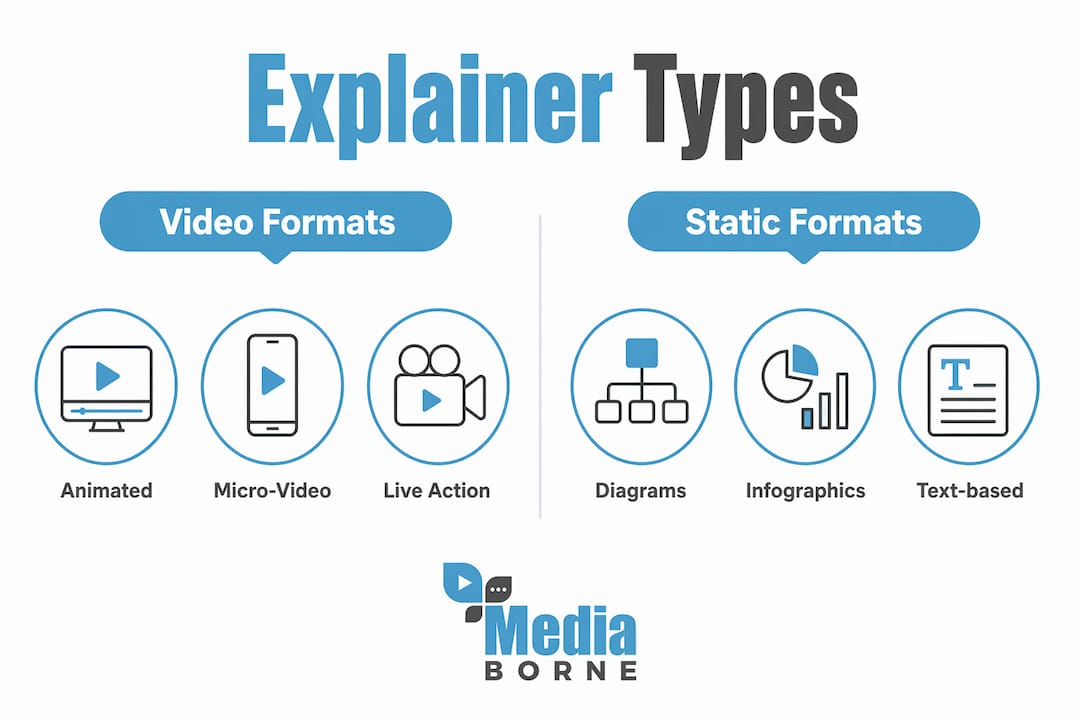
Not all explainers serve the same purpose, and choosing the wrong format for your objective is one of the most common mistakes in explainer video strategy. The format must match the audience's context, the platform's constraints, and the complexity of the topic.
Here is a comparison of the four main formats:
| Format | Ideal length | Best platform | Primary use |
|---|---|---|---|
| Animated explainer video | 60–120 seconds | YouTube, website landing pages | Product or concept explanation |
| Micro-explainer video | 30–90 seconds | TikTok, Instagram Reels, LinkedIn | News context, quick facts, trend commentary |
| Long-form explainer article | 1,500–3,000 words | Blog, SEO-indexed pages | Evergreen topic authority |
| Interactive explainer | Variable | Web apps, microsites | Complex processes with user input |
Short-form video explainers perform best at 30–120 seconds, with the 30–90 second micro-explainer range producing the highest retention and discoverability. That range is not arbitrary. It maps to platform algorithm preferences and human attention patterns simultaneously.
For 2026, two formats are gaining ground:
- Micro-explainers with a strict framework: hook, three supporting facts (context, update, and significance), and a clear call to action. This structure works across TikTok, LinkedIn, and YouTube Shorts.
- AI-optimised long-form articles: structured with question headings, named entities, and clear definitions in the first paragraph, specifically to appear in AI-generated answers from tools like ChatGPT and Perplexity.
The choice between formats is not about preference. It is about where your audience is and what they need to do next. A procurement manager researching a technical product needs a long-form article with specifications. A brand-aware consumer on Instagram needs a 45-second animated clip.
Why do explainers matter for SEO and AI search in 2026?
The importance of explainers has grown sharply because of how search itself has changed. Google's helpful content updates and the rise of generative AI search tools have made well-structured, intent-matched explainers the most citable content type online.
Explainer articles serve a dual role in both traditional SEO and Generative Engine Optimisation (GEO), becoming top sources for AI citations and driving organic visibility. That dual function is the reason content strategists should treat explainers as infrastructure, not just individual posts.
Here is how to build explainers that perform in both environments:
- Lead with a definition. AI models cite content that answers the query in the first sentence. Open every explainer with "X is defined as..." or "X is the primary cause of Y."
- Use question-based headings. Research shows 78.4% of AI-cited content originates from question headings. Structure your H2s as the exact questions your audience types.
- Build topic clusters. Explainers form hubs and clusters that demonstrate comprehensive coverage to both search engines and users. A single explainer hub linked to five satellite articles outperforms five standalone posts.
- Refresh regularly. Explainers must be dynamic assets designed for rapid updates. A stale explainer on a fast-moving topic loses ranking durability within months.
- Name your entities. High-performing cited content averages 20.6% named entity density. Replace "many tools" with "Grammarly, Hemingway Editor, and ProWritingAid."
Explainers are essential for navigating the 24/7 news cycle, providing contextual hubs that explain why and how events matter. That function extends beyond journalism. Any brand operating in a fast-moving category, whether fintech, health, or technology, needs explainers that can be updated within hours of a significant development, not days.
The content strategy for intent-based clusters is the architecture that makes this work at scale. Map your explainers to specific search intents, link them to related content, and update the hub when the topic evolves. That is the system that builds lasting search authority.
How to integrate explainers effectively within a content strategy
Utilising explainers effectively requires more than producing good individual pieces. The real value comes from how they connect to the rest of your content ecosystem.
Start by mapping explainers to the customer journey. Discovery-stage audiences need broad, accessible explainers that answer "what is this?" Consideration-stage audiences need comparative explainers that answer "how does this work and why does it matter?" Decision-stage audiences need specification-level explainers that answer "is this right for my situation?"
The most common structural mistake is brand centrism. Effective explainer production avoids brand centrism by leading with audience curiosity and layering brand perspective as supporting evidence, not the central argument. An explainer about cloud security that opens with your product's features is not an explainer. It is a brochure. An explainer that opens with the three most common cloud security failures, then references your product as one solution, builds trust and converts.
Practical integration steps:
- Build a hub and spoke model. One central explainer covers the main topic. Three to five satellite articles cover sub-intents. All link back to the hub.
- Repurpose across formats. A long-form explainer article becomes a micro-explainer video script, a LinkedIn carousel, and a newsletter section. One research investment, four content outputs.
- Schedule quarterly refreshes. Set a calendar reminder to review every explainer hub every 90 days. Update statistics, add new examples, and adjust headings to match evolving search queries.
- Track engagement signals. Time-on-page, scroll depth, and return visits tell you whether your explainer is actually explaining. If scroll depth drops at 40%, the structure breaks at that point.
Pro Tip: For micro-explainer video production, use the hook, three facts, CTA framework every time. Write the hook as a question your audience is already asking. The three facts should cover context, the current development, and why it matters. The CTA should direct to the long-form hub article.
For a deeper look at short-form video strategy and how to maximise retention across platforms, the principles align directly with explainer production at scale.
Key takeaways
Explainers are the most versatile and citable content format available to strategists in 2026, delivering audience clarity, SEO authority, and AI search visibility when built with intent and structure.
| Point | Details |
|---|---|
| Explainers serve the full funnel | Map each explainer to a specific journey stage: discovery, consideration, or decision. |
| Format choice determines reach | Match animated video, micro-explainer, or long-form article to platform and audience context. |
| AI search rewards structure | Open with a definition, use question headings, and maintain high named entity density for GEO performance. |
| Clusters outperform standalone posts | Build a hub and spoke architecture to demonstrate topical authority to search engines and users. |
| Avoid brand centrism | Lead with audience curiosity and position brand perspective as supporting evidence, not the main argument. |
Why I think most brands are still using explainers wrong
The research is clear. The frameworks exist. Yet most brand explainers I encounter still open with a company introduction, bury the core insight in paragraph four, and treat the format as a one-off post rather than a living asset.
The shift that changes everything is treating explainers as infrastructure rather than content. A well-built explainer hub, refreshed quarterly and linked to a cluster of satellite articles, compounds in value over time. A standalone explainer published once and forgotten depreciates. The difference in SEO and audience trust outcomes between those two approaches is not marginal. It is the difference between a brand that owns a topic and one that occasionally comments on it.
The second thing most brands get wrong is the audience-first principle. PR professionals succeed when their explainers demonstrate knowledge rather than brand presence. That same principle applies to every content strategist producing explainers for commercial brands. If your explainer reads like a product page with a few extra paragraphs, you have not written an explainer. You have written a sales document with an identity crisis.
My prediction for the rest of 2026 is that the gap between brands who treat explainers as dynamic, audience-first assets and those who treat them as occasional blog posts will widen significantly. AI search tools are already preferring structured, entity-rich, regularly updated content. The brands building explainer clusters now are building a citation moat that will be very difficult to close later.
The content strategy and entertainment approach that Media borne advocates, where content earns attention rather than interrupting it, is exactly the mindset that produces explainers worth reading and sharing.
— Stephen
How Media borne can help you produce explainers that perform
Media borne produces explainer videos and short-form content built for both audience engagement and search performance. The team combines strategic content planning with professional production to create explainers that work as standalone assets and as part of wider content clusters.
Whether you need animated explainer videos for a product launch, micro-explainer series for TikTok and LinkedIn, or a full video production strategy that integrates with your SEO and GEO objectives, Media borne builds content that earns attention rather than interrupting it. The production process is built around the same audience-first principles outlined in this article, so every explainer starts with the audience's question, not the brand's message. If you want explainer content that compounds in value over time, that is the conversation to have.
FAQ
What is the role of explainers in content strategy?
Explainers are concise content pieces that clarify complex topics, serving as the primary trust-building and discovery assets within a content strategy. They improve audience retention, support SEO through topic clusters, and are the format most frequently cited by AI search tools.
How long should an explainer video be?
Short-form explainer videos perform best at 30–120 seconds, with micro-explainers in the 30–90 second range producing the highest retention and platform discoverability.
How do explainers support SEO and AI search?
Explainers that open with a direct definition, use question-based headings, and link to related cluster content are the top candidates for AI citations and enhanced Google rankings. Keeping them updated regularly maintains their ranking durability.
What is the biggest mistake brands make with explainer content?
The most common pitfall is brand centrism, where the content prioritises the brand's perspective over the audience's questions. Effective explainers lead with audience curiosity and use brand perspective as supporting evidence only.
How often should explainer content be refreshed?
Explainer hubs should be reviewed and updated at least every 90 days. For topics tied to fast-moving news or industry developments, monthly refreshes are more appropriate to maintain relevance and search authority.