
TL;DR:
- Interactive media transforms passive content into active experiences by responding to user input and creating personalized feedback loops. This approach drives higher engagement, improves retention, and significantly increases conversion rates across marketing and education. Most underperforming interactive systems fail due to poor design of these feedback loops, highlighting the need for systematic, purpose-driven development.
Interactive media is digital content that responds dynamically to user input, turning audiences from passive viewers into active participants across marketing, education, and entertainment. Where traditional formats broadcast a fixed message, the role of interactive media is to create a two-way exchange: the user acts, the system responds, and the experience adapts. Platforms such as TikTok, YouTube, and AI-powered learning tools have accelerated this shift dramatically. For content creators, marketers, and educators, understanding how this exchange works is no longer optional. It is the difference between content that converts and content that gets scrolled past.
How does interactive media drive higher engagement than static content?
Interactive media shifts the audience from observer to participant by giving users direct control over text, sound, video, graphics, and animation. This structural difference is what makes engagement metrics so dramatically different from static formats. When users make choices, they invest attention. That investment compounds.

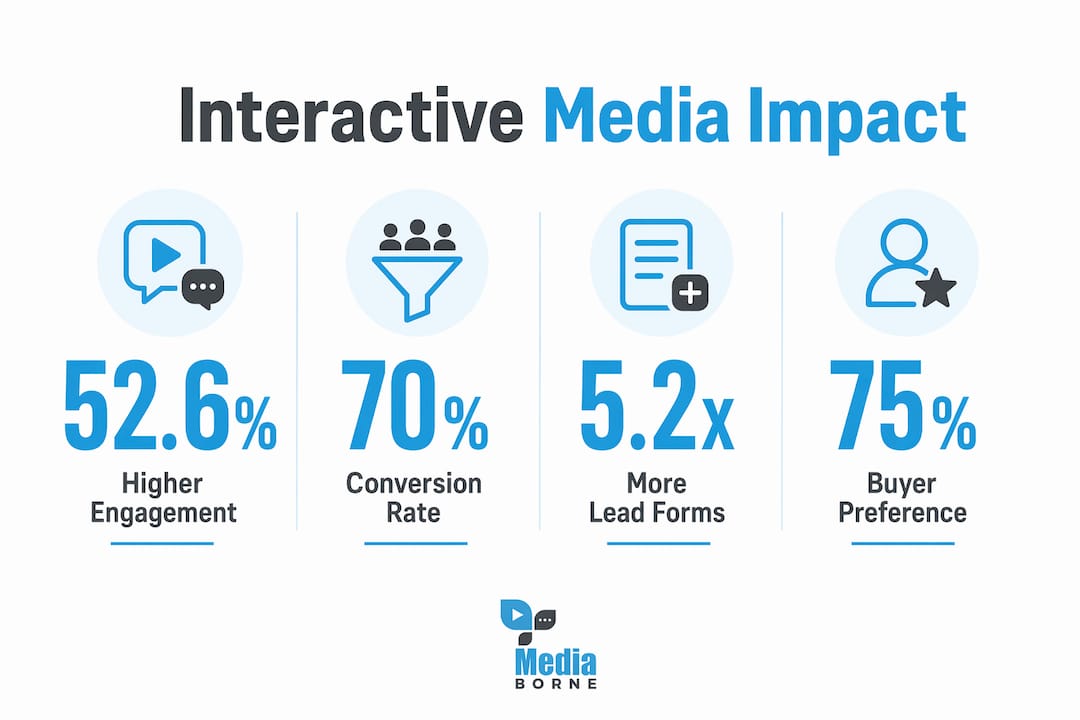
The numbers are stark. Interactive content drives 52.6% higher engagement and converts at 70% compared to 36% for static formats. That gap is not a marginal improvement. It represents a fundamentally different relationship between audience and content.
The cognitive reason is straightforward. Multi-modal content that requires input activates more mental processing than passive reading or viewing. When a learner answers a quiz, a buyer configures a product demo, or a viewer chooses a branching video path, they are encoding information through action rather than observation. Retention follows naturally.
Key formats driving this engagement advantage include:
- Interactive video with embedded questions, hotspots, and branching paths
- Quizzes and assessments that personalise results based on responses
- Calculators and configurators that produce outputs specific to user inputs
- Interactive demos that let buyers explore products at their own pace
- Simulations that replicate real-world scenarios for training or education
Interactive video alone generates 5.2x more lead form submissions than standard video. That figure should reframe how marketers and educators think about production budgets and format choices.
What makes interactive media structurally different from passive content?
The distinction between genuinely interactive media and static content with cosmetic additions is critical. True interactivity requires a structural redesign so user actions directly determine the subsequent experience. A PDF with clickable links is not interactive media. A branching scenario where each choice changes the narrative, the data shown, or the next question asked, is.
The mechanism at the centre of this is the feedback loop. A user takes an action, the system registers it, and the content changes in response. This loop does three things simultaneously: it sustains attention, it generates data about user intent, and it creates a personalised experience without requiring manual customisation for each individual.
Effective interactive systems use several structural techniques:
- Branching scenarios where decisions alter the content path
- Adaptive content that adjusts difficulty or depth based on prior responses
- Embedded assessments that test comprehension and redirect accordingly
- Real-time data capture that feeds personalisation engines
The difference between a well-designed interactive experience and a poorly designed one comes down to whether the feedback loop actually closes. Many organisations bolt interactive features onto existing static content and wonder why engagement does not improve. The meaningful interactive media redesigns systems so that user input and content response are inseparable parts of the same architecture.
Pro Tip: Before adding interactive elements to existing content, map the feedback loop first. Ask: what does the user do, what does the system register, and how does the content change as a result? If you cannot answer all three, the interactivity is cosmetic.
How does interactive media influence behaviour and drive business results?
The commercial case for interactive media is well-documented and growing. Gartner research shows 75% of B2B buyers prefer rep-free, self-directed experiences at some stage of their buying journey. Forrester notes that buyers engaging with interactive content are twice as likely to convert. These figures point to a structural shift in how purchasing decisions are made.
Walnut's 2026 data across thousands of B2B sales cycles shows that decision-stage interactive demos lift opportunity-to-close conversion by 38 to 45%. This is the point in the funnel where buyers have intent but uncertainty. An interactive demo that lets them explore the product on their own terms resolves that uncertainty faster than any sales call.
Wistia's 2026 findings add another dimension. Nearly 20% of viewers fill lead forms embedded inside B2B marketing videos. That is a conversion rate most landing pages would envy, achieved inside the content itself rather than after a redirect.
| Funnel stage | Interactive format | Conversion impact |
|---|---|---|
| Awareness | Interactive video, quizzes | 52.6% higher engagement vs. static |
| Consideration | Calculators, assessments | Personalised outputs increase time on page |
| Decision | Interactive demos | 38 to 45% lift in opportunity-to-close rate |
| Retention | Branching scenarios, simulations | Sustained recall advantage over 3 to 7 days |
The practical implication is that format selection should be driven by funnel stage, not production convenience. A quiz works at awareness. An interactive demo works at decision. Stacking these formats across the funnel compounds the effect. Combining multiple interactive types can push conversion rates above 6%, according to Clixie AI's 2026 analysis.
Pro Tip: Audit your current content funnel and identify which stages rely entirely on static formats. Replace one format per stage with an interactive equivalent and measure the change in time-on-page, lead quality, and conversion rate over 30 days.
For a deeper look at how interactive formats can be applied to product demonstrations, the principles of funnel alignment apply directly to both B2B and consumer contexts.
What is the role of interactive media in education?
Interactive media in education operates through the same feedback loop mechanics as marketing, but the outcome being optimised is knowledge retention rather than conversion. Interactive Open Educational Resources (iOER) are openly licensed materials that go beyond content delivery to embed simulations, branching exercises, and assessments directly into the learning experience. The distinction matters because access to content and active engagement with content produce very different learning outcomes.
A 2026 Frontiers study evaluated an AI-powered interactive learning platform against traditional digital textbooks. Students using the interactive platform maintained immediate recall scores of 77% and long-term recall of 78% over three to seven days. Textbook users showed lower scores overall and a steeper decline over time. The retention advantage held precisely because the interactive platform closed the feedback loop during learning, not just at assessment.
The pedagogical frameworks supporting this are well-established. Constructivism holds that learners build understanding through active engagement rather than passive reception. Active learning theory extends this by requiring learners to apply, analyse, and create rather than simply receive. Interactive media is the practical implementation of both frameworks at scale.
Three specific benefits stand out for educators:
- Multimodality: Learners engage through video, audio, text, and interaction simultaneously, which supports different learning styles and reduces cognitive overload when designed well.
- Self-directed pacing: Students control the speed and depth of their exploration, which improves both motivation and comprehension.
- Embedded assessment: Formative checks within the content itself identify gaps in real time rather than waiting for end-of-unit tests.
The AI-powered multimodal platforms tested in the Frontiers experiment showed that the sustained retention advantage over digital textbooks was only visible when measured after three to seven days, not immediately post-use. This matters for educators designing assessments. Immediate recall scores underestimate the long-term benefit of interactive learning. Measuring retention at intervals gives a more accurate picture of what the format actually achieves.
The importance of interactive media in education extends beyond individual learning outcomes. In diverse classrooms where students arrive with different prior knowledge and learning preferences, adaptive interactive content can personalise the experience without requiring one-to-one teacher intervention. That scalability is what makes the format genuinely transformative for institutions, not just individual learners.
Key takeaways
Interactive media drives measurably better outcomes than static content across marketing, sales, and education because it closes the feedback loop between user action and system response, creating personalised experiences that sustain attention and accelerate decisions.
| Point | Details |
|---|---|
| Engagement advantage is structural | Interactive content converts at 70% vs. 36% for static formats because user input sustains attention. |
| Feedback loops define true interactivity | Effective interactive media redesigns content so user actions directly alter the subsequent experience. |
| Funnel alignment multiplies results | Matching interactive format to funnel stage, from quizzes at awareness to demos at decision, compounds conversion gains. |
| Education benefits are retention-led | Interactive platforms show sustained recall advantages over three to seven days, not just immediate post-use scores. |
| Stacking formats increases conversion | Combining quizzes, calculators, and branching videos across a funnel can push conversion rates above 6%. |
Why most interactive media underperforms, and what to do about it
The evidence for interactive media is overwhelming. The execution, in my experience, is where most teams fall short. The most common mistake is treating interactivity as a feature to add rather than a system to design. I have seen marketing teams spend significant budgets embedding clickable hotspots into videos that were never structured to support a branching experience. The result looks interactive but behaves like a static asset with extra steps.
The second mistake is ignoring the data. Every interaction a user takes inside interactive content is a signal. Which path did they choose? Where did they drop off? What answer did they give to the quiz? That data should feed directly into personalisation, follow-up content, and product development. Most teams collect it and do nothing with it. That is where the real value of customer engagement strategies gets left on the table.
What actually works is starting with the feedback loop and working backwards. Define what you want the user to do, what the system should register, and how the content should change in response. Then build the format around that architecture. Whether you are producing an interactive demo for a B2B sales cycle or an adaptive learning module for a classroom, the principle is identical.
The third point I would make is about measurement. Most teams measure interactive media on the same metrics as static content: views, time on page, click-through rate. These miss the point. The metrics that matter are path completion rates, response distributions in quizzes, and conversion lift at specific funnel stages. Measure what the interaction reveals about user intent, not just whether the user stayed.
AI tools are making this easier. Platforms like the one evaluated in the Frontiers 2026 study can now adapt content in real time based on learner responses, without requiring manual content variants for every possible path. For marketers and educators alike, that represents a significant reduction in production overhead while increasing personalisation depth.
— Stephen
Bring your interactive media to life with Media Borne
Media Borne produces interactive media that is built around the feedback loop, not bolted onto existing assets. From interactive video production and animated content to virtual immersive experiences, the team designs formats that align with your funnel stage, your audience, and your commercial objectives. Whether you are a marketer looking to lift conversion rates, an educator building adaptive learning content, or a brand building audience communities on TikTok and YouTube, Media Borne creates the systems that turn attention into measurable outcomes. If you want content that performs rather than content that exists, explore social selling video formats designed to drive direct commercial results.
FAQ
What is interactive media?
Interactive media is digital content that responds to user input, allowing the audience to control or influence text, video, audio, graphics, and animation. Britannica defines it as a computer-delivered system where users manipulate media elements, transforming a one-way presentation into a two-way exchange.
How does interactive media improve engagement?
Interactive content produces 52.6% higher engagement than static formats and converts at 70% versus 36%, because user input activates deeper cognitive processing and sustains attention through the feedback loop.
What are the benefits of interactive media in education?
Interactive media in education improves knowledge retention, supports self-directed learning, and enables real-time formative assessment. A 2026 Frontiers study found that students using an AI-powered interactive platform maintained recall scores of 77 to 78% over three to seven days, outperforming textbook users.
How does interactive media influence buyer behaviour in B2B marketing?
Buyers engaging with interactive content are twice as likely to convert, and 75% of B2B buyers prefer self-directed, rep-free experiences at some point in their journey. Interactive demos aligned to the decision stage lift opportunity-to-close rates by up to 45%.
What is the difference between interactive and static media?
Static media delivers a fixed experience regardless of who consumes it. Interactive media changes based on user input, with each action feeding back into the content to personalise the experience. The structural difference is the feedback loop: user action, system response, content change.