

TL;DR:
- Online retail opportunities are expanding, but success now depends on trust, personalization, and cohesive multichannel experiences. Building compelling storytelling through video and media, maintaining impeccable product data, and ensuring strict legal compliance are crucial for sustained growth in 2026. Focusing on fundamental factors like speed, accurate information, and authentic content outweighs reliance on trendy tactics and ad spending alone.
Selling online has never been more accessible, and yet the gap between stores that thrive and those that quietly stagnate has never been wider. Online retail is not broken, but the playbook that worked in 2020 is genuinely obsolete. Consumers now research across social platforms, AI discovery tools, marketplaces, and physical stores before making a purchase. They are more selective, better informed, and quicker to abandon a brand that feels untrustworthy. This guide cuts through the noise and gives you a clear, practical framework for building and growing an online retail business that performs in 2026.
Table of Contents
- Key takeaways
- The evolving landscape of online retail
- Performance benchmarks for online retail
- Optimising your online retail strategy
- Storytelling and media in online retail
- Compliance and legal requirements in 2026
- My honest take on selling online in 2026
- How Mediaborne can transform your retail brand
- FAQ
Key takeaways
| Point | Details |
|---|---|
| Market scale is significant | Global e-commerce sales are projected to exceed $7 trillion in 2026, representing real commercial opportunity. |
| Conversion rates vary widely | Product price, traffic channel, and device type all shift conversion benchmarks dramatically, so compare like with like. |
| Video and storytelling convert | Authentic brand content builds trust faster than product descriptions alone, directly improving engagement and sales. |
| Compliance is non-negotiable | Cookie banners are no longer sufficient; granular consent management is now a legal requirement in most markets. |
| Channel quality beats quantity | Email converts three to five times better than paid social; focus on channels that match your audience's buying intent. |
The evolving landscape of online retail
The scale of opportunity in online retail right now is genuinely striking. E-commerce sales worldwide are expected to exceed $7 trillion in 2026, accounting for roughly 21% of all retail globally. That figure represents not just growth but a structural shift in how people buy. If you are still treating your online store as a secondary sales channel, that mindset is costing you revenue.
The most significant shift in 2026 is the rise of what industry analysts call agentic commerce. AI tools are now capable of conducting product research on behalf of users, comparing prices, reading reviews, and even completing purchases autonomously. This means your product data, descriptions, and pricing must be impeccable across every platform your audience might use. Multi-channel research is now standard consumer behaviour, and inconsistent product information across channels is one of the fastest ways to lose a sale.
Omnichannel shopping has also matured considerably. The old distinction between online and offline retail is dissolving. Consumers might discover a product on TikTok, research it on a marketplace, visit a physical store to inspect it, and then buy online for home delivery. Each of those touchpoints must feel cohesive and trustworthy.
"Personalisation and trust are now the two most important levers in e-commerce shopping. Consumers increasingly expect brands to demonstrate sustainability and inclusivity, and they will choose competitors who do." — Philips E-commerce Trends 2026
Some additional forces shaping the current landscape:
- AI-driven personalisation is moving from nice-to-have to table stakes, with product recommendations and dynamic pricing now expected by shoppers.
- Social commerce continues to grow, with live selling formats on TikTok and Instagram driving impulse purchases at scale.
- Consumer trust signals such as verified reviews, transparent returns policies, and clear sustainability commitments now directly influence purchase decisions.
- Longer research phases mean your content must serve buyers who are weeks into their consideration, not just those ready to buy today.
Performance benchmarks for online retail
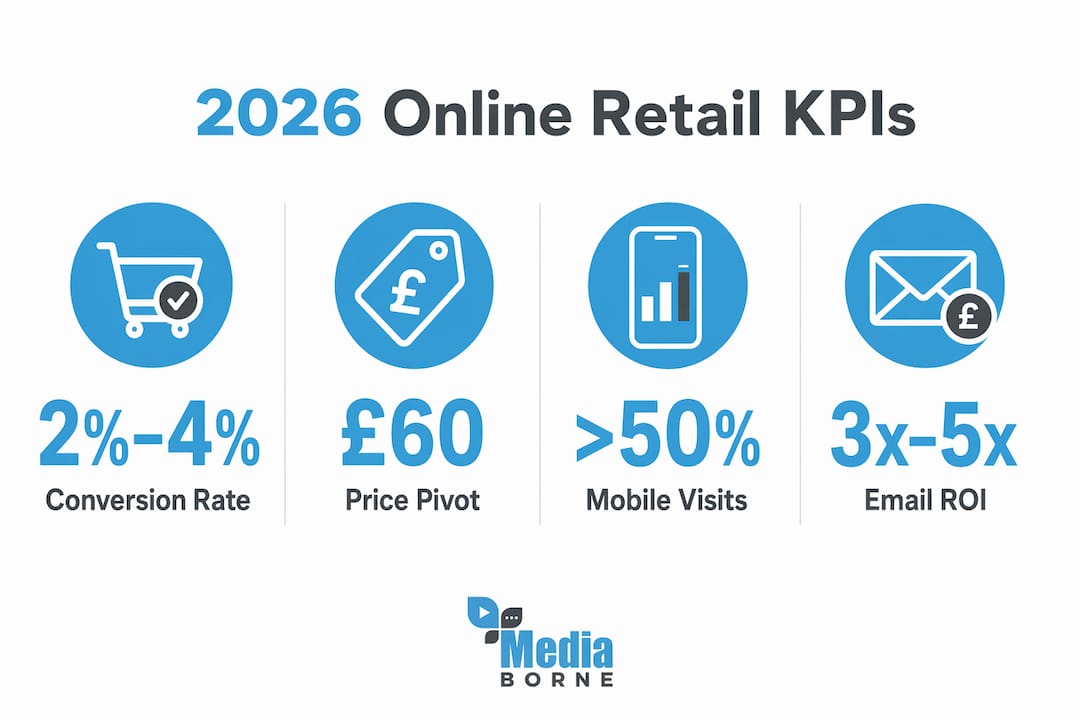
Understanding where you stand requires honest comparison with real data, not aspirational figures from success stories. The average e-commerce conversion rate sits between 2% and 4%, but that headline number obscures enormous variation.
Price point is perhaps the most underappreciated factor. Products priced under £60 see conversion rates around 4.63%, while products priced above £200 typically convert at just 0.95%. If you are selling premium goods and benchmarking against a general average, you will draw completely wrong conclusions about your store's performance.
| Metric | Benchmark | Notes |
|---|---|---|
| Overall conversion rate | 2%–4% | Varies by industry and AOV |
| Mobile conversion rate | Below 3% typical | Above 3% is excellent in 2026 |
| Add-to-cart rate | 8%–12% | Stores above 10% ATC consistently convert above 3.8% |
| Email traffic conversion | 3%–5% | Converts 3–5x better than paid social |
| Paid social conversion | 0.5%–1.5% | Highly variable by creative quality |
Store size also matters in ways that surprise many operators. Large stores often carry lower conversion rates because they attract broad, lower-intent traffic. Very small stores struggle without sufficient traffic volume to test and optimise. Mid-tier revenue stores consistently show the healthiest conversion rates because they have both traffic quality and the resources to optimise properly.
Mobile traffic now accounts for the majority of e-commerce visits globally, but it still converts below desktop. If your site delivers a poor mobile experience, you are losing sales from your biggest traffic source.

Pro Tip: Track your add-to-cart rate as a leading indicator of product page performance. If visitors browse but do not add to cart, your problem is product presentation or pricing, not checkout flow. Fix the right thing first.
Optimising your online retail strategy
Knowing the benchmarks is useful. Knowing how to move them is where the real work begins. Here is a practical sequence for improving your online store's performance in 2026.
-
Audit your product data across every channel. Your product titles, descriptions, images, and pricing must be consistent and accurate on your own site, Google Shopping, any marketplaces you use, and your social commerce profiles. Optimising product titles for Google Shopping alone can increase click-through rates by 20 to 40%. Start there.
-
Check your pricing competitiveness on Google Merchant Center. Being more than 15% above price benchmarks in your category severely limits conversions regardless of how well your feed is optimised. The algorithm actively suppresses products it considers uncompetitive on price.
-
Prioritise mobile checkout speed. Page load time above three seconds on mobile causes significant bounce rates. Test your checkout flow on a mid-range Android device, not just a high-end phone on fast Wi-Fi.
-
Segment your traffic channels by intent. Email subscribers are warm and convert well. Paid social audiences are cold and require more nurturing. Build different landing experiences for each traffic source rather than sending everyone to the same product page.
-
Deploy personalisation where it matters most. AI-powered recommendation engines on product and cart pages can lift average order value meaningfully. Even basic "frequently bought together" features outperform static pages.
-
Invest in product media beyond static photography. Video demonstrations, 360-degree views, and user-generated content all reduce the uncertainty that prevents purchases. You can explore social video workflows to build a sustainable content production process without burning your budget.
Pro Tip: Do not overlook the Google Shopping feed approval window. Feed changes can take up to 72 hours to approve, so plan campaign launches accordingly and avoid last-minute product data changes before major sales events.
Storytelling and media in online retail
There is a persistent myth in e-commerce shopping that better paid advertising solves most problems. It does not. What actually builds a retail brand that customers return to is a combination of trust and emotional connection, and both of those come primarily from storytelling.
Video and visual storytelling have become the most effective tools for building that connection at scale. A product video that shows real people using a product in real contexts does more for conversion than a polished but sterile studio shot. Authentic content that acknowledges how people actually live reduces the cognitive distance between "I'm browsing" and "I need this."
Consider how effective storytelling works across different formats:
- Product page videos reduce return rates because customers arrive with accurate expectations.
- Behind-the-scenes brand content on social platforms builds familiarity and preference before a purchase decision is even considered.
- Founder or team stories humanise a brand in a way that no advertising copy can replicate.
- Customer testimonial videos carry far more credibility than written reviews, particularly for higher-priced products.
The brands pulling ahead in online retail right now are those that treat content production as a core business function, not a marketing afterthought. Discover how to use product discovery strategies that convert social attention into measurable sales.
"Consumers increasingly expect brands to reflect their own values. Sustainability, inclusivity, and genuine transparency are now purchase criteria, not just brand positioning statements." — Philips E-commerce Trends 2026
Compliance and legal requirements in 2026
Digital retail strategies in 2026 must account for a significantly stricter regulatory environment. Cookie banners that simply ask users to accept all tracking are no longer legally compliant in the EU, UK, and increasingly in US states. Granular, timestamped consent with genuine script-blocking capability is now the minimum standard.
The practical requirements for compliance in your online retail operation include:
- Implementing a Consent Management Platform that records individual consent decisions with timestamps.
- Blocking all tracking scripts until explicit consent is granted. False compliance, where scripts fire before consent, creates real legal and financial risk.
- Reviewing your marketing tech stack for any third-party tools that collect or share user data without clear consent.
- Staying current with the Digital Markets Act if you operate in or sell to European markets, as enforcement has accelerated in 2026.
Tracking scripts must be blocked until a user actively consents. This is not optional, and the penalties for getting it wrong are substantial. Treat compliance as infrastructure, not a legal footnote.
My honest take on selling online in 2026
I've watched a lot of e-commerce businesses make the same mistake. They chase the tactic of the moment, whether that's TikTok Shop, AI chatbots, or the latest Google Shopping update, without getting the fundamentals right. And the fundamentals are not glamorous. They are product page quality, pricing honesty, mobile speed, and the kind of brand story that makes someone feel good about buying from you.
What I've found is that the stores doing best right now are not necessarily the ones with the biggest budgets or the most sophisticated tech stacks. They are the ones that have genuinely thought about who their customer is and what makes buying from them feel different. That starts with being honest about your own conversion data rather than comparing yourself to mythical averages.
The rise of AI in e-commerce shopping is real, and it matters. But I've seen too many brands invest in AI personalisation tools while their product photography looks like it was shot on a 2015 phone. Fix the obvious things first. Then layer in the sophisticated tools.
Storytelling is the one area I would argue most online retail businesses are genuinely under-investing in. Not content marketing in the blogging sense, but real visual storytelling: video that makes someone feel something, social content that earns attention rather than buying it. That is where the long-term brand equity is being built right now, and most brands are leaving it on the table.
— Stephen
How Mediaborne can transform your retail brand
If the storytelling and media section of this article resonated, that is exactly the territory Mediaborne works in. The team builds entertainment-led content that earns attention rather than interrupting it, and for online retail brands, that translates directly into better engagement, stronger conversion, and customers who come back.
From professional video production that elevates your product pages and brand channels, to social selling video formats built specifically for TikTok and Instagram commerce, Mediaborne connects production quality with commercial purpose. If you are ready to make content that actually moves product, get in touch and talk through what that looks like for your brand.
FAQ
What is a good e-commerce conversion rate in 2026?
A rate between 2% and 4% is considered average, but context matters enormously. Products priced above £200 typically convert below 1%, while lower-priced goods can reach 4% to 5%. Compare your rate against stores with similar price points and traffic sources.
How does mobile affect online retail performance?
Mobile accounts for the majority of e-commerce traffic but converts at lower rates than desktop. A mobile conversion rate above 3% is considered excellent in 2026. Prioritising checkout speed and simplified navigation on mobile is the most direct way to close this gap.
Which traffic channel converts best for online shopping?
Email consistently outperforms other channels, converting three to five times better than paid social. Paid social requires significant creative investment to be effective, while email works best for warming existing audiences and recovering abandoned carts.
Do I need a Consent Management Platform for my online store?
Yes, if you are collecting any user data or running tracking scripts. Simple cookie banners no longer meet legal requirements in the UK, EU, or many US states. A proper CMP with granular consent logging and genuine script-blocking is now the legal minimum.
How important is video for online retail conversion?
Video content on product pages reduces return rates, increases time on site, and builds the kind of trust that written descriptions alone cannot achieve. For higher-value products especially, video is one of the highest-return investments an online retailer can make.