
TL;DR:
- A marketing through entertainment workflow integrates entertainment content into marketing to foster emotional engagement early. It emphasizes separating awareness and conversion assets, automation of routine tasks, and measuring brand recall and community growth. A clear approval process and consistent episodic releases are essential for building audience loyalty and maximizing results.
A marketing through entertainment workflow is the process of building entertainment content directly into your marketing operations so audiences engage emotionally before they ever see a call to action. Brands like Marvel and Lionsgate have proved this model at scale. The industry term for the broader approach is entertainment-led marketing, and it sits at the intersection of media production, brand strategy, and distribution planning. This guide gives marketing professionals a practical framework for designing, running, and measuring an entertainment-first workflow that builds audiences and drives commercial results.
What are the essential components of a marketing through entertainment workflow?
Entertainment-led marketing starts with a different kind of brief. Traditional briefs lead with product features. Entertainment-first briefs specify the emotional state the audience should feel within the first five seconds, with narrative as the vehicle and product as a passenger. That single shift changes everything downstream, from how you cast talent to how you write scripts to how you approve final cuts.

The workflow requires specific team roles that most marketing departments do not currently have. You need a producer or creative director who owns entertainment quality, a brand manager who owns compliance and messaging, and a distribution strategist who owns platform scheduling. These three roles must operate in parallel, not in sequence. When they work sequentially, approval bottlenecks kill creative momentum.
The tools divide into three categories:
- Automation platforms such as HubSpot or Marketo for scheduling, performance tracking, and approval routing
- Content management systems for organising assets by type, stage, and platform destination
- Analytics tools such as Brandwatch or Sprout Social for sentiment tracking and organic share monitoring
Pro Tip: Keep entertainment assets and conversion assets in entirely separate folders within your content management system. Mixing them leads teams to dilute entertainment value with product messaging at the edit stage.
The most overlooked prerequisite is asset separation. Separating awareness assets from conversion assets prevents the entertainment content from being watered down by direct-response requirements. Each asset type needs its own brief, its own approval path, and its own performance metrics.
How do you design and execute each stage of the workflow?
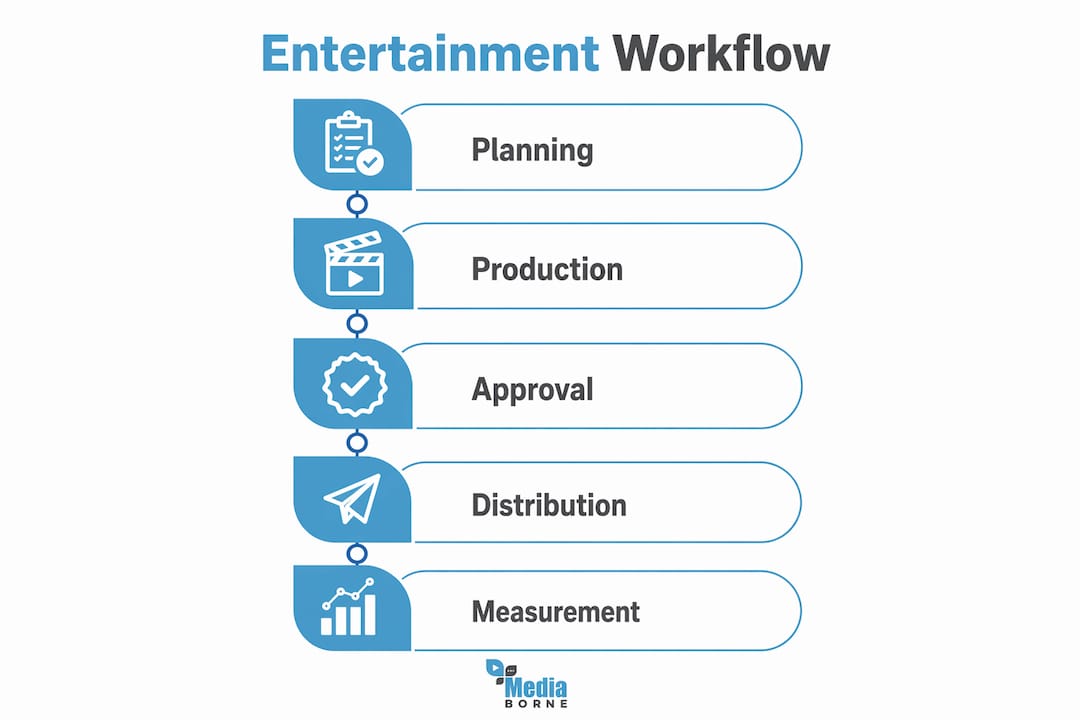
A well-run entertainment marketing workflow has five distinct stages. Each stage has a clear owner, a defined output, and a handoff point.
-
Planning. Define the story world, the emotional premise, and the entertainment format before any production begins. Decide whether you are building a short-form episodic series for TikTok or YouTube, a long-form documentary, or a live social event. The format determines the production budget, the timeline, and the distribution strategy.
-
Production. Integrate the brand into the narrative without interrupting it. The brand should feel like a natural part of the world you are building, not a sponsor message inserted between scenes. Lionsgate and Marvel both build long-term demand by treating their marketing content as extensions of the entertainment universe, not as advertisements about it.
-
Approval. Run two separate approval tracks simultaneously. The first track is creative quality review, owned by the producer or director. The second track is brand compliance review, owned by the brand manager or legal team. Merging these two tracks is the single most common cause of entertainment value being stripped out of finished content.
-
Distribution. Schedule episodic releases with consistent timing to build audience rituals. Episodic series are the top social content priority for marketers in 2026, ahead of AI-generated content and influencer partnerships. Consistent release cadence trains audiences to return, which compounds organic reach over time.
-
Optimisation. Review performance after each episode or content drop. Track brand recall lift, organic shares, and sentiment shifts rather than click-through rates alone. Adjust the story world, format, or release timing based on what the data shows.
Pro Tip: Lock production three days before your release date. The final 72 hours should be reserved entirely for distribution logistics and monitoring, not for new edits or last-minute changes.
| Stage | Primary owner | Key output |
|---|---|---|
| Planning | Creative director | Story world document and format brief |
| Production | Producer | Finished entertainment and conversion assets |
| Approval | Producer + brand manager | Two signed-off asset sets |
| Distribution | Distribution strategist | Scheduled release calendar |
| Optimisation | Analytics lead | Performance report and next-cycle brief |
What automation techniques improve entertainment marketing workflows?
Automation does not replace creative work. It removes the manual tasks that slow creative teams down. Marketing automation reduces manual effort by 60–70%, saving teams roughly 12 hours per week. Those 12 hours are the difference between a team that iterates quickly and one that is always catching up.
The tasks best suited to automation in an entertainment marketing workflow include:
- Content scheduling across TikTok, YouTube, and Instagram using tools such as Later or Buffer
- Performance tracking with automated weekly reports pulled from platform analytics into a central dashboard
- Approval routing so that assets move automatically between creative review and compliance review without manual email chains
- Audience segmentation to deliver episodic content to the right subscriber lists at the right time
AI-orchestrated workflows go one step further. Content operations costs have surged by 340% over the last decade while revenue per asset dropped 28%. That gap makes AI-assisted production planning and asset tagging a commercial necessity, not a nice-to-have.
The caution is real, though. Automation works on repeatable tasks. The creative brief, the story world, and the entertainment quality judgement must remain human decisions. Teams that automate too far upstream produce content that is efficient to make and dull to watch. The media production trends shaping 2026 all point toward human-generated episodic content as the format audiences trust most, precisely because it cannot be fully automated.
How do you measure and optimise marketing impact through entertainment?
Measurement in entertainment-led marketing requires a different set of KPIs from traditional campaign reporting. Click-through rates and cost per acquisition tell you how your conversion assets are performing. They tell you almost nothing about whether your entertainment content is building the brand.
The metrics that matter for entertainment assets are brand recall lift, organic share rate, sentiment score, and community growth. Measure these before your campaign launches to establish a baseline. Without a baseline, you cannot prove that the entertainment content is doing anything at all.
Pro Tip: Run a brand recall survey with a small audience panel before your first episode goes live. Repeat it after episode three. The lift between those two data points is your clearest proof of entertainment-led brand growth.
Brands with entertainment-first strategies achieve 2–4 times the campaign effect multipliers of interruption-based advertising. That multiplier only shows up in measurement if you are tracking the right things. Most teams measure the conversion assets and ignore the awareness assets, then wonder why the entertainment investment is hard to justify.
Episodic series data is particularly useful for iterative improvement. Each episode gives you a fresh data point on audience retention, drop-off moments, and share triggers. Use that data to refine the story world, adjust the episode length, or shift the release time. The content production guide approach of planning episodic content in advance gives you the flexibility to adjust mid-series without losing narrative coherence.
Marvel's approach is the clearest large-scale example. The brand builds community participation rituals between official releases, including fan events, trailer drops, and social activations, that keep audiences engaged and measuring organic engagement throughout. That sustained engagement between releases is what separates entertainment-led brands from brands that simply produce good content occasionally.
Key takeaways
A marketing through entertainment workflow succeeds when entertainment quality, automation, and measurement are each given their own dedicated process rather than being folded into a single generic campaign workflow.
| Point | Details |
|---|---|
| Entertainment-first briefs | Specify the emotional state within the first five seconds, not the product feature. |
| Separate asset types | Keep awareness entertainment assets and conversion assets on distinct approval tracks. |
| Automate repeatable tasks | Scheduling, approval routing, and reporting can save teams up to 12 hours per week. |
| Measure the right KPIs | Track brand recall lift and organic share rate, not just click-through rates. |
| Build audience rituals | Consistent episodic release cadence compounds organic reach and community loyalty over time. |
Why approval processes are the part nobody talks about
The approval stage is where most entertainment marketing workflows break down, and almost no one writes about it honestly. Brand managers and legal teams are trained to remove risk. Producers and directors are trained to protect emotional impact. When those two functions review the same asset at the same time with equal authority, the result is usually a compromise that satisfies neither goal.
The fix is structural, not cultural. Creative quality review and compliance review must be separate gates with separate owners. The producer signs off on entertainment value first. The brand manager signs off on compliance second. Neither gate can override the other's domain. That structure sounds simple, but I have seen teams resist it for months because it requires brand managers to accept that they do not have final say over creative decisions.
The other thing I would push back on is the idea that automation is the answer to workflow inefficiency. Automation solves scheduling and reporting problems. It does not solve the problem of a brief that asks for entertainment but rewards safety. The brand storytelling techniques that actually build audiences are the ones where someone in the room had the authority to protect the creative idea all the way to publication. That authority has to be written into the workflow before a single frame is shot.
The shift toward human-generated episodic content as the top social priority in 2026 is not a trend. It is a correction. Audiences have become very good at identifying content that was made to satisfy a checklist. The brands winning attention right now are the ones that gave a producer genuine creative authority and built the workflow around protecting that.
— Stephen
How Media borne supports your entertainment marketing workflow
Media borne builds entertainment-led workflows for brands that want to grow through content rather than interrupt their way to attention. The team combines professional video production with distribution strategy and social commerce to produce episodic series, live social formats, and original content built for TikTok, YouTube, and beyond. Every project starts with an entertainment-first brief and ends with measurable commercial outcomes. If you are ready to build a workflow that turns audience attention into brand growth, Media borne is the production partner to do it with.
FAQ
What is a marketing through entertainment workflow?
A marketing through entertainment workflow is a structured process for creating, approving, distributing, and measuring entertainment content that serves brand objectives. It separates entertainment assets from conversion assets and assigns distinct owners to each stage.
How does entertainment-first marketing differ from traditional advertising?
Entertainment-first marketing leads with narrative and emotional engagement rather than product messaging. Brands using this approach achieve 2–4 times the campaign effect multipliers compared to interruption-based advertising.
Which platforms suit entertainment marketing workflows best?
TikTok, YouTube, and Instagram are the primary platforms for episodic entertainment content in 2026. Each platform rewards consistent release cadence and community engagement differently, so distribution strategy must be platform-specific.
How much can automation improve an entertainment marketing workflow?
Marketing automation reduces manual effort by 60–70%, saving teams approximately 12 hours per week. Automation works best on scheduling, approval routing, and performance reporting rather than on creative or strategic decisions.
What KPIs should you track for entertainment-led campaigns?
Track brand recall lift, organic share rate, sentiment score, and community growth for entertainment assets. Use click-through rates and cost per acquisition only for conversion assets, which serve a different purpose in the workflow.