
TL;DR:
- Effective product demos are immersive, relevant, and tailored to specific buyer roles.
- Modern media tools enhance demos through interactivity, modularity, and analytics tracking.
- Balancing live, AI, and hybrid demos maximizes engagement and sales success.
Standing out in crowded construction and e-commerce markets is genuinely hard. Traditional advertising is losing its grip, and buyers have become remarkably adept at filtering out noise. Product demonstrations have always been a powerful sales tool, but the bar has risen sharply. Buyers now expect experiences that are relevant, immersive, and frictionless. The good news is that modern media tools have transformed what a demonstration can be, shifting it from a static walkthrough into a dynamic commercial engine. This article gives you a practical, tested framework for designing, executing, and measuring demonstrations that convert.
Table of Contents
- Essential tools and prerequisites for successful product demonstrations
- Step-by-step guide to creating engaging demonstrations
- Troubleshooting and common mistakes in product demonstrations
- Measuring success and iterating your demonstration strategy
- Why product demonstration needs a strategic rethink
- Transform your demonstrations with expert media support
- Frequently asked questions
Key Takeaways
| Point | Details |
|---|---|
| Media-driven demos boost sales | Carefully designed video and interactive demos can multiply conversion rates and close higher quality deals for both construction and e-commerce brands. |
| Personalised demos double engagement | Role-specific and personalised content significantly improves demo view rates and speeds up the sales cycle. |
| Automation improves efficiency | Automated demo flows reduce repetitive workload, but balancing automation with live, tailored presentations yields the best results. |
| Measure and iterate performance | Tracking key demo metrics and regularly refreshing assets ensures continual improvement and sustained sales impact. |
Essential tools and prerequisites for successful product demonstrations
Building on the importance of visibility, let us look at what you need to prepare for a compelling demonstration.
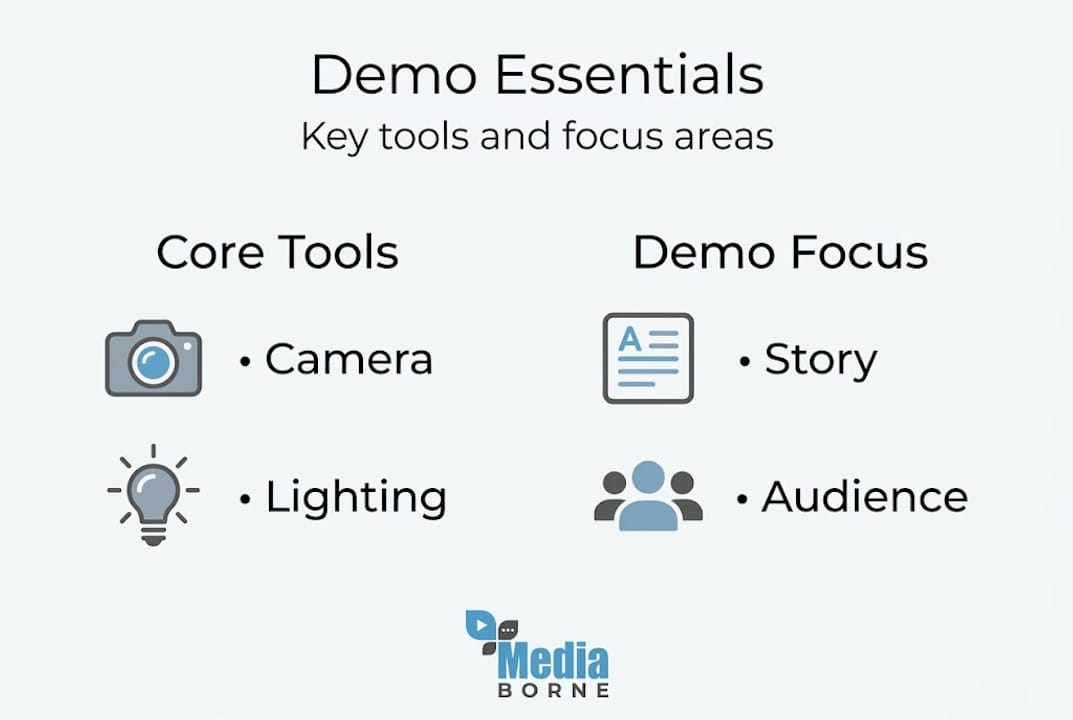
A strong product demonstration does not happen by accident. Before a single camera rolls or a screen recording starts, the foundations need to be in place. For marketers in construction and e-commerce, the toolkit looks different, but the principle is the same: the right assets, presented in the right environment, to the right person.
Core media tools by sector
| Tool | Construction demos | E-commerce demos |
|---|---|---|
| Video footage | Hardware walkthroughs, site footage | Product close-ups, lifestyle content |
| 360 walkthroughs | Jobsite and facility tours | Virtual showrooms |
| QR codes | On-site access for field workers | Campaign landing pages |
| Live data overlays | Progress tracking, real-time ROI | Stock levels, conversion analytics |
| VR/immersive content | Safety training, spatial planning | Virtual try-on, product configuration |
Role-specific construction demos integrate hardware footage, 360 walkthroughs, and live data for field project managers, while delivering boardroom ROI visuals for executives, with QR codes enabling jobsite access and side-by-side status quo comparisons. That layered approach is crucial because a field project manager and a finance director are evaluating entirely different things. One wants to know whether the tool works on a muddy site with poor connectivity. The other wants a clear return on investment figure.
Here is what every demonstration toolkit should include, regardless of sector:
- High-quality video assets that reflect real usage scenarios, not polished fantasies
- Modular content blocks that can be rearranged based on audience role
- Interactive elements such as clickable hotspots, product configurators, or embedded forms
- Ungated access wherever possible, since friction kills engagement before the demo even starts
- Analytics tracking baked in from day one, not added as an afterthought
Well-produced corporate videos serve as anchor assets across all of these formats, giving you raw footage that can be repurposed for multiple demonstration contexts.
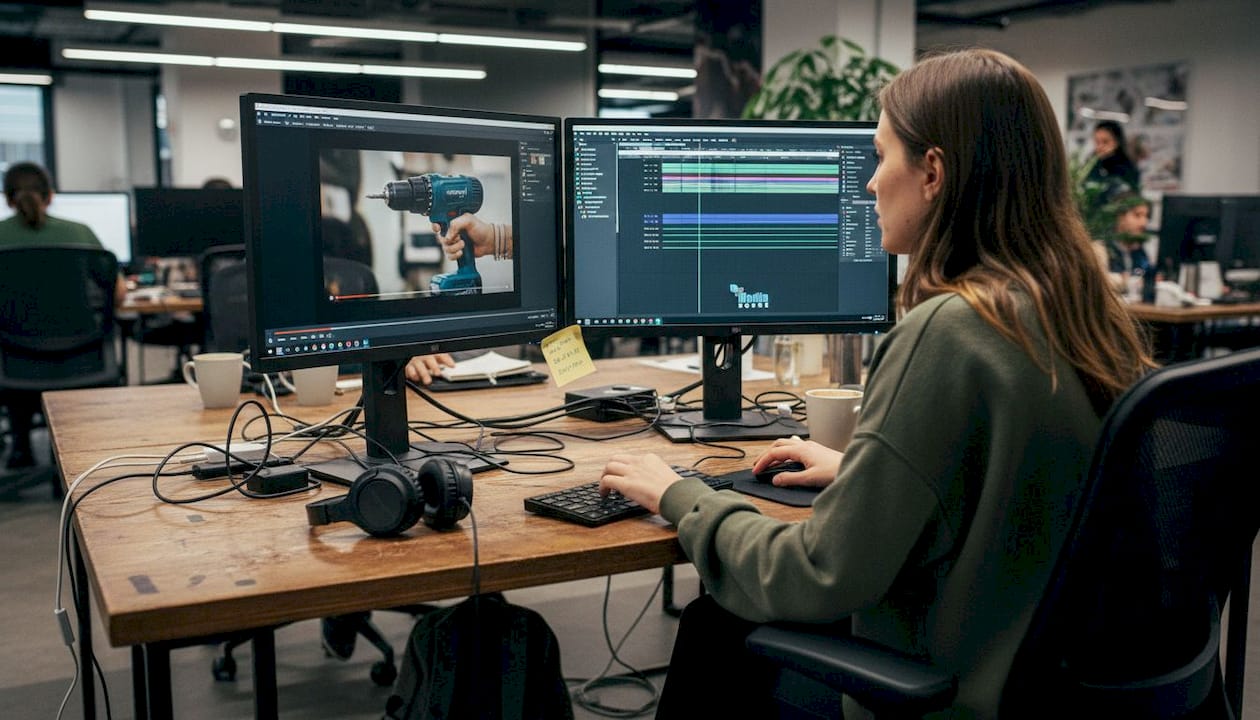
Pro Tip: Stage your demonstration environment deliberately. Clutter, poor lighting, or background noise signals to the viewer that the product itself might be just as unreliable. A clean, purposeful backdrop communicates confidence and professionalism before a single feature is showcased.
For e-commerce brands, the preparation phase also means auditing your product catalogue for gaps. Missing imagery, inconsistent descriptions, and broken links in your demo flow all undermine the experience. For construction firms, preparation means briefing your subject matter experts well in advance so they can speak authentically about real site conditions rather than reading from a script.
Step-by-step guide to creating engaging demonstrations
Once tools and assets are ready, here is how to map out and execute the demonstration itself.
The structure of your demonstration matters far more than most marketers realise. A great product can still lose a sale if the demo meanders, front-loads features, or fails to connect with the viewer's specific situation. Here is a reliable, field-tested process.
- Define your buyer personas before scripting anything. A field engineer in construction needs entirely different triggers than a procurement director.
- Script for conversation, not presentation. Use "you" and "your" language throughout. Buyers engage more when they feel the demo is about their problem, not your product.
- Film with modularity in mind. Shoot scenes that can stand alone and be recombined. This lets you personalise without reshoot costs.
- Keep flows short. Top interactive demos run between 5 and 13 steps with 25 to 30 words per dialogue panel, use muted colour schemes, open with modal windows on the first step, and average five calls to action with checklist-style branches for different paths.
- Edit for pace and clarity. Remove any moment that does not actively move the viewer toward a decision. Every scene should earn its place.
- Deploy across the right channels. Embed demos on product pages, share in sales conversations, and syndicate through LinkedIn and email sequences.
- Track engagement at every step. Know exactly where viewers drop off and treat that as a signal to rework that section.
Live vs AI vs hybrid demonstrations
| Demo type | Strengths | Best for |
|---|---|---|
| Live | Deep validation, handles objections in real time | Complex construction sales, enterprise deals |
| AI-driven | Scalable, always available, consistent delivery | E-commerce, top-of-funnel qualification |
| Hybrid AI-human | Combines scale with personal touch | Mid-market deals, considered purchase journeys |
The data here is striking. Interactive demos boost e-commerce B2B conversions by six times compared to static formats. Autonomous AI demos with live navigation are preferred by 61% of buyers. Top-performing demos achieve a 67% click-through rate versus just 8% at the median. And hybrid AI-human combinations close 1.8 times more high-quality deals. These are not marginal gains. They represent a fundamental shift in what buyers expect from a purchase experience.
Reviewing your video marketing tips can sharpen your scripting instincts, while a clear understanding of social video workflows helps you map how demo content flows across platforms without losing consistency or momentum.
"Buyers no longer want to be taken on a tour of your product. They want to explore the parts that matter to them, at their own pace, on their own terms. The most effective demonstrations are the ones that feel less like presentations and more like self-service discovery."
Troubleshooting and common mistakes in product demonstrations
Even the best plans can stumble. Here are the issues to watch for as you roll out product demonstrations.
Most demonstration failures are not caused by bad products. They are caused by avoidable process errors that compound over time. Knowing what these pitfalls look like is the first step to eliminating them.
The most common mistakes include:
- Generic, one-size-fits-all walkthroughs. In construction especially, complex multi-stakeholder ecosystems demand role-specific content. A demo that tries to speak to everyone usually speaks to no one.
- Overlong formats. Buyers lose attention quickly. A 40-minute demo that could be 12 minutes is not thorough; it is disrespectful of the viewer's time.
- Absence of personalisation. Personalised demos achieve a 29% view rate compared to just 15% for generic formats. Multiple automated follow-up touches close deals 19 days faster on average. And yet 94% of sales engineers still run repetitive demos averaging seven per week, totalling 3.6 hours each.
- Failing to automate repetitive demo tasks. When your sales engineers spend 25 hours a week delivering the same walkthrough to similar audiences, that is a resource drain that automation can eliminate without sacrificing quality.
- Skipping A/B testing. If you never test different opening sequences, calls to action, or visual styles, you are guessing rather than optimising.
Pro Tip: Audit your demo library every quarter. Identify the three lowest-performing assets, isolate the specific step where viewers drop off, and rework just that section before refreshing the full piece. Small, targeted edits often outperform full-scale rebuilds.
Practical remediation looks like this: create a master checklist covering audience, persona, flow length, personalisation tokens, and CTA placement. Before any demo goes live, run it through the checklist. This simple gate catches the majority of errors before they reach a real buyer.
Keeping pace with media production trends ensures your demo formats stay relevant rather than dated. And building content hubs around your demonstrations gives buyers a structured environment to explore content at their own pace, which improves engagement and reduces abandonment.
The efficiency argument for automation is compelling, but it only works when the automated version is genuinely good. A fast, mediocre demo still underperforms a slower, well-crafted one. Automate the distribution and scheduling. Keep the quality control human.
Measuring success and iterating your demonstration strategy
After launching your product demos, understanding their effect is essential. Here is how to measure and improve.
Running great demonstrations without measuring their impact is like filming an incredible campaign and never checking the viewing figures. Metrics transform gut feeling into reliable insight, and they give you the evidence you need to justify further investment.
Here is a structured approach to demo measurement:
- Set baseline metrics before launch. Know your current close rate, average time to close, and demo completion rate. Without a baseline, you cannot prove improvement.
- Track click-through rate at each demo step. This tells you which moments drive action and which cause disengagement.
- Monitor demo view rate segmented by persona. A high overall view rate that masks low engagement from your target persona is misleading.
- Record time-to-close for demo-assisted versus non-demo deals. The comparison will quickly reveal the commercial value of your demonstration programme.
- Review quarterly and run A/B tests on your highest-traffic demos. Test one variable at a time: opening format, CTA wording, demo length, or visual style.
Key demo performance benchmarks
| Metric | High-performing demos | Median benchmark |
|---|---|---|
| Click-through rate | 67% | 8% |
| Deal quality (AI-human hybrid) | 1.8x higher | Baseline |
| Conversion boost vs static | 6x | 1x |
| View rate (personalised) | 29% | 15% |
| Days faster to close | 19 days | Baseline |
Statistic to note: Top-performing demos achieve a 67% click-through rate. The median sits at 8%. That gap is not a minor performance difference. It is the difference between a demonstration programme that drives revenue and one that merely exists.
General best practices recommend focusing on the "aha moment," using AI to draft demos before polishing manually, running A/B tests as a standard practice, refreshing content quarterly, and deploying demos within digital sales rooms. Mobile and offline readiness are also essential, particularly for construction teams accessing content at remote sites with unreliable connectivity.
Knowing how to optimise video campaigns gives your demo analytics a sharper edge, and building a coherent social video strategy ensures that your demonstration content reaches the right audiences across the platforms where they already spend their time.
Why product demonstration needs a strategic rethink
Now that we have covered the practical steps, here is a view on what is often overlooked.
Most marketers treat automation as a destination rather than a tool. They automate their demo programme, watch the efficiency gains roll in, and stop there. The problem is that automation without strategic intent produces scale without quality. A buyer who has watched a beautifully produced but entirely generic demo has learned nothing useful about whether your product solves their specific problem.
Live demos remain essential for custom proof-of-value exercises and deep validation, even as repetitive demos waste sales engineers' time at roughly 25 hours per week. The answer is not to choose one over the other. It is to be deliberate about which format serves which moment in the buyer journey.
In construction especially, field-friendly formats that blend hardware and software, demonstrate real site conditions, and show a credible before-and-after comparison consistently outperform polished generic walkthroughs. The buyer on a muddy site at 7am does not want a boardroom presentation. They want proof that the product works in their world.
The smartest demonstration strategies we see are the ones that treat innovative media production as a long-term asset, not a one-off project. Build for reuse, personalise at the point of delivery, and never mistake a high production budget for a high-quality message.
Transform your demonstrations with expert media support
For those seeking to elevate their demonstrations even further, expert media partners can provide the advanced support needed.
If this article has outlined the what and the why, Media Borne provides the how. Our video production services are built for brands that need demonstration content that actually performs, not just content that looks impressive in a portfolio.
For construction and e-commerce brands ready to go beyond standard video, our virtual reality videos and broader virtual immersive services open up entirely new demonstration formats, from interactive 360 site walkthroughs to immersive product configurators. If your demonstrations need to work harder and reach further, we are the team to make that happen. Get in touch and let us build something that converts.
Frequently asked questions
What makes an engaging product demonstration in e-commerce?
Interactive demos with short, modular flows, ungated access, and personalised content significantly increase conversion rates. Interactive demos boost e-commerce B2B conversions by six times, with top performers achieving a 67% click-through rate.
How can construction software demonstrations be tailored for different buyer roles?
Demos should use role-specific content, with hardware footage and live data for field managers and ROI visuals for executives. QR codes for jobsite access combined with side-by-side status quo comparisons make construction demos genuinely persuasive across both audiences.
Does automation outperform live product demos?
Automation drives efficiency and scale, but live demos remain crucial for custom validation and engaging complex buying groups. Repetitive demos waste sales engineers roughly 25 hours per week, making a hybrid approach the most commercially sensible strategy.
What metrics are most important for evaluating demo success?
Click-through rate, close rate, demo view rate, and speed to close are the most informative metrics for gauging demo effectiveness. Hybrid AI-human demos close 1.8 times more high-quality deals, making deal quality a particularly telling indicator of demonstration performance.