

TL;DR:
- Brands building systematic creator networks see significantly higher conversion rates and predictable growth compared to ad hoc influencer activities. Focusing on operational discipline, measurement, and long-term relationships transforms creator marketing into a reliable revenue channel. Small and mid-sized brands can achieve enterprise-level results by adopting structured workflows, measurement infrastructure, and strategic platform management.
Brands using structured creator networks are seeing conversion rate boosts upwards of 250%, yet the majority of mid-sized e-commerce teams still treat creators as a reach play rather than a revenue engine. The brands pulling ahead are not necessarily working with bigger names or spending more money. They are building systematic, measurable creator operations that function more like a performance channel than a PR activity. This guide covers how to define, build, measure, and optimise a creator network that consistently converts audiences into customers.
Table of Contents
- What are creator networks and why do they matter for e-commerce?
- Building a high-performing creator network: Workflow, sourcing, and vetting
- Measuring success: Attribution, KPI standardisation, and real campaign performance
- Driving conversions: Workflow optimisation, in-campaign tactics, and case studies
- What most brands overlook about creator networks
- How Media Borne accelerates creator network success
- Frequently asked questions
Key Takeaways
| Point | Details |
|---|---|
| Creator networks drive revenue | Brands treating creator networks as structured performance engines see major conversion uplifts, not just awareness. |
| Workflow and attribution matter most | Operational discipline and robust tracking systems make or break creator network ROI. |
| Standardise KPIs for accurate measurement | Agreeing on success definitions and data windows across channels is essential for genuine insight. |
| Repetition builds value | Long-term creator partnerships provide compounding benefits over one-off influencer campaigns. |
| Mid-sized brands can win big | With the right system, smaller budgets can still yield enterprise-level success from creator networks. |
What are creator networks and why do they matter for e-commerce?
A creator network is not simply a roster of influencers you activate occasionally. It is a structured, ongoing system of relationships with content creators, each selected, briefed, and measured against defined business objectives. The distinction matters enormously. One-off influencer campaigns are like buying individual ad placements with no retargeting. A creator network is more like owning a media channel with compounding audience reach and increasingly reliable performance data.
Many brands still operate under the assumption that creator marketing is primarily about awareness. That was largely true five years ago. Today, the platforms, commerce tools, and attribution capabilities have matured to the point where creator economy for brand growth is firmly a conversion and revenue conversation. TikTok Shop, Instagram Checkout, and affiliate-linked YouTube content have made the path from discovery to purchase shorter than ever before.
"A practical way for mid-sized e-commerce brands to use creator networks is as a sourcing and fulfilment system, optimised for business outcomes." — Shopify's overview on Instagram influencer marketing
The shift in thinking requires you to move beyond vanity metrics. Likes, shares, and impressions tell you that content landed. What you need to know is whether it moved product. This is why the most sophisticated brands now approach creator partnerships the same way they approach collaborative sponsored content: with defined deliverables, tracked outcomes, and clear accountability on both sides.
Key characteristics that separate a creator network from ad hoc influencer activity:
- Ongoing relationships rather than transactional, single-campaign engagements
- Standardised briefing templates so creators receive consistent direction across campaigns
- Performance-linked compensation models such as affiliate commissions or sales bonuses
- Centralised tracking using unique links, discount codes, and UTM parameters
- Regular review cadences where performance data informs future creator selection and content direction
This structural shift is what turns creator spend from a variable marketing line item into a predictable growth mechanism.
Building a high-performing creator network: Workflow, sourcing, and vetting
Assembling a creator network without a clear operational framework is one of the most common mistakes mid-sized brands make. The creative side gets attention; the operational side gets underbuilt. Sourcing and vetting at scale are top workflow priorities for e-commerce brands in 2026, with AI-driven creator matching becoming a central focus area in discovery workflows.
Here is a practical sequence for building your network from scratch:
- Define your creator tiers. Decide whether you need nano creators (1,000 to 10,000 followers), micro creators (10,000 to 100,000), or mid-tier talent, and in what proportions. Micro and nano creators typically deliver stronger engagement rates and more authentic content for lower costs.
- Build your discovery process. Use platform search, hashtag research, and creator marketplace tools to identify candidates. AI-driven matching platforms can dramatically reduce the time spent sifting through irrelevant profiles.
- Apply a structured vetting framework. Assess audience authenticity (fake follower checks), engagement quality, content alignment with your brand values, and historical sponsored content performance.
- Create a scalable onboarding system. This includes a welcome brief, content guidelines, affiliate or tracking link setup, and a clear timeline. Efficient onboarding reduces friction and improves creator satisfaction.
- Establish a briefing cadence. Regular campaign briefs, ideally templates with a consistent structure, ensure creators know what is expected without requiring extensive back-and-forth.
- Review and reallocate. Use performance data at the end of each campaign cycle to adjust your creator mix, pausing underperformers and scaling up high converters.
Pro Tip: Do not underestimate the value of a strong video workflows for e-commerce infrastructure. Creators who receive clear video briefs and asset guidelines consistently produce content that outperforms vague, open-ended briefs. Specificity drives quality.
The manual versus automated sourcing question comes up constantly for growing brands. Here is a direct comparison:
| Factor | Manual sourcing | Automated/AI-assisted sourcing |
|---|---|---|
| Time investment | High (weeks per campaign) | Low (hours per campaign) |
| Quality control | Strong with experienced team | Dependent on platform quality |
| Cost | Low tool cost, high labour cost | Higher tool cost, lower labour cost |
| Scale | Limited by team capacity | Easily scalable |
| Creator relationship depth | Stronger with direct outreach | Can feel transactional |
| Data accuracy | Variable | Generally stronger |
For most mid-sized brands, a hybrid approach works best. Use AI-assisted tools to build a shortlist, then apply human judgement for the final selection and all ongoing relationship management. This keeps the process scalable without losing the personal dimension that makes creator relationships work.
Building production strategies for engagement into your briefing process is also critical. The brands seeing the best results treat content development as a collaborative process, not a directive one, and they invest in content development acceleration to reduce the lag between brief and publication.

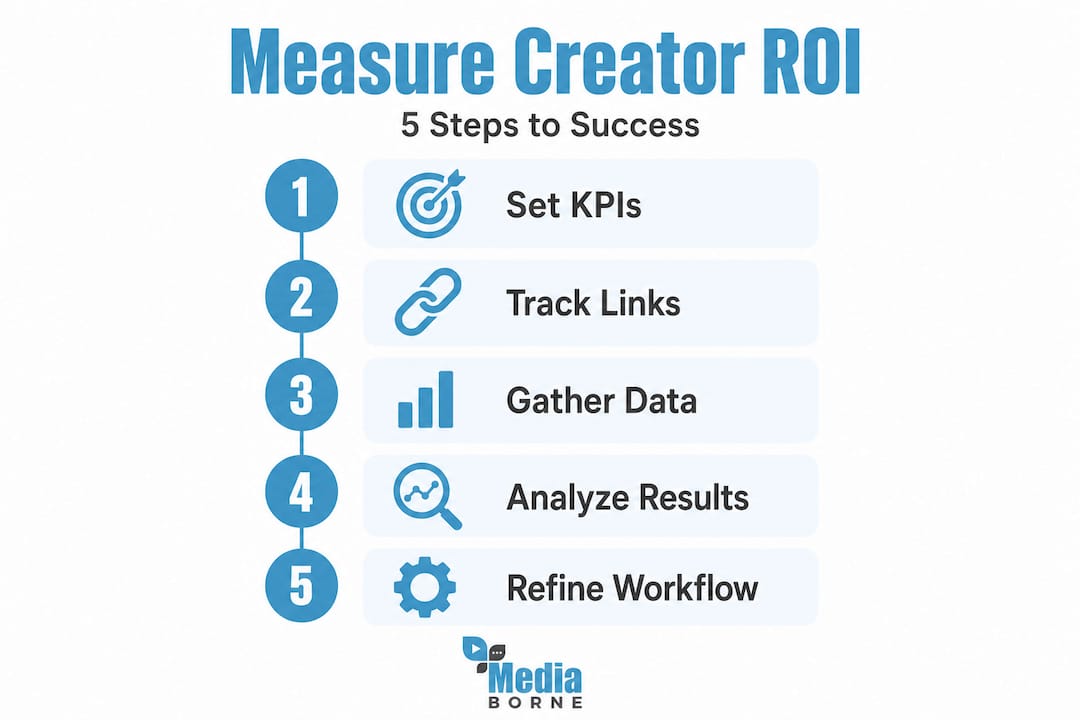
Measuring success: Attribution, KPI standardisation, and real campaign performance
Once your network is running, measurement becomes the most strategically important activity you can invest in. It is also the area where most brands experience significant frustration. Attribution and KPI comparability can break down across ecosystems; ROI needs clear definitions and an instrumentation plan before campaigns go live, not after.
The core measurement challenges you will face:
- Cross-platform data fragmentation. TikTok, Instagram, and YouTube all report metrics differently. What counts as a "view" or an "engagement" varies widely across platforms.
- Attribution window disagreements. A customer might discover your product via a creator on Tuesday and purchase on Saturday. Short attribution windows miss this entirely.
- Last-click bias. Standard analytics tools default to last-click attribution, which systematically undervalues top-of-funnel creator content.
- Coupon code sharing. Discount codes get shared beyond the original creator's audience, inflating some creators' apparent performance unfairly.
The most reliable measurement framework combines several tracking mechanisms working together. Unique affiliate links tied to each creator provide click-level data. Creator-specific discount codes offer a secondary check. UTM parameters enable session-level tracking in your analytics platform. And post-purchase surveys asking customers "how did you hear about us?" provide valuable qualitative data that fills attribution gaps.
Pro Tip: Set your KPI agreements in writing before any campaign launches. Aligning on whether you are optimising for clicks, attributed revenue, new customer acquisition, or repeat purchase rate changes everything about how you evaluate performance. Misaligned KPIs are the fastest route to wasted spend and strained creator relationships.
The data on what proper instrumentation delivers is compelling. [ROI improved from 3.2:1 to 4.8:1](https://hs-21030792.f.hubspotemail.net/hubfs/21030792/2025-26 State of Creator Marketing/CreatorIQ-StateofCreatorMarketing2025-2026.pdf?utm_campaign=21707554-SCM26-State-of-Creator-Marketing&utm_medium=email&_hsenc=p2ANqtz--q-z70v0PgEZyGLdupBKusF_p79BgKhyoYiD8kC02R2wWXyDbJP4MqH9b2UVfrqHukt2r6sA27Xpb-6KpGDPnX6ywmrA&_hsmi=383251612&utm_content=383251612&utm_source=hs_automation) after implementing automated tracking and attribution within 90 days, according to the State of Creator Marketing 2025 to 2026 report. That is not a marginal improvement. It represents a fundamental shift in the economics of the channel.
A structured data table for tracking creator performance across your network might look like this:
| Metric | What it measures | Recommended tool |
|---|---|---|
| Click-through rate | Traffic driven by creator | UTM links in analytics |
| Attributed revenue | Direct sales tied to creator | Affiliate platform |
| New customer rate | Whether creator drives acquisition | CRM segmentation |
| Content engagement rate | Audience quality and resonance | Native platform analytics |
| Cost per acquisition | Efficiency of creator spend | Calculated manually |
Connecting media production marketing ROI principles to your creator network measurement ensures you are evaluating creative investment with the same rigour applied to paid media. And once you have reliable data flowing, you can optimise video campaigns in real time rather than waiting for campaign end.
Driving conversions: Workflow optimisation, in-campaign tactics, and case studies
With your attribution infrastructure in place, the focus shifts to converting the attention your network generates into actual revenue. This is where the operational decisions made earlier pay off most visibly. According to the data, commerce-oriented creator networks can deliver conversion rate boosts of over 250% and ROI of 6.5x when properly integrated into commerce flows.
The Sky and Sol case study is instructive. By moving from isolated influencer activations to a structured creator network with clear commerce integration, the brand achieved dramatic conversion improvements. The key was not simply finding better creators. It was building better systems around the creators they already had.
"The brands winning with creator networks in 2026 are the ones treating them as performance channels with clear commercial accountability, not as brand awareness experiments." — creator marketing challenges discussion, EMARKETER
Here is how to optimise in-campaign performance, rather than waiting for end-of-campaign analysis:
- Monitor early signals. Watch the first 24 to 48 hours of each creator post. Strong early engagement is a reliable predictor of eventual conversion performance. Identify high performers quickly.
- Reallocate budget mid-campaign. If one creator is outperforming others, increase their deliverables or extend their contract. Pull resource from underperformers in real time.
- Test content formats within the network. Have some creators try product demonstrations, others try lifestyle content, and others try comparison content. Let the data tell you what converts for your audience.
- Shorten the path to purchase. Ensure every creator post has a frictionless route to your product page. One extra click costs conversions. Direct links, Linktree pages, or native shopping integrations all reduce drop-off.
- Build creator feedback loops. Creators who understand their own performance data produce better content over time. Sharing what worked and what did not builds better briefs for the next campaign.
The Moonboon example is equally powerful. A network of 300 creators, managed systematically, drove over one million pounds in net sales with a 6.5x return. This is not an enterprise-only result. It is a direct consequence of operational discipline applied consistently at a mid-market scale.
The compounding effect is real. Each campaign cycle produces more data, better briefs, stronger creator relationships, and more refined audience targeting. For creator marketing for engagement to become a genuine growth asset, it needs to be treated as a long-term system, not a series of isolated activations.
What most brands overlook about creator networks
Here is the uncomfortable truth most creator marketing content avoids: the biggest barrier to ROI from creator networks is not finding the right creators. It is operational complexity that teams are not equipped to manage.
Measurement complexity and campaign optimisation are persistent pain points, requiring more instrumentation and more structured experimentation than most brands currently have in place. The brands that outperform are not necessarily those with the largest creator rosters or the biggest budgets. They are the ones with the most disciplined reporting infrastructure and the clearest performance criteria.
We see this pattern repeatedly. A brand invests in expanding their creator network, adding more talent and increasing spend, only to find that performance does not improve proportionally. The problem is almost always the same: the operational layer has not scaled with the creative layer. Attribution is still manual, KPI agreements are informal, and there is no systematic process for learning from each campaign and applying those lessons to the next.
The fix is counterintuitive. Rather than growing your network wider, go deeper with fewer, better-structured partnerships. A network of 20 highly instrumented, well-briefed creators will almost always outperform a network of 200 loosely managed ones. The data is cleaner, the relationships are stronger, and the content quality is higher.
Treating every platform as equivalent is another common misstep. TikTok, YouTube, and Instagram each have distinct commerce behaviours, audience expectations, and content formats. A creator who converts brilliantly on TikTok Shop may deliver minimal returns on YouTube without significant content adaptation. Platform-specific media production trends analysis should inform how you allocate creator effort across channels.
The brands that build sustainable competitive advantage through creator networks do so by treating workflow and measurement as primary strategic assets, not as administrative overhead. Process optimisation is the moat.
How Media Borne accelerates creator network success
If reading this has highlighted gaps in your current creator network approach, the good news is that these are solvable problems with the right operational support.
Media Borne specialises in building the creative and operational infrastructure that mid-sized e-commerce brands need to turn creator relationships into measurable revenue. From structured video production services designed for creator-led campaigns, to immersive formats built through virtual production services, the team combines production quality with performance focus. Rather than simply producing content, Media Borne builds systems that generate compounding commercial results. If you are ready to move from ad hoc creator activity to a fully instrumented growth channel, this is where to start.
Frequently asked questions
What is the main advantage of using a creator network over one-off influencer partnerships?
A creator network enables repeatable workflow, more accurate attribution, and long-term ROI growth compared to isolated influencer buys. Treat creator relationships like long-term media partnerships to unlock compounding value over time.
How do you measure the ROI of creator networks?
By implementing creator-specific tracking links, standardising KPIs across all platforms, and integrating reliable attribution mechanisms before campaigns launch. [ROI improved significantly](https://hs-21030792.f.hubspotemail.net/hubfs/21030792/2025-26 State of Creator Marketing/CreatorIQ-StateofCreatorMarketing2025-2026.pdf?utm_campaign=21707554-SCM26-State-of-Creator-Marketing&utm_medium=email&_hsenc=p2ANqtz--q-z70v0PgEZyGLdupBKusF_p79BgKhyoYiD8kC02R2wWXyDbJP4MqH9b2UVfrqHukt2r6sA27Xpb-6KpGDPnX6ywmrA&_hsmi=383251612&utm_content=383251612&utm_source=hs_automation) with automated tracking and agreed KPI frameworks in place from the outset.
What are common challenges when running creator network campaigns?
Measurement complexity, differences in KPI definitions across stakeholders, and cross-network attribution breakdowns are the most frequently cited barriers to accurate campaign evaluation. Measurement and optimisation remain major operational pain points for brands at every scale.
How automated can creator discovery and workflow management get for mid-sized brands?
Significantly automated. AI-driven creator matching is a top operational priority for 2026, with purpose-built platforms reducing discovery and vetting time from weeks to hours for teams of all sizes.
Can small and mid-sized brands realistically achieve the same results as enterprise brands with creator networks?
Yes, with the right tools and structured workflow in place. Moonboon's 300 creators drove over one million dollars in net sales and a 6.5x ROI, demonstrating that scale of spend is far less important than operational discipline and systematic measurement.