

TL;DR:
- Most marketing teams fail to maximize revenue by neglecting post-traffic conversion optimization efforts.
- Effective funnel analysis, psychology, and continuous testing are essential to improving conversion rates and driving growth.
Most marketing teams spend their budgets acquiring traffic, then leave a staggering amount of revenue on the table by ignoring what happens next. Conversion, the process of turning an interested visitor into a paying customer, is where that revenue lives. And the gap between a 1% and a 3% conversion rate is not a minor performance tweak. It is the difference between a struggling campaign and a profitable one. This article breaks down the metrics, psychology, and technical frameworks that separate average optimisation efforts from the ones that genuinely compound over time.
Table of Contents
- Key takeaways
- Understanding conversion metrics and funnel analysis
- Psychology and design principles that drive conversions
- Advanced data-driven approaches to conversion
- How to increase website conversions in practice
- Measuring success and iterating continuously
- My honest take on conversion optimisation
- Turn attention into conversions with Mediaborne
- FAQ
Key takeaways
| Point | Details |
|---|---|
| Funnel analysis is non-negotiable | Mapping each stage of your conversion funnel reveals the specific bottlenecks costing you revenue. |
| Psychology outperforms aesthetics | Pages built around processing fluency and cognitive load reduction consistently outperform beautifully designed but cluttered alternatives. |
| Speed is a conversion lever | Pages loading in one second convert 2.5x higher than those loading in five, making site speed a direct revenue driver. |
| Testing needs a discipline, not just tools | A prioritised test backlog with ICE scoring produces better results than running ad hoc experiments. |
| Measurement must be continuous | Optimisation compounds when you review results consistently and align marketing with sales on shared KPIs. |
Understanding conversion metrics and funnel analysis
Before you can improve conversions, you need to know precisely where your funnel is leaking. Most teams track overall conversion rate and stop there. That single number hides everything useful.
A well-structured conversion funnel analysis breaks performance into discrete stages: visitor to lead, lead to meeting, meeting to qualified opportunity, and opportunity to closed deal. Each transition has its own conversion rate, and each one points to a different problem when it underperforms. A weak visitor-to-lead rate usually signals a messaging or friction problem on your landing pages. A poor lead-to-meeting rate often points to slow follow-up or misaligned targeting.
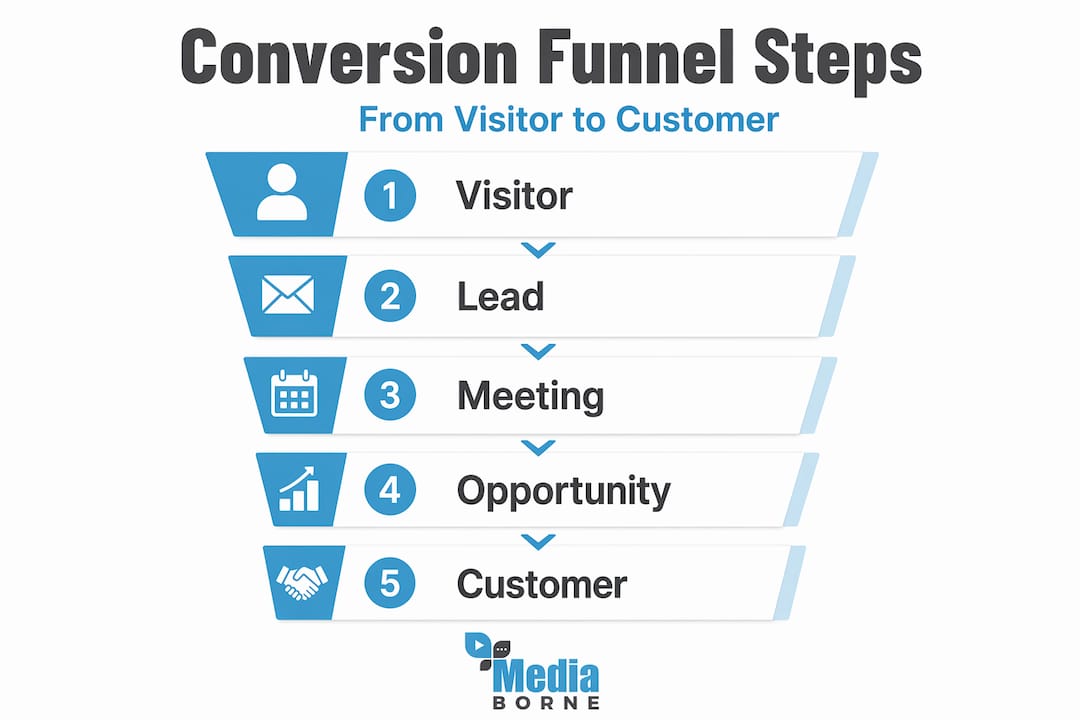
Here is a practical reference for the metrics worth tracking at each stage:
| Metric | What it measures | Why it matters |
|---|---|---|
| Conversion rate | Visitors who complete a goal | Top-line health of your funnel |
| Cost per lead (CPL) | Spend divided by leads generated | Efficiency of paid acquisition |
| Lead-to-meeting rate | Leads that book a discovery call | Quality of inbound lead targeting |
| Meeting-to-opportunity rate | Meetings that progress to pipeline | Sales and marketing alignment |
| Win rate | Opportunities that close as customers | Overall funnel effectiveness |
One area that trips up even experienced marketers is attribution. Attribution windows are strategic levers that shape channel crediting and budget decisions, not just technical settings. A 7-day click window will make your paid social look weaker than a 30-day window, even if the underlying performance has not changed. This matters when you are deciding where to shift budget.
There is also a critical distinction between session-based and multi-session conversions. GA4's default session-based funnel analysis can undercount conversions for products with extended buying journeys. If your customer takes three visits over two weeks before converting, a session-locked funnel will show them as three abandoned sessions rather than one successful conversion. Enabling elapsed time windows gives you a far more accurate picture of how your audience actually buys.
Psychology and design principles that drive conversions
Understanding the mechanics of your funnel gets you to the right questions. Psychology tells you how to answer them.
The most useful framework for conversion psychology is not Cialdini's principles (though they remain relevant). It is Daniel Kahneman's distinction between System 1 and System 2 thinking. System 1 is fast, instinctive, and largely visual. System 2 is slow, deliberate, and analytical. Most visitors arrive at your page in System 1 mode. They are scanning, not reading. They are making snap trust judgements before they have processed a single word of your copy.
High-converting landing pages must deliver immediate trust and processing fluency, matching the brain's cognitive decision-making processes. Processing fluency is simply how easily the brain absorbs information from a page. High fluency feels trustworthy. Low fluency feels effortful and suspicious, even when the content itself is accurate and compelling.
This is where cognitive load theory becomes practical. Most landing pages lose conversions by adding too much. More proof points, more features, more options. But every element you add forces the visitor's brain to work harder. And a brain working hard does not buy. It leaves.
The practical implications are significant:
- Remove any element that does not directly serve the conversion goal
- Reduce the number of choices on a single page (Hick's Law: more options, longer decision time)
- Use familiar design patterns so visitors spend zero cognitive effort working out how to navigate
- Apply loss aversion in copy ("Stop losing leads to slow follow-up") rather than generic benefit statements ("Improve your conversion rate")
- Place social proof close to the conversion action, not buried at the bottom of the page
The Fogg Behaviour Model adds another useful lens. Conversion happens when motivation, ability, and a trigger align simultaneously. Most optimisation focuses on motivation (better copy, stronger offers). But ability, specifically how easy it is to complete the conversion action, is often the faster fix.
Pro Tip: Audit your most important landing pages by asking one question per element: "Does this make it easier or harder to convert?" If you cannot answer immediately, the element is adding cognitive load. Remove it and test.
Advanced data-driven approaches to conversion
Once your funnel is mapped and your pages are psychologically sound, the gains come from systematic testing and smarter data use.
The most common mistake in A/B testing is not running bad tests. It is running good tests in the wrong order. A structured optimisation approach starts with a prioritised backlog. The ICE scoring method (Impact, Confidence, Ease) gives each test idea a numerical score so you work through the highest-value experiments first rather than defaulting to whatever is easiest to implement.
Here is how to build that discipline:
- Collect hypotheses from analytics, session recordings, heatmaps, and customer interviews. Every data source tells you something different about where and why people drop off.
- Score each hypothesis on Impact (how much will this move the needle if it works?), Confidence (how strong is the evidence?), and Ease (how long will this take to implement and run to significance?).
- Set minimum sample sizes before you start. Running a test to 200 visitors and declaring a winner is not testing. It is noise.
- Document every result, including tests that produced no change. Null results are data. They tell you what is not the problem.
- Review the backlog monthly and reprioritise as new data comes in. Optimisation is a continuous discipline requiring shared KPIs and a test-and-learn approach for compounding gains.
On attribution, the most sophisticated teams combine multi-touch attribution for day-to-day decision-making with annual incrementality testing to validate their channel assumptions. Combining multi-touch attribution with incrementality testing clarifies true channel impact and informs budget allocation far more reliably than either approach alone.
AI-powered personalisation and predictive lead scoring are worth serious investment at scale. Predictive scoring uses behavioural signals to rank leads by likelihood to convert, letting your sales team focus effort where it will have the highest return.
Pro Tip: Set your measurement cadence before you launch any campaign. Weekly check-ins for pacing, monthly for performance trends, and quarterly for strategic reallocation. Reacting to daily data is how budgets get wasted on statistical noise.
How to increase website conversions in practice
Theory becomes revenue when you translate it into a prioritised action list. These are the changes that produce measurable results without requiring a full platform rebuild.
Pages loading in one second convert 2.5x higher than those loading in five seconds, and a single additional second of load time decreases conversions by 7%. Site speed is not a technical nicety. It is a direct revenue variable. Run your key landing pages through Core Web Vitals and fix the largest issues first, typically image optimisation and third-party script loading.

For CTAs, personalised calls to action convert over 200% better than generic alternatives. This does not require a complex personalisation platform at the start. Segmenting by traffic source (paid versus organic, returning versus new visitor) and serving different CTA messaging to each group is achievable in most marketing automation tools and produces meaningful lifts.
Here is a practical comparison of quick-win tactics versus longer-term conversion strategies:
| Tactic | Time to implement | Expected impact | Effort level |
|---|---|---|---|
| Site speed optimisation | 1 to 2 weeks | High | Medium |
| Reducing form fields | 1 to 3 days | Medium to high | Low |
| Personalised CTAs by segment | 2 to 4 weeks | High | Medium |
| Progressive profiling | 4 to 8 weeks | Medium | Medium |
| Full A/B testing programme | 3 to 6 months | Very high (compounding) | High |
| Predictive lead scoring | 2 to 4 months | High | High |
Progressive profiling deserves specific attention. Rather than asking for every piece of information on a single form, you collect data incrementally across multiple interactions. First visit: name and email. Second visit: company size and role. Third visit: specific challenge or intent. This reduces friction on the first conversion action and builds a richer lead profile over time without frightening prospects away with a 12-field form.
Pro Tip: Before increasing your paid media budget, model what a 1 percentage point improvement in conversion rate would do to your revenue. In most cases, it outperforms adding 20% more ad spend. Optimise before you scale.
Measuring success and iterating continuously
Getting results once is execution. Getting results consistently is a system. These are the practices that separate teams with compounding conversion gains from those that plateau after their first win.
- Set realistic baselines before running any test. If your current conversion rate is 1.8%, a target of 5% in 90 days is not ambitious. It is a fantasy that will lead to bad decisions.
- Interpret metrics in context. A rising click-through rate alongside a falling conversion rate often means your ad creative is attracting the wrong audience, not that your landing page is broken.
- Create a shared review rhythm between marketing and sales. 90% of startups audited lacked a lead response system within 24 hours, and responding to a lead after five minutes drops qualification odds by 80%. Closing that gap requires marketing and sales operating on the same data and the same timelines.
- Document every test result in a shared repository. When team members change or campaigns restart, institutional knowledge should not disappear.
- Review your social video strategy and content performance alongside conversion data. Engagement quality upstream directly affects conversion rates downstream.
My honest take on conversion optimisation
I have worked alongside enough marketing teams to see the same pattern repeat itself. Someone runs a successful A/B test on a button colour, gets excited, and then spends the next quarter testing minor surface changes while ignoring the structural issues costing them 40% of their funnel.
The uncomfortable truth is that most conversion problems are not creative problems. They are ability problems. Visitors are motivated enough to arrive. What stops them converting is friction: a slow page, a form with too many fields, a CTA that does not match what the ad promised, a lead that sat in a CRM for 48 hours before anyone followed up.
Motivation is harder to engineer than ability. You cannot control whether someone wants what you are selling. You can absolutely control whether your site makes it easy to take the next step. In my experience, fixing ability-based friction consistently outperforms even the most carefully crafted motivational copy.
The teams I have seen achieve sustained growth treat conversion optimisation the same way they treat paid media or SEO. It is a discipline with its own operating model, its own KPIs, and its own review cadence. Not a project that runs for a quarter and gets shelved. If you are serious about media production for marketing ROI, optimisation is where that investment pays off.
Conversion optimisation is not a tactic. It is a fundamental marketing competency. Build it properly and it compounds across every campaign you ever run.
— Stephen
Turn attention into conversions with Mediaborne
The most technically optimised funnel still needs content that earns attention in the first place. At Mediaborne, we produce video and entertainment-led content designed to stop the scroll and move audiences towards a decision.
Professionally produced video consistently outperforms static content across every platform, and when it is built around your specific conversion goals, the results compound. Our video production services are built for brands that want measurable commercial outcomes, not just views. For brands selling directly through social platforms, our social selling video production turns engaged audiences into paying customers at scale. We also help brands understand how to optimise video campaigns for maximum conversion impact across TikTok, YouTube, and beyond. If your content is working against your funnel, we can fix that.
FAQ
What is conversion rate and how is it calculated?
Conversion rate is the percentage of visitors who complete a desired goal, calculated by dividing the number of conversions by total visitors and multiplying by 100. A page with 1,000 visitors and 25 completed goals has a 2.5% conversion rate.
How do I identify bottlenecks in my conversion funnel?
Break your funnel into discrete stages (visitor to lead, lead to meeting, and so on) and calculate the conversion rate at each transition. The stage with the sharpest drop-off is your highest-priority bottleneck to investigate and fix.
How much does site speed affect conversions?
Significantly. Pages loading in one second convert 2.5x higher than those loading in five seconds, and a one-second delay reduces conversions by approximately 7%.
What is an attribution window and why does it matter?
An attribution window is the period during which a conversion is credited to a specific marketing touchpoint. Shorter windows favour lower-funnel channels while longer windows reveal the influence of brand and awareness campaigns, so the window length you choose directly shapes your budget decisions.
How quickly should I respond to new leads?
Immediately if possible. Responding to a lead within five minutes preserves 80% of qualification odds, while waiting longer than that dramatically reduces conversion success. Lead response speed is one of the highest-leverage, lowest-cost conversion improvements available to most teams.