

TL;DR:
- Effective affiliate marketing requires rigorous management to prevent fraud and optimize ROI.
- Building authentic partnerships and high-quality content boosts long-term success.
- Regular measurement, compliance, and creative investment are essential for sustainable growth.
Affiliate marketing is one of the fastest-growing channels in digital commerce, yet its reputation for being a low-risk, passive revenue stream is dangerously misleading. With up to 25% of affiliate traffic estimated to be fraudulent, costing the industry approximately $71 billion annually, e-commerce and entertainment brands that treat affiliate programmes as "set and forget" are quietly haemorrhaging budget. This guide is written for marketing professionals who want to build affiliate strategies that genuinely deliver brand growth, protect ROI, and create sustainable partnerships. Real results require rigour, creativity, and consistent management.
Table of Contents
- Understanding affiliate marketing: Definitions and models
- Where affiliate marketing drives value (and risk))
- Mitigating affiliate fraud and maximising ROI
- Best practices for affiliate marketing in 2026
- Our perspective: Why disciplined affiliate management is everything
- Make affiliate marketing work harder for your brand
- Frequently asked questions
Key Takeaways
| Point | Details |
|---|---|
| Affiliate marketing basics | Affiliates promote offers using tracked links and earn commission only when your defined goals are met. |
| Fraud is a real risk | A significant portion of affiliate traffic can be fraudulent, with measurable impact on true ROI. |
| Disciplined management wins | Vigilance, cross-team reviews and good processes are vital to optimise results and reduce exposure. |
| Creative content boosts results | High-impact media and engaging campaigns fuel audience action and affiliate channel success. |
Understanding affiliate marketing: Definitions and models
Before evaluating whether an affiliate programme is working, you need to be completely clear on what it actually is. At its core, affiliate marketing is a performance-based model where publishers and affiliates promote a brand's offers using tracked links and earn a commission when referred users complete a defined action, typically a purchase. That sounds simple. In practice, it is considerably more nuanced.
Affiliates come in many different forms. Content creators, comparison websites, loyalty and cashback platforms, influencer networks, and email list owners all operate as affiliates under different motivations and audience dynamics. Each type of affiliate brings a different quality of traffic and a different likelihood of genuine conversion. A technology comparison website might drive highly intent-driven traffic, while a lifestyle influencer drives aspirational interest that converts at a lower but more emotionally engaged rate.
Commission structures vary widely depending on the product category and affiliate model:
- Cost per sale (CPS): The affiliate earns a percentage of the transaction value, typically the most common model in e-commerce
- Cost per lead (CPL): A fixed fee for every qualified lead delivered, popular in financial services and SaaS
- Cost per click (CPC): Payment for every click, regardless of whether a purchase follows, which is higher risk for advertisers
- Revenue share: Common in entertainment and gaming, where affiliates take a percentage of ongoing customer spend
| Affiliate type | Best suited for | Typical commission model |
|---|---|---|
| Content creators | Brand awareness, product discovery | CPS or revenue share |
| Comparison sites | High-intent buyers, product research | CPS or CPC |
| Loyalty platforms | Repeat purchase, retention | CPS |
| Email list owners | Targeted offers, launches | CPL or CPS |
| Influencer networks | Engagement, entertainment brands | Revenue share or flat fee |
The mechanics holding all of this together are tracking and attribution. Cookies, pixel tracking, and increasingly server-side tracking tools ensure that conversions are correctly attributed to the right affiliate. Without reliable tracking infrastructure, you will have no clear picture of what is working, and your affiliate performance models will be built on incomplete data.
"The sophistication of your tracking is directly proportional to the accuracy of your ROI reporting. If your attribution model is flawed, every optimisation decision you make is based on fiction."
This is why technology selection matters from day one. Platforms such as Impact, CJ Affiliate, and Partnerize give brands both network access and the measurement infrastructure to make informed decisions. Starting with the right technical foundations saves significant time and money later.
Where affiliate marketing drives value (and risk)
Affiliate marketing's appeal is obvious: you pay for results. In theory, there is no wasted spend because you only pay when a conversion happens. In practice, the gap between theory and execution is where most brands run into trouble. Understanding the full picture of value and risk is essential before scaling any programme.

On the value side, affiliate relationships can do several meaningful things at once. They extend your brand's reach into audiences you would not otherwise access organically. They can accelerate customer acquisition during product launches or seasonal campaigns. For entertainment brands specifically, affiliate partnerships with content creators offer a way to integrate brand messaging into storytelling rather than interrupting it, which is exactly the kind of brand-led engagement strategy that converts sceptical audiences into genuine customers.
Content monetisation is another powerful use case. Entertainment brands that invest in original programming or editorial content can leverage affiliate links as a native revenue layer within their content. A review series, a product-focused episode, or a live shopping event can all embed affiliate mechanics directly into the audience experience. This creates a virtuous cycle: better content drives more traffic, and more traffic means more affiliate conversions.
However, affiliate fraud and attribution problems are not edge cases; they are endemic to the channel and can materially distort your reported ROI. The most common forms of fraud brands encounter include:
- Bot traffic: Automated click farms generating fake engagement that triggers commission payouts without real customers
- Cookie stuffing: Affiliates dropping tracking cookies on users who never actually engaged with their content, stealing attribution from legitimate partners
- Coupon abuse: Affiliates creating or scraping coupon codes to claim last-click credit for customers who were already converting organically
- Click fraud: Inflated click volumes driven by scripts rather than real audiences, particularly damaging for CPC models
| Risk type | Impact on ROI | Detection difficulty |
|---|---|---|
| Bot traffic | High | Moderate |
| Cookie stuffing | Very high | Difficult |
| Coupon abuse | Moderate | Relatively easy |
| Click fraud | High | Moderate |
| Attribution hijacking | Very high | Difficult |
Pro Tip: Cross-reference your affiliate-reported conversions against your own first-party analytics data every fortnight. Significant discrepancies between platform-reported conversions and your CRM or Google Analytics data are an early signal of attribution manipulation.
The brands that genuinely benefit from boosting marketing ROI through affiliate marketing are those who treat it as an active channel that requires ongoing management, not a passive pipeline.
Mitigating affiliate fraud and maximising ROI
Once you understand the risks, the next step is building the systems and habits that keep fraud at bay while maximising legitimate returns. This is not about paranoia; it is about being a disciplined operator in a channel that rewards vigilance.
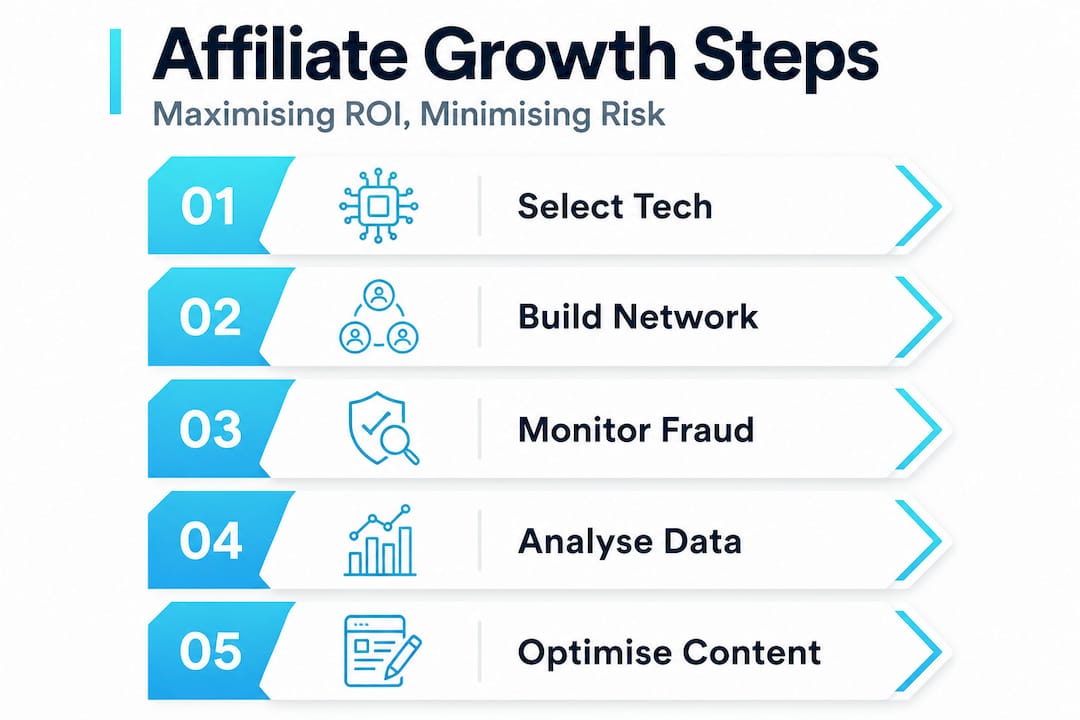
The clearest insight from working across e-commerce and entertainment brands is that fraud and compliance issues require active controls and measurement. If you are optimising your affiliate programme without first validating the quality of the data feeding your decisions, you are optimising against noise.
Here is a practical framework for reducing your exposure:
-
Vet affiliates before onboarding. Review their content quality, audience authenticity, and historical performance data. Look for affiliates whose traffic sources align with your customer profile. Do not simply accept every application to a programme.
-
Implement multi-touch attribution. Last-click attribution systematically over-rewards affiliates who intercept customers at the point of purchase rather than those who drove discovery. Multi-touch models give a fairer picture of where value is genuinely being created.
-
Use third-party fraud detection tools. Platforms such as CHEQ, ClickCease, and Fraudlogix integrate directly with affiliate networks and flag suspicious traffic patterns in near-real time. Budget for these tools as a standard line item.
-
Set clear programme policies. Your affiliate agreement should explicitly prohibit cookie stuffing, coupon scraping, incentivised clicks, and misleading advertising. Policies without enforcement are useless; make sure your terms allow you to withhold commissions for policy violations.
-
Conduct regular programme audits. At minimum, review affiliate performance monthly. Look for traffic volume spikes that are not accompanied by proportional conversion improvements, which is one of the clearest signs of bot activity.
-
Segment your affiliate cohorts. Group affiliates by type, channel, and performance tier. This makes anomalies far easier to spot and enables more targeted interventions when something looks off.
-
Create a clear escalation process. When fraud is detected, you need a documented process for suspending affiliates, withholding payments, and reporting to your network. Ad hoc responses are slower and more expensive.
Pro Tip: Do not rely solely on your affiliate network's fraud reporting. Networks have a commercial interest in keeping affiliates active and generating volume. Independent verification using your own analytics and third-party tools gives you an unfiltered view.
Pair strong fraud controls with content hub engagement strategies that naturally attract high-quality affiliates. When your brand produces genuinely valuable content, you attract partners who care about their audience relationships, which tends to self-select for higher-quality traffic.
A well-run affiliate programme should deliver a clear return. But that clarity only comes when the data feeding your decisions is trustworthy.
Best practices for affiliate marketing in 2026
The affiliate marketing landscape in 2026 looks meaningfully different from five years ago. Increased platform regulation, greater consumer awareness of sponsored content, and the sophistication of fraud operations have all raised the bar for what it takes to run a sustainable programme. 67% of marketers now express serious concerns about fraud, and click bot fraud has risen by 33% since 2022. These numbers demand a more professional approach.
Here is what separates the brands winning with affiliate marketing right now from those wasting budget:
-
Prioritise compliance from day one. Advertising standards around disclosure have tightened significantly. Affiliates must clearly identify sponsored content, and brands are legally accountable if they fail to enforce this. Build compliance checks into your onboarding and regular review cycles.
-
Invest in creative quality. Affiliates who produce genuinely engaging, high-quality content consistently outperform those pushing low-effort promotional material. Supporting your top affiliates with branded assets, exclusive access, or co-created content pays dividends. Explore marketing innovation trends to understand which formats are capturing attention right now.
-
Leverage video for affiliate conversion. Video consistently converts at higher rates than static formats across e-commerce and entertainment categories. Well-produced advertising campaign videos and short-form social media video content that affiliates can use and adapt will meaningfully improve programme performance.
-
Focus on long-term partnerships over volume. A smaller number of highly aligned, high-performing affiliates will consistently outperform a sprawling network of low-quality partners. Invest in relationships, not just reach.
-
Review attribution models regularly. Technology and customer behaviour evolve continuously. What worked in attribution last year may be systematically misreporting value today. Build in quarterly attribution reviews as a standard operating procedure.
-
Build affiliate incentive structures around quality. Reward affiliates based on metrics that reflect genuine customer value: average order value, retention rate, or customer lifetime value, not just volume of conversions that can be gamed.
Pro Tip: Create a tiered affiliate programme with escalating benefits for affiliates who consistently deliver high-quality traffic. This creates positive selection pressure and motivates your best partners to prioritise your brand over competitors.
The brands that thrive with affiliate marketing in 2026 are those who treat it as a strategic channel requiring the same creative investment, measurement discipline, and relationship management as any other major marketing initiative.
Our perspective: Why disciplined affiliate management is everything
Here is the uncomfortable truth that most affiliate marketing guides sidestep. Many brands approach affiliate programmes as a cheap growth hack rather than a proper marketing channel, and they get exactly what they pay for.
We see it consistently. A brand launches an affiliate programme, onboards dozens of partners quickly, and enjoys a short-term conversion spike. Then the anomalies start appearing. Traffic volumes climb but revenue does not follow. Customers arrive via coupon codes but churn at twice the rate of organic acquisitions. Attribution reports look impressive, but margin analysis tells a different story. By the time the real picture emerges, significant budget has already been lost.
The brands that sustain genuine affiliate success approach it like any other serious marketing investment: with defined objectives, rigorous measurement, and genuine creative commitment. They schedule cross-team reviews that bring together marketing, finance, and tech to examine programme health holistically. They are not just asking "are we getting conversions?" but "are these the right customers, acquired at the right cost, with the right long-term value?"
Creative evolution is equally undervalued. Affiliate content that was working 12 months ago often loses relevance as audience tastes and platform algorithms shift. Investing in optimised video affiliate campaigns and refreshing creative assets regularly keeps the programme alive and competitive. The affiliates who stick with brands that provide this support are invariably the ones who deliver the best results.
Ultimately, disciplined affiliate management is not glamorous. It is iterative, sometimes tedious, and requires consistent attention. But that discipline is precisely what turns affiliate marketing from a budget drain into a genuine growth engine.
Make affiliate marketing work harder for your brand
If you are serious about affiliate-led growth, the quality of the content and creative assets supporting your programme makes an enormous difference. At Media Borne, we combine entertainment-first production with sharp commercial strategy to help brands build affiliate programmes that audiences actually respond to.

Whether it is through professional video production that gives your affiliates compelling content to work with, social selling strategies that integrate affiliate mechanics into live commerce, or 360° virtual reality content that creates genuinely immersive brand experiences, we help you build programmes that convert audiences rather than just reach them. If you want to explore how entertainment-led production can elevate your affiliate strategy and protect your ROI, get in touch to discuss a bespoke approach.
Frequently asked questions
What is the average commission rate in affiliate marketing?
Most affiliate programmes offer a commission between 5% and 10%, but rates vary considerably by industry, product type, and partner relationship.
How do brands identify affiliate fraud?
Regular data analysis, anomaly detection tools, and monitoring for unusual traffic spikes or conversion patterns are the most effective methods for identifying fraudulent affiliate activity early.
What are common mistakes in affiliate marketing?
Failing to update compliance policies, underestimating fraud risk, and relying on last-click attribution are the most prevalent errors, particularly given how easily bot-driven click fraud can distort programme data.
Does affiliate marketing still deliver ROI in 2026?
Yes, absolutely, provided brands actively manage fraud and invest in authentic partnerships where affiliates promote through performance-based tracked links tied to genuine customer actions rather than inflated metrics.
Recommended
- Boost brand growth: media production for marketing ROI
- Social Selling Video Production to Drive More Sales
- YouTube for brands: boost engagement and drive sales
- Social video marketing for brand engagement and ROI
- Growth Marketing for eCommerce – Driving Scalable ROI – Lind Creative
- Data-Driven Marketing Strategies Guide to Boost AOV - Affinsy Blog | Affinsy