
TL;DR:
- Viral content rapidly spreads because of emotional resonance, social currency, and platform mechanics. It generates exponential brand reach, attracts new audiences, and can improve long-term brand equity. To create viral content, brands should use psychological frameworks, platform-native formats, and integrate viral moments into broader marketing strategies.
Viral content is defined as any piece of media that audiences share so rapidly and widely that it generates exponential reach far beyond its original distribution. Understanding why viral content matters is not optional for marketing professionals in 2026. Brands that grasp the mechanics of content virality gain access to audience growth that paid media alone cannot replicate. Sprout Social, Brandwatch, and researcher Jonah Berger have each mapped the psychology and platform dynamics that separate content people share from content people scroll past. The difference is not luck. It is design.
How does viral content impact brand reach and audience growth?
Viral content moves brand exposure from thousands to millions of engagements through audience sharing rather than paid promotion. Sprout Social's 2026 guidance describes this as a compounding effect: each share opens a new network, and each new network generates further shares. The result is reach that grows geometrically, not linearly.

The practical difference is significant. A paid campaign delivers reach proportional to budget. Viral content delivers reach proportional to resonance. Shedd Aquarium in Chicago demonstrated this when a series of social posts about its penguins exploring the empty building during lockdown spread globally without a single pound of paid amplification. The posts generated millions of interactions and a surge in brand affinity that no ad spend could have manufactured at equivalent cost.
The benefits of viral content extend beyond impressions:
- New audience acquisition: Viral posts reach people who have never encountered the brand, building follower counts and email lists organically.
- Earned media value: Shares, reposts, and duets function as free distribution, reducing cost per impression dramatically.
- Social proof at scale: When millions of people engage with content, the engagement itself signals credibility to new viewers.
- Sales conversion: New-to-brand attention generated by viral moments converts to sales and loyal followers when content aligns with brand positioning.
One caution applies here. Viral moments are accelerators, not strategies. A single viral post cannot substitute for a consistent, platform-native content programme. The brands that benefit most from virality are those with an existing content infrastructure ready to capture and retain the influx of new attention.
Pro Tip: Set up a rapid-response content plan before you need it. When a post starts gaining traction, you have a narrow window to publish follow-up content that converts new viewers into followers.
What psychological drivers make content go viral?
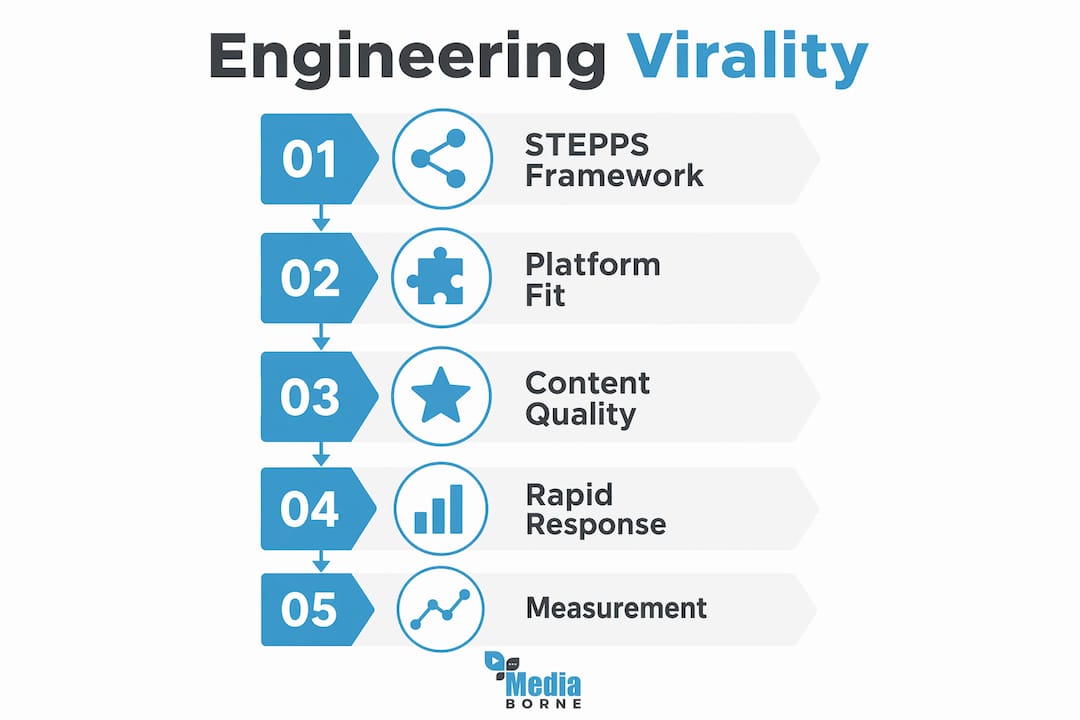
Virality results from the psychology of social transmission, making it a controllable design challenge rather than pure luck. Jonah Berger's STEPPS framework, discussed in detail on the APA podcast, identifies six factors that predict whether content spreads:
- Social Currency: People share content that makes them look good, knowledgeable, or interesting to their network.
- Triggers: Content linked to everyday cues gets recalled and shared repeatedly over time.
- Emotion: High-arousal emotional states drive sharing behaviour more reliably than neutral content.
- Public: Behaviour people can observe publicly is behaviour they imitate and amplify.
- Practical Value: Useful content gets shared because sharing it signals helpfulness.
- Stories: Narrative wrapping makes information more memorable and more shareable than raw facts.
Emotion is the most potent of these six factors. University of Arkansas research confirms that emotional arousal drives sharing, with mirth (genuine amusement) being one of the strongest positive triggers. The key distinction is that emotional experience matters more than message positivity alone. Content can be bittersweet, awe-inspiring, or even mildly uncomfortable and still generate high share rates, provided the emotional intensity is sufficient.
"High-arousal emotions accelerate sharing, but valence and context also matter. Mirth increases engagement, while political framing can reduce share rates due to social risk perception." — Walton College, University of Arkansas
Political or divisive content presents a specific risk. Audiences perceive social risk in sharing content that could alienate their networks. Research from Walton College recommends A/B testing emotional direction to manage this risk before publishing at scale. A/B testing emotional framing is one of the most underused tools in content production.
Pro Tip: Before publishing, identify which STEPPS factor your content activates most strongly. If you cannot name at least two, rework the concept.
How can marketers engineer viral content rather than wait for it?
Virality is a design challenge, and the STEPPS framework functions as a pre-publication checklist. Run every piece of content through it before it goes live. Ask whether the content gives the audience social currency, whether it connects to a recognisable trigger, and whether the emotional charge is high enough to motivate action.
Platform mechanics matter as much as content quality. Brandwatch emphasises that platform-native formats reduce friction and increase participation. TikTok duets, Instagram Story reposts, and YouTube Shorts replies all create structural incentives for audiences to engage and redistribute content. A video optimised for TikTok's duet mechanic is structurally more likely to spread than the same video posted as a static upload.
The comparison below shows how format choice affects viral potential:
| Format | Sharing mechanic | Viral friction |
|---|---|---|
| TikTok duet | Built-in participation tool | Very low |
| Instagram Story repost | One-tap redistribution | Low |
| YouTube Shorts | Algorithm-driven discovery | Low to medium |
| Long-form blog post | Manual link sharing | High |
| Static image post | Save and repost | Medium |
Beyond format, three practical factors separate engineered viral content from accidental hits:
- Clear share reason: Audiences need an obvious reason to share. "This is funny" or "This is useful" must be immediately apparent, not buried in the content.
- Visible branding without dominance: Brand presence must be clear enough to attribute the content, but not so heavy that it feels like an advert. Audiences do not share adverts; they share experiences.
- Cultural hooks and trendjacking: Attaching content to a current cultural moment, trending audio, or platform challenge dramatically increases discovery. Sprout Social's guidance on viral marketing strategy highlights trendjacking as one of the fastest routes to earned reach.
The brands that consistently produce shareable content treat virality as a repeatable process. They study what worked, identify which STEPPS factor drove the result, and build the next piece of content with that factor amplified.
Does viral content deliver long-term brand impact?
Viral content builds brand equity over years, not just days. Research from Dentsu, Kantar, and Lumen published in 2026 shows that video advertising, including viral short-form formats, can contribute to brand spend uplift of 1%–5% over three years from a single campaign. That figure represents sustained commercial return from a one-time creative investment.
Short-form and digital video formats are the primary vehicles for this long-term effect. Audiences who encounter a brand through a viral video carry a memory trace of that brand into future purchase decisions. The initial impression compounds over time as the brand appears in other contexts. This is why digital video drives multi-year equity gains rather than a single-period sales spike.
"Underinvestment in video for brand building creates a significant opportunity gap for brands that rely solely on performance marketing." — Dentsu/Kantar/Lumen, 2026
The caveat is alignment. Viral attention that does not connect to brand positioning generates impressions without commercial value. A brand known for professional software that goes viral for an unrelated comedy sketch gains reach but not relevance. The importance of viral content lies in its ability to attract the right audience, not just any audience.
Brands must also measure beyond share counts. Conversion rate from viral traffic, follower retention after a viral moment, and brand search volume uplift are the metrics that reveal whether virality is generating genuine commercial impact. Shares alone are vanity. Shares that convert are strategy.
Key takeaways
Viral content is a design challenge governed by psychology, platform mechanics, and emotional resonance. Brands that treat it as such generate compounding reach, long-term brand equity, and measurable commercial returns.
| Point | Details |
|---|---|
| Virality is engineered, not accidental | Apply Berger's STEPPS framework as a pre-publication checklist for every piece of content. |
| Emotion drives sharing | High-arousal emotions like mirth increase share rates; political framing reduces them due to social risk. |
| Platform format determines friction | TikTok duets and Instagram Story reposts structurally lower barriers to sharing and increase reach. |
| Long-term brand value is real | Dentsu/Kantar/Lumen research shows viral video can deliver 1%–5% brand spend uplift over three years. |
| Viral moments need a strategy behind them | Integrate viral content into a broader social programme to convert attention into followers and sales. |
Viral content is an accelerator, not a magic trick
I have worked with brands that treated a single viral post as proof their content strategy was working. It rarely was. What they had was a lucky moment, and without the infrastructure to capture it, the spike in attention disappeared within 72 hours. The followers did not stick. The sales did not follow. The brand was back to baseline within a week.
The brands I have seen genuinely benefit from virality share one characteristic: they were ready. They had a content calendar, a follow-up plan, and a clear brand voice that new audiences could immediately understand. When the viral moment arrived, it fed into a system designed to retain and convert.
The other mistake I see constantly is measuring virality by shares alone. Shares feel good. They are visible, countable, and easy to screenshot for a board presentation. But a post with 500,000 shares and zero conversion is a creative success and a commercial failure. The metric that matters is what happens after the share. Did those new viewers follow the account? Did they visit the website? Did they buy?
Platform evolution also changes the calculus regularly. TikTok's algorithm in 2026 rewards watch time and completion rate as much as shares. Instagram's Reels distribution favours saves. YouTube Shorts prioritises click-through to longer content. Creators who understand these mechanics build content that works with the platform, not against it. That is where the short-form video guide for 2026 becomes genuinely useful, not as theory, but as a practical map of where the platforms are heading.
Viral content matters. But it matters most when it is part of something bigger.
— Stephen
How Media borne's video production supports viral growth
Creating content with genuine viral potential requires more than a good idea. Production quality, format precision, and platform-native editing all determine whether content spreads or stalls. Media borne specialises in professional video production built specifically for brands that want to grow through entertainment rather than interruption. From short-form social content to full campaign production, the team combines creative direction with platform knowledge to give content the best possible chance of reaching the audiences that matter. If you are a marketer or content creator looking to build a content programme with real viral potential, Media borne's production services are worth exploring.
FAQ
What is content virality?
Content virality is the process by which audiences share a piece of media so widely and rapidly that it reaches far beyond its original distribution. It is driven by emotional resonance, social currency, and platform mechanics rather than paid promotion.
Why does viral content matter for brands?
Viral content generates exponential reach and new-to-brand attention at a fraction of the cost of paid media. Sprout Social's research shows it accelerates audience growth and can convert into measurable sales uplift when integrated into a broader marketing strategy.
What makes content go viral?
Jonah Berger's STEPPS framework identifies six drivers: Social Currency, Triggers, Emotion, Public, Practical Value, and Stories. High-arousal emotions, particularly mirth, are the strongest predictors of sharing behaviour.
How long does the impact of viral content last?
Dentsu, Kantar, and Lumen research published in 2026 shows that viral video exposure can deliver brand spend uplift of 1%–5% over three years. The effect compounds as audiences encounter the brand in additional contexts after the initial viral moment.
Should viral content replace paid media?
Viral content should complement paid media, not replace it. Sprout Social's guidance confirms that viral moments are accelerators within an integrated social strategy, not standalone substitutes for consistent, scalable content programmes.