
TL;DR:
- Retail innovation encompasses strategies that deliver measurable value across customer experience, operations, and business models, not just new technologies. Successful programs focus on customer needs, avoid shiny object syndrome, and incorporate clear piloting, measurement, and scaling processes. Building strong creator communities and content quality further enhances retail success in a data-driven, customer-centered approach.
Retail innovation gets misunderstood more than almost any other business discipline. Marketing professionals in retail brands are told to "innovate or die," then handed a budget and pointed towards the shiniest tech on offer. The result is predictable: expensive pilots that solve no real problem, customer journeys that get more complicated rather than better, and boards asking why the ROI never materialised. The truth is that retail innovation in 2026 means any strategy that delivers measurable shopper value across customer experience, operations, and business models. Not just a new app. This guide breaks down exactly how to do it properly.
Table of Contents
- What is retail innovation and why does it matter?
- Reimagining the role of physical stores in the AI era
- Building a high-impact social commerce strategy
- Leveraging creator communities for co-created retail innovation
- Pilot, measure, and scale: a practical roadmap for retail innovation
- Why treating innovation as a customer-centred, data-driven journey beats chasing technology fads
- Support your retail innovation with professional video production services
- Frequently asked questions
Key Takeaways
| Point | Details |
|---|---|
| Broad definition | Retail innovation includes improving customer experience, operations, business models, and products, not just technology. |
| Store mission clarity | Defining each store’s role (convenience, discovery, social) with aligned technology is key for evolving retail success. |
| Social commerce structure | Effective social commerce requires program design, incentive alignment, attribution clarity, and continuous optimisation. |
| Community co-creation | Structured customer communities with consistent feedback loops drive authentic innovation and engagement. |
| Pilot to scale | Start with clear problems and KPIs, pilot in limited scope, and scale systematically for sustainable innovation. |
What is retail innovation and why does it matter?
Retail innovation is not a synonym for technology adoption. That distinction sounds obvious until you watch a retailer install digital kiosks nobody uses while their returns process still takes three weeks. Real innovation touches four distinct areas, and the strongest programmes work across all of them.
The four pillars of retail innovation:
- Customer-facing innovation: New ways to attract, convert, and retain shoppers. Think live social selling, personalised recommendations, and experience-led store formats.
- Operational innovation: Changes to fulfilment, inventory, staffing, or supply chain that reduce cost or improve speed. These often have the fastest measurable payback.
- Business model innovation: Rethinking how revenue is generated. Subscriptions, resale programmes, and creator affiliate structures all qualify.
- Product and service innovation: New offerings built from customer feedback loops, co-creation programmes, or emerging category insights.
Innovation also exists on a spectrum. Incremental innovation improves what you already do, such as faster checkout. Adjacent innovation takes an existing strength into a new context, like a loyalty programme that powers a creator community. Transformative innovation redefines how the business works entirely.
The challenge for most marketing teams is avoiding what practitioners call "shiny object syndrome." That is where a new retail technology trend lands in a trade publication and suddenly becomes a budget priority without any defined problem it is solving. The media production trends shaping content marketing share this exact same trap. The antidote is always the same: start with the customer problem, not the technology solution.
Reimagining the role of physical stores in the AI era
The data on store visits is clear. Consumers go less often, but they expect significantly more when they do. That shift changes what a physical store should actually be. A store that tries to compete with e-commerce on convenience alone will lose. But a store that delivers genuine discovery, community, or speed where digital falls short? That remains extremely difficult to replace.
Stores are evolving into distinct mission formats: convenience hubs focused on frictionless replenishment, discovery flagships designed for exploration and experience, and social connection nodes that build community around a brand. These are not aesthetic choices. They determine staffing models, layout priorities, technology investment, and how success gets measured.
What each store mission actually requires:
- Convenience hub: AI-powered inventory accuracy, minimal queuing, fast fulfilment options, and mobile checkout. Staff focus on problem resolution, not product education.
- Discovery flagship: Dedicated space for brand storytelling, product demonstrations, and sensory experiences that cannot be replicated online. Staff are product experts and brand ambassadors.
- Social connection node: Scheduled events, community programming, creator meet-ups, and content creation facilities built into the physical environment.
AI in retail now enables genuine personalisation at store level. Predictive inventory tools can adjust stock based on local demand signals. AI scheduling software matches staffing levels to footfall patterns in real time. And AI in retail media allows marketing teams to serve contextual content to shoppers both inside and outside the store, closing the loop between physical and digital.
Pro Tip: Before investing in any in-store technology, define your store's primary mission in a single sentence. If a piece of technology does not directly serve that mission, it belongs in a different store format or not at all.
Hybrid digital-physical journeys are no longer optional. A customer who researches on TikTok, tries in store, and buys on mobile is now the norm, not the exception. The stores that thrive are those built to serve that exact journey rather than compete against parts of it.
Building a high-impact social commerce strategy
Social commerce is often conflated with influencer marketing. They are related but fundamentally different disciplines. Influencer marketing buys reach and brand awareness. Social commerce builds a performance system where social platform attention converts directly to revenue. That distinction matters enormously when you are accountable for marketing ROI.
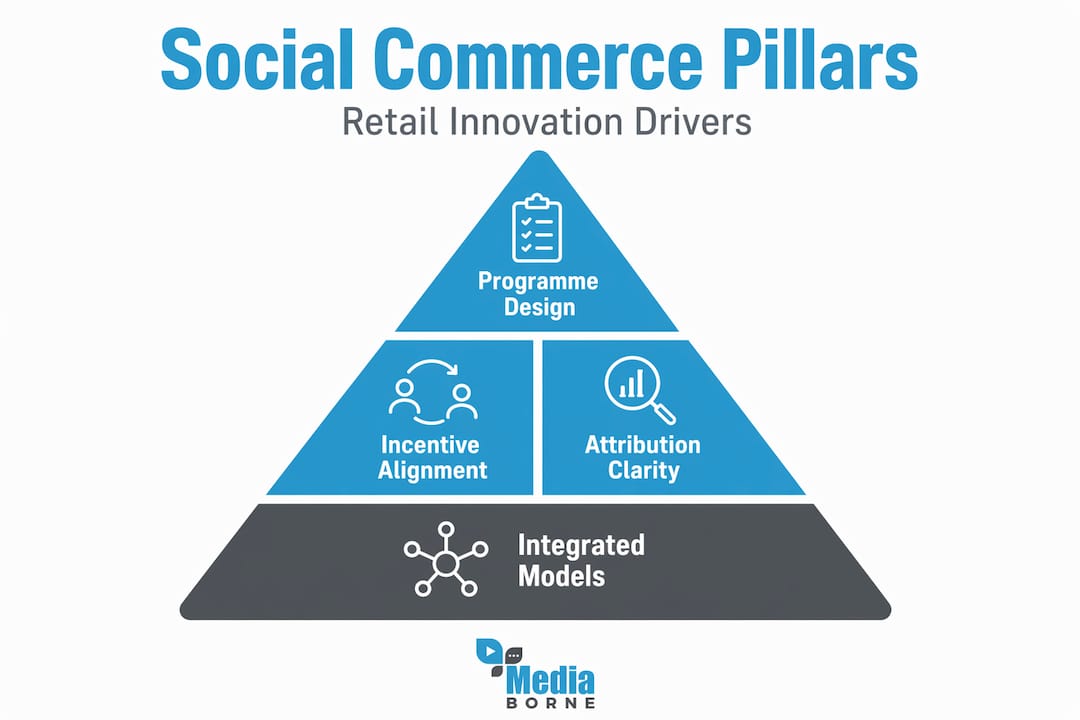
A social commerce strategy built for results rests on four pillars: programme design, incentive alignment, attribution clarity, and continuous optimisation.
| Dimension | Traditional influencer marketing | Social commerce |
|---|---|---|
| Primary goal | Brand awareness and reach | Direct revenue and conversion |
| Success metric | Impressions and engagement rate | Sales, revenue, and ROAS |
| Creator relationship | Campaign-by-campaign | Ongoing affiliate or partnership |
| Attribution model | Last-click or estimated | AI-powered multi-touch |
| Budget scaling | Fixed campaign spend | Scales with performance |
The four pillars in practice:
- Programme design: Map your entire creator tier structure, from micro-creators with niche engaged audiences to mid-tier partners with broader reach. Each tier needs a distinct brief and content format.
- Incentive alignment: Commission structures should reward the behaviours that actually drive sales, not just clicks. Tiered commissions that increase with revenue performance align creator motivation with brand goals.
- Attribution clarity: Last-click attribution systematically undervalues top-of-funnel social content. AI-powered attribution models assign partial credit across all touchpoints, giving a far more accurate picture of what is actually driving purchases.
- Continuous optimisation: Treat social commerce like a paid media channel. Weekly performance reviews, A/B testing of content formats, and rapid reallocation of spend towards what is working.
Pro Tip: Before launching a social commerce programme, audit your social media strategy to ensure your content infrastructure can support consistent creator briefs and rapid content turnaround. Weak content pipelines are the most common reason social commerce programmes underperform.
Blending multiple social commerce models covers gaps that a single approach misses. Affiliate creators handle discovery and consideration. Live selling events convert warm audiences. Shoppable short-form video supports both. A well-structured social video workflow makes that blended approach operationally viable rather than chaotic.
Leveraging creator communities for co-created retail innovation
The most underused asset in retail marketing is not a new technology. It is the existing customer base. Brands that build structured communities around their most engaged customers unlock a feedback loop that accelerates both product development and marketing effectiveness at minimal cost.
Heaven Mayhem's approach is a strong blueprint. Their community programme is built on monthly concept calls, in-person events, and direct customer input into product and launch decisions. The result is content that feels genuinely authentic because it is, and a customer segment that markets the brand voluntarily because they feel genuinely involved.
Aerie's creator community took a different but equally instructive approach. By banning AI-generated content from their programme outright, they signalled clearly what the community stood for: real people, real bodies, real stories. That single rule attracted over 12,000 members and drove measurable lifts in both brand awareness and engagement.
How to build a co-creation community that delivers results:
- Define the community's purpose explicitly. Is it product feedback? Content generation? Brand advocacy? Ambiguity kills participation.
- Create a recurring engagement calendar. Monthly calls, quarterly events, and seasonal input moments give members genuine reasons to stay active.
- Establish clear content guidelines. Rules like Aerie's no-AI policy do not reduce participation. They increase it by clarifying what the community values.
- Build two-way feedback mechanisms. Community members who see their input reflected in actual products become long-term advocates. Show your working.
- Track the right KPIs. Brand awareness lift, engagement rate, post reach, and net promoter score are all more meaningful than follower count.
The creator economy rewards brands who treat creators as collaborators rather than distribution channels. That shift in mindset from "content supplier" to "co-creator" is what separates communities that compound over time from campaigns that spike and fade.
Pilot, measure, and scale: a practical roadmap for retail innovation
The most common failure mode in retail innovation is not bad ideas. It is good ideas poorly executed because the team skipped the discipline of structured piloting. A framework that consistently works across both digital and physical retail follows a clear sequence.
Step-by-step roadmap:
- Choose a specific problem, not a technology. Identify a concrete pain point in the customer journey or a measurable operational inefficiency. The problem should be specific enough that you will know when it is solved.
- Define KPIs before you start. Defining clear KPIs upfront and piloting narrowly before scaling is what separates retail brands who outperform from those who chase every trend. Agree on two or three metrics that will determine success or failure.
- Pilot in the narrowest viable scope. One store, one social channel, one customer segment. Narrow pilots give clean data. Broad rollouts give noisy data you cannot act on.
- Measure rigorously and without bias. Build your measurement framework before the pilot begins. Retrofitting measurement after the fact almost always produces the answer the team was hoping for rather than the truth.
- Scale with documented procedures. Successful pilots often fail at scale because the institutional knowledge that made the pilot work never gets written down. Standard operating procedures and system integrations are not bureaucracy. They are the difference between a one-store success and a network-wide transformation.
Common pitfalls to avoid:
- Scaling before statistical significance is reached in the pilot
- Measuring outputs (activities) rather than outcomes (results)
- Ignoring frontline staff feedback during pilots
- Treating technology vendors' case studies as evidence your implementation will achieve the same results
Pro Tip: Set a formal "kill threshold" before every pilot. Define in advance the minimum result that justifies continued investment. This removes the emotional pressure to declare a failing pilot a success, which is the single most expensive mistake in retail innovation.
The marketing ROI discipline that applies to content and production applies equally to innovation investment. The process is the same: clear hypothesis, clean measurement, honest evaluation.
Why treating innovation as a customer-centred, data-driven journey beats chasing technology fads
Here is the uncomfortable truth most retail consultants will not say out loud: the majority of retail technology investments in the last five years failed to deliver the projected returns. Not because the technology was bad, but because it was acquired before the problem was properly defined.
Treating AI and digital upgrades as add-ons rather than core to reimagining store roles and operating models is the biggest risk facing retailers today. The brands winning right now are not the ones with the most technology. They are the ones with the clearest understanding of what their customers actually need and the discipline to test their way towards delivering it.
Retailers who pilot narrowly and scale proven innovations systematically outperform those chasing every new capability. The competitive advantage is not in adopting technology faster. It is in building the organisational muscle to evaluate, test, and scale more accurately.
The role of creative quality in this picture is consistently underestimated. A social commerce programme with precise attribution and a compelling incentive structure still fails if the content is weak. A co-creation community with a brilliant structure produces nothing if the brand cannot create assets worthy of that community's attention. Media production insights consistently show that production quality directly correlates with content performance across social platforms.
Our view at Media Borne is that retail innovation is ultimately a creative and commercial discipline simultaneously. The teams who win are those who bring data rigour and creative ambition to the same table rather than treating them as separate functions. That combination, not any single technology, is what defines the future of shopping for brands who want to lead rather than follow.
Support your retail innovation with professional video production services
The strategies covered in this article all share one dependency: content quality. Social commerce converts when the video is compelling. Creator communities generate value when the brand assets they work with are genuinely worth sharing.
At Media Borne, we produce social selling video content built specifically for retail brands executing social commerce strategies across TikTok, Instagram, and YouTube. Our professional video production team combines editorial expertise with commercial intent, ensuring every piece of content earns attention and drives measurable outcomes. Whether you are activating a creator community, launching a live selling event, or building a library of shoppable content, Media Borne brings the production capability and marketing strategy together in one place.
Frequently asked questions
What exactly counts as retail innovation beyond new technology?
Retail innovation covers any strategy that delivers measurable shopper value, including improvements to customer experience, operations, business models, and products, not just the adoption of new tools or platforms.
How can stores remain relevant as AI changes shopping behaviour?
Stores stay relevant by defining a clear mission, whether convenience, discovery, or community, and using AI to personalise every aspect of that experience rather than applying technology without strategic intent.
What makes social commerce more effective than traditional influencer marketing?
Social commerce directly links social interactions to revenue through performance-based incentives and advanced attribution, whereas influencer marketing typically measures success by reach and engagement without a direct connection to sales.
How do retail brands successfully build and leverage creator communities?
By establishing structured monthly engagement through calls, events, and product input sessions, combined with clear content guidelines, brands transform engaged customers into co-creators who drive authentic marketing and product development simultaneously.
What is the recommended process for piloting and scaling retail innovations?
Start by defining the problem and success KPIs clearly, pilot in a single channel or store, measure rigorously, then scale only what demonstrates proven results by documenting procedures before broader rollout.