

TL;DR:
- Creating engaging content depends on audience understanding, smart formatting, and disciplined iteration. Responding quickly to early comments and using compelling hooks significantly boost reach and interaction. Focusing on saves, shares, and thoughtful comments provides deeper insights into content effectiveness and community building.
You post consistently, you use the right hashtags, you even spend hours on production. Yet the comments section sits empty and shares stay stubbornly low. Knowing how to create engaging content is not a talent reserved for a lucky few creators. It is a repeatable craft built on audience understanding, smart formatting, and disciplined iteration. This guide unpacks every layer of that craft, from building your content foundation to measuring what actually moves the needle, so you can stop guessing and start producing work that earns genuine attention.
Table of Contents
- Key takeaways
- How to create engaging content: the foundation
- Crafting content that actually stops the scroll
- Execution: series, batching, and interaction
- Measuring what actually matters
- Common pitfalls that kill engagement
- My honest take on what actually works
- How Mediaborne can help you create content that performs
- FAQ
Key takeaways
| Point | Details |
|---|---|
| Start with audience clarity | Define your audience by their problems and desires, not just age or job title, before writing a single word. |
| Build content pillars first | Organise your output around three to four themes to signal expertise and make planning far easier. |
| Hooks decide everything | The first line or frame of any post carries more weight than the rest of the content combined. |
| Engagement quality beats quantity | Saves and meaningful comments signal far more to algorithms than a flood of emoji reactions. |
| Respond in the golden window | Replying to early comments within 30 to 60 minutes is one of the highest-leverage actions available to any creator. |
How to create engaging content: the foundation
Before you write a single word or record a single frame, you need to know who you are speaking to and why. Skipping this step is why so many creators post daily and still see flat results. The content exists but the connection does not.
Start by defining your audience around their problems, desires, and daily context rather than generic demographics like age or location. A 35-year-old marketing manager in Manchester and a 35-year-old marketing manager in Singapore may share a job title but face entirely different pressures, platforms, and expectations. Get specific about the friction your audience experiences and the outcomes they are reaching for.
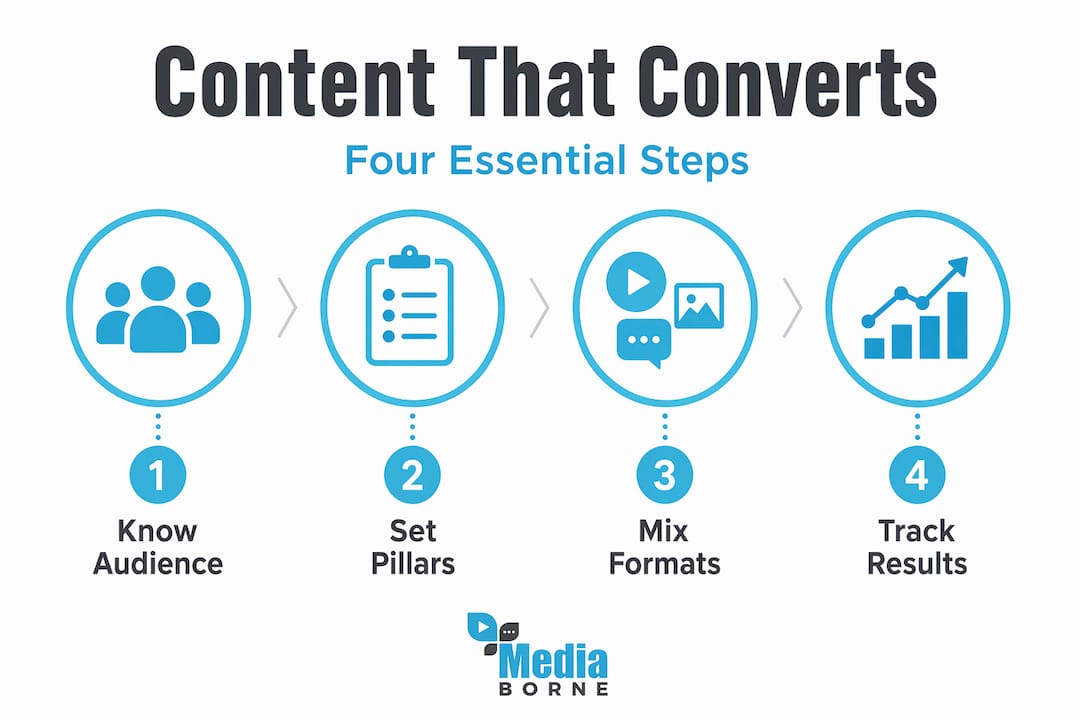
Once you know your audience, build content pillars to organise your output. Three to four recurring themes work best. A typical set might include authority content (expertise and insight), connection content (stories and values), and proof content (results, testimonials, and case studies). These pillars stop your feed from feeling random and train your audience to anticipate value in a predictable category. A consistent publishing rhythm, such as posting Tuesday through Thursday, also helps the algorithm and your audience learn when to expect you, which materially improves engagement over sporadic posting.
Set measurable objectives before each campaign or content sprint. Vague goals like "grow my following" produce vague strategies. Specific goals like "increase post saves by 20% in 60 days" give you something to test against and learn from.
Here is what a functional content planning table looks like in practice:
| Content pillar | Format | Posting frequency | Primary metric |
|---|---|---|---|
| Authority and insight | Carousel, long-form post | 2x per week | Saves and shares |
| Connection and story | Short video, text post | 1x per week | Comments and DMs |
| Proof and social validation | Case study, testimonial clip | 1x per week | Profile visits and clicks |
Finally, build a format mix that serves your audience across different mindsets. Some people read on their commute. Others watch during lunch. A sustainable schedule that covers two to three formats keeps you relevant across contexts without burning you out.
Crafting content that actually stops the scroll
The hook is everything. Whether you are writing a LinkedIn post or scripting a TikTok, the first line or frame will determine whether anyone sees the rest. Strong hooks fall into three categories: they promise specific value, they challenge a common belief, or they open an information gap that the reader needs to close. "Three reasons your content gets ignored despite being good" does all three at once.
Here is a practical sequence for crafting compelling content once your hook lands:
- Open an information gap. Introduce a tension or question in your first two sentences. Creating an information gap with a cliffhanger or partial reveal significantly increases completion rates by motivating continued consumption.
- Use a narrative arc. Set up the problem, deliver the reveal or insight, then close with a clear takeaway. Even a 200-word LinkedIn post benefits from this three-part structure.
- Match the format to the platform. Carousels perform particularly well on Instagram because the swipe mechanic extends dwell time. Text-first posts often outperform images on LinkedIn. Platform-specific adaptation consistently outperforms generic cross-posting, so adapt every piece rather than duplicating it verbatim.
- Keep headlines tight. Research shows that headlines between 10 and 20 words maximise audience interaction. Longer than that and attention fractures before the content even begins.
- Design visuals for context. Use concise text overlays, maintain consistent brand colours and fonts, and always consider accessibility. Captions on video are not optional; they are the difference between someone watching in a quiet room and someone scrolling silently on the Tube.
Pro Tip: Never cross-post identical content across platforms. A caption written for Instagram reads as clunky on LinkedIn and invisible on TikTok. Adapt the core message to each platform's native tone and format, even if it takes an extra 15 minutes per piece.
For video specifically, the outdoor storytelling and action videography techniques you choose can be the difference between content that feels alive and content that feels produced for a brochure. Motion, perspective, and pacing are the storytelling elements that text simply cannot replicate.
Execution: series, batching, and interaction
One of the clearest differences between creators who grow and creators who plateau is how they think about individual posts versus content series. Successful creators treat their content as a repeatable series, conditioning their audience to anticipate value rather than banking on one-off viral hits. A weekly "Myth Busted Monday" or a monthly "Behind the Numbers" series builds anticipation and dramatically reduces the creative friction of staring at a blank screen each week.

Batching your content production is the operational practice that makes series sustainable. Rather than creating posts one at a time on the day they go live, block two to three hours once a week to produce a week's worth of content in one session. You will find creative momentum builds across a batch session in ways that isolated production never allows.
Key habits that separate consistent, high-performing creators from those who burn out:
- Map the week in advance. Assign each post day a content pillar and a format before the week begins. Remove the daily decision.
- Produce before you publish. A minimum two-day buffer between creation and publishing gives you editing distance and flexibility when life intervenes.
- Respond to early comments quickly. Failing to respond within 30 to 60 minutes of publishing reduces post reach because algorithms interpret silence as low-quality content.
- Include at least one interactive element per post. A poll, a direct question, or a "tell me your answer in the comments" prompt invites participation rather than passive consumption. Top-performing brands include at least one interactive element per post and reply to every comment within an hour.
Pro Tip: Set a phone reminder for 30 minutes after you publish. Use that window exclusively to reply to every comment that has come in. This single habit can transform your algorithmic reach more reliably than any posting frequency increase.
Also consider your social video engagement strategy across platforms. Short-form video carries its own rhythm and its own interactive conventions. Responding to comments with video replies on TikTok, for example, creates content and demonstrates community at the same time.
Measuring what actually matters
Most creators look at likes and follower counts and call it analysis. That is like judging a restaurant by how many people walked past the window rather than how many booked a table. The metrics that genuinely indicate engagement quality are saves, shares, comments, direct messages, and dwell time.
Saves deserve particular attention. A save carries roughly five times the algorithmic weight of a like on most platforms because it signals that the audience found the content worth returning to. If your posts are being saved, you are producing reference-quality material. That is a meaningful signal that you are producing content people trust.
Here is how the most commonly tracked metrics stack up against each other in terms of depth of engagement signal:
| Metric | Engagement depth | What it signals |
|---|---|---|
| Like / reaction | Low | Passive approval |
| Comment (short) | Medium | Acknowledgement |
| Comment (thoughtful) | High | Genuine conversation |
| Share or repost | High | Audience endorsement |
| Save | Very high | Reference-quality content |
| DM or reply | Very high | Direct relationship |
Build a monthly review into your workflow. Pull the top five posts from the previous month and look for patterns: which pillar, which format, which hook type performed best? Then make one or two small changes to the next month's plan. Building an A/B testing workflow around hooks, formats, and calls to action allows you to isolate what works and improve steadily rather than guessing. Keep changes small and singular so you know what caused any shift in results.
On LinkedIn specifically, the median engagement rate on personal profiles sits at around 2.9%, with three or more meaningful comments per post indicating a healthy conversation. Use that as a benchmark rather than chasing arbitrary follower milestones.
Common pitfalls that kill engagement
Understanding how to drive engagement with content also means knowing what actively destroys it. Several habits are surprisingly common and consistently damaging.
- Overposting low-quality content. High-frequency, low-quality posting trains your audience to scroll past you, and that habit is hard to reverse even when your quality improves. Two excellent posts a week will outperform seven mediocre ones every time.
- Chasing viral tactics without a strategy. Trending audio and viral formats are tools, not strategies. Without a content pillar to anchor them, they attract an audience that has no reason to stay.
- Spreading across too many platforms without adapting. Each platform has distinct expectations. A post that performs brilliantly on Instagram may fall completely flat on X or LinkedIn if it has not been adapted to the platform's native tone and format.
- Vague calls to action. "Let me know your thoughts" is not a call to action. "Which of these two approaches do you use? Drop the number below" is. Specificity drives response.
Engagement grows when creators stop broadcasting and start conversing, treating their audience as people rather than metrics. The shift from monologue to dialogue is where real community begins.
Responding to comments is not an optional extra. Consistently replying to comments can increase engagement levels by up to 42% on platforms like Threads. That figure alone should reframe how you budget your time between creation and interaction.
My honest take on what actually works
Over the years, the single most consistent finding I have come across is that creators who obsess over virality rarely achieve it, while creators who obsess over usefulness often do. I have seen accounts with 800 followers generate more qualified leads than accounts with 80,000 because their content was precise, consistent, and built for a specific person rather than the broadest possible audience.
The content pillar framework genuinely changes everything for retention. In my experience, when a creator commits to three clear pillars and holds to them for 90 days, their most engaged audience members start to self-identify as fans of a specific type of content they produce. That kind of loyalty is worth far more than any single viral post.
I also think the industry vastly underestimates platform-specific optimisation. Most creators treat adaptation as a nice-to-have. I treat it as non-negotiable. The social media formats that drive results on one platform are genuinely different to those that work on another, and ignoring that distinction costs you reach every single day.
My advice on iteration: keep it boring. Change one variable per month, record the result, and move on. The creators I admire most do not have magical instincts. They have systematic habits.
— Stephen
How Mediaborne can help you create content that performs
Knowing the principles behind how to create engaging content is one thing. Executing them consistently at a quality level that actually converts is another. Mediaborne specialises in exactly that gap. From professional video production filmed and edited to platform specification, to social selling video content built to drive measurable commercial outcomes, Mediaborne helps brands and creators move from good intentions to content that earns attention and builds community. If you want to understand the wider picture of what is working in 2026, explore the engagement strategies and trends Mediaborne tracks across the platforms that matter most.
FAQ
What makes content engaging on social media?
Engaging content combines a strong hook, a clear narrative, and a specific call to action tailored to the platform. Saves, meaningful comments, and shares are the most reliable indicators that your content is genuinely resonating.
How often should you post to maximise engagement?
Quality and consistency matter more than frequency. A regular schedule of two to four platform-native posts per week outperforms daily low-quality posting, which can train audiences to scroll past your content over time.
What is the best time to respond to comments?
Respond within 30 to 60 minutes of publishing. This window is critical because algorithms interpret early interaction as a signal of content quality, which directly affects how widely your post is distributed.
How do you write engaging articles and posts for blogs?
Start with a hook that promises specific value or opens a question the reader needs answered. Use short paragraphs, concrete examples, and close with a clear and specific prompt for action or response.
Which metrics should content creators prioritise?
Focus on saves, shares, and meaningful comments over likes or follower counts. Saves in particular carry approximately five times the algorithmic weight of a like and indicate that your content is worth returning to.