
TL;DR:
- Long-term media assets are owned content files that generate value through reuse and strategic management. Implementing media asset management and a modular approach enhances searchability, reduces costs, and builds long-term brand authority. AI tools further unlock dormant content value, ensuring assets deliver sustained, compounding returns over time.
Long-term media assets are defined as owned content, footage, images, and digital files that continue to generate audience value and commercial return well beyond their original production date. The importance of long-term media assets lies in their ability to compound brand equity, reduce per-campaign costs, and create a foundation for consistent audience engagement that paid advertising alone cannot replicate. For marketing professionals and business owners, these assets represent the difference between renting attention and owning it. Platforms like YouTube, tools such as Cloudinary, and frameworks like Media Asset Management (MAM) all exist to help brands extract maximum value from content they have already created.
What are the key benefits of long-term media assets?
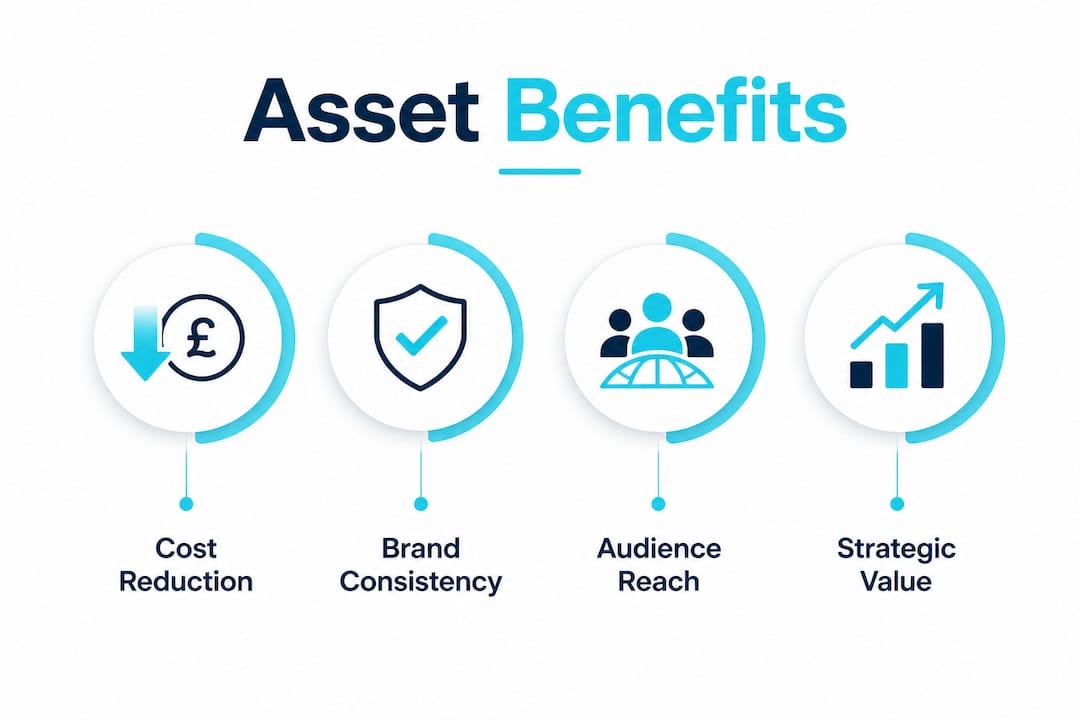
Long-term media assets deliver three measurable advantages: cost reduction, brand consistency, and sustained audience trust. Each benefit compounds over time, meaning the value of a well-managed asset library grows the longer you maintain it.

Cost reduction through reuse is the most immediate benefit. When assets are structured for reuse rather than single-campaign deployment, the marginal cost of producing new content variations falls sharply. Modular asset architecture reduces the cost of new content variations to near zero. That means a single shoot can fuel dozens of campaigns across multiple channels and markets.
Brand consistency is the second major gain. MAM systems improve brand consistency by ensuring teams always access approved, on-brand files rather than recreating assets from memory or outdated templates. Inconsistent branding erodes audience trust faster than most marketers realise.
Productivity gains are equally significant. Marketing teams spend 36 minutes daily searching for files on average. Across a team of ten, that is six hours of lost productivity every single day. Structured asset libraries eliminate that waste and redirect time toward creative work.
- Assets structured for reuse reduce marginal production costs to near zero
- Centralised libraries cut daily file-search time significantly
- Consistent brand assets build audience recognition and trust over time
- Reusable footage and templates accelerate multi-market campaign delivery
Pro Tip: Audit your existing content library before commissioning new shoots. You will often find 30–40% of what you need already exists in an untagged or poorly organised folder.
How does media asset management support long-term asset value?
Media Asset Management, or MAM, is the operational discipline of organising, tagging, and governing digital media files so they remain findable, usable, and legally compliant over time. Without MAM, even the most expensive content becomes invisible within months of production.
The core capabilities of a MAM system include metadata tagging, search functionality, version control, and access governance. Metadata tagging and automated workflows are what separate a functional asset library from a chaotic archive of campaign folders. When every file carries structured metadata, your team can find the right asset in seconds rather than minutes.
AI is accelerating this process dramatically. One global media company used AI-driven video intelligence to save approximately USD 10 million and compressed 40 analyst years of manual metadata work into a fraction of the time. That is not a marginal efficiency gain. It is a structural transformation in how media libraries generate value.
Licensing management is another area where MAM pays for itself. Assets without clear usage rights create legal exposure. A well-governed library tracks licence expiry dates, usage restrictions, and territorial rights automatically, removing a significant compliance risk from your marketing operation.
| MAM Capability | Business Benefit |
|---|---|
| Metadata tagging | Assets become searchable and reusable across teams |
| Access governance | Approved files reach the right people; outdated versions do not |
| Licence tracking | Reduces legal risk from expired or misused media rights |
| AI-driven discovery | Unlocks dormant content value without reshoot costs |
Pro Tip: Treat your MAM system as a living catalogue, not a storage drive. Schedule quarterly audits to tag new assets, archive obsolete ones, and update licence records.
What practical strategies improve asset longevity and reuse?
The most effective long-term content strategy is built on modular thinking. Rather than producing finished campaign files, you decompose deliverables into atomic components: individual shots, voiceover clips, graphic elements, and music beds. Each component carries its own metadata and can be reassembled into new formats without a reshoot.
Restructuring asset libraries around reusable components lets teams find assets 60% faster and accelerate campaign publishing by 40%. Those are not incremental improvements. They represent a fundamental shift in how quickly your marketing operation can respond to new opportunities.
AI retrofitting is the second major strategy. Legacy libraries often contain thousands of untagged files with significant latent value. AI tools can scan existing footage, generate descriptive metadata, and surface content that has been effectively invisible for years. AI retrofitting of legacy libraries dramatically increases asset discoverability without reshoot costs. For brands with years of accumulated content, this is often the fastest route to immediate ROI.
Multi-market adaptation is the third strategy. When assets are built modularly, producing localised versions for different regions or languages requires only the variable elements to change. The core footage, brand graphics, and music remain constant. This approach slashes the cost of international campaigns and maintains brand consistency across markets.
Common pitfalls to avoid:
- Storing assets as finished campaign files rather than reusable components
- Skipping metadata at the point of ingest, creating a backlog that compounds over time
- Failing to track licence expiry dates, which creates legal risk and forces unnecessary reshoots
- Treating the asset library as an archive rather than a production resource
Pro Tip: When briefing a production shoot, always ask for a "component delivery" alongside the finished edit. Request individual shots, isolated audio tracks, and layered graphic files. This single habit multiplies the long-term value of every production budget you spend.
How do long-term media assets create strategic advantages?
The strategic value of owned media assets extends well beyond operational efficiency. For brands and media companies alike, accumulated content becomes a competitive moat that is genuinely difficult for competitors to replicate.
Back catalogues illustrate this principle at scale. Netflix and Paramount bidding for back catalogues mirrors strategies used by 18th-century publishers, demonstrating that legacy content ownership shapes future entertainment landscapes. The principle applies equally to brand marketing. A library of high-quality, on-brand video content accumulated over five years is worth more than the sum of its production costs.
Attention economics reinforce this view. Attention to content accumulates over time, shifting value creation from peak campaign performance to lifetime yield. A single well-produced video published on YouTube in 2021 may still be generating search traffic, brand awareness, and conversions in 2026. Short-term campaign thinking ignores this compounding dynamic entirely.
Building a topical ecosystem amplifies the effect further. A topical ecosystem of interconnected assets establishes verifiable expertise and reduces dependence on short-term campaigns. When your brand owns a body of content that covers a subject comprehensively, search engines and audiences treat you as an authority. That authority is extraordinarily difficult to buy and takes years to build through paid media alone.
"Brands that treat their content library as a strategic asset rather than a cost centre consistently outperform those that view each campaign as a standalone investment."
The competitive advantages compound across three dimensions:
- Financial stability: Owned assets generate returns without ongoing media spend
- Brand authority: Accumulated content signals expertise and builds audience trust over time
- Operational speed: Teams with well-managed libraries launch campaigns faster than competitors starting from scratch
For brands working with platforms like TikTok and YouTube, this long-term thinking is particularly powerful. Content that earns organic reach today continues to surface in recommendations and search results for years, delivering value that no paid placement can match.
Key takeaways
Long-term media assets deliver compounding value through cost reduction, brand consistency, and audience authority that short-term campaign spending cannot replicate.
| Point | Details |
|---|---|
| Define assets for reuse | Structure content as modular components, not finished campaign files, to reduce future production costs. |
| Invest in MAM early | Metadata tagging and access governance keep assets findable, compliant, and commercially viable over time. |
| Use AI to unlock dormant value | AI retrofitting surfaces untagged legacy content, generating ROI without additional production spend. |
| Think in lifetime yield | Content accumulates attention over time; engineer assets for long-term return, not just campaign peaks. |
| Build a topical ecosystem | Interconnected assets across video, written, and interactive formats establish brand authority that compounds year on year. |
Why most brands are sitting on untapped asset value
I have worked with enough marketing teams to know that the most common problem is not a lack of content. It is a lack of organisation. Brands routinely commission expensive shoots, publish the finished edit, and then let the raw footage sit in a hard drive that nobody can find six months later. That is not a storage problem. It is a strategic failure.
The research backs this up. Teams losing 36 minutes daily to file searches are not inefficient by nature. They are operating without the systems that make efficiency possible. The fix is not complicated, but it does require committing to operational discipline before the next campaign brief lands on your desk.
What I find most compelling about the modular content approach is how it changes the economics of production entirely. When you brief a shoot with reuse in mind, you are not spending more money. You are spending the same money more intelligently. The cost of a single well-structured production day, with proper component delivery and metadata, can fuel 12 months of content across multiple channels.
The brands I see winning long-term are not necessarily the ones with the biggest budgets. They are the ones treating their content IP as a strategic asset rather than a line item. That shift in perspective changes everything about how you plan, produce, and manage media.
— Stephen
Build media assets that work harder for your brand
Media borne specialises in creating video content designed from the outset for long-term reuse and strategic brand growth. Every production is structured to deliver modular components alongside the finished edit, giving your team the raw material to fuel campaigns across TikTok, YouTube, and beyond for months after a single shoot.
Whether you are building a content library from scratch or looking to extract more value from existing footage, Media borne's approach combines production expertise with a clear understanding of media production ROI. The result is content that compounds in value rather than expiring with the campaign. Explore Media borne's professional video production services to start building assets that deliver returns well beyond their launch date.
FAQ
What are long-term media assets?
Long-term media assets are owned content files, including video, images, and audio, structured and managed to deliver commercial value well beyond their original campaign use. They differ from standard campaign content because they are built for reuse, searchability, and multi-channel adaptation.
How does media asset management improve ROI?
MAM systems reduce the time teams spend searching for files and eliminate the cost of recreating assets that already exist. Marketing teams lose an average of 36 minutes daily to file searches, and structured MAM eliminates that waste directly.
What is the modular content approach?
The modular content approach involves decomposing finished productions into atomic components, such as individual shots, isolated audio, and layered graphics, each tagged with metadata. Teams can then reassemble these components into new formats, finding assets 60% faster and publishing campaigns 40% more quickly.
Why do back catalogues have strategic value?
Back catalogues represent owned media that continues generating audience attention and commercial return without additional production spend. Major platforms like Netflix actively bid for legacy content because accumulated attention compounds over time, as the long tail of attention principle demonstrates.
How can AI help manage existing media libraries?
AI tools can scan legacy footage, generate descriptive metadata, and surface content that has been effectively invisible due to poor organisation. One global media company used AI video intelligence to save approximately USD 10 million and eliminate 40 analyst years of manual processing, unlocking significant dormant asset value.