
TL;DR:
- Behind-the-scenes content builds trust by revealing internal processes, decision-making, and team responsiveness to audiences. It significantly influences purchase likelihood when showcasing genuine operational moments rather than staged or polished footage. Effective BTS content requires careful planning, employee briefing, and platform-specific adaptation to authentically connect with viewers and reinforce brand value.
Behind-the-scenes content is defined as any material that reveals a brand's internal processes, people, and decision-making to an external audience. It is one of the most direct trust-building tools available to marketers today, and the research backs this up. A Harvard Business School study analysing 2 million WeChat messages found that visible internal coordination between employees correlates directly with customer trust and purchase likelihood. Platforms like TikTok and Instagram have made this format more accessible than ever, lowering production barriers while increasing the potential for genuine audience connection. The question is not whether to use it. The question is how to use it well.
Why behind-the-scenes content drives customer trust
The psychological mechanism behind BTS content is straightforward. When customers observe how a team operates internally, they form judgements about quality, reliability, and care. This is not a soft, anecdotal effect. Dennis Campbell's research at Harvard Business School demonstrates that internal team responsiveness is the single strongest trust signal a brand can make visible. Customers read how quickly employees respond to each other as a proxy for how the brand will treat them.

What makes this finding particularly useful for content creators and marketers is the specificity. Generic "meet the team" posts do not move the needle. What moves the needle is footage that shows real coordination: a product manager responding to a quality concern in real time, a customer service lead flagging an issue to the fulfilment team, or a designer iterating on feedback within a visible workflow. These moments communicate competence without a single scripted line.
The impact on purchase decisions is measurable. BTS content boosts perceived quality and purchase likelihood when it reveals genuine operational detail rather than polished highlights. For brands selling at a premium, this matters enormously. Showing craftsmanship, care, and the real cost of doing things properly reinforces value in a way that a price justification paragraph never could.
| Trust signal | Why it works |
|---|---|
| Internal responsiveness | Shows customers the team is attentive and coordinated |
| Real-time problem-solving | Demonstrates competence under pressure |
| Visible decision trade-offs | Signals honesty and transparency over perfection |
| Employee consistency | Builds familiarity and reduces perceived risk |
Pro Tip: Film the moments just before and after a key decision, not just the outcome. The deliberation is what audiences find credible.
What makes BTS content authentic and what to avoid
Authenticity in behind-the-scenes content requires more planning than most brands expect. Cristel Russell, a marketing expert cited by Marketing Brew, is direct on this point: using BTS content as a crisis communication tool is a terrible idea. Brands that reach for BTS footage when something goes wrong, hoping transparency will defuse the situation, almost always make things worse. The audience can tell the difference between a brand that has been open all along and one that has suddenly decided to show its workings under pressure.
Over-staging is the other major pitfall. There is a recognisable aesthetic to BTS content that has been too carefully art-directed: the perfectly lit "messy" desk, the too-relaxed employee who clearly rehearsed their lines, the "spontaneous" reaction that lands exactly on cue. Audiences on TikTok and Instagram are particularly attuned to this. When staged content is detected, the backlash is disproportionate to the offence because it feels like a deliberate deception rather than a production choice.
The solution is not to abandon planning. It is to plan the right things. Russell's guidance, supported by Marketing Brew's analysis, points to pre-briefing employees who appear in BTS content as a key differentiator. Brands that prepare their people without scripting them appear more genuine, not less. The goal is to give employees the context and confidence to be themselves on camera, not to hand them a script.
Key principles for authentic BTS content:
- Designate spokespeople who are comfortable on camera and genuinely knowledgeable about their area of the business.
- Control the narrative frame, not the footage itself. Decide what story you are telling before you start filming.
- Avoid crisis deployment. BTS content should be part of an ongoing strategy, not a reactive tool.
- Protect genuinely sensitive information. Transparency does not mean showing everything. It means showing the right things consistently.
Pro Tip: Build a short internal briefing document for any employee appearing in BTS content. Cover the brand's tone, the story being told, and what is off-limits. This takes 20 minutes and prevents most staged-content problems.
BTS content formats: which type works best?
Not all behind-the-scenes content performs equally, and the format you choose should match both your brand's operational reality and your audience's expectations. The table below outlines the most common BTS formats and their respective strengths.
| Format | Best for | Watch-out |
|---|---|---|
| Day-in-the-life | Building character and familiarity with team members | Can feel repetitive without narrative variety |
| Product creation footage | Justifying premium pricing and showing craftsmanship | Requires genuine production quality to land well |
| Problem-solving episodes | Demonstrating responsiveness and competence | Needs real stakes to feel credible |
| Decision trade-off content | Building deep trust with engaged audiences | Requires editorial confidence to execute |
One of the most underrated benefits of behind-the-scenes content is its community-building potential. Repeated appearances of the same team members across BTS content create character-driven communities rather than transactional customer bases. Audiences begin to follow individuals within a brand, not just the brand itself. This is the fandom dynamic that Media borne sees operating in entertainment, and it is entirely replicable in brand content when the format is consistent.
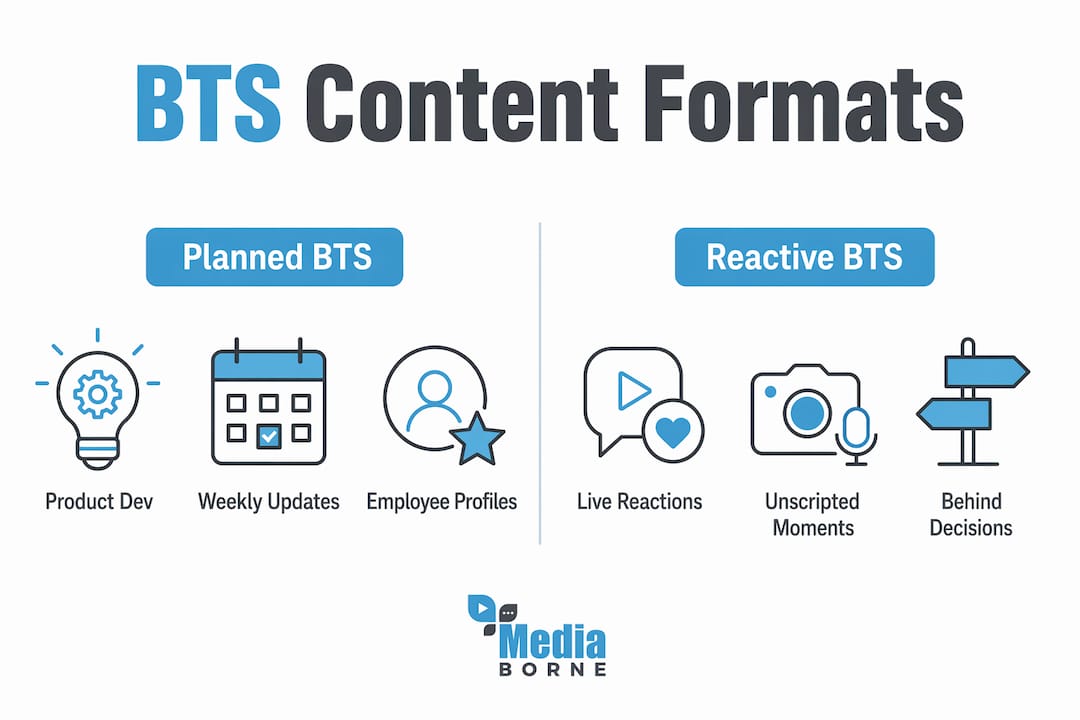
The contrast between planned and reactive BTS content is worth understanding. Planned BTS, such as a weekly product development update or a recurring "how we made this" series, builds audience habit and expectation. Reactive BTS, such as a spontaneous response to a trending moment or an unplanned behind-the-scenes clip, can generate spikes in reach. The most effective content strategies combine both: a planned backbone that builds loyalty, with reactive moments that extend reach.
How to create behind-the-scenes content that actually works
Effective BTS content is not a matter of pointing a camera at your office and hoping for the best. It requires a clear strategic framework aligned with the trust signals your audience actually responds to.
-
Map your trust signals first. Before filming anything, identify what your audience most needs to believe about your brand. Is it speed of delivery? Quality of materials? The expertise of your team? Your BTS content should make those specific things visible, not just show general busyness.
-
Brief your people properly. Any employee appearing in BTS footage should understand the brand's tone, the story being told, and what is off-limits. This is not about scripting. It is about giving people the confidence to be genuine on camera. Pre-briefing employees is the single most effective way to avoid the staged-content trap.
-
Show feedback loops, not just finished products. Formats that reveal decision-making trade-offs and real reactions consistently outperform polished highlight reels. Film the moment a team member spots a problem and fixes it. That sequence communicates more trust than any product reveal.
-
Build BTS into your content calendar. One-off BTS posts do not build loyalty. Consistent formats, recurring characters, and regular posting rhythms are what increase discovery and engagement on TikTok and Instagram. Treat BTS as a content pillar, not a filler post.
-
Optimise for the platform. TikTok rewards raw, fast-paced footage with strong hooks in the first two seconds. Instagram Reels performs better with slightly more polished editing and clear visual identity. A single BTS clip can be repurposed across both, but the edit should be tailored to each platform's native expectations. A solid media production checklist will help you capture the right footage for multiple formats in a single shoot.
Pro Tip: Shoot more than you think you need. The best BTS moments are often the ones that happen between takes, not during them. Give yourself the raw material to find those moments in the edit.
Key takeaways
Behind-the-scenes content builds brand trust most effectively when it makes internal responsiveness and real decision-making visible, not when it simply shows a polished version of operations.
| Point | Details |
|---|---|
| Responsiveness is the core trust signal | Show how your team coordinates and responds internally, not just how they perform for the camera. |
| Authenticity requires planning | Pre-brief employees, control the narrative frame, and never deploy BTS as a crisis tool. |
| Repeated characters build community | Consistent team appearances create fandom dynamics that deepen loyalty beyond transactional relationships. |
| Format matters as much as content | Match your BTS format to your platform. TikTok and Instagram each reward different editing styles. |
| BTS supports premium pricing | Showing craftsmanship and care reinforces value proposition more credibly than copy alone. |
The uncomfortable truth about BTS content
I have worked with enough brands to know that most behind-the-scenes content fails not because of poor production, but because of poor intent. Brands reach for BTS when they want to appear relatable, not because they have something genuinely worth showing. The audience always senses the difference.
The research from Harvard Business School changed how I think about this. The finding that internal coordination speed drives trust more than surface communication reframed the entire brief for me. It means the question to ask before any BTS shoot is not "what looks good?" but "what do we actually do well that we can make visible?" Those are very different questions, and they produce very different content.
What I have observed in practice is that brands with genuinely strong operations tend to produce the best BTS content almost by accident. They film their team solving a problem, and it lands because the competence is real. Brands with weaker operations tend to over-stage, and it shows. The implication is that BTS content is, in a sense, a mirror. It reflects what is actually there.
The other thing I would push back on is the idea that BTS content is low-effort. Planoly's analysis confirms it earns high watch-through rates, but that does not mean it is easy to produce well. The best BTS content I have seen is the result of careful editorial thinking, good briefing, and consistent execution over time. It just does not look like it.
— Stephen
Bring your behind-the-scenes content to life
Raw footage and good intentions only go so far. The brands that get the most from behind-the-scenes content are the ones that combine genuine operational transparency with professional production thinking. At Media borne, we help brands capture the moments that actually build trust, not just the ones that look good in a brief. Whether you need professional video production to capture your team at work, immersive virtual tours that put audiences inside your process, or social selling video formats built for TikTok and Instagram, we produce content that converts attention into commercial outcomes. Talk to us about making your BTS strategy work harder.
FAQ
What is behind-the-scenes content in marketing?
Behind-the-scenes content in marketing is any material that reveals a brand's internal processes, team dynamics, or decision-making to an external audience. It is used to build trust, demonstrate competence, and create emotional connection with customers.
Why do audiences respond so strongly to BTS footage?
Audiences respond to BTS footage because it signals authenticity and operational competence in ways that scripted advertising cannot. Research from Harvard Business School shows that visible internal coordination directly increases customer trust and purchase likelihood.
How do you avoid BTS content looking staged?
Pre-brief employees without scripting them, control the narrative frame rather than the footage itself, and build BTS into an ongoing content strategy rather than using it reactively. Marketing expert Cristel Russell identifies crisis deployment and over-staging as the two most common authenticity failures.
Which platforms work best for behind-the-scenes content?
TikTok and Instagram are the primary platforms for BTS content in 2026. TikTok rewards raw, fast-paced footage with strong opening hooks, while Instagram Reels performs better with slightly more polished editing and consistent visual identity.
Can BTS content justify premium pricing?
Yes. Brands that reveal production detail, craftsmanship, and the real cost of doing things properly reinforce their value proposition to consumers in a way that price copy alone cannot achieve.