
TL;DR:
- Brand experience encompasses all sensory, emotional, and cognitive interactions shaping a customer's holistic perception of a brand. It is essential for building loyalty, trust, and differentiation, especially when consistently managed across touchpoints. Measuring and deliberately designing brand experience involves balancing quantitative metrics with qualitative insights and aligning cross-functional teams to deliver experience parity.
Brand experience is defined as the total sum of every sensory, emotional, and cognitive interaction a person has with a brand across all direct and indirect touchpoints. It is not a campaign, a logo, or a single customer service call. It is the holistic perception that forms before, during, and after any transaction. Qualtrics research confirms that emotional brand connections drive higher Customer Lifetime Value and repeat purchase rates. Starbucks has mapped over 80 distinct touchpoints to manage this perception with precision. Understanding what is brand experience, and how to shape it deliberately, is one of the highest-leverage skills a brand manager can develop.
What is brand experience and how is it defined?
Brand experience, as a formal discipline, is the intersection of visual, verbal, sensory, physical, human, and digital interactions that together define how a brand is perceived. The Interaction Design Foundation describes it as a holistic, subjective perception shaped by both controlled brand outputs and uncontrolled factors like reputation and word-of-mouth. That distinction matters enormously. You can control your website copy and your packaging. You cannot fully control what a journalist writes or what a customer posts on TikTok.

The brand experience definition sits above related concepts like customer experience (CX) and user experience (UX). CX refers to the quality of interactions during a specific customer journey, such as a purchase or a support call. UX refers to how a person interacts with a product or digital interface. Brand experience is the broader frame that gives both CX and UX their meaning and direction.
| Concept | Scope | Primary focus |
|---|---|---|
| Brand experience | All touchpoints, direct and indirect | Holistic perception and emotional resonance |
| Customer experience | Customer journey touchpoints | Satisfaction and service quality |
| User experience | Product or digital interface | Usability and interaction design |
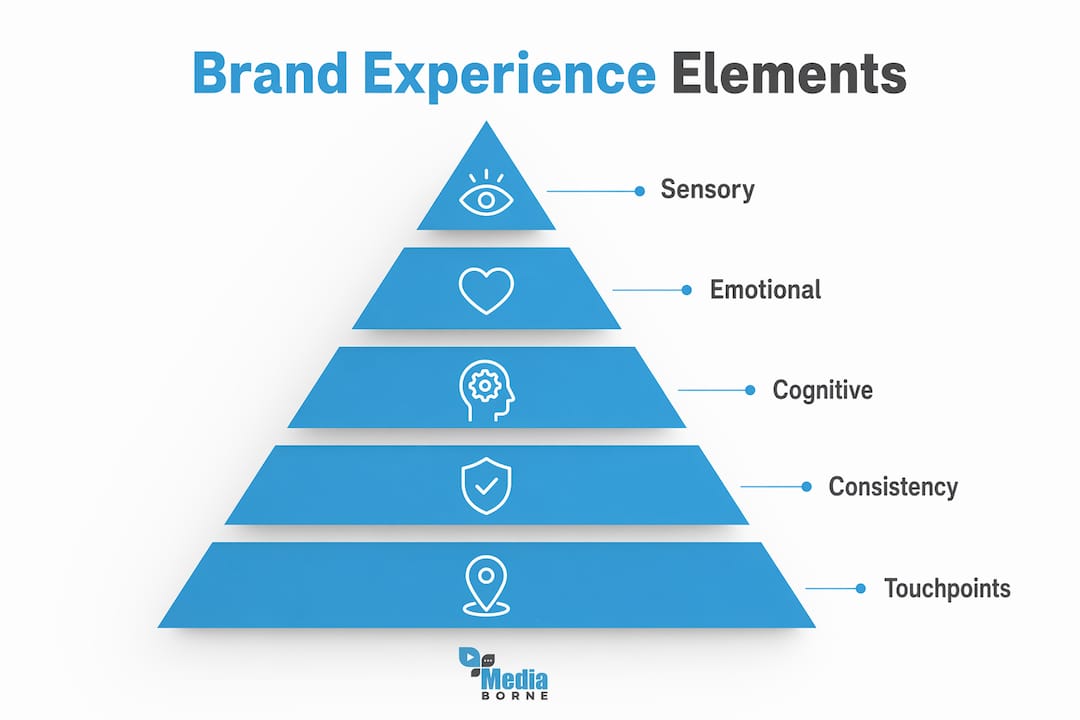
The elements of brand experience include sensory cues (sound, scent, visual identity), emotional associations (trust, excitement, belonging), and cognitive impressions (brand values, reputation, promise). Creative Bloq notes that brand experience is not just a marketing function. It is the entire behaviour of a brand across every touchpoint, which means operations, HR, and product teams all contribute to it whether they realise it or not.
Why does brand experience matter for growth and loyalty?
Brand experience is the primary driver of customer loyalty, premium pricing power, and organic advocacy. When a brand creates consistent, positive emotional associations, customers are more likely to return, spend more, and recommend the brand to others. Positive emotional associations correlate directly with increased Customer Lifetime Value. That is not a soft metric. It translates into measurable revenue over time.
The Interaction Design Foundation highlights that a great brand experience is shared by consumers, creating distinct, memorable associations that shift a brand from interrupting consumer environments to becoming part of them. Word-of-mouth amplified by shared experience is among the most cost-efficient growth mechanisms available to any brand. It cannot be bought directly. It has to be earned through consistent delivery.
"Brand experience validates the brand promise at every contact point. When the experience fails to match the promise, trust erodes faster than it was built." — Qualtrics Brand Experience Research
The danger of inconsistency is real and measurable. Qualtrics research shows that even minor failures in tone or process damage brand experience and erode trust quickly. A luxury hotel brand that delivers a flawless check-in but a poor digital booking experience creates cognitive dissonance. The customer remembers the friction, not the thread count. Brand managers who treat experience as a continuous, cross-functional responsibility rather than a marketing deliverable protect against this erosion.
The importance of brand experience also extends to competitive positioning. In markets where product features converge, experience becomes the primary differentiator. Apple and Nike do not compete on specification sheets. They compete on the feeling their brands produce at every interaction, from unboxing to community to retail environment.
How do you measure brand experience effectively?
Brand experience measurement combines quantitative metrics with qualitative insight to give a complete picture of perception and performance. Relying on one type alone produces blind spots.
The core quantitative metrics are:
- Net Promoter Score (NPS): Measures the likelihood of customers recommending your brand. A strong NPS signals positive emotional associations and advocacy potential.
- Customer Lifetime Value (CLV): Tracks the total revenue a customer generates over their relationship with the brand. Rising CLV indicates that experience investments are compounding.
- Experience-to-revenue ratios: Map specific experience improvements to revenue outcomes, giving brand managers a direct line between investment and return.
Qualitative measurement is equally important. Companies use NLP tools to analyse social media posts, reviews, and customer feedback in real time, surfacing sentiment patterns that surveys miss. A spike in negative sentiment around a specific touchpoint, such as a checkout process or a customer service script, can be identified and addressed before it compounds into a broader trust problem.
Pro Tip: Map your NPS data against specific touchpoints rather than treating it as a single brand-wide score. This reveals which interactions are driving advocacy and which are quietly damaging perception.
Balancing quantitative and qualitative data gives brand managers the full picture. Numbers tell you what is happening. Sentiment analysis tells you why. Together, they make brand experience measurement a genuine strategic tool rather than a reporting exercise. For a deeper look at how media businesses use analytics to assess brand effectiveness, the Media borne guide on measuring brand growth is worth reading alongside this framework.
How to create brand experience across every touchpoint
Creating a consistent, emotionally resonant brand experience requires deliberate architecture across every touchpoint. The following approach gives brand managers a practical framework to build from.
-
Map your moments of truth. Identify the interactions that carry the highest emotional weight for your customer. These are the points where perception is formed or broken. For a SaaS brand, it might be the onboarding call. For a retailer, it might be the returns process. Standardising behaviours at these moments, including scripted language and defined service standards, is the foundation of consistent brand experience.
-
Audit all touchpoints, direct and indirect. Starbucks manages over 80 distinct touchpoints to maintain consistent customer impressions. Most brands manage far fewer with far less rigour. A full audit includes your website, social media profiles, packaging, customer service scripts, email tone, physical environments, and third-party review platforms.
-
Align cross-functional teams. Brand experience is not owned by the marketing department. UX designers, customer service teams, operations managers, and HR all contribute to the experience a customer has. Cross-department alignment on brand values, tone, and service standards is non-negotiable for experience parity.
-
Establish experience parity across channels. Experience parity means the quality, tone, and emotional resonance of your brand is consistent whether a customer encounters you on TikTok, in a physical store, or via a support email. Experience parity is critical for sustaining long-term loyalty. Inconsistency across channels signals to customers that the brand is fragmented or inauthentic.
-
Build feedback loops into the experience. Measurement should not be a quarterly exercise. Embed NPS surveys, sentiment monitoring, and customer interviews into the ongoing operation of the brand. This turns brand experience management from a project into a discipline.
Pro Tip: Avoid siloed touchpoint ownership. When the social media team, the web team, and the in-store team each manage their channel independently, tone and quality diverge. Appoint a brand experience lead whose remit crosses all channels.
Understanding how brand-led media integrates visual, verbal, and sensory creativity can sharpen how you think about channel-specific experience design. The principles of brand experience strategy apply equally to content formats as they do to physical environments.
The brands that get this right treat every touchpoint as a creative and strategic asset. They do not leave indirect touchpoints, such as press coverage or user-generated content, to chance. They actively shape the conditions in which those touchpoints occur, through community building, creator partnerships, and consistent brand behaviour that gives people something worth sharing.
Key takeaways
Brand experience is the total perception formed across every touchpoint, and consistency across those touchpoints is the single most important factor in building lasting customer loyalty.
| Point | Details |
|---|---|
| Brand experience definition | The holistic perception formed by all sensory, emotional, and cognitive interactions with a brand. |
| Distinct from CX and UX | Brand experience is the broader frame; CX and UX operate within it at a more specific level. |
| Consistency drives loyalty | Experience parity across physical, digital, and human touchpoints prevents trust erosion. |
| Measurement requires both types | Combine NPS and CLV with NLP sentiment analysis for a complete view of brand perception. |
| Moments of truth are the priority | Standardise behaviour at high-stakes interactions first; these carry the most weight in shaping perception. |
Brand experience in 2026: what I have learned working with media and brand teams
The conversation about brand experience has shifted considerably over the past few years. When I started working with brand and media teams, the dominant view was that brand experience was a marketing responsibility. Get the campaign right, get the visuals right, and the experience would follow. That view is now demonstrably wrong, and the brands still operating that way are paying for it in churn and stagnant advocacy scores.
What I have found is that the brands building the strongest experiences in 2026 are the ones treating it as an organisational discipline rather than a creative output. They have brand experience leads with cross-functional authority. They measure sentiment continuously, not quarterly. They treat their content, their community, and their customer service as a single integrated system rather than separate departments with separate KPIs.
The other shift I have noticed is the growing importance of indirect touchpoints. Brands used to focus almost entirely on what they could control: the website, the packaging, the advertising. But the experiences that move people most are often the ones that happen outside brand-controlled environments. A creator's honest review on YouTube. A customer's unboxing video on TikTok. A thread on Reddit about a brand's returns policy. These are the moments where brand experience is either validated or undermined, and the only way to influence them is to build a brand that genuinely earns positive word-of-mouth at every controlled touchpoint first.
The brands I respect most are not the ones with the biggest budgets. They are the ones with the clearest brand promise and the most rigorous commitment to delivering it consistently. That is the work. It is less glamorous than a campaign launch, but it compounds in a way that advertising spend simply cannot.
— Stephen
How Media borne helps brands build experience through creative media
Brand experience lives or dies on the quality of the content and media that carry it. A clear brand promise delivered through weak, inconsistent creative undermines the very perception you are trying to build. Media borne specialises in producing original content, entertainment formats, and video that give brands a consistent, compelling presence across TikTok, YouTube, and live social platforms. The work is built around the idea that attention is earned through entertainment, not interruption. If you are looking to strengthen your brand's presence through high-quality production, explore Media borne's video production services or discover how immersive video formats can create experiences that audiences genuinely want to share.
FAQ
What is the brand experience definition in simple terms?
Brand experience is the total perception a person forms through every interaction with a brand, including sensory, emotional, and cognitive responses across both direct and indirect touchpoints.
How does brand experience differ from customer experience?
Customer experience focuses on the quality of specific interactions during a customer journey. Brand experience is the broader perception that frames all of those interactions, including indirect ones like reputation and word-of-mouth.
What are the key elements of brand experience?
The core elements are sensory cues, emotional associations, and cognitive impressions, delivered consistently across visual identity, digital channels, physical environments, and human interactions.
How do you measure brand experience?
Brand managers use Net Promoter Score, Customer Lifetime Value, and experience-to-revenue ratios for quantitative insight, combined with NLP-based sentiment analysis of social media and reviews for qualitative depth.
Why is consistency so important in brand experience?
Inconsistency across touchpoints creates cognitive dissonance and erodes trust. Experience parity, meaning the same quality and tone across every channel, is the foundation of long-term customer loyalty.